Inside a school notebook, late at night, a world has come alive. The characters drawn in its margins — made of paper and imagination and scrap material — don’t know they’re fictional. They take their quests and prophecies and alliances seriously. They fight for their fates. And somewhere between the ruled lines, their stories cross and accumulate.
Graphite, the debut project from Colombian studio RipRed (published by indie.io), launches July 27 with a full Act 1 demo already available on Steam. Lead developer Juan Rodriguez described the creative ambition directly: “We wanted to create something original and engaging that has never existed before, based on the RPG and roguelite genres we love.”
The community’s most frequent response to what they’ve seen so far is a single word: “originality.”
The Notebook World and Its Irony
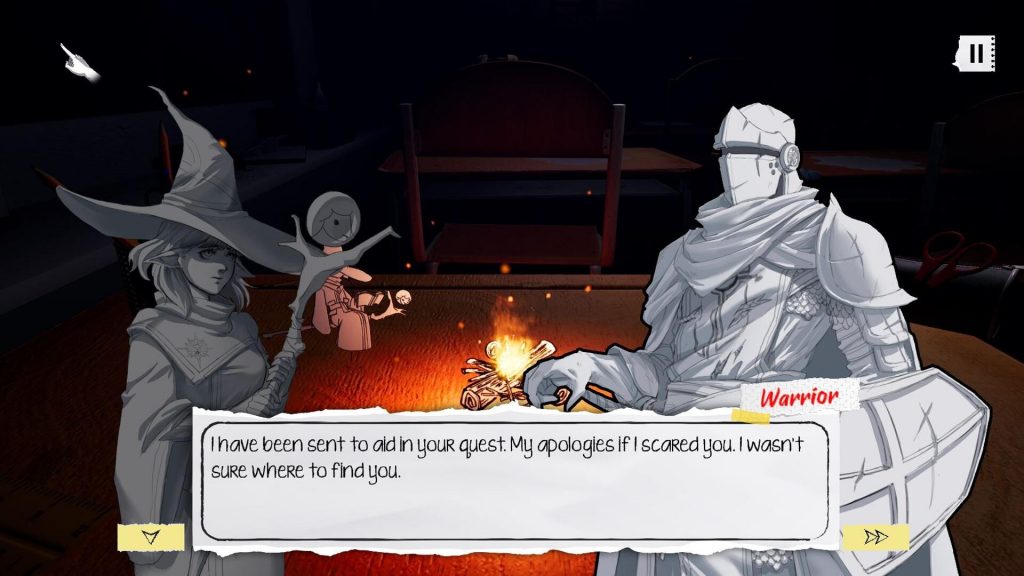
The school notebook as game world is doing more than aesthetic work. The conceit — characters who don’t know they’re products of imagination, inhabiting a notebook with all the seriousness that their circumstances require — creates a specific tonal register that neither pure comedy nor earnest fantasy achieves.
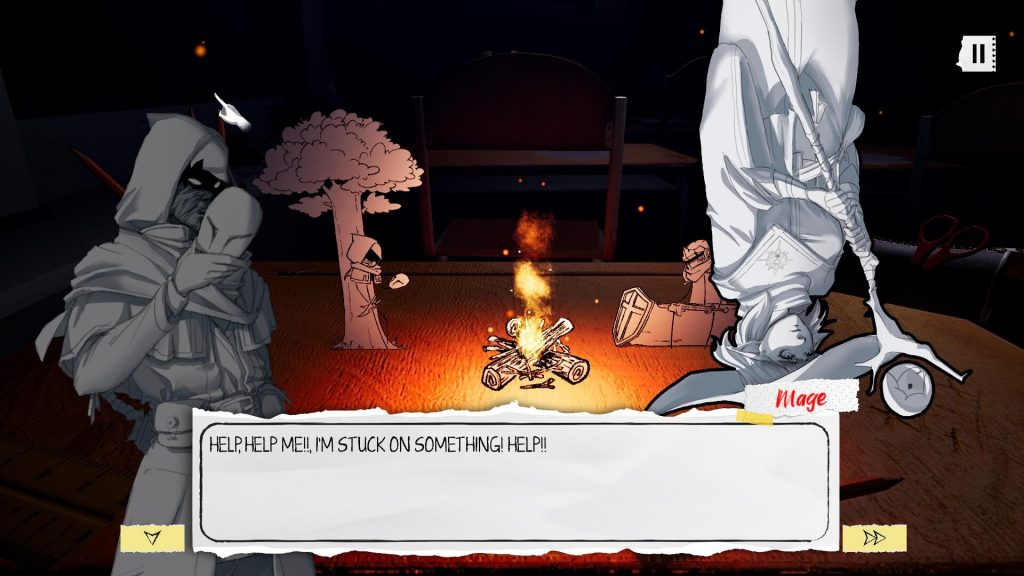
The characters take everything seriously: the prophecies, the alliances, the missions from The Scribe. The game’s narrator and structural framing know what they are. This gap between what the characters experience and what the player understands produces the specific pleasures of dramatic irony — the characters’ earnestness is charming precisely because of the incongruity between the gravity of their situation and the humble notebook that contains it.
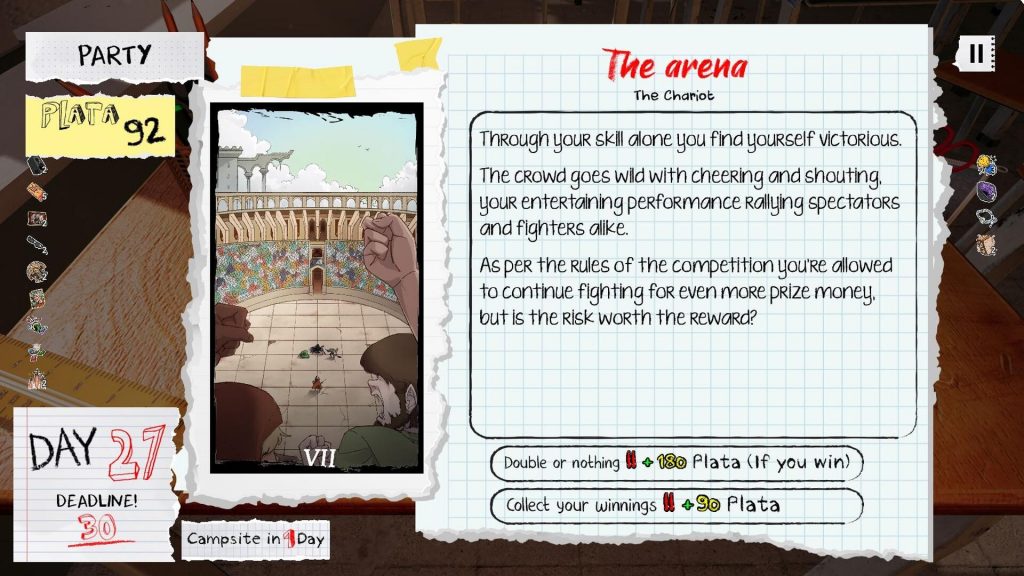
The tarot card-style event cards with narration-based branching choices extend this further. Tarot as narrative framing carries associations of fate, prophecy, and the predetermined — appropriate for characters who are, literally, created by someone else’s imagination and are acting out their creator’s unconscious designs. The branching choices that generate different stories across playthroughs capture the way doodles in the same notebook become different adventures depending on which page you turn to.
Lead developer Rodriguez’s description of the trigger: “childhood memories of drawing characters in notebook margins and playing homemade board games.” The game is explicitly nostalgia-construction — recreating the specific creative pleasure of populating space with imagined lives.
The Dynamic Timeline Combat
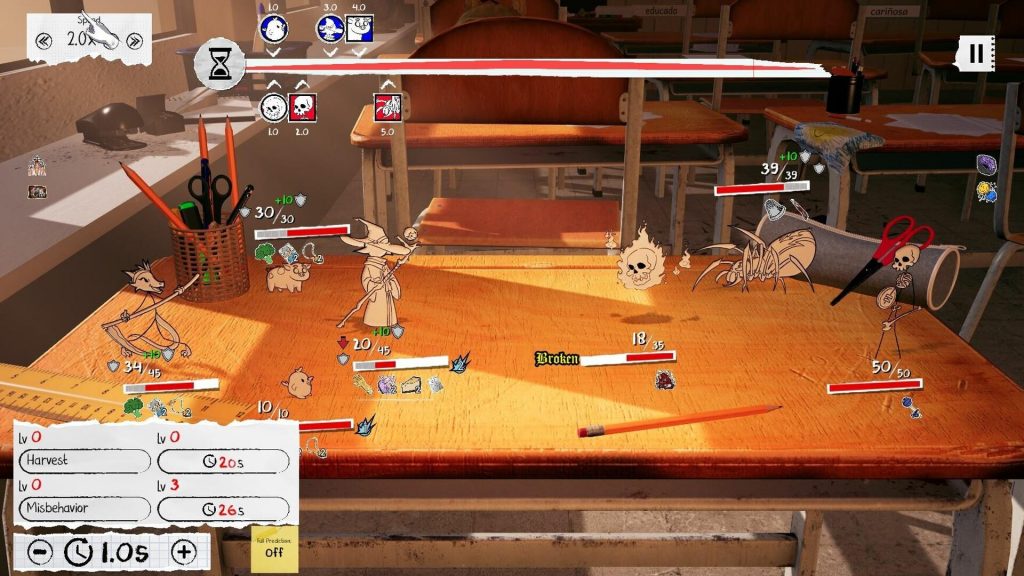
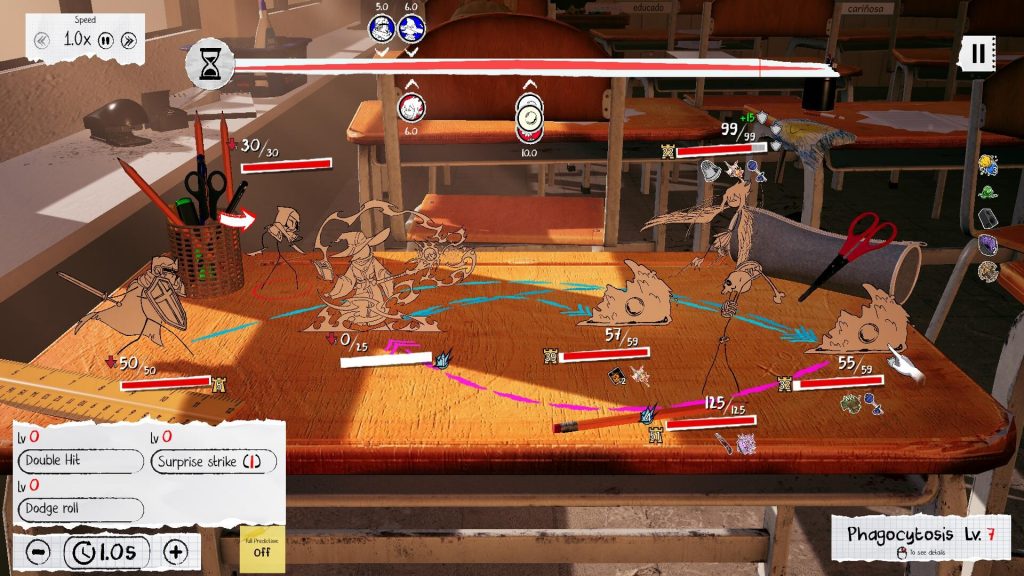
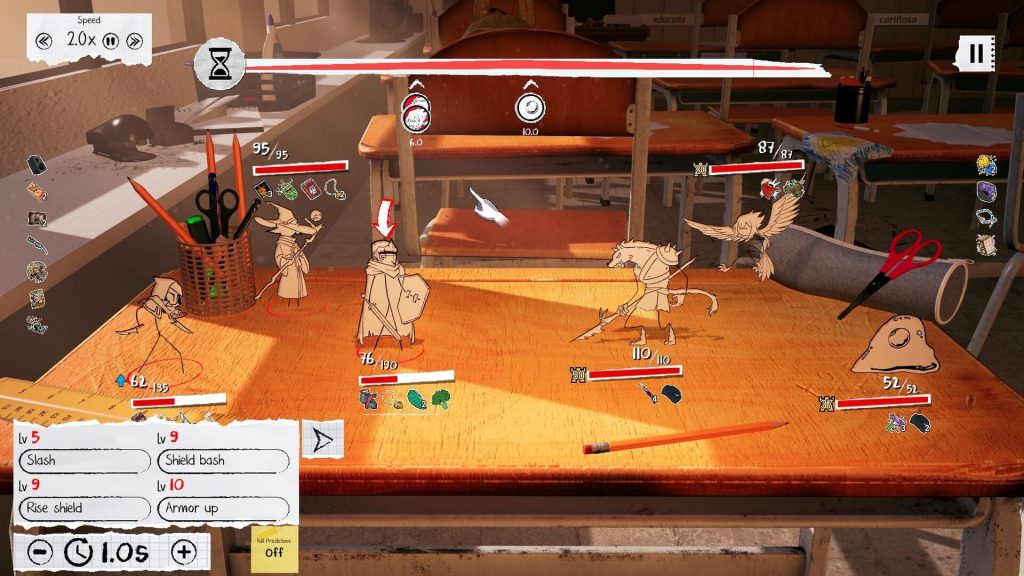
The timeline combat system positions every action within a temporal flow that all participants share. This is turn-based combat reimagined as time management rather than action sequencing — when you act matters as much as what you do, because the timeline determines when enemy actions resolve and when player actions interrupt or preempt them.
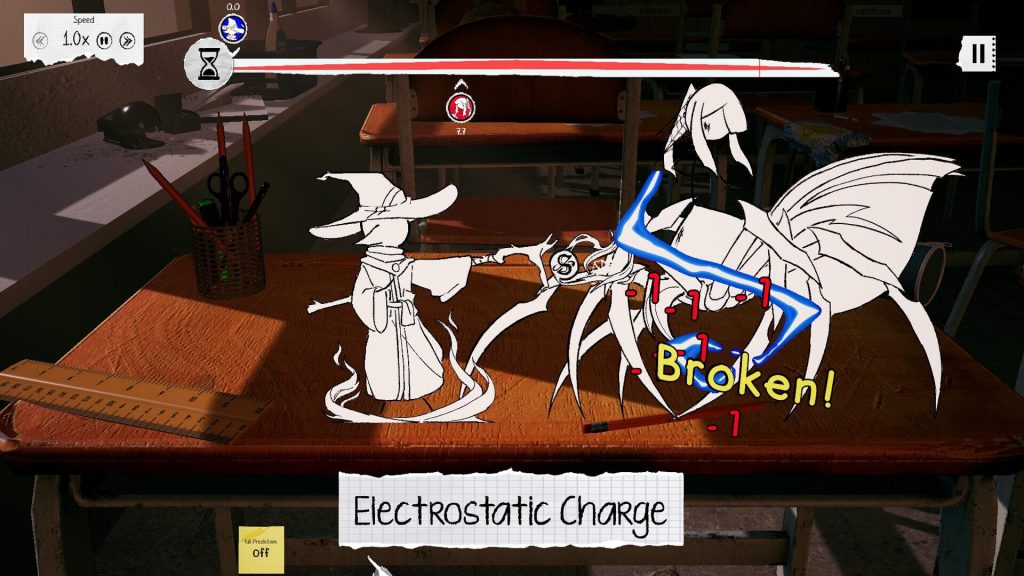
The Break system is the most strategically significant element. Depleting an enemy’s Poise (resistance to disruption) cancels their scheduled action — a planned powerful attack becomes nothing, a summoning is interrupted, a buff is denied. This creates a specific priority calculus: breaking an enemy’s action before it resolves may be more valuable than dealing maximum damage, depending on what that action would have done.
The symmetry is the key design choice: enemies can break player actions through the same mechanism. This means every aggressive strategy simultaneously creates vulnerability — concentrating on Poise damage to break an enemy leaves you less able to defend your own Poise. The tactical tension between breaking opponents and protecting your own planned actions is the combat system’s core.
This symmetric design produces something that pure player-versus-environment combat typically lacks: genuine adaptability on both sides. The enemy isn’t just responding to you; it’s threatening you through the same strategic vocabulary you’re using against it.
The Unlimited Artifact Stacking
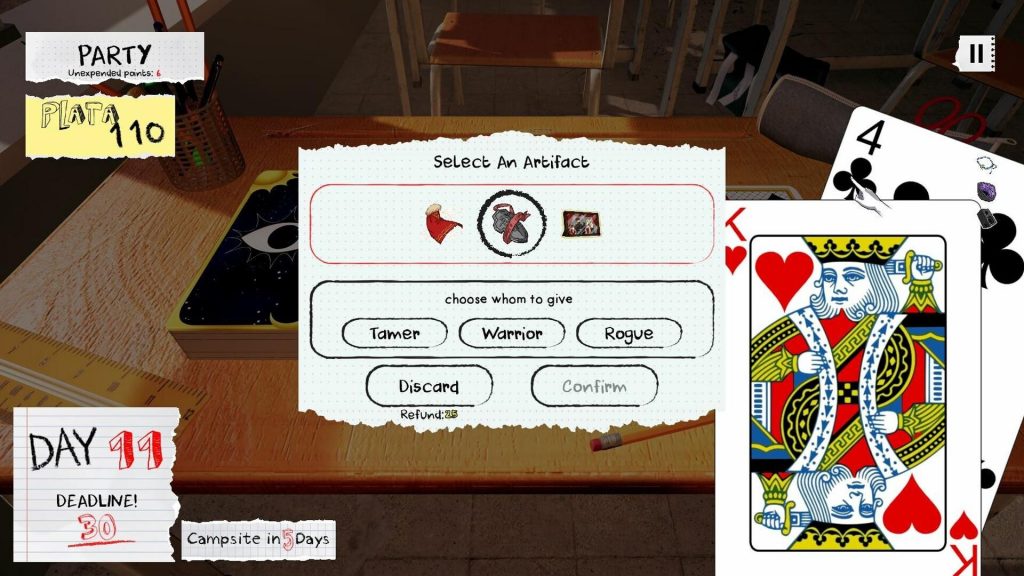
The decision not to cap artifact accumulation is a philosophical statement about roguelite design. Most roguelites impose limits on how many passive items a character can hold, creating resource scarcity and forcing trade-off decisions between acquired items. Removing this constraint allows builds to accumulate complexity without bound — the build at run’s end is a genuinely different entity from the build at run’s start, with no ceiling on how many layers of synergy can be achieved.
The risk of unlimited stacking is power creep that makes late-run combat trivially easy. Graphite addresses this through the enemy artifact mechanic: opponents also acquire artifacts during encounters, scaling their capabilities alongside the player’s. The arms race this creates maintains tension that unlimited player power alone would eliminate — you’re getting stronger, but so is what you’re fighting.
This design prevents the “build complete, content trivial” trajectory that some roguelites fall into at late game. The final boss of a long run isn’t fighting the same enemy that the first encounter presented; it’s fighting an enemy that has accumulated its own power through the same system you’ve been using.
The Seven Heroes and Narrative Cross-Pollination
Seven heroes with individual personalities, combat styles, and narratives who interact across runs give Graphite the narrative depth that roguelite games typically sacrifice for replayability. Each hero presumably tells part of a larger story across their individual arc, and their encounters with each other — given the roguelite structure that reshuffles compositions — create combinatorial narrative variation.
The Scribe, as the figure assigning missions, frames the meta-narrative appropriately: someone is writing these characters, assigning them purpose, watching their stories unfold. The player, controlling the party, occupies a position analogous to the Scribe — making choices that determine which heroes pursue which fates.
The dual-world structure (fantasy notebook world and implied real world) creates the metafictional layer that sophisticated roguelites use to make the repetition of runs feel narratively meaningful rather than mechanically repetitive. Each run through the notebook world is another set of pages; the story continues whether or not any individual run succeeds.
The RipRed and Colombian Indie Context
RipRed’s debut represents Colombian indie gaming’s continued growth in international visibility. Latin American indie development has been building a presence in global markets — this coverage has tracked Brazilian, Argentine, and now Colombian studios producing internationally-reaching work. Graphite‘s indie.io publishing partnership provides distribution infrastructure; the full Act 1 demo strategy provides the extended hands-on experience that demonstrates the concept before the commercial commitment.
The demo’s completion of the full first act rather than a vertical slice is a confidence signal similar to what we’ve noted in other games: developers who offer substantial content before purchase believe the experience justifies itself rather than requiring artificial scarcity to generate sales.
Who This Is For
Strong fit for: roguelite RPG enthusiasts who specifically want narrative depth alongside mechanical variety; players who responded to the childhood notebook doodle premise with immediate recognition; Slay the Spire and similar card/artifact roguelite fans who want a different structural approach; players who appreciate symmetric game design where player and enemy use the same systems; Disco Elysium and narrative-focused RPG fans who want strong world and character writing; Latin American indie game supporters; players who find most roguelites mechanically competent but narratively thin.
Cautious fit for: pure action roguelite players who find timeline-based combat slower than preferred; players who want conventional movement-based platforming rather than turn-adjacent strategic combat.
Less ideal for: players who dislike roguelite structure; anyone who finds artifact accumulation systems overwhelming rather than satisfying; players seeking real-time action over strategic deliberation.
What to Watch For
The full Act 1 demo answers the most important questions immediately: whether the pen-and-ink world’s ironic premise generates sustained emotional engagement, whether the timeline-and-Break combat creates the strategic depth it promises, and whether the unlimited artifact system builds toward the complexity it implies rather than collapsing into a small number of dominant strategies.
Post-launch, the question of how seven heroes’ individual narratives interweave across the full game will determine whether Graphite‘s story ambitions deliver the accumulated resonance that roguelite narrative structure can achieve at its best.
The Takeaway
Graphite is one of July 2026’s most conceptually distinctive releases — a Colombian debut studio’s pen-and-ink roguelite RPG built around a notebook world whose inhabitants don’t know they’re imaginary, with timeline combat where enemies break your actions and you break theirs, unlimited artifact stacking met by artifacts the enemy is also acquiring, and seven heroes whose crossing stories give the repetition of roguelite runs genuine narrative meaning.
The community’s “originality” response is the right response. The school notebook conceit isn’t a visual theme applied over a conventional game structure — it’s a world-building premise whose irony shapes the characters’ emotional weight, whose tarot-card narrative framing reflects the randomness of how stories get told, and whose pen-and-ink aesthetic carries the specific warmth of things made by hand in margins.
The notebook is open. The characters don’t know they’re imaginary. The Scribe is watching. And somewhere between the Break system and the unlimited artifact stack, there’s a story accumulating that this particular run will tell differently than any other.
July 27. Act 1 is already available.
Information regarding ‘Graphite’
| item | detail |
|---|---|
| Developer | RipRed (Colombia) |
| Publisher | indie.io |
| Genre | Pen & Ink Roguelike RPG |
| Release platform | PC (Steam) |
| Release date | July 27, 2026 |
| demo | Free Steam demo available (Act 1 full playable) |
| graphic style | Pen and Ink / Notebook Doodle Concept |
| Hero number | 7 people (each with a unique personality, playstyle, and narrative) |
| core system | Dynamic Timeline Battle / Break / Unlimited Artifact Stack / Tarot Adventure Deck |
| Unique mechanic | Enemies can acquire artifacts / Party composition responsive branching choices |
| Main Keywords | Roguelike, RPG, Pen and Ink, Notebook, Timeline Combat, Indie, South America |
| Steam Page | Shortcut |