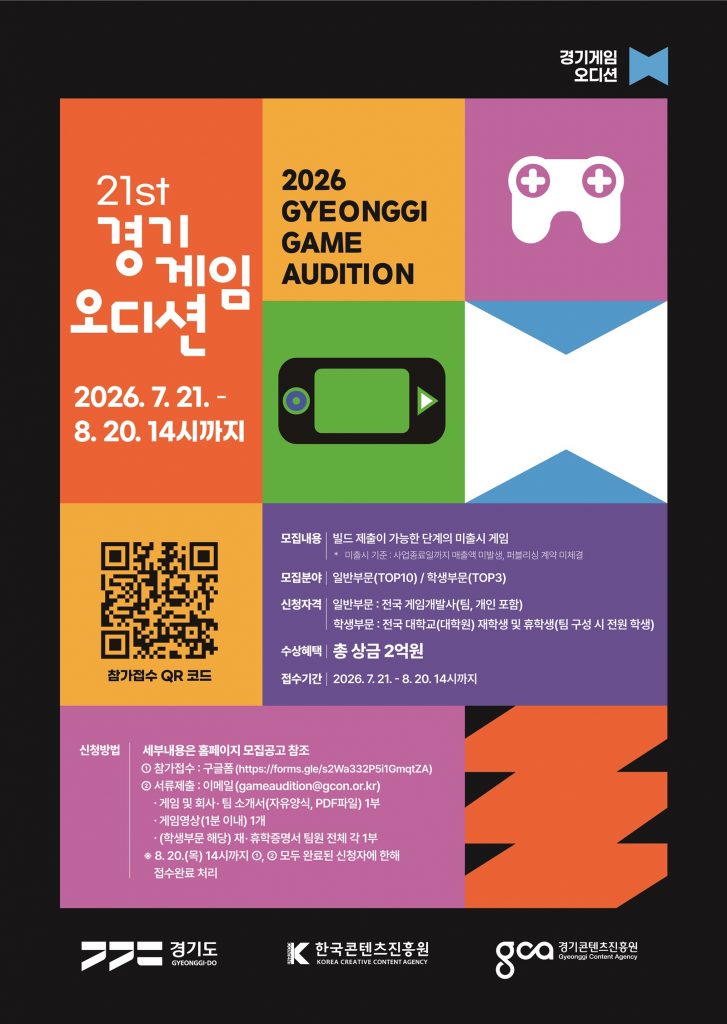
The Gyeonggi Content Promotion Agency (경기콘텐츠진흥원) and Gyeonggi Province are accepting applications for the 21st Gyeonggi Game Audition through August 20, 2026. The program selects 13 teams total — 10 in the General Division and 3 in the newly created Student Division — and provides ₩200 million in total prizes alongside commercialization consulting, marketing support, media relations assistance, weighted consideration for Gyeonggi Global Game Center incubator residency, and partner network connections.
The Student Division is this year’s most significant structural change. Previous editions focused on developers with unreleased commercial projects; the new division specifically targets teams composed of high school students and university/graduate students who are pre-professional. The practical effect is that a competition previously accessible primarily to developers with studio infrastructure is now accessible to teams still in school — expanding the pipeline that the program can identify and support at earlier career stages.
The Program’s Track Record
The Gyeonggi Game Audition’s 21-year history includes alumni who validate the program’s role as a genuine industry entry point rather than a ceremonial competition. Sannabi contributed to the Korean independent game wave when it won the Korea Game Award; Shape of Dreams and Devils Within: Dagger demonstrated the pipeline’s commercial viability. Last year’s 199 applicants produced Studio BBB’s Monowave as the top finalist — a competitive field from which a specific project emerged with the institutional backing to pursue commercialization.
For Korean indie game developers, this alumni network is the relevant credential. A game that was selected by the Gyeonggi Game Audition sits in a category of projects that industry stakeholders recognize as having cleared a meaningful review process.
What Selected Teams Receive
The support package beyond prize money addresses the actual post-development bottlenecks that prevent quality games from reaching markets. Commercialization consulting and partner network connections address the business development gap that technically capable developers often face; marketing and media support address the visibility problem that keeps well-made games undiscovered; and the Gyeonggi Global Game Center residency preference connects winners to physical infrastructure and ongoing support that individual teams typically can’t access independently.
The ₩200 million total prize pool distributed across 13 selected teams creates meaningful financial support at the individual project level, particularly for student teams operating without revenue.
Eligibility and Process
Open to any game developer or aspiring developer nationwide with an unreleased playable game — individual or team, professional or student.
General Division: unreleased game-holding developers, 10 finalists selected.
Student Division: teams of high school or university/graduate students, 3 finalists selected.
The selection process moves through document review, first-round audition, and finals. Applications close August 20. Full program details and submission procedures are available at www.gcon.or.kr. Inquiries go to the Gyeonggi Content Promotion Agency’s Game Industry Team at 031-776-4781 or gameaudition@gcon.or.kr.