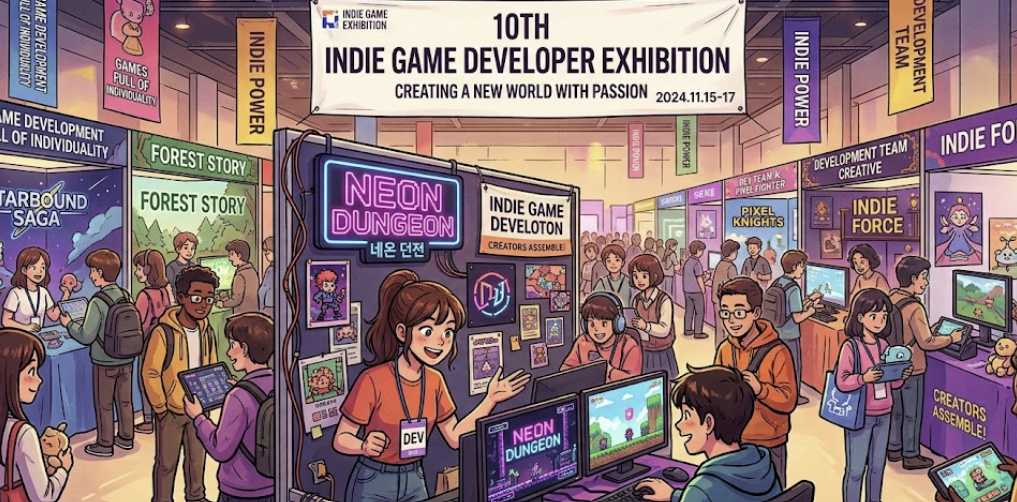
Participating in an exhibition is certainly an exciting event for indie developers and a great opportunity to communicate with various developers and meet diverse users. However, for indie developers who participate with similar versions every time with the simplistic strategy that ” the exhibition is merely an opportunity to promote my game, ” the conclusion is likely that “this exhibition, too, yielded no significant gains, either commercially or in terms of promotion.”
BIC, G-Star, Beaver Rocks, Illusta Fest. Although these events differ in name, scale, and nature, the most valuable thing they can offer indie developers in common is neither media exposure nor publisher meetings. It is the reaction of real users encountering my game for the first time . And only a thoroughly prepared team can reap a proper response.

The distance between the game we developed and the users
How prepared and considerate is your game for users encountering it for the first time at an exhibition? They have no context, no patterns, and no intentions. All that exists are pixels on the screen and the user’s pure intuition reacting to them. Consequently, they click in the wrong places, fail to find obvious buttons, and stop to ponder over things you assumed they would naturally understand. — This is the reality.
And there are developers who are disappointed and unconvinced at that moment. “My game isn’t that difficult,” or “Do they not understand the parts I designed?” Conversely, a wise developer sees that moment as a gold mine. This is because it is the most honest and essential feedback that can be obtained from actual users for free before release.
Exhibition visitors do not go out of their way to tell the developer, “This part is difficult.” They simply leave my game and move on to another. They do not criticize the game. However, their facial expressions and actions already speak volumes about their evaluation of my game.
The 5-Minute Rule
Most visitors spend about 5 to 15 minutes per game. They have to visit multiple booths today, meet people, and are hungry. Die-hard fans who play a game for 60 minutes make up a tiny fraction of the total. Furthermore, the users we will encounter upon actual launch will leave our game much more ruthlessly and quickly. It is common for the average first play session in the market to be less than 5 minutes.
This is why you need to prepare a separate exhibition version. Bringing the full build as is yields completely different results compared to bringing a version with a meticulously designed early experience.
What we must first verify at an exhibition is not rich mid-game content or a touching ending, but precisely those first five minutes. If a user leaves the game before the first five minutes are fully realized, all subsequent content becomes meaningless. Therefore, the core of an offline exhibition is to create content that allows players to understand the game, find enjoyment, and want to continue playing within the first five minutes, and to have that verified by the users.
A tutorial is not required. However, there is a condition.
Many indie developers ask, “How much more should the tutorial be improved?” The answer is that the tutorial should be integrated into the game . Furthermore, the game should be structured to speak for itself without a tutorial.
Every icon, every color, every button placement—all of these must either induce or prevent the player from doing something. This is called affordance. Following UI syntax already proven within the genre is the fastest way. If you design a completely independent card selection system while creating a roguelike deck-building game, players will feel like they are learning a new language. Even for an indie game, no user will play if they have to endure such inconvenience.
UI/UX is not about uniqueness, but about familiarity.
One of the areas indie developers most frequently misunderstand is UI/UX. It is easy to think that creating a unique UI is necessary to make a game distinctive. However, the reality is the opposite. Users already have ‘expectations’ based on tens to hundreds of hours of gameplay in the genre. A UI that differs from those expectations is perceived as ‘inconvenience’ rather than ‘individuality’.
Analyze the UI/UX presentation of reference games frame by frame. Where is the HP bar located? How is the skill cooldown displayed? How many steps does it take for the menu to open? Detailed and precise presentation based on functions and actions—following this exactly is not a surrender by the developer, but a consideration for the user. Differentiation can be sufficiently achieved through mechanics, art, story, and narrative.
You must first decide what you want to get confirmation from the user.
Good test objectives in an exhibition must be observable and actionable. “Is it fun?” is not a test objective. “Does the player start the first battle within 3 minutes without a tutorial?”, “Does the player voluntarily choose to restart after the first death?”, “Does the player understand the shop UI within 5 minutes?” — these are the test objectives.
Three goals or fewer is sufficient. If there are more, you will not be able to properly verify anything. Relentlessly track those three things throughout the exhibition period. Record every single one of these three: the point where the player gets stuck, the moment they trigger something, and the moment they voluntarily restart.
“Quietly observing gameplay from the sidelines is sometimes more meaningful than conversing with the user. Recorded observations travel much longer and further than mere appreciation.”
Which exhibition you participate in is also a strategy.
Not all exhibitions bring in the same users. The choice must vary depending on the exhibition’s objectives. I recommend participating in smaller-scale events like Illusta Fest before major events. It is much better to familiarize yourself with the flow of on-site operations and gain experience making mistakes under low pressure. The real thing is always rougher than practice.
Do not be afraid to modify code in the field.
On the evening of the first day of the exhibition, there are developers in their hotel rooms who open their laptops and spread out their observation logs. If all players were stuck at the same point during the day—that night is the fastest time for fixes. They change button positions, add a hint effect, and clarify the text. The next morning, the improved version is put up at the booth.
This is the most powerful weapon of indie development. Large studios cannot do this. However, there is a prerequisite. You must secure a rollback point that can be reverted at any time. Preserve the build from three days prior to the exhibition as a ‘sanctuary’ that you must never touch. Only apply hotfixes on top of that.
After the exhibition ended
On the way home after the exhibition, my feet will be aching and my voice hoarse. However, my bag is filled with dozens of observation sheets, as well as the players’ facial expressions, utterances, and moments of frustration. That is the real gift the exhibition gave our team.
Organize your records within 72 hours. Memories fade quickly. Identify the most frequent roadblocks and the moments with the most positive responses—based on this, set the goals for the next milestone sprint. You must construct the next version of the destination using data, not sentiment.
And above all, remember the expression on the face of the person sitting in front of my game at the booth, engrossed. Remember the moment a stranger becomes immersed in the world I created. That alone is reason enough for the team to continue development. Therefore , the moment the exhibition ends is the very setting that motivates our team to set goals for developing the next version.
Text (Planning/Review): Professor Moo-Sik Jung (Associate Professor, Department of Game & Video, Gachon University / Ph.D. in Engineering)
Who is Professor Jeong Mu-sik?
He is a first-generation Korean game developer who started as a founding member of Trigger Soft in 1994 and served as a director at NCSoft, an outside director at NASDAQ-listed company Gravity, and a vice president at Runosoft. Since planning and hosting Korea’s first indie game contest in 2003, he has maintained a long-standing interest in and support for the nurturing of domestic indie games. Currently, he serves as a member and director of the Game Rating and Administration Committee under the Ministry of Culture, Sports and Tourism, and as the head of the Content/Digital/Space subcommittee of the Seongnam City Special Committee on the 4th Industrial Revolution, striving for the development of the domestic game industry and the establishment of a sound culture.