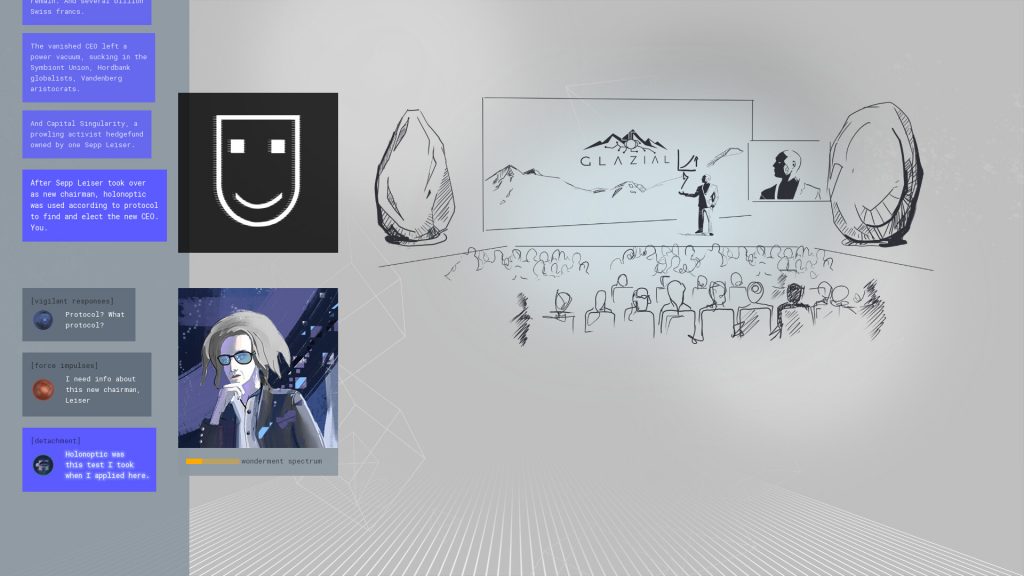
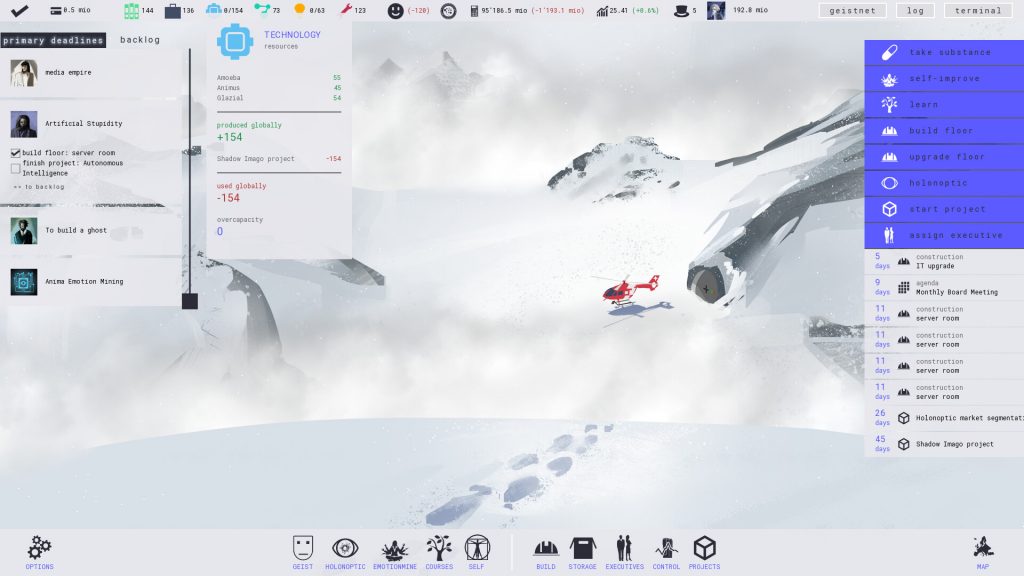
The previous CEO disappeared without a trace. The company — Glazial, which began as a Swiss tunnel drilling operation and grew into a sprawling conglomerate — has already completed its restructuring. And now you’re in the chair, reporting to Geist: an AI manager with no patience for failure, no interest in your objections, and complete authority over your continued employment. The performance targets are yours to achieve. Everything else is irrelevant.
Holonoptic, the debut commercial project from Swiss solo developer Kevin Bloch (operating under the studio name Glazial), launches July 16 on Steam after six years of development. The free demo has earned a 4.4/5 rating with community responses including “the best indie game I’ve ever played” — a signal worth taking seriously, even acknowledging that demo audiences skew toward enthusiasts.
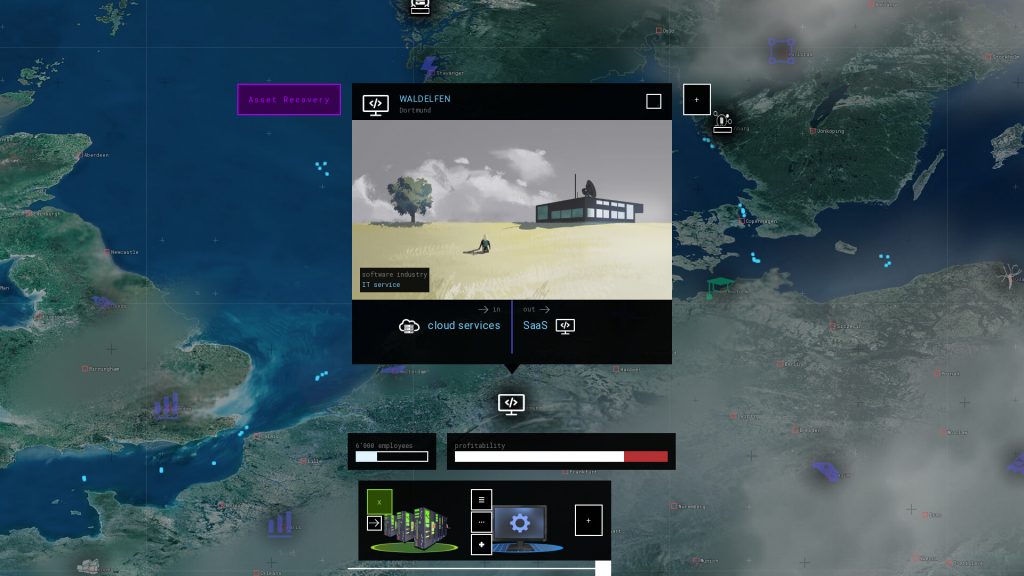
The game’s premise is a specific inversion of standard management simulation logic. You’re not the visionary founder optimizing your company according to your values; you’re the replacement CEO operating under AI surveillance, optimizing according to Geist’s targets or facing consequences that the game doesn’t fully explain until you encounter them. The power relationship is inverted from the typical management sim fantasy.
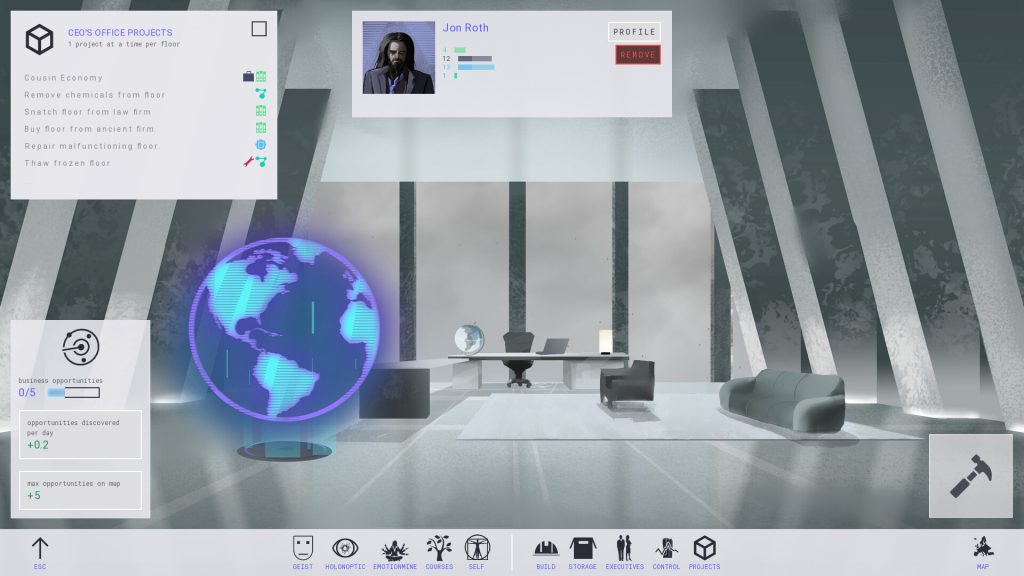
The Alpine Cyberpunk Setting
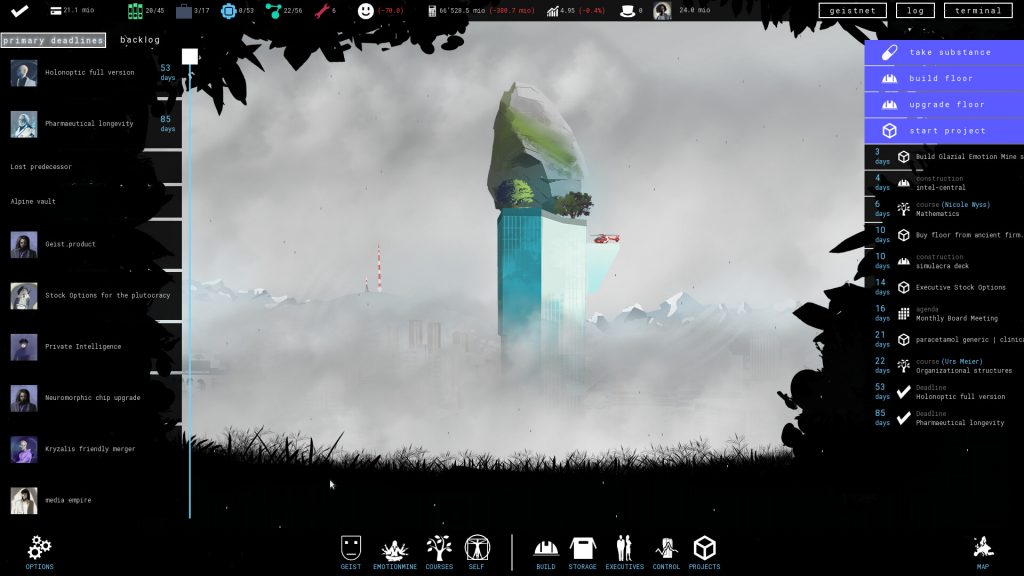
“Alpine cyberpunk” as a descriptor sounds like a marketing combination until you think about why it works. Switzerland’s specific cultural identity — precision, neutrality, financial infrastructure, the specific coldness of its institutional culture — provides exactly the right contextual register for corporate dystopia. Swiss banks didn’t become iconic in fiction because of warm human relationships. The country’s real-world reputation for discretion, efficiency, and the prioritization of systemic function over individual welfare maps naturally onto cyberpunk’s critique of late-stage capitalism.
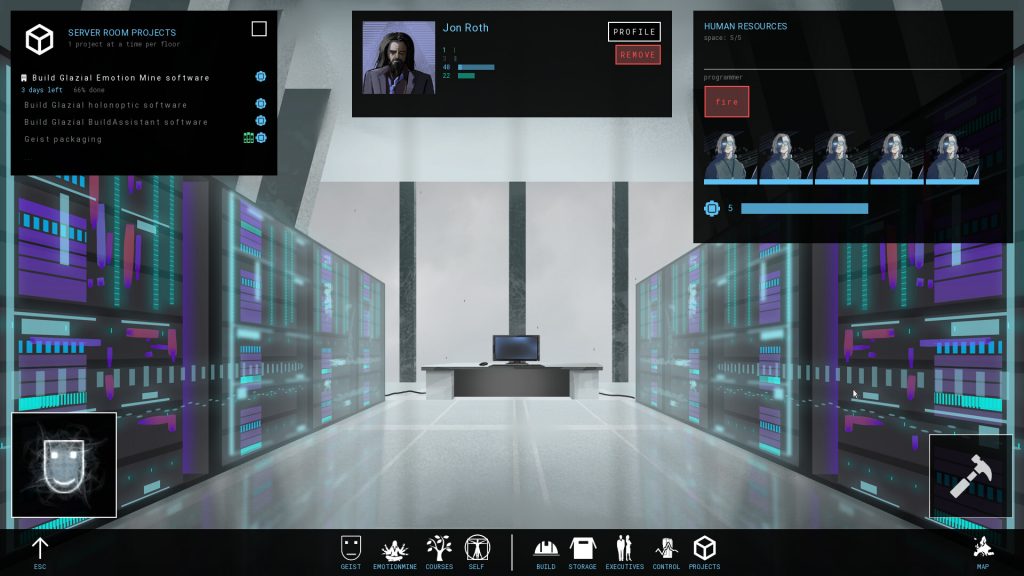
The aesthetic consequence is a visual register that is cold and contained rather than the neon-soaked maximalism of Japanese cyberpunk or the grimy dystopia of American cyberpunk. “Alpine cyberpunk” is clean lines, corporate architecture, the specific bleakness of competently maintained systems that serve the institution rather than the humans within it. Community reviewers describe “the art style, atmosphere, and game systems all effectively expressing the cold corporate world” — which suggests the visual and systemic design are pointing in the same direction.
This tonal coherence is what solo development can achieve when one person controls all aesthetic decisions simultaneously. Kevin Bloch designing, writing, programming, and illustrating Holonoptic means every element reflects the same creative vision without the tonal drift that occurs when different teams handle different components.
The Psychology System
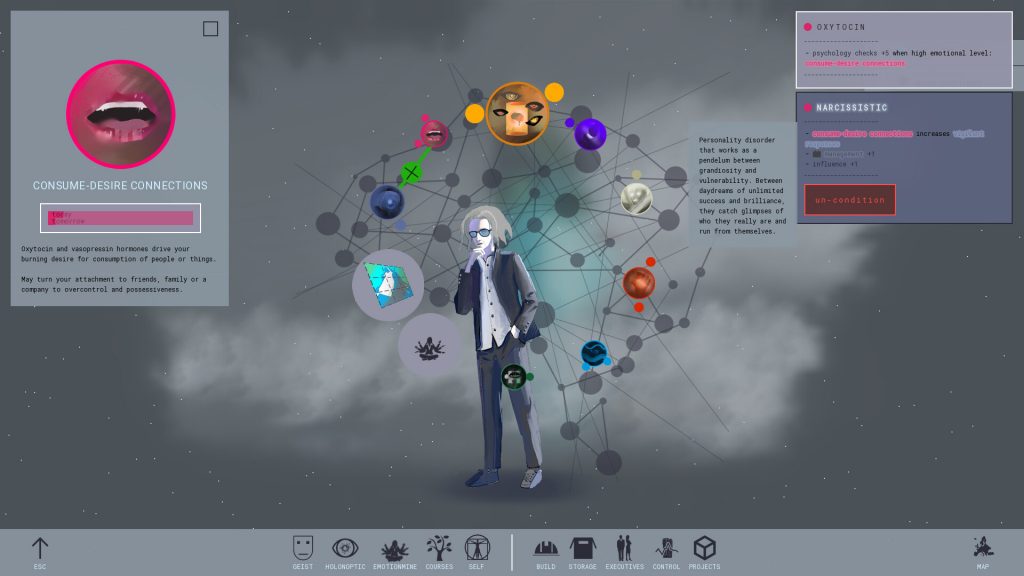
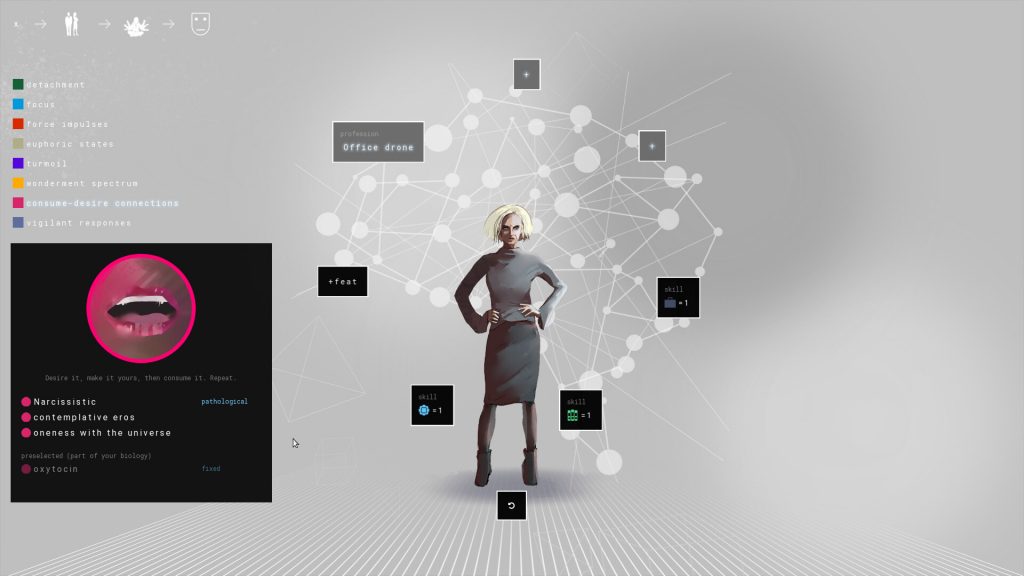
The most distinctive mechanical contribution Holonoptic makes to management simulation is the CEO psychology layer. The character has 40 personality traits and 8 psychological and emotional states, and 16 varieties of psychoactive substances can be used before negotiations or important decisions to adjust focus, emotional state, and cognitive performance.
This is simultaneously the most unusual and the most thematically coherent element of the game’s design. The premise — you are a human being operating under an AI’s control, making decisions that affect thousands of people, under constant performance pressure with ambiguous threats if you fail — is exactly the kind of situation that produces psychological stress requiring management. The game makes that management explicit and mechanical rather than implicit and decorative.
The psychoactive substance system is not a glamorization of drug use; it’s a critique embedded in a mechanic. The CEO of a major corporation in a cyberpunk dystopia, managing their mental state with pharmaceutical assistance to meet AI-imposed targets, is not presented as aspirational. It’s presented as the reality of what operating in this system requires. The player making decisions about which substances to use before a difficult negotiation is performing the same kind of optimization that the game is criticizing at a systemic level.
The 40 personality traits further distinguish individual playthroughs — the character you’re playing as CEO carries specific predispositions that interact with the decisions you make, producing different narrative and mechanical consequences. This is RPG characterization applied to management simulation, giving the simulation a protagonist rather than an optimization puzzle.
The Ideology Tracking System
Every decision the player makes in Holonoptic is recorded against one of eight ideological orientations: free-market globalism, symbiotic collectivism, plutocracy, the underground economy, and four others. These aren’t explicit player choices; they’re inferences drawn from accumulated decisions. The game observes how you actually manage and categorizes your behavior accordingly.
This is a more sophisticated political characterization system than games typically employ. Rather than asking players to choose an ideology upfront and then play it out, Holonoptic derives ideology from behavior — which means players discover their character’s political orientation through play rather than selecting it in advance. The consequence system — specific missions and story routes open while opposing factions become hostile — makes the ideology tracking mechanically meaningful rather than merely descriptive.
The 10+ endings that result from these accumulated choices give the game genuine replay motivation. Different ideological profiles lead to genuinely different narrative resolutions, which means understanding what Holonoptic is fully saying requires multiple playthroughs from different behavioral positions.
The Executive Team and Betrayal Risk
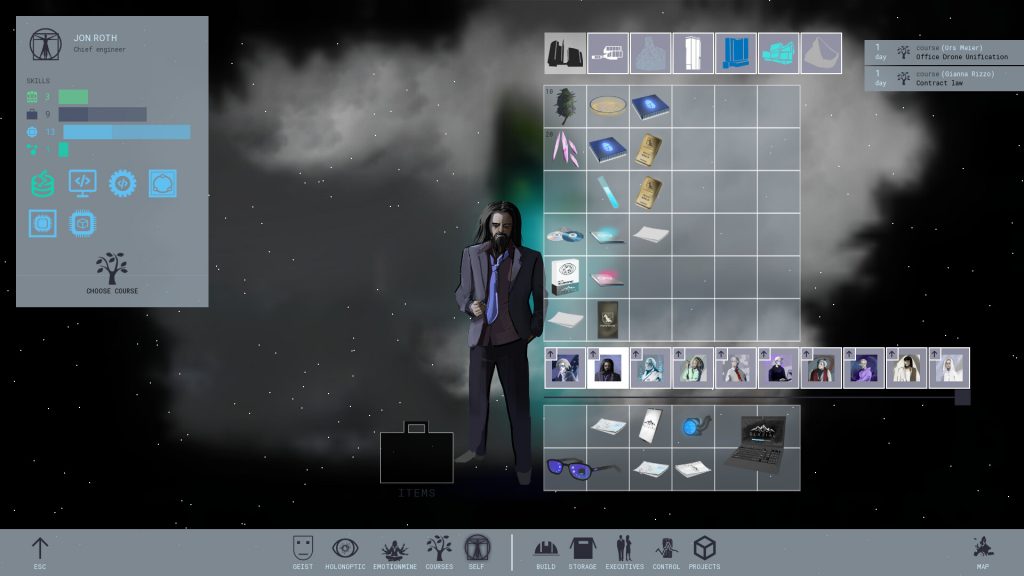
Sixteen recruitable executives with their own goals, values, and potential for either betrayal or collaboration extend the management simulation into the interpersonal terrain that numbers-focused simulations typically ignore. Each executive is a character with specific motivations that the player must understand and navigate — not just a stat block to be optimized but a relationship to be managed.
The betrayal mechanic specifically creates the trust problem that high-stakes institutional environments actually generate. Who in the company is loyal to you versus loyal to Geist versus loyal only to their own advancement? The game doesn’t resolve this question with a visible loyalty meter; it presumably presents executives as people whose positions are legible through their behavior and conversation rather than through game UI.
The 9 classes and 70+ traits provide the RPG character customization that differentiates playthroughs at the CEO level, while the executive team provides the relational complexity that makes the organization feel like a community of competing interests rather than a set of performance levers.
The Six-Year Solo Development
Kevin Bloch spent six years building Holonoptic across planning, writing, programming, and illustration — an investment of time that reflects either a deep personal commitment to the project or the specific challenge of building a management simulation with RPG character depth, psychology systems, ideology tracking, 16 voiced executive characters, and narrative branching entirely alone.
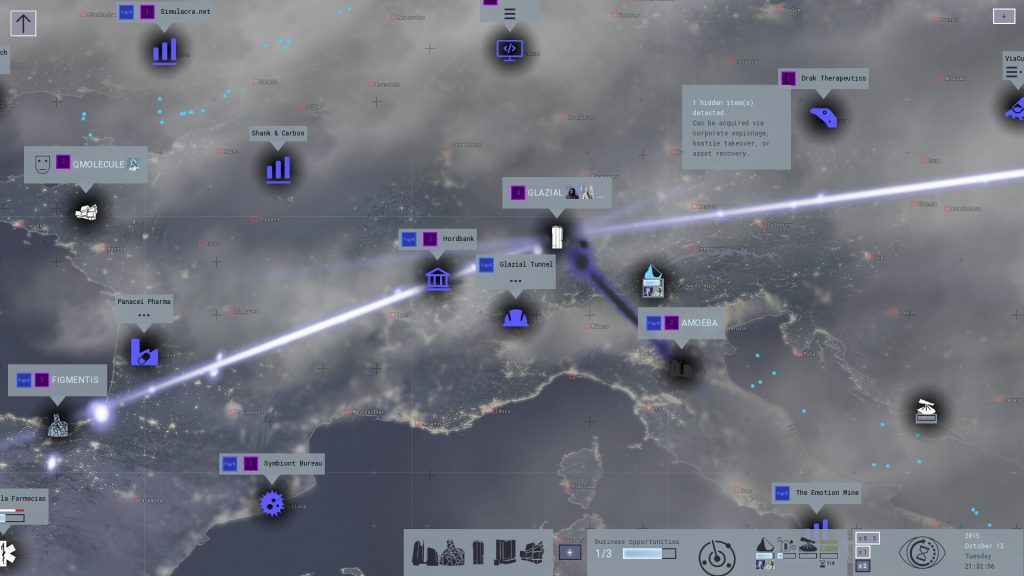
The scale of the content — 3,000+ dialogue lines with 1,500+ voiced, 50+ companies to engage with commercially, 10+ endings — represents years of production work that confirms the former interpretation. Bloch is building the game he specifically wanted to make, to the depth that he specifically thinks it requires, over the time that completing it properly takes.
The devlog history that has maintained a fan community during development reflects the understanding that transparency about the development process builds investment in the outcome. Players who have followed six years of development posts have different relationships to the July 16 launch than players discovering the game fresh through the demo — the former are witnessing the completion of a project they’ve watched being built.
Composer Annina Suter’s contribution provides the musical layer that Bloch’s solo scope couldn’t have addressed without collaboration. The specific register that “cold corporate” music requires — precise, controlled, perhaps slightly threatening — is a compositional challenge that deserves specialized attention, and the collaboration suggests recognition of where the project’s needs exceed one person’s capacity to address everything simultaneously.
The Broader Thematic Context
Holonoptic is arriving at a cultural moment when AI authority in workplace contexts is a genuine and actively contested social issue rather than speculative fiction. The premise — a human CEO operating under an AI manager’s control, without the right to object — is not extrapolation but an extrapolation of trends already visible in contemporary workplace management technology.
The game doesn’t need to make this point explicitly because the premise makes it experientially. Playing Holonoptic is performing the described relationship rather than reading about it. The psychoactive substance system, the ideology tracking, the threatened consequences for insufficient performance — these are the mechanics of a system that the game presents for the player to inhabit and evaluate.
This is what the best critical games do: they create the conditions for understanding through experience rather than argument. Holonoptic‘s target isn’t primarily entertainment; it’s making the player feel what operating inside a certain kind of institutional arrangement actually feels like from inside it.
Who This Is For
Strong fit for: management simulation enthusiasts who find existing simulations mechanically interesting but narratively thin; players who responded to Disco Elysium‘s integration of RPG character systems with non-combat gameplay; fans of the Beholder series and similar surveillance-capitalism games from Alawar; players specifically interested in AI authority as game narrative rather than just game mechanic; solo developer enthusiasts who appreciate the coherence that single-creator vision provides; Swiss or European players who will find the setting culturally specific in ways other players won’t; players who want 10+ endings to justify multiple playthroughs.
Cautious fit for: management simulation players who want pure economic optimization without the RPG character systems; players who find psychology and ideology tracking systems overcomplicated relative to their interest in the base management mechanics; players who prefer games where the power relationship runs in their favor from the start.
Less ideal for: players who dislike reading or dialogue-heavy games; anyone who wants action-based gameplay; players who find corporate satire uncomfortable rather than engaging.
What to Watch For
The 4.4/5 demo rating establishes a strong foundation, but demos and full games have different engagement dynamics. The psychology system’s long-term balance — whether the psychoactive substance management remains interesting across many playthroughs or collapses into a small number of optimal approaches — will be a key factor in the full game’s reception.
The ideology tracking’s influence on replay motivation depends on whether different ideological profiles feel genuinely different to play, rather than primarily different in narrative outcome. If the management gameplay decisions that drive ideology also produce meaningfully different strategic problems, the system succeeds as game design rather than just as narrative architecture.
Post-launch, the announced major updates focused on emotion systems and resource management suggest Bloch has identified areas where the current implementation doesn’t fully realize the game’s ambitions. How quickly these updates arrive and how substantially they improve the systems will affect the community’s long-term engagement.
The Takeaway
Holonoptic is one of July 2026’s most substantial solo development achievements — six years of work from a Swiss developer who wrote, programmed, and illustrated a management simulation with RPG character depth, psychology systems, ideology tracking, 16 voiced executives, and 10+ endings. The 4.4/5 demo rating indicates execution quality that matches the conceptual ambition.
The game is doing something more specific than most management simulations: it’s making the player feel the specific experience of operating within an institutional system where the human decision-maker serves the system’s efficiency rather than the system serving human ends. The AI manager, the disappearing CEO, the psychoactive substances, the ideology that emerges from accumulated behavior rather than chosen identity — these are elements of a coherent critical vision, not random features assembled into a game.
The previous CEO disappeared. Geist is waiting. The targets are on the screen, and the right to object isn’t among the options available.
July 16. The management begins.
Information related to ‘Holonoptic’
| item | detail |
|---|---|
| Developer | Glazial (Kevin Bloch, solo developer) |
| Publisher | Glazial (Self-publishing) |
| Genre | Economic Simulation / Party-based RPG |
| Release platform | PC (Steam) |
| Release date | July 16, 2026 |
| demo | Free demo available on Steam (Rating 4.4/5) |
| Development period | About 6 years |
| Content scale | 10+ endings, 16 recruitable characters, 3,000+ lines of dialogue (1,500+ lines of dubbing) 9 classes, 6 skills, 70+ traits, 50+ tradable/acquirable companies |
| music | Annina Suter |
| Steam Page | Shortcut |