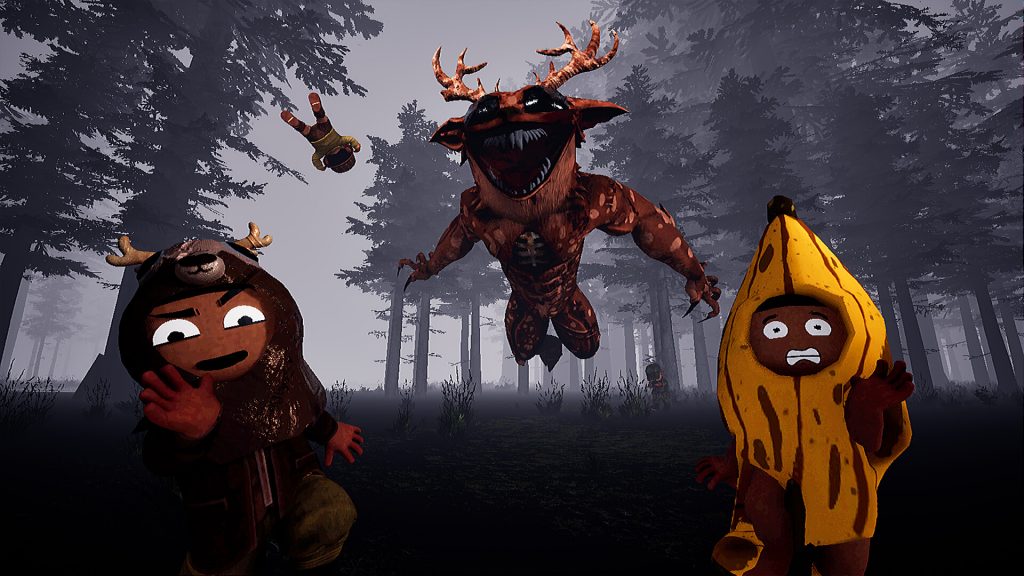
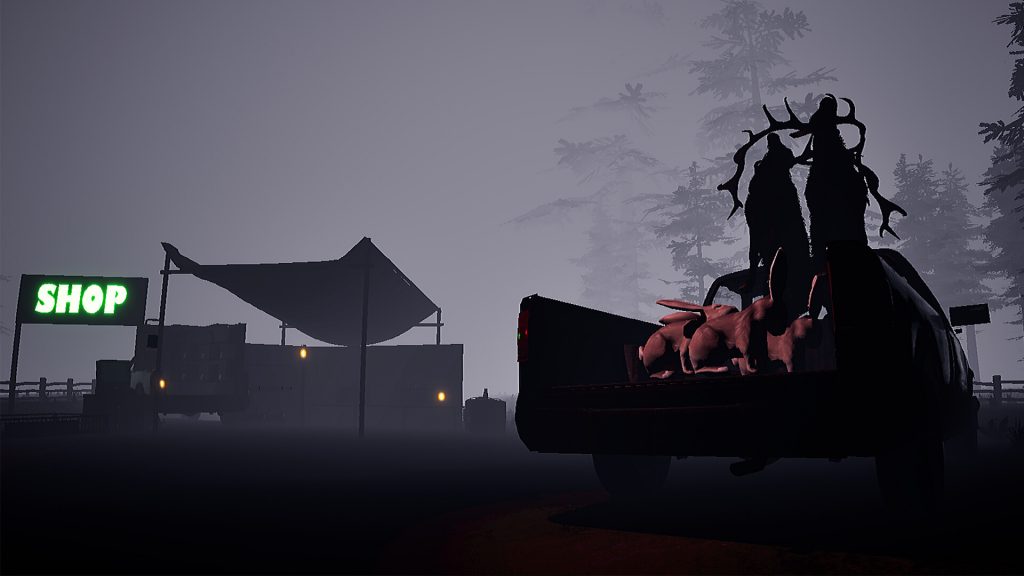
The hunting contract seemed straightforward. Go into the national park, take down the specified animals, drag the carcasses to the truck, hit the weight quota, and drive out before anything happens. What the contract didn’t mention: the deer have both eyes on the same side of their head. The goat speaks Latin. And the longer you stay in the park, the more insistently something begins hunting you back.
Huntin’ Buddies from solo developer Huntin’ Buddies Wildlife Management launched July 24 on Steam — a 4-player co-op comedy horror game built around a hunting extraction loop where the prey becomes predator and the wrongness of the park’s wildlife creates discomfort well before any explicit monster appears. At $7.99 with a 20% launch discount, it’s in the price range where the barrier to trying something unusual with a friend group is essentially trivial.
The review situation is honestly mixed. 73% positive across 87 demo reviews signals genuine audience engagement with the concept. 58% positive from 12 full-release reviews is too small a sample to draw conclusions from, but “too small to be conclusive” is different from “clearly indicating problems.” The developer has been actively responding to community feedback and patching issues throughout the pre-launch period; the launch-day state reflects that iterative process.
The Horror Approach
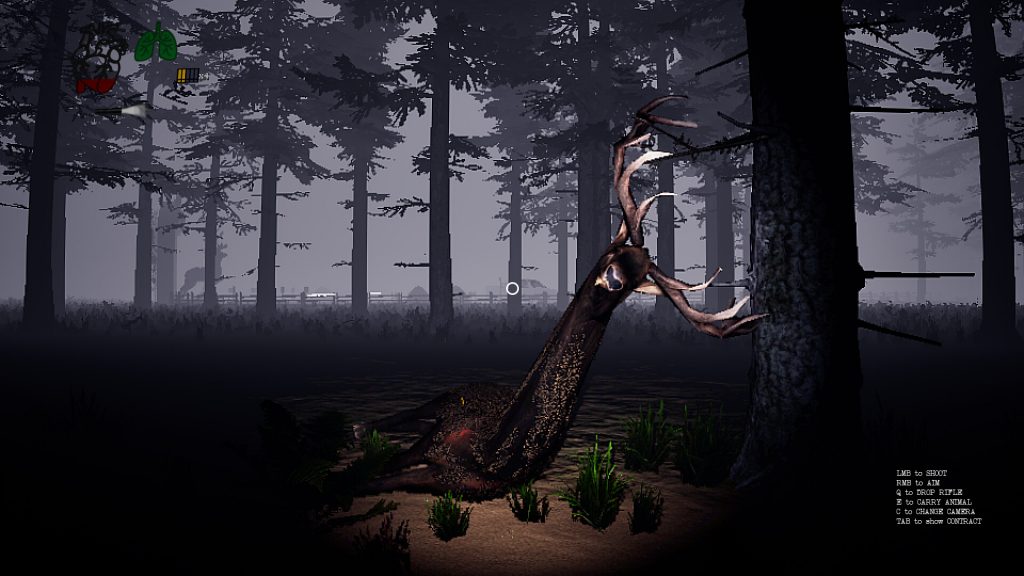
Huntin’ Buddies is using a specific horror technique that is less common than jump scares or monster chases: uncanny wrongness. The deer with eyes on the same side of their head isn’t scary in the way a jump scare is scary. It’s wrong. It violates the expected pattern in a way that triggers the specific discomfort of encountering something that almost makes sense but doesn’t. The goat that speaks Latin extends this — not inherently threatening, but deeply incorrect in ways that make the familiar feel unstable.
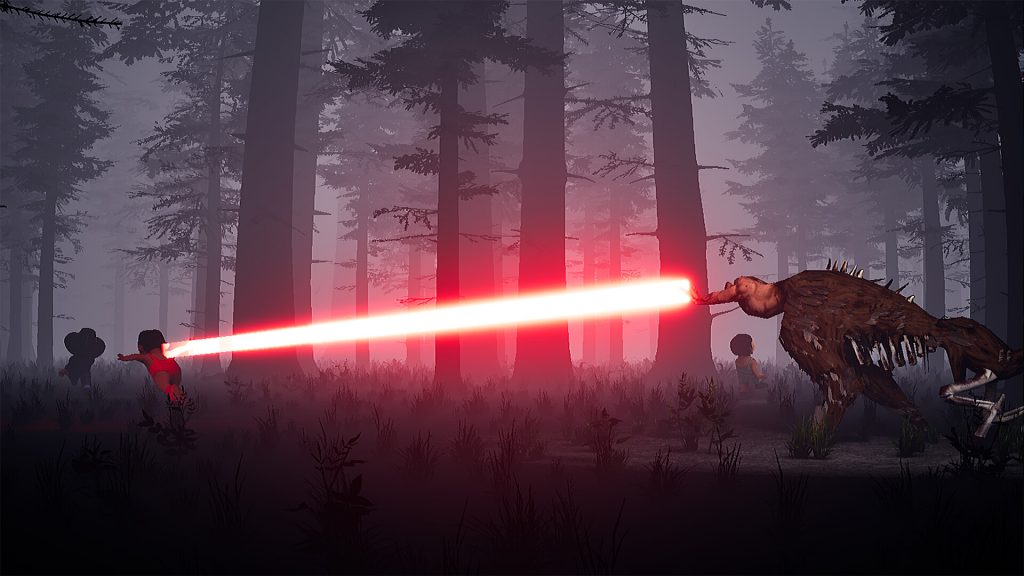
This is the horror of Welcome to Night Vale, of Twin Peaks, of the SCP Foundation’s milder entries: the suggestion that the rules of ordinary reality are inconsistently applied in this specific location, and that the ordinary things here are not ordinary things. The wrongness of the wildlife precedes and prepares for the entity that starts hunting you as the nights escalate — by the time something explicitly threatening appears, the player’s sense of what is normal in this park has already been undermined.
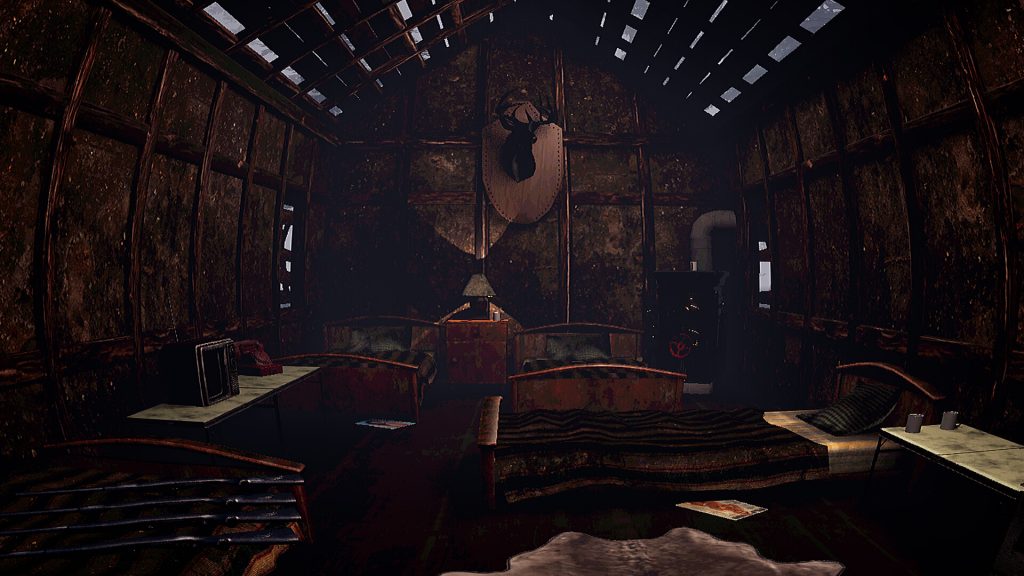
The 1980s retro aesthetic amplifies this specific effect. The retrofitted national park setting (pagers for receiving contracts, the specific visual texture of that era’s public lands infrastructure) creates a nostalgic familiarity that the uncanny wrongness then disturbs. The setting should be comfortable; the park makes it not.
Comedy and this kind of horror coexist more naturally than comedy and jump scare horror. The goat speaking Latin is funny AND wrong; the deer’s misaligned eyes are unsettling AND absurd. The physics-based carcass transport that causes bodies to explode if dragged too aggressively is pure slapstick that would feel tonally inconsistent in straight horror but fits perfectly in comedy horror because the horror is already absurd at its foundation.
The Extraction Loop
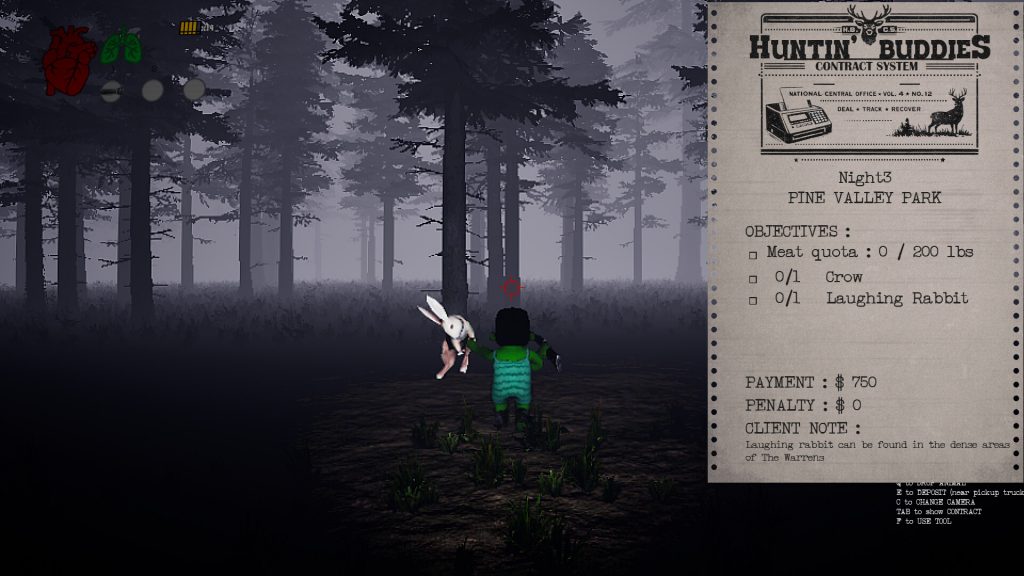
The pager contract → hunt specified animals → transport to truck → weight quota → escape structure is the extraction genre’s mission loop applied to hunting. This creates a specific kind of pressure that differs from both combat extraction games (Escape from Tarkov, Hunt: Showdown) and horror survival games: the weight of the carcasses.
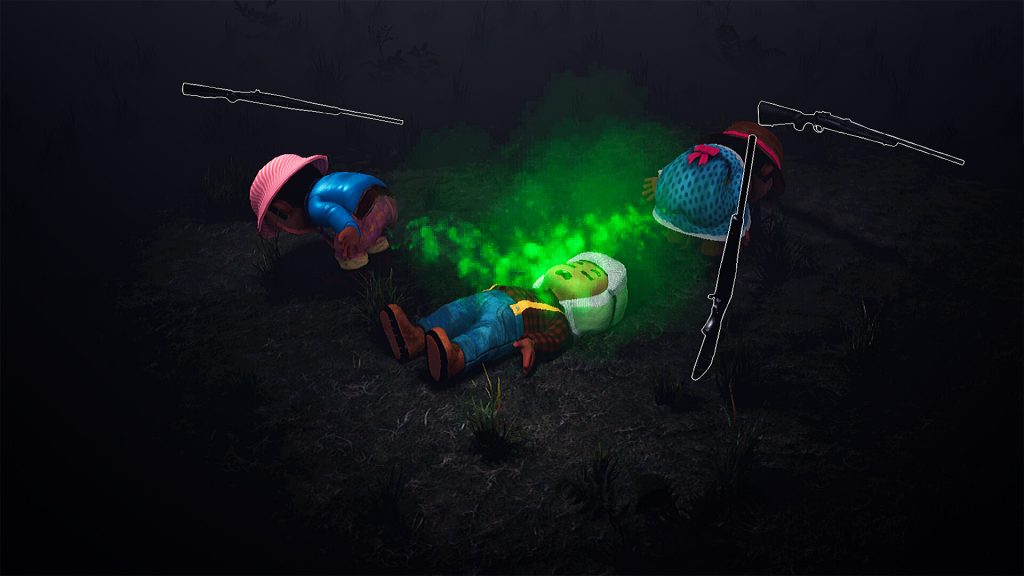
In most extraction games, the primary limitation is how much you can carry in inventory. In Huntin’ Buddies, you’re physically dragging dead animals to a truck — and the animals have physics-based bodies that can be damaged or destroyed through careless handling. The weight quota creates mission completion pressure; the fragility of the cargo creates the specific challenge of getting there intact.
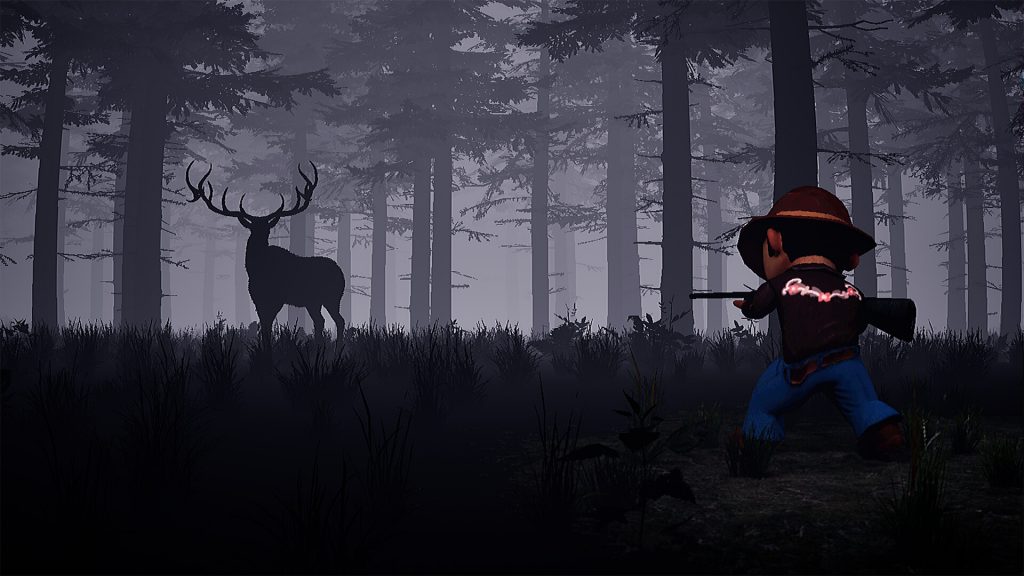
The one-shot kill weapon system — limited ammunition, single shots that kill if they connect — creates the hunting game’s specific rhythm of careful approach, patient positioning, and deliberate execution rather than the spray-and-pray dynamics of combat games. Missing a shot in Huntin’ Buddies doesn’t just waste ammunition; it alerts the target and potentially the entities monitoring the park’s activity level.
The 15-night escalation structure means the contract work becomes progressively more demanding as the park’s supernatural dimension becomes increasingly active. Early nights establish the loop; later nights test whether players have learned to execute it efficiently under increasing pressure from the pursuing entities.
The Co-op Dynamic
Four players with separate roles in a hunting extraction loop — some hunting, some carrying, someone watching for entities, communication about contract status — creates the natural role division that makes co-op games with asymmetric tasks engaging. Not everyone is doing the same thing at the same time; coordination is required rather than just simultaneous individual play.
The drop-in multiplayer and shared contract progress (one player’s contract advancement benefits the group) are the co-op design choices that make the experience social rather than parallel. When one player makes progress on the weight quota, everyone benefits; when one player makes a mistake that draws an entity, everyone faces the consequence.
The proximity voice chat that games like Shift at Midnight use to create spatial audio — discussed earlier this week — isn’t mentioned for Huntin’ Buddies, but the vocal communication of a four-player group trying to coordinate carcass transport while one member is being pursued by an entity that speaks Latin is the kind of co-op moment that generates the stories these games are for.
The Solo Developer Context
Huntin’ Buddies Wildlife Management — the solo developer’s chosen studio name, which is also a genre joke — has been active in community engagement throughout development. The pre-launch patch history (voice input fixes, multiplayer stability improvements, balance adjustments) shows responsiveness to feedback rather than just development in isolation.
The developer’s public note that individual Steam reviews matter significantly for a solo developer’s game is both honest and the kind of transparency that small games need players to understand. A game with 12 reviews at 58% positive is a game whose rating is genuinely undetermined — a handful of additional reviews in either direction changes the percentage meaningfully. The demo’s 87-review Mostly Positive baseline suggests an audience that found the concept engaging; the launch review count just hasn’t caught up yet.
Who This Is For
Strong fit for: co-op horror players who want comedy in the tonal mix alongside genuine dread; friend groups specifically looking for something at the $7.99 price point to try together; players who found Shift at Midnight or Lethal Company appealing and want the hunting extraction frame; fans of uncanny wrongness as a horror technique over jump scare-based horror; players who specifically enjoy physics-based chaos in co-op settings; solo developer supporters who want to help establish a game’s Steam review foundation.
Cautious fit for: players who want sustained genuine terror rather than horror-comedy; anyone who needs higher review counts before purchasing; players who prefer larger content scope for their co-op games.
Less ideal for: solo players without co-op groups; anyone who dislikes hunting as a thematic setting regardless of the comedic framing; players seeking narrative depth over extraction loop gameplay.
What to Watch For
The 12-review sample is too small to evaluate the launch rating meaningfully, but two weeks of reviews following the launch should provide a clearer picture. The developer’s stated community engagement suggests issues raised in those reviews will receive responses — which means the next few weeks of updates following launch will indicate how quickly identified problems get addressed.
The 15-night escalation’s pacing will be the core gameplay evaluation as more players complete the full experience: whether the escalation from ordinary-feeling hunting to genuinely threatening pursuit builds properly or whether the transition feels abrupt or poorly calibrated.
The Takeaway
Huntin’ Buddies is a co-op comedy horror extraction game built on a genuinely good horror premise — the wrongness of familiar things in an unfamiliar park, escalating toward explicit supernatural threat over 15 nights — at a price point where the risk of trying it with friends is low. The demo’s 73% positive baseline from 87 reviews validates the concept; the full game’s launch needs more reviews before its rating is meaningful.
The solo developer who named their studio after the game, who has been patching and responding to community feedback for months before launch, who is publicly acknowledging the importance of individual reviews for small games — this is the specific context in which a Mixed rating from 12 reviews is less informative than it would be for a larger release.
The goat in Pine Valley speaks Latin. The deer see things from the wrong angles. Something has been tracking how long you’ve been in the park. And the truck is still on the other side of the map.
$7.99. Four players maximum. 15 nights of escalating wrongness. The demo is still available if you want to check the uncanny deer eyes before committing.
Information regarding ‘Huntin’ Buddies’
| item | detail |
|---|---|
| Developer / Publisher | Huntin’ Buddies Wildlife Management (Solo Developed) |
| Genre | Cooperative Extraction / Comedy Horror |
| Release platform | PC (Steam) |
| Official release date | July 24, 2026 |
| price | $7.99 / £7.15 / €8.15 (20% off for 2 weeks after launch) |
| Maximum number of people | Online co-op up to 4 players |
| Content composition | 3 hunting grounds (Pine Valley, Granger Farm, Blackmire Swamp), 15th night |
| Steam Review (Official) | Complex (58%, 12 cases) |
| Steam Review (Demo) | Generally positive (73%, 87 cases) |
| Official Channel | Discord |
| Steam Page | Shortcut |