When the creator of RimWorld shows up in the comments section of a Splattercat video to tell a small Korean indie team they’re doing great, the indie strategy community pays attention. That moment, more than any official trailer or press push, captured what’s been happening around Dungeon Settlers — the dark fantasy strategy game from Seoul-based studio CanOpener that’s been quietly building one of the more enthusiastic pre-release communities in the genre.
The public playtest is live now, the wishlist has crossed 85,000 during that playtest phase alone, and a Q3 2026 full release is the target. Based on what’s been shown and what’s been said about it, Dungeon Settlers might be one of the more exciting strategy debuts of the year.
The Pitch That Earned the Wishlist
The conceptual pitch is the kind that immediately makes strategy players sit up: RimWorld‘s colony management depth meets Darkest Dungeon‘s expedition tension, executed in a single integrated game where both halves feed each other.
That’s an ambitious combination. RimWorld and Darkest Dungeon operate on fundamentally different design philosophies. RimWorld is about emergent narrative through systemic simulation — what unfolds at your colony is the story. Darkest Dungeon is about authored stress and resource attrition — what happens to your roster is the story. Combining them isn’t just a matter of layering features; it requires reconciling two distinct theories of what strategy games should make players feel.
Dungeon Settlers attempts this reconciliation through structural integration. The colony layer produces the resources, training, and team composition that enable expeditions. The expedition layer produces both the rewards that fuel colony growth and the casualties that disrupt it. Neither half is decorative — both are essential, and the game’s central tension is in how players allocate attention and resources between them.
This is the right way to combine these genres. Many hybrid attempts treat one half as the “main” game and the other as supporting content. Dungeon Settlers appears to treat both as primary, with the player’s strategic identity emerging from how they balance the two domains.
The Setting and Permadeath Stakes
The world is a magical-corruption apocalypse: a wasteland severed from the outside, populated by survivors trying to build something stable while sending four-person expeditions into dungeons that don’t forgive mistakes. Death is permanent. Every casualty is real. Every expedition decision carries the weight of potentially losing characters players have invested in.
This is the design choice that places Dungeon Settlers firmly in the hardcore strategy lineage rather than the more forgiving colony sim category. Permadeath in a colony-building context is a different design problem than permadeath in pure roguelike contexts. In a roguelike, character loss resets the run; in a colony game, character loss is a setback the player has to absorb while continuing. The emotional weight is different, and the resource implications are different.
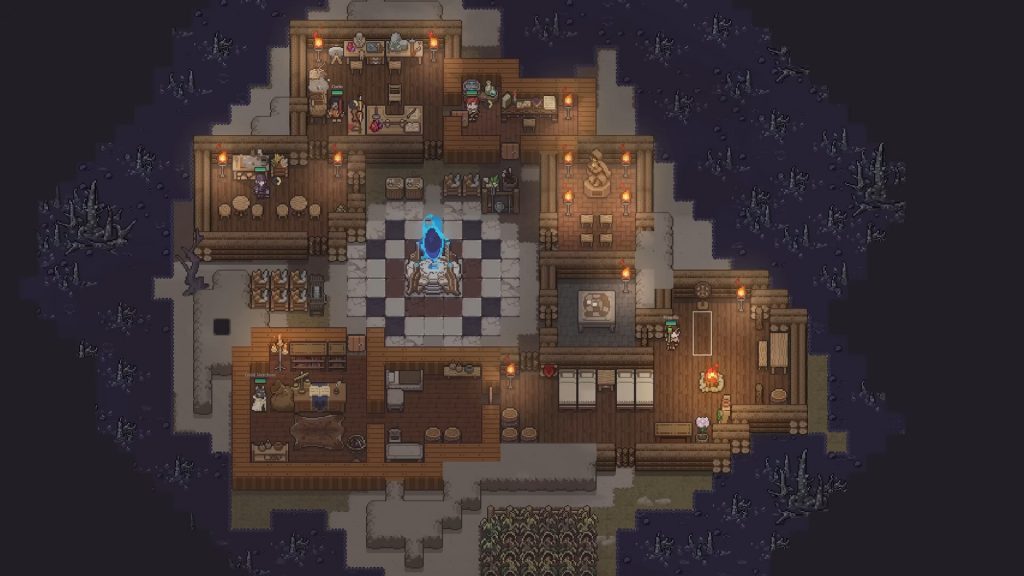
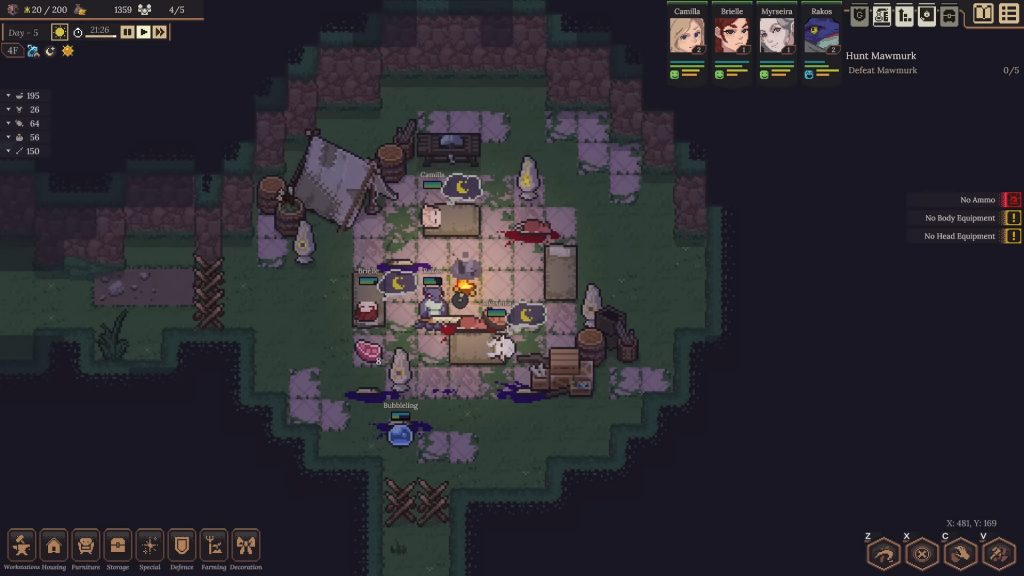
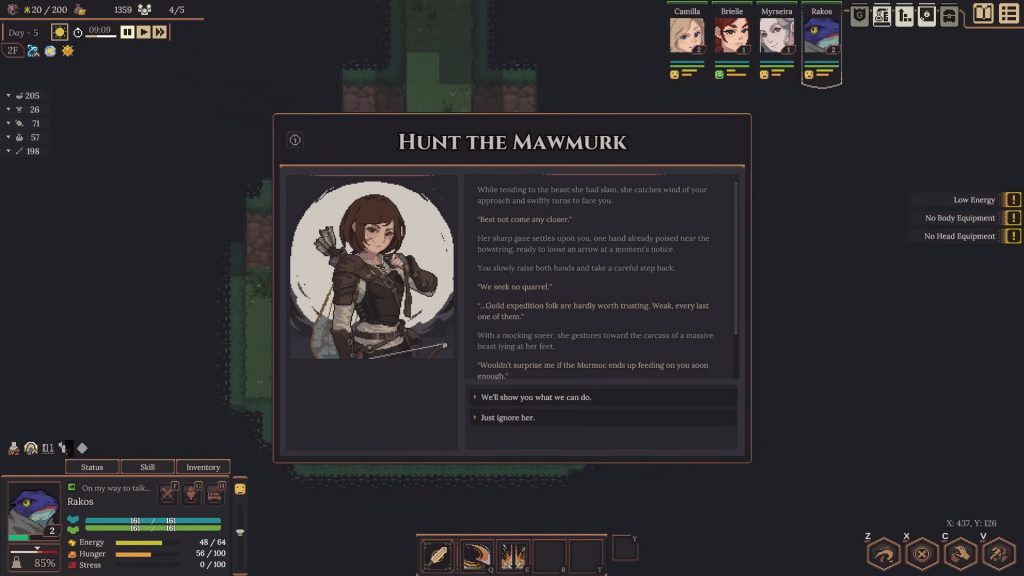
The dark fantasy framing supports this register. The 2D pixel art commits to atmospheric gloom — collapsed wasteland landscapes, ominous dungeon corridors, character portraits that convey personality through detailed expression work. Medieval fantasy audio reinforces the tone, with the contrast between relatively peaceful settlement music and the tense intensity of combat music doing real work to mark transitions between the game’s two registers.
The Four-System Structure
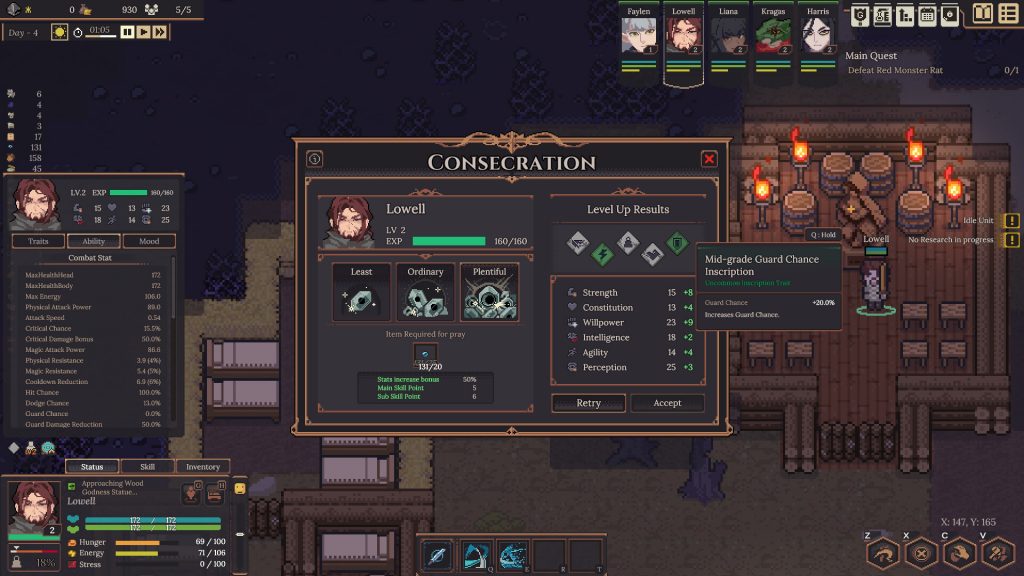
The game organizes around four interlocking systems: settlement management, character development, combat, and dungeon exploration. Each has substantial depth in itself, and the interactions between them define the game’s strategic identity.
Settlement Management. Players place walls and doors freely to design space, then construct facilities — bedrooms, dining halls, smithies, and other infrastructure. Crop cultivation and resource management build the survival foundation. Expedition food and camping supplies have to be produced. Research unlocks new buildings and equipment. This is recognizably the RimWorld design lineage, with the specific spatial flexibility that makes that game’s colony-building so satisfying.
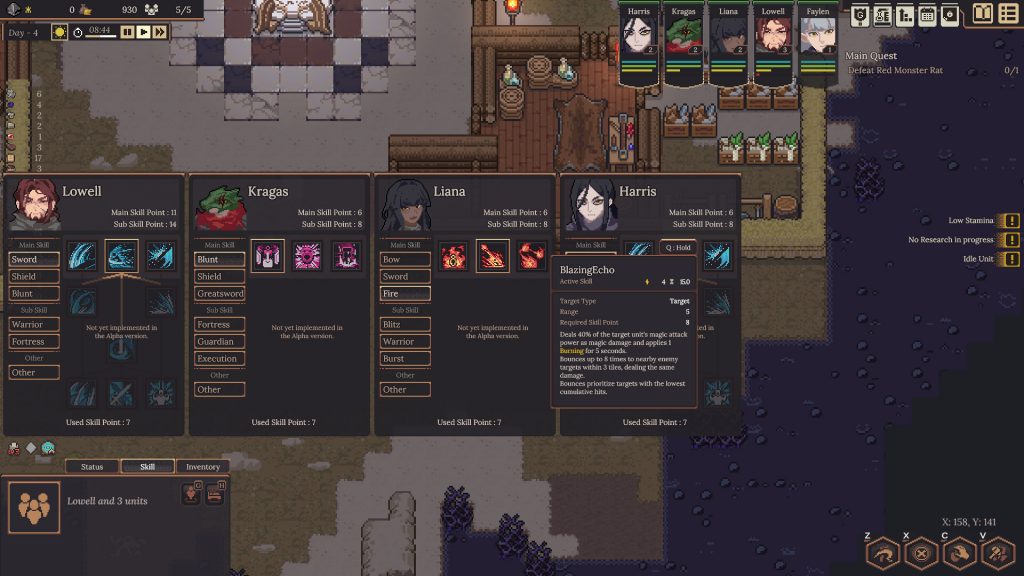
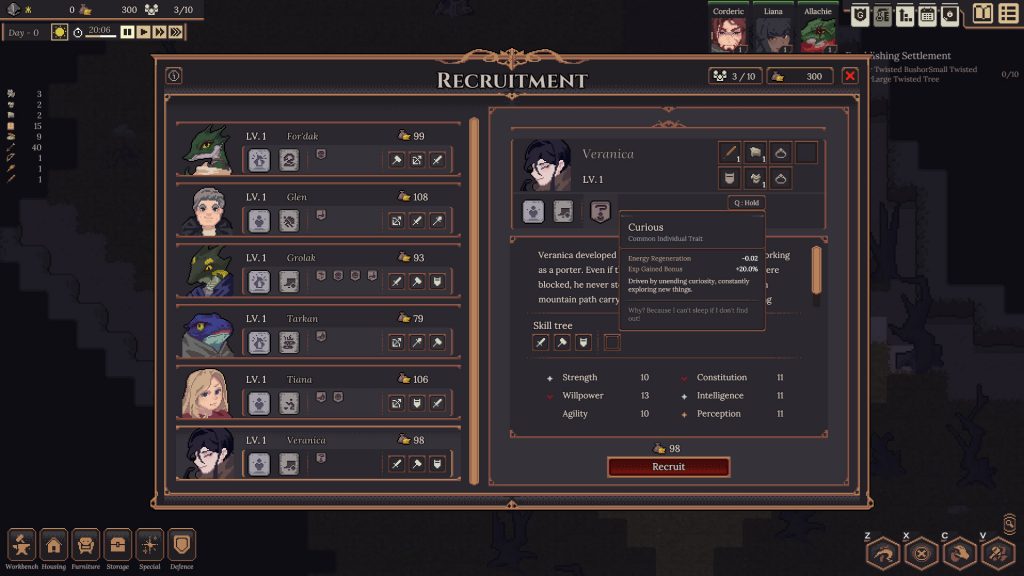
Character Development. Each settler has six primary stats, talents, and various combat and life stats, with characteristics determined by race, background, and personality. The game’s example of “a curious lizardman wanderer” captures the design philosophy — characters aren’t generic class templates but specific personality-mechanical combinations. Players grow characters through level-ups and equipment configuration, then assemble four-person expeditions considering role and synergy: swords, maces, bows, fire magic, and other combat specializations.
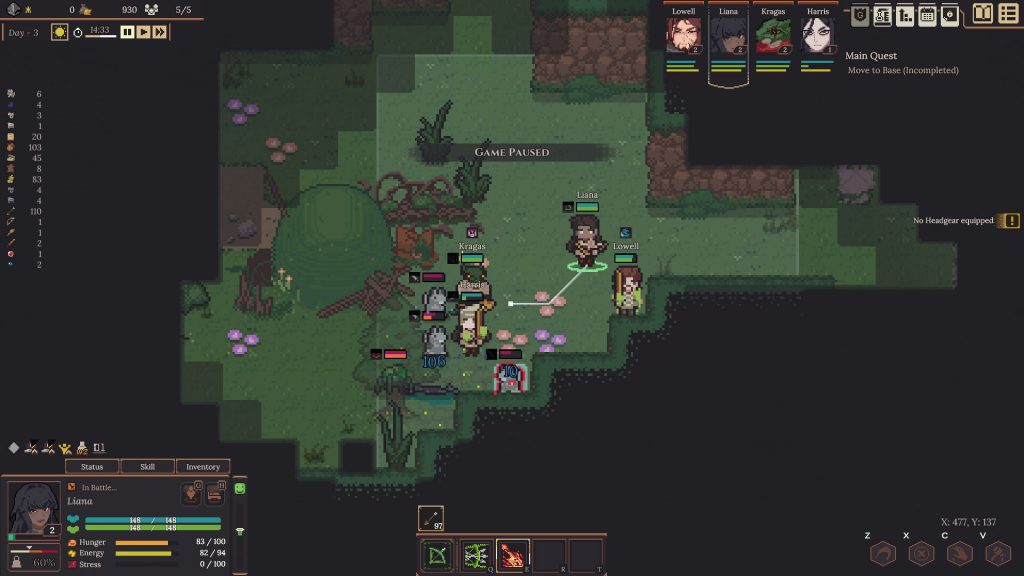
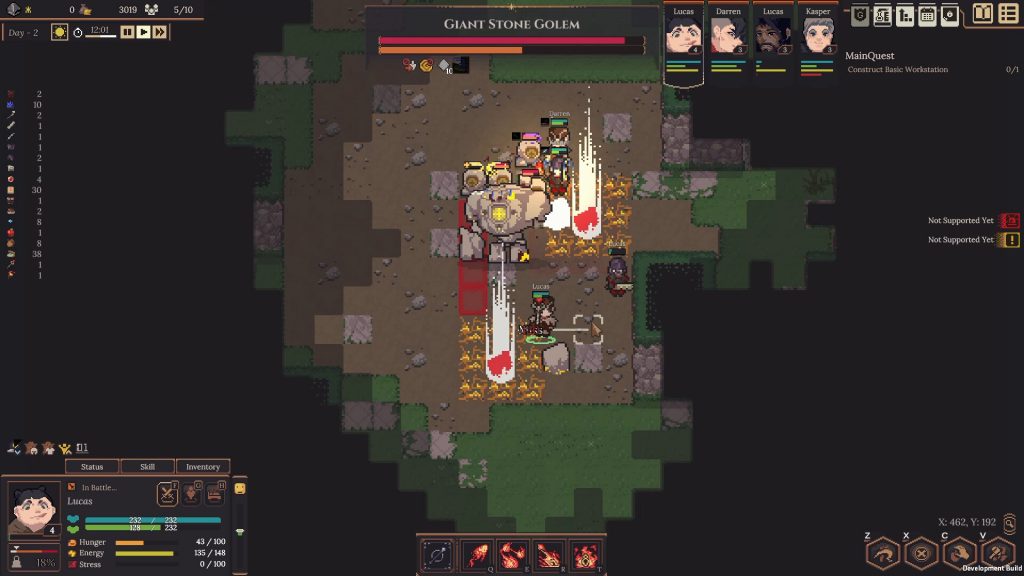
Combat. Real-time with pause, which is the right call for this design. Pure turn-based would slow the expedition pacing too much; pure real-time would remove the strategic thinking time the system requires. The pause-and-plan structure lets the action maintain its momentum while preserving the deliberate decision-making the genre needs. Status effects, mechanics, positioning, weakness exploitation, and skill timing all matter. This is tactical combat, not action combat, and the game’s lineage clearly traces to the more strategic end of the spectrum.
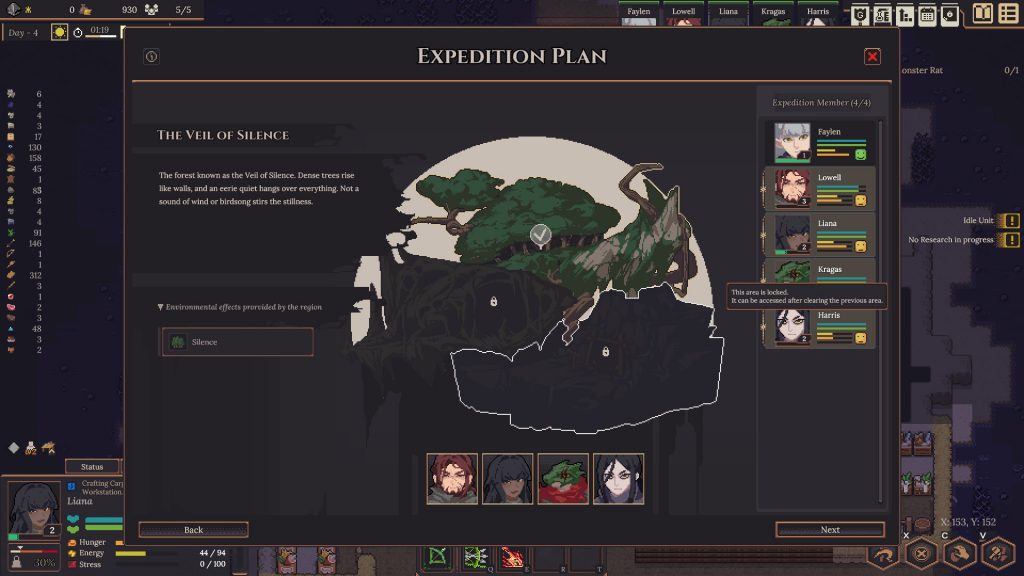
Dungeon Exploration. Each dungeon is procedurally generated — floor structures and room arrangements change, with different environmental effects applied by region. Deeper exploration produces rarer resources but escalating danger. Giant golems, acidic creatures, and other threats populate the dungeons. Resource gathering includes wood, herbs, gem veins, and mysterious mandrakes. Special events — dungeon merchants, ancient trees that demand blood — add variables that prevent expeditions from becoming routine.
The integration of these four systems is the project’s central design challenge. Hybrid games succeed when their systems feed each other meaningfully and fail when their systems operate in parallel without genuine interaction. Dungeon Settlers‘ structural promise is that every system informs every other system — colony decisions shape expedition capability, expedition outcomes shape colony resources, character development serves both contexts, and combat capability emerges from the interaction of all three preceding layers.
The Splattercat Moment and What It Signals
Pre-release attention in the strategy space tends to be quiet. Big trailers get views; mid-tier strategy games often build their audience slowly through word of mouth, niche press coverage, and content creator features. Dungeon Settlers‘ 260,000 views and 13,000 likes on the March 2025 trailer is unusually strong for an unreleased indie strategy game from a small Korean studio.
The Splattercat coverage was a turning point. Splattercat (Splattercatgaming on YouTube) is one of indie strategy’s most influential content creators, with a track record of identifying interesting projects before they reach mainstream visibility. His features have launched the awareness phase for many successful indie strategy releases.
Tynan Sylvester’s appearance in those video comments — saying “you guys are doing great” — is the kind of validation that travels in strategy circles. Sylvester rarely engages publicly with comparable projects, and his explicit encouragement of a RimWorld-influenced game from a different studio carries meaningful credibility. It signals that someone with deep expertise in the colony sim design space recognizes what CanOpener is building.
The 85,000 wishlist figure during the playtest phase reflects the community attention this kind of organic validation generates. For a pre-release indie strategy game, that’s a substantial figure — and one that suggests the full release has real commercial potential beyond the niche indie strategy audience.
The Studio Context
CanOpener is a small Seoul-based indie studio, and Dungeon Settlers is their debut commercial project. Self-publishing the game is a meaningful choice — it gives the studio full creative control but also requires them to handle all distribution, community management, and global marketing themselves.
The community engagement approach is one of the project’s strongest signals. Active presence on Discord, YouTube, X, and Bilibili, with explicit community feedback integration from the playtest phase forward, demonstrates the kind of developer responsiveness that strategy game communities specifically reward. Strategy games depend heavily on extended community engagement — the genre’s audience expects developers to listen, iterate, and continue developing the game post-launch.
The multilingual launch plan is also worth noting. Korean, English, Japanese, Simplified and Traditional Chinese, French, German, Russian, and Spanish coverage at launch is unusually broad for a small studio debut. It signals that CanOpener is treating Dungeon Settlers as a global release from day one rather than a domestic project with international ambitions later.
This international focus has been a notable pattern in Korean indie strategy releases recently. The combination of strong development talent, established multilingual support infrastructure, and tight community engagement is producing increasingly competitive global releases from Korean indie studios. Dungeon Settlers is positioned within that broader pattern.
How It Compares to Its Influences
It’s worth being precise about what Dungeon Settlers shares with RimWorld and Darkest Dungeon and what it doesn’t.
Shared with RimWorld: Colony spatial design and construction; resource management depth; character generation with personality and background variance; emergent narrative through systemic interaction; permadeath weight; long-form strategic engagement.
Different from RimWorld: Explicit fantasy framing rather than sci-fi flexibility; integrated combat system rather than abstracted raids; structured expedition gameplay layer; more directed progression through research and equipment unlocks.
Shared with Darkest Dungeon: Four-person party expeditions; tactical combat with status effects and positioning; expedition risk-reward calculation; character-specific abilities and synergies; permadeath as central emotional mechanic; dark fantasy aesthetic.
Different from Darkest Dungeon: Real-time with pause rather than pure turn-based; full colony management layer that’s absent from Darkest Dungeon; procedural dungeon generation rather than authored encounter design; broader strategic context for individual expedition decisions.
The combination produces something genuinely new despite the recognizable influences. It’s not a RimWorld mod or a Darkest Dungeon expansion — it’s an attempt at a third design that draws structural lessons from both without being either.
Who This Is For
Strong fit for: RimWorld players curious about more directed expedition gameplay; Darkest Dungeon fans interested in a strategic colony layer; tactical RPG players who enjoy permadeath stakes; colony sim enthusiasts open to dark fantasy framings; players who appreciate hardcore strategy games that don’t soften their consequences.
Cautious fit for: players who prefer the pure systemic emergence of RimWorld without authored expedition structure; Darkest Dungeon fans who specifically love that game’s turn-based combat and might not adapt to real-time with pause.
Less ideal for: players who want lighter, more forgiving colony sim experiences; anyone allergic to permadeath; players sensitive to dark fantasy aesthetic registers.
What to Watch For
A few questions will shape Dungeon Settlers‘ Q3 2026 release.
The first is whether the four-system integration actually delivers in practice. The promise is that colony, character, combat, and dungeon systems all feed each other meaningfully. The risk is that the integration is partial — that systems run in parallel without genuine mutual influence. The playtest is where this becomes visible, and community response across the playtest period will be telling.
The second is depth of long-form engagement. Strategy games of this ambition need substantial content depth — enough character variety, enough dungeon variation, enough mid-to-late-game systems — to support hundreds of hours of play. Whether the full release delivers that depth or whether it ships with the systemic promise but limited content support will determine its longer commercial trajectory.
The third is balance refinement. Permadeath strategy games are particularly sensitive to balance issues — when character loss is permanent, players notice difficulty calibration issues more acutely than they would in more forgiving games. CanOpener’s responsiveness to playtest feedback on balance will significantly shape launch reception.
The fourth is how the self-publishing approach scales. Strategy games depend on sustained post-launch development — patches, content additions, and community engagement. Self-publishing puts all of that responsibility on a small team. Whether CanOpener can maintain the development pace that the genre requires will affect the project’s long-term arc.
The Takeaway
Dungeon Settlers is one of the more genuinely exciting strategy projects on the 2026 calendar. The conceptual pitch is strong. The community response has been organic and substantial. The pre-release endorsements — both formal press coverage and the more meaningful informal validation from Tynan Sylvester — suggest the project is being recognized by people with deep expertise in the design space.
The 85,000 wishlist figure during playtest is the headline number, but the more important signal is the qualitative community response. Strategy game audiences are difficult to impress — they’ve seen the genre’s promises broken many times. When they get excited about a project, it’s usually for real reasons.
For strategy fans, this is one to engage with at the playtest stage. The active feedback loop is exactly when player input has the most impact on the final game, and CanOpener has clearly designed their development process around community engagement. For everyone else, this is one to wishlist and watch as Q3 2026 approaches.
A wasteland torn by magical corruption. A settlement to build. Four-person expeditions into procedurally generated dungeons where death is permanent. The promise is one of the most ambitious strategy hybrids in years, made by a small Korean studio with full creative control and an unusually strong pre-release foundation. If the execution matches the ambition, Dungeon Settlers might be one of the strategy releases people are still talking about a year after launch.
The playtest is open. The wishlist is one click. And somewhere in the comments section of an old YouTube video, the creator of RimWorld is still telling them they’re doing great.
Information regarding ‘Dungeon Settlers’
| item | detail |
|---|---|
| Developer | CanOpener (Seoul, South Korea) |
| Publisher | CanOpener (Self-publishing) |
| Genre | Colony Simulation / Dungeon Crawler / Strategy RPG / Dark Fantasy |
| Release platform | PC (Steam) |
| Scheduled release date | Q3 2026 |
| price | Undecided |
| Steam Wishlist | 85,000 (Playtesting stage) |
| YouTube trailer views | 260,000 views (released in March 2025) |
| YouTube Like | 13,000 pieces |
| core system | Real-time Pause Combat / Settlement Construction / Character Development / Random Dungeon |
| graphics | 2D pixel art |
| Main Keywords | Rimworld, Darkest Dungeon, Colony Sim, Hardcore, Permadeath, Tactical RPG |
| Supported languages | English, French, German, Russian, Japanese, Chinese (Simplified/Traditional), Korean, Spanish |
| Steam Page | Shortcut |