Last year, a record 19,112 games shipped on Steam. That works out to roughly 52 a day — more than two new titles landing in the store every hour. And now that a game can be finished in an afternoon by one-click AI development, the volume arriving on the market is exploding by the minute.
The Day Valve Tore Up Its Own Tags
On May 18, 2026, Valve overhauled Steam’s tag system. Seventeen tags were added; twenty-one were removed. Read that list carefully, and it tells you exactly what is happening to the PC games market right now.
Among the new tags is Desktop Companion — recognition that software which simply lives in a corner of your desktop and keeps you company, software you can barely call “play” in the traditional sense, is now a genre in its own right. Bullet Heaven was added, finally giving the Vampire Survivors lineage an official name. And the old Clicker tag was renamed Incremental. Meanwhile, tags that rendered a verdict on a work’s stature — “Masterpiece,” “Cult Classic,” “Well-Written” — were swept away.
What a platform chooses to name, and what it chooses to delete, is a market report in itself. Valve has stopped sorting games by which ones are great, and started sorting them by how players consume them.
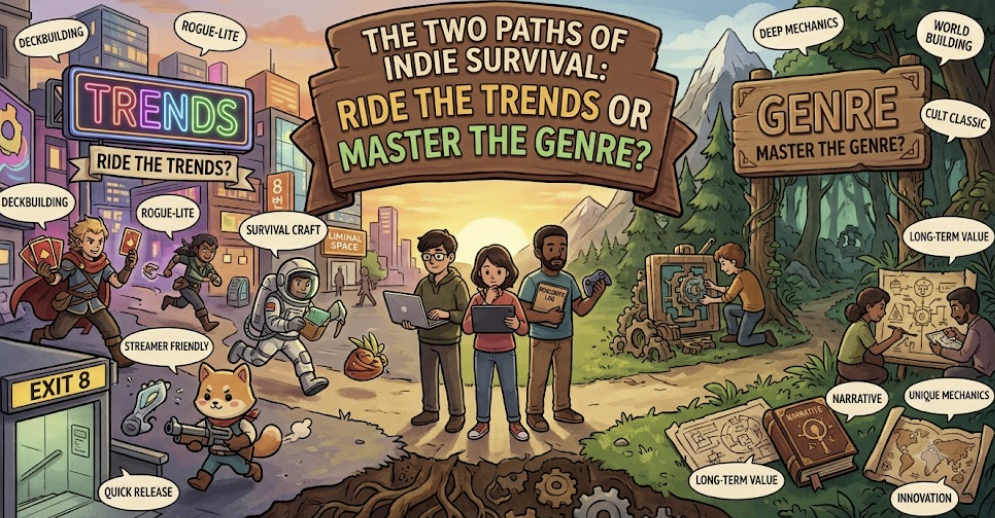
Road One: The Trend Axis — Games Now Compete With Social Media
Your competition is no longer other games
The party games that MECCHA CHAMELEON brought to full flower, and the ever-growing pile of friendslop titles built to make a group laugh for one evening and then be done. The concepts and the art styles differ wildly, but the underlying structure is identical: short, light, instantly funny, and spent.
This is not a failure of craft. It is that the competition has changed. What fights for a player’s two free evening hours is no longer another game — it is short-form video and social media. Once you are fighting for attention in the same market as a medium that lands a reward every thirty seconds, your game’s rhythm gets pulled in that direction too. Generational change has made games shorter, and that compression is not decay. It is adaptation.
The principle that works on this axis is simple: loud, short, and sharp; funny, faster.
What matters most is who these players are — mainstream, and skewing young. They drive the flow of social media; they are acutely sensitive to trends, and they do not stay with one game for long. They are constantly hunting for the next game to burn through — the next piece of raw material. Which is why the channel they search is not the Steam store. It is Shorts, TikTok, and streaming.
A deep player pool → relentless game consumption → a social-media trend → an even deeper pool
Influencers are the group with the most sensitive antenna for what is about to break. They sniff out the material that is going to land and get on it first. So on this axis, marketing is not “sending keys to streamers.” Marketing is building the material an influencer will want to ride.
Design principles that work on this axis
The whole game has to be visible in the first thirty seconds. Tutorials, lore, systems that unlock slowly — on this axis, every one of them is a cost.
The clippable moment has to be designed into the game. The instant a player bursts out laughing, or screams, has to be deliberate, repeatable, and spaced closely together. The standard is not “it’s fun to play.” It is “it’s fun to watch.“
Your development time and your price have to be shorter than the trend’s half-life. An eighteen-month plan on the trend axis is a failed design on day one. With AI-led development now the reality, if you cannot compress the cycle from spotting a trend to shipping into three to six months, you are better off not standing on this axis at all.
Timing beats quality. Bluntly: here, an 80-point game that arrives two months early beats a 95-point game that arrives two months late.
The trap on this axis
Trends have a half-life, and the graveyard of latecomers is always far bigger than the winners’ circle. More importantly, success on this axis does not accumulate into a studio identity — the next project starts from zero again. One lucky hit guarantees nothing about your studio’s survival. So if you choose this road, design your development stamina not around a single hit, but around sense that outruns technology, the nerve to get ahead of a trend, and the expectation of stepping up to bat dozens of times.
Road Two: The Genre Niche Axis — A Market That Sells Trust
An entirely different buyer
On the other side of Steam’s buying public sits a completely different group. They choose carefully among the games they love, and they consume them steadily, slowly. They do not react to trends — but they will open their wallets for content that is proven and trustworthy. And once a developer has earned that trust, they wait for the next game.
CRPGs, hardcore strategy, survival crafting, traditional Metroidvanias, simulation, rhythm, shmups. The numbers are smaller than on the trend axis, but they do not go out. If the trend axis produces a spike that shoots up in days and vanishes within a month, this axis produces a low, long plateau. And it is on that plateau that you talk to the fans waiting for your work and build the sequel.
Condition one: you have to be a core consumer of the genre yourself
The first requirement for standing on this axis is neither technology nor capital.
The developer has to be, personally, a core consumer of that genre.
Players in a niche genre can tell from a single concept sheet — from the shape of a demo alone — whether the person who made it actually loves the genre. A game that copies only the surface grammar gets filtered out by the community first and hardest. On this axis, genre authenticity is not something market research can substitute for. It is not a marketing technique. It is the developer’s own pride.
Depth of mechanical understanding sets the depth of level design
You have to aim precisely at what the players of that genre respond to — which concepts, which features, which moments. And to do that, you have to understand the genre’s core mechanics clearly.
“Understanding” here does not mean being able to list that Soulslikes have parrying and roguelikes have permadeath. It means knowing why that mechanic produces fun, and under what conditions it collapses. You should be able to explain why the character of an entire combat system changes depending on how many invincibility frames a dodge carries.
Without complete mechanical understanding, no sound game design can be assembled. A creative play concept makes level design harder, not easier — which is precisely where indie developers get their legs cut out from under them. What a genre player expects from your game is not innovation and creativity, but familiar, proven fun wearing the clothes of innovation and creativity — an experience in the genre they bought into that returns more than what they paid. So while a niche player may come in through the concept, they judge your game against the classics of the genre — the depth of its level design included. Not by volume. By depth.
Start talking before you start building
Marketing on this axis does not begin three months before launch. It begins before development starts.
Put the art concept, the game concept, and the direction of the core mechanics in front of that community early. Talk with them. Persuade them of why you are making this game. Doing so buys the team two things at once: design validation and a buying audience secured before launch.
If marketing on the trend axis is about being discovered, marketing on the niche axis is about building trust in advance with the players who will buy your game. You have to plant a reason — I have to own this one — and trust at the point of payment simply cannot be manufactured in a short window.
The Worst Choice Is the Middle
Most of the games quietly disappearing on Steam are not badly made games. They are games that belong to neither axis.
One chases the lightness of whatever is trending right now — and spends three earnest years building it. Another flies the flag of a niche genre without knowing the genre’s depth or its core recipe. Too serious to break out on social media, too shallow to convince the core. The result is an ambiguous game that belongs to no paying audience at all.
“Make a good game and eventually people will notice” — the line a handful of successful indie developers pass down — has become, amid an uncountable mass of slop, closer to neglect than to comfort. There are plenty of good games. The masterpieces and the blockbusters already sitting in wishlists get sold first, at brutal discounts. The point is not only to make a good game. It is precise targeting — who your game is for — and a meticulously built strategy that makes sure they buy it, and by what route.
By Professor Jung Musik
Department of Game and Visual Studies, Gachon University / Doctor of Game Engineering
Founder of Indiegame.com
Professor Jung Musik is an Associate Professor in the Department of Game and Visual Studies at Gachon University and holds a doctorate in engineering. He was a founding member of Trigger Soft in 1994 and has since served as Director at NCSoft, outside director at NASDAQ-listed Gravity, and Vice President of Lunosoft. He organized Korea’s first indie game contest in 2003 and has supported the domestic indie game ecosystem for more than two decades. He currently serves as a member of the Korea Game Rating and Administration Committee under the Ministry of Culture, Sports and Tourism, and as chair of the Content/Digital/Space division of Seongnam City’s Fourth Industrial Revolution Special Committee.