Last year, a record-breaking 19,112 games were released on Steam. This means an average of 52 games are uploaded to the store every day, or more than two per hour. Furthermore, with the advent of the era of AI-driven “click” development that completes a game in just a day, the volume of games being released into the market is increasing explosively every moment.
The day Valve revamped the tag
May 18, 2026, was the day Valve extensively updated the Steam Tag system. 17 new tags were added, and 21 were removed. And if you take a close look at the update list, it clearly reveals what is currently happening in the PC gaming market.
Among the newly created tags is “Desktop Companion.” This signifies that software residing in a corner of the desktop—which lags behind the user and is difficult to categorize as “play” in the traditional sense—has now been officially recognized as a genre. With the introduction of “Bullet Heaven,” the Vampire Survivor genre has finally acquired an official name. Additionally, the existing ” Clicker” has been renamed “Incremental .” Conversely, subjective tags that evaluated the quality of a work, such as “Masterpiece,” “Cult Classic,” and “Well-Written,” have been eliminated.
What a platform names and what it erases is, in itself, a market report. In other words, Valve has now stopped classifying ‘masterpieces’ and started classifying based on how users consume games.
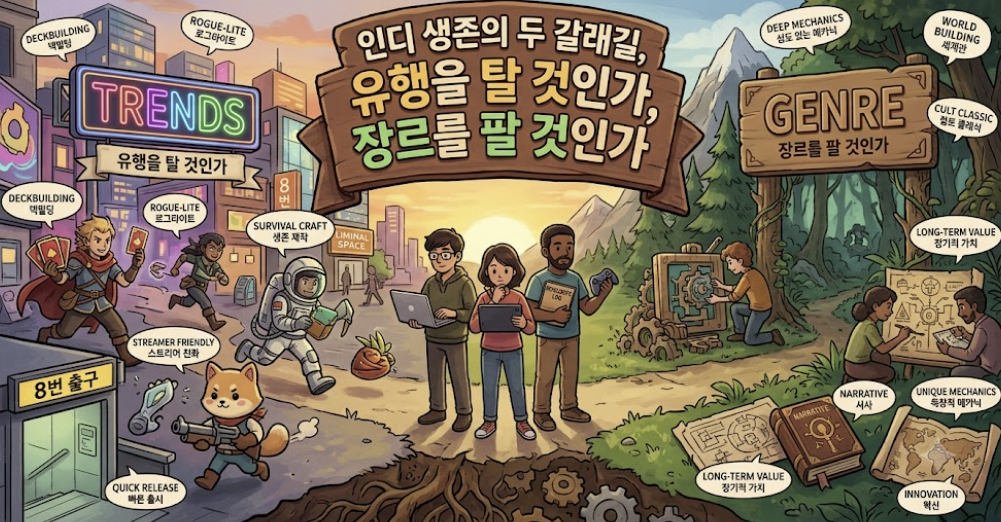
First Path: The Axis of Trend — Games Now Compete with Social Media
The competitor in a game is no longer a game.
Party games perfected with *Mecha Chameleon* and various Friendslop games that end with a laugh with friends. While their concepts and styles differ, they share one structure: short, light, instantly funny, and exhausting.
This is not because the game was poorly made. It is because the target of competition for games has changed. Today, it is not other games but short-form media and social media that are vying for a player’s two-hour evening. As long as they compete in an attention market like media that delivers rewards every 30 seconds, the rhythm of games is drawn in that direction. In other words, the shift toward short-form games driven by generational change is not a degradation of the game, but an adaptation to the times.
And the principle that applies to this axis is simple: stimulating, short and intense, faster and more enjoyable.
The key point is that the user base of this axis is mainstream and centered on youth . As a major force in social media, they lead trends, are sensitive to them, and do not stick with a single game for long. They are constantly looking for the next game to consume —in other words, the next source of material . Therefore, the channels they seek are not the Steam Store, but Shorts, TikTok, and streaming channels. They are the ones who create trends while also endlessly chasing them.
Large user base → Continuous game consumption → Social media trend → Re-expansion of the user base
Influencers are a group with the most sensitive antennas for popularity. They are uncanny at spotting material that is likely to take off and jump on board first. In other words, from this perspective, the essence of marketing is not ‘throwing keys to influencers,’ but rather creating the material that influencers will want to jump on in advance .
Design principles applicable to this axis
The entire game must be visible within the first 30 seconds. Tutorials, worldbuilding explanations, and gradually unfolding systems are all costs in this regard.
Scenes that become clips must be designed within the game. Moments when the player bursts into laughter or screams must be intentionally, repeatably, and placed at short intervals. The standard is not “fun to play,” but ” fun to watch .”
Development time and cost must be shorter than the half-life of a trend. An 18-month development plan within the trend axis is a failed design in itself. Now that AI-centric development has become a reality, if you cannot compress the cycle from trend detection to launch within 3 to 6 months, it is better not to stand on this axis.
Timing trumps quality. To be frank, in this regard, the 80-point product released two months earlier beats the 95-point product released two months later.
The trap of this axis
Trends have a half-life, and the graveyard for latecomers is always much larger than that of the leaders. Above all, since success in this field does not accumulate into the team’s identity, the next project must always start from scratch. This means that a single accidental blockbuster never guarantees the studio’s sustainability. Therefore, if you choose this path, you must design your development stamina not for a single hit, but with a creative sense rather than just technical skill, a challenging spirit that stays ahead of trends, and the determination to step up to the plate dozens of times .
The Second Path: The Axis of the Genre Niche — A Market Selling Trust
completely different consumers
On the opposite side of Steam buyers stands a completely different group. They carefully select the games they like and consume them steadily and slowly. Instead of reacting to trends, they open their wallets for verified and trustworthy content . And they wait for the next work from a developer they have once trusted.
CRPG, hardcore strategy, survival crafting, authentic Metroidvania, simulation, rhythm, shooting. The numbers may be smaller than those of the trend axis, but they do not fade. If the success curve of the trend axis is a spike that soars in a few days and vanishes in a month, the curve of this axis is a low, long-lasting plateau. And on that plateau, I communicate with the fanbase awaiting my work and create sequels.
Condition 1: The developer must be a core consumer of the genre.
The first condition for standing on this axis is neither technology nor capital.
The developer themselves must be the core consumer of that genre.
Users of niche genres can tell whether a creator truly loves the genre based on just a single concept art or demo composition. Games that merely superficially copy the genre’s grammar are the first and harshest filtered out by the community. In other words, on this level, ‘genre authenticity’ is an area that cannot be replaced by market research, and it is a developer’s pride and honor that transcends marketing techniques.
Understanding the mechanism determines the depth of the level design.
You must keenly target what appeals to users of that genre—what concepts, features, and moments they react to. To do this, you must clearly understand the core mechanisms of the genre.
Here, ‘understanding’ does not mean a mere listing of things like “Soulslikes have parrying” and “Roguelikes have permanent death. ” It means knowing why those mechanisms create fun and under what conditions they break . You must be able to explain why the entire nature of combat changes depending on how many frames the dodge invincibility frame is.
Without a complete understanding of the mechanics, proper game design cannot be constructed. The creativity of the play concept makes level design more difficult, which ultimately holds indie game developers back. What genre players expect from a game is not innovation and creativity, but proven and familiar fun disguised as innovation and creativity —in other words, a satisfying experience that exceeds the value paid for the genre game. Therefore, even if they approach it from a conceptual standpoint, niche players evaluate a game precisely based on the depth of its level design. It is about depth, not quantity.
Communicate before development begins.
Marketing for this axis does not start three months before launch. It starts even before development begins .
From the beginning, the direction of the art concept, game concept, and core mechanics must be exposed to the relevant community, and through dialogue, the team must persuade them why this game is being made. In this process, the team gains two things simultaneously: design validation and a customer base already secured before launch .
If trend-oriented marketing is about ‘being discovered,’ niche-oriented marketing is about ‘building trust in advance with users who will purchase my game.’ You must instill a justification for purchase, such as ‘I absolutely must buy this game,’ and trust in the payment process can never be built in a short period of time.
The worst choice is the middle ground.
Most of the games quietly disappearing from Steam are by no means poorly made games. They are games that do not fall into any category .
We spent three years developing the game seriously, pursuing the lightheartedness of recently trending games. Conversely, while claiming to follow the conventions of a niche genre, we actually lacked the depth and core recipe of that genre. It is too serious to go viral on social media, and too shallow to persuade core users. As a result, it becomes an ambiguous game that does not belong to any payment group .
The words of a few successful indie game developers—”If you make a good game, it will eventually be recognized”—are now closer to neglect than comfort amidst the countless slump games. There are many good games, and the masterpieces and blockbusters on wishlists are always sold first at drastically discounted prices. The key is not just making a good game, but clear targeting and a meticulous purchase inducement strategy regarding who will definitely buy your game and in what way .
Written by: Professor Moo-Sik Jeong (Associate Professor, Department of Game & Video, Gachon University / Ph.D. in Engineering)
Who is Professor Jeong Mu-sik?
He is a first-generation Korean game developer who started as a founding member of Trigger Soft in 1994 and served as a director at NCSoft, an outside director at NASDAQ-listed company Gravity, and a vice president at Runosoft. Since planning and hosting Korea’s first indie game contest in 2003, he has maintained a long-standing interest in and support for the nurturing of domestic indie games. Currently, he serves as a member and director of the Game Rating and Administration Committee under the Ministry of Culture, Sports and Tourism, and as the head of the Content/Digital/Space subcommittee of the Seongnam City Special Committee on the 4th Industrial Revolution, striving for the development of the domestic game industry and the establishment of a sound culture.