Seoul, Busan, Gyeongju, Jeonju, Suwon, Andong, Suncheon, Tongyeong, Gangneung, Chuncheon, Gongju/Buyeo, and Jeju make up exactly a third of Solitaire World Tour‘s 34-city roster — rendered entirely in watercolor by Japanese solo developer oneWheat (Kondo Shunichi), who built, illustrated, and published the entire game independently.
Klondike Rules, Travel Structure Layered On Top
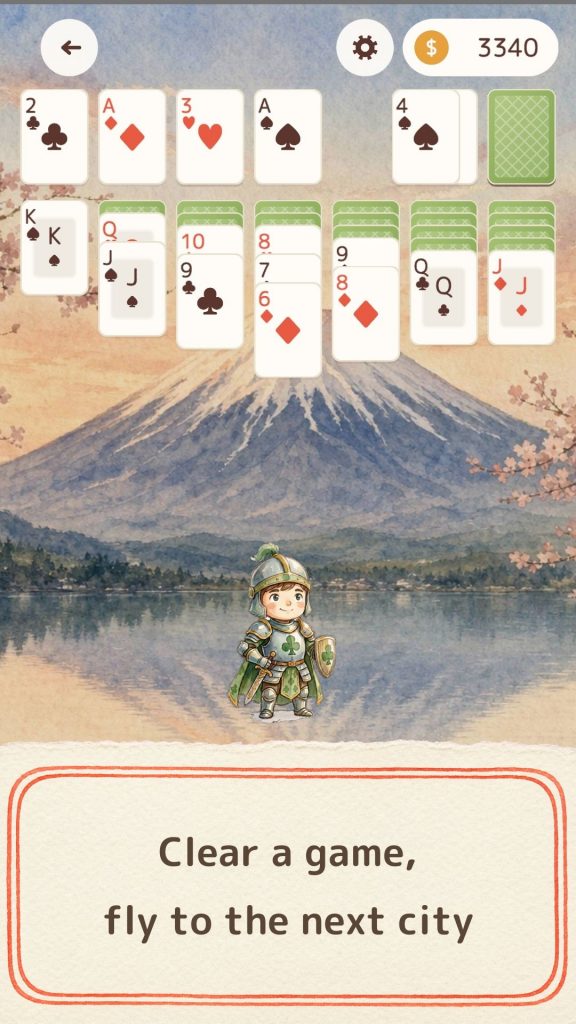
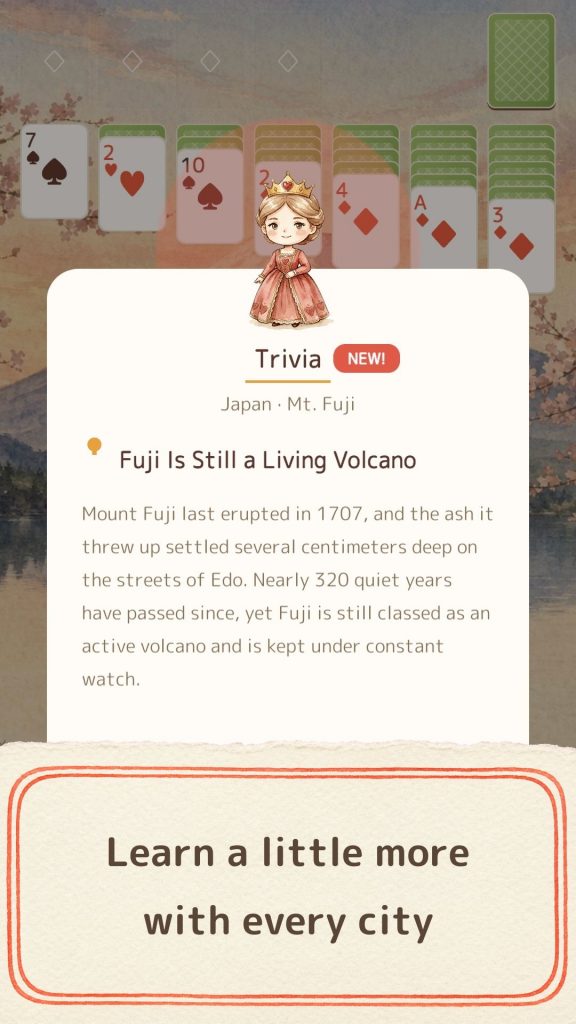
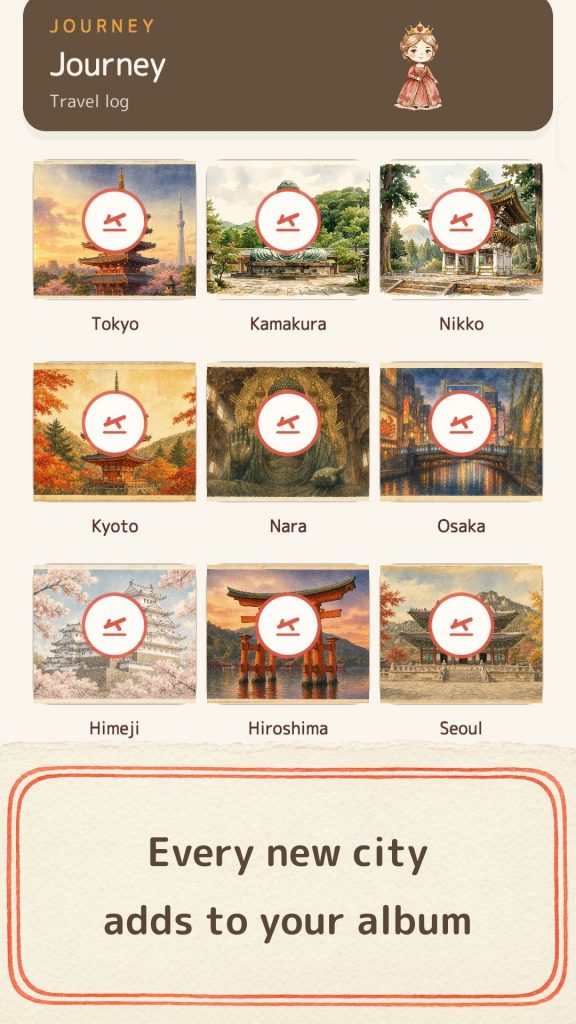
The core card game is standard Klondike solitaire — no rule modifications, no gimmicks layered onto the shuffle and deal. What oneWheat has built around that familiar foundation is a travel-collection meta-structure: clearing a round earns coins and a piece of local trivia about whatever city the player is currently visiting. Playing repeatedly in the same city unlocks that city’s postcard for purchase, and the in-game passport collects a stamp for each place visited.
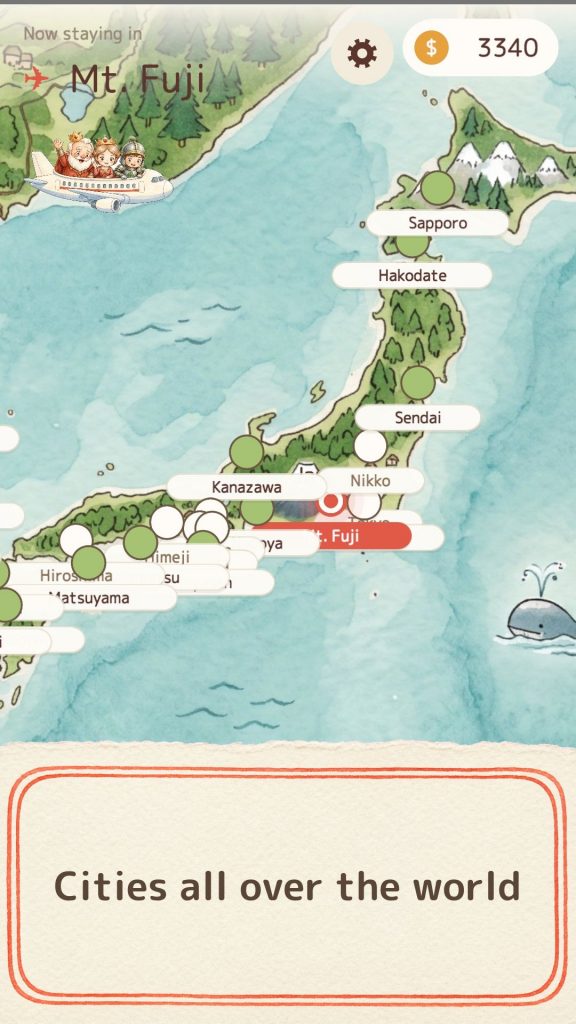
Earned coins buy plane tickets on a world map, letting players choose their next destination directly — with ticket cost scaling by distance, so a jump from Tokyo straight to Jeju costs more than a shorter regional hop. There’s no timer and no score competition anywhere in the design; hints and undo are unlimited and free, autocomplete is supported, everything works offline, and any in-progress game can be paused and resumed at will. This is solitaire built entirely around unhurried pacing rather than any competitive or challenge-oriented framing.
Thirty-Four Cities, Watercolor Throughout
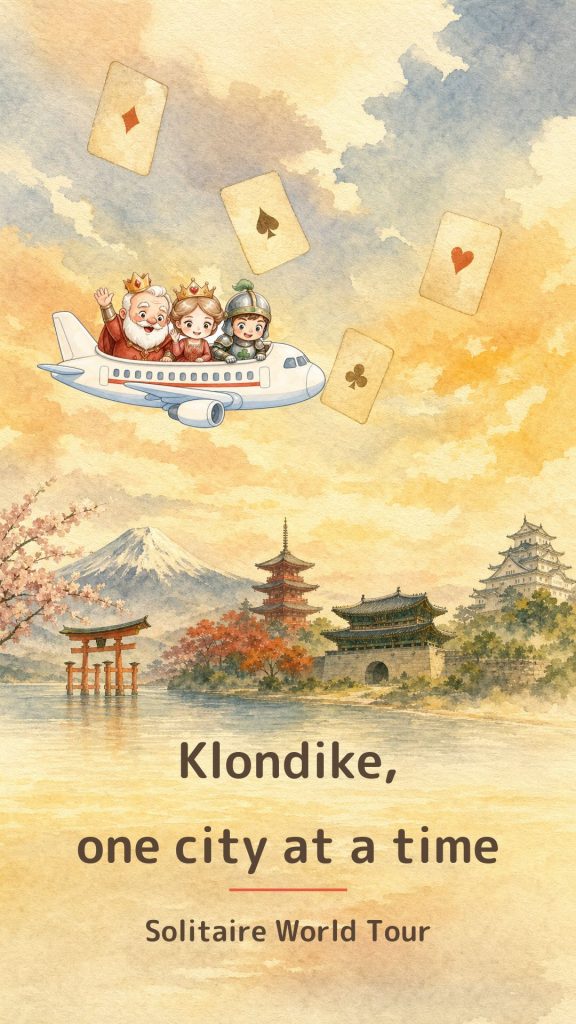
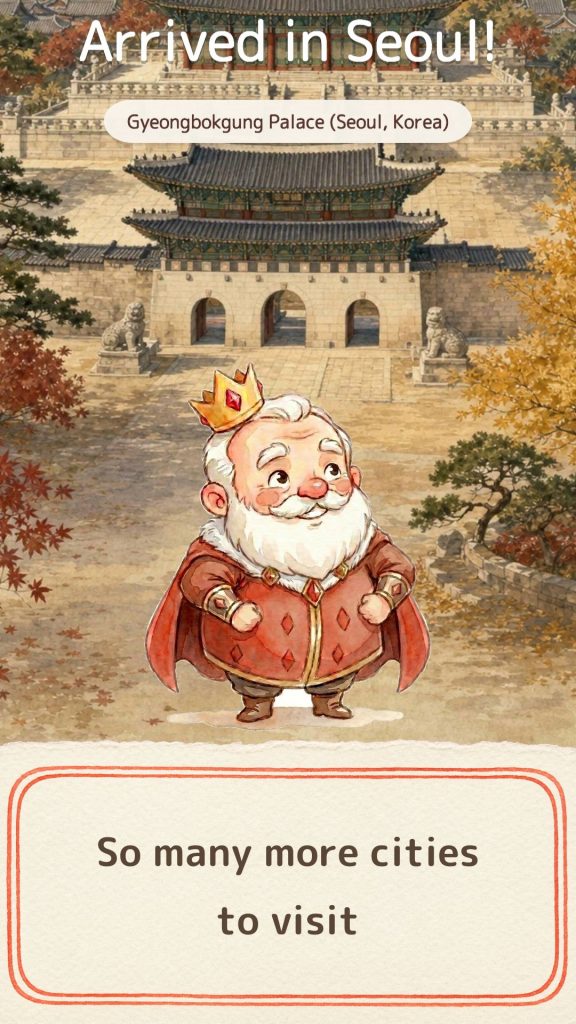
Every background is a watercolor rendering of whatever city the player is currently stopped in, spanning all 34 destinations across Japan and Korea. Tokyo is the starting city; the other 21 Japanese locations join the 12 Korean cities named above to round out the full roster. Visited cities are logged on a world map, with flight paths tracing the player’s cumulative route as a visual travel record.
Each city carries 10 trivia facts unlocked progressively through solitaire clears — 340 facts total, expressed across 680 sentences in Japanese and English. Per the developer’s own press kit, both the city backgrounds and the postcard artwork were produced using image generation technology, a disclosure worth noting plainly given the scale of consistent watercolor art (34 distinct cityscapes) a solo developer produced for a free, ad-only mobile release.
Solo, Free, and Notably Missing One Language
oneWheat handled every stage of the release alone — development, art direction, and self-publishing — opening pre-orders on the App Store on September 2 ahead of the September 19 launch. The game is free with ad support and carries no in-app purchases whatsoever, a genuinely uncommon monetization choice in the current mobile casual-game landscape.
The detail most worth flagging directly: despite building a full third of the game’s destination roster around Korean cities, Solitaire World Tour currently supports only Japanese and English — no Korean localization exists at launch. All promotional imagery, trailer content, and the press kit itself are produced in English rather than Korean, suggesting the international marketing push wasn’t specifically aimed at the Korean market the content so heavily features.
Who This Is For
Strong fit for: casual solitaire players who want a relaxed, no-pressure Klondike variant with a collection layer on top; travel and geography enthusiasts who enjoy accumulating trivia and postcards tied to real cities; players who appreciate unlimited hints/undo and offline play; anyone drawn to watercolor mobile game aesthetics.
Cautious fit for: Korean players specifically hoping for native-language support given the game’s heavy use of Korean destinations (not currently available); players who want to evaluate AI-generated art quality directly before downloading.
Less ideal for: players who dislike ad-supported free games; anyone seeking competitive, timed, or scored solitaire variants; players who need in-app purchase options to unlock content faster.
The Takeaway
Solitaire World Tour pairs unmodified Klondike rules with a genuinely calm travel-collection structure — coins, postcards, passport stamps, and trivia accumulating across 34 watercolor-rendered cities, twelve of them Korean. A single Japanese developer built the entire thing alone, disclosed the use of image generation for its city and postcard art, and shipped it free with no in-app purchases. The one detail that stands out against all of that craft: a game built substantially around Korean destinations currently has no Korean text anywhere in it.
Tokyo is the first stop. Seoul, Busan, and ten more Korean cities are somewhere further along the flight map. Whether Korean players can read any of it yet is a separate question from whether their hometown is in the game.
Free on the App Store now. Android version to follow.
Information regarding the ‘ Solitaire World Tour’
| item | detail |
|---|---|
| Development and distribution | oneWheat (one-person development) |
| Genre | Klondike Solitaire, Travel Collection |
| platform | iOS (released), Android (scheduled for release) |
| Release date | September 19, 2026 (App Store) / 28 (Google Store) |
| price | Free (Includes ads, no in-app purchases) |
| language | Japanese, English (Korean not supported) |
| App Store | Shortcut |
| Google Store | Shortcut |