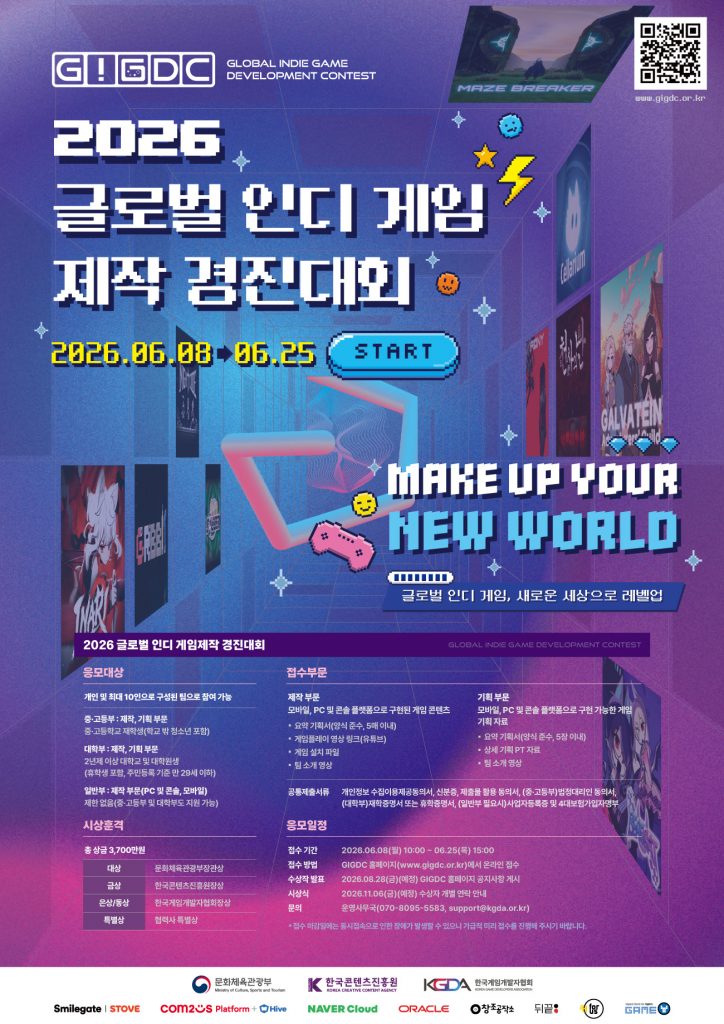
The 2026 Global Indie Game Developers Competition (GIGDC 2026) — Korea’s premier annual indie game competition, organized by the Korea Game Developers Association, sponsored by the Ministry of Culture, Sports and Tourism, and hosted by the Korea Creative Content Agency — opens its participation period on June 8.
GIGDC has long served as the gateway entry point for Korean indie game developers seeking industry recognition. Each year, hundreds of works are submitted, and the competition’s award winners have consistently achieved domestic and international market success. The competition’s reputation has been particularly strengthened by major successes, including Skul: The Hero Slayer and Sanabi, along with 2023’s University Division Production Gold Prize winner Shape of Dreams — all of which have achieved meaningful global market presence after their GIGDC recognition.
The competition operates with explicit goals: discovering creative and original game content, activating indie game culture, expanding the foundation of Korea’s domestic game industry, and strengthening global competitiveness. Each year’s edition extends this mission while adapting to current industry conditions.
New Mobile Production Category Expands Participation
This year’s competition operates under the slogan “Make up your New World! — Global Indie Games, Level Up to a New World,” focused on discovering promising indie developers and outstanding game content that will lead the next generation of the game industry.
The most significant structural change in GIGDC 2026 is the addition of a mobile category to the General Production Division. This expansion enables developers focused on mobile platforms to participate more actively in the competition. Mobile development represents a substantial portion of contemporary indie game creation — particularly in Korean and broader Asian markets where mobile gaming holds significant cultural and commercial importance — and the new category recognition reflects the competition’s adaptation to current industry realities.
Awards are conducted across five total categories: three production divisions and two planning divisions. Grand prize winners in each division receive Minister of Culture, Sports and Tourism Awards — among the most prestigious recognitions available to Korean indie developers.
Expanded Sponsorship Brings Enhanced Development and Marketing Support
The 2026 competition expands its sponsorship roster significantly. Existing sponsors Smilegate Holdings, Com2uS Platform, Naver Cloud, and Oracle are joined this year by new sponsors Creative Workshop, Backend, AdForus, and NY Media.
These sponsors will provide diverse support programs leveraging their respective specializations — including game sound production, server infrastructure development, mobile performance marketing, and promotional support. The combined sponsorship support aims to enhance award winners’ development capabilities and service competitiveness while supporting successful market entry.
This kind of multi-sponsor approach distinguishes GIGDC from purely award-focused competitions. The sponsors provide not just financial support but operational infrastructure that indie developers often struggle to access independently. Sound production support means awards don’t have to budget for audio professionals; server infrastructure means cloud hosting concerns are addressed; mobile marketing means promotional expertise becomes available. Each sponsor’s involvement addresses specific challenges that indie developers commonly face.
Continued Growth Support Beyond Awards
Award winners receive more than prize money. GIGDC’s follow-up support includes the “Award Winner Capability Enhancement Program,” providing ongoing development assistance after the initial competition.
This program comprises expert training in development and service domains, customized mentoring, interview video production, and practical training for global market entry. The structure ensures GIGDC’s value extends beyond ceremony — providing the sustained guidance that helps award-winning developers translate competition recognition into lasting industry success.
This post-award support model is particularly significant. Many competitions provide prize money and disappear; GIGDC explicitly commits to ongoing developer relationships. The capability enhancement program represents the kind of institutional support that helps indie developers navigate the genuinely difficult transition from competition success to sustainable commercial operation.
The combination of competition recognition, sponsor-provided operational support, and post-award development assistance positions GIGDC less as a simple competition and more as a comprehensive growth platform for emerging Korean indie developers seeking international market presence.
The Korean Indie Scene Context
GIGDC’s evolution reflects broader Korean indie gaming’s maturation. The Korean game industry has historically been dominated by major studios producing AAA work for global markets (NEXON, NCSoft, Krafton). Indie development has been comparatively underserved, with smaller studios and individual developers facing genuine challenges in finding visibility and resources.
GIGDC has played a meaningful role in addressing this gap. By providing systematic recognition for indie work, the competition helps individual developers gain industry visibility they couldn’t easily achieve through commercial release alone. The success stories — Skul, Sanabi, Shape of Dreams, and others — demonstrate that GIGDC recognition can translate into substantial commercial outcomes.
The mobile category addition specifically responds to the Korean indie reality. Mobile development has become increasingly accessible to small teams and individual developers, and Korean mobile gaming culture provides natural commercial pathways that PC-focused indie games sometimes lack. Recognizing mobile development equally with PC development at the competition level reflects a mature understanding of the contemporary indie ecosystem.
Sponsor Specialization Breakdown
The expanded sponsorship roster deserves a brief explanation for international readers:
Smilegate Holdings is one of Korea’s major game companies, known for CrossFire and various other commercial successes. Their participation reflects established industry commitment to indie development support.
Com2uS Platform specializes in mobile gaming and provides relevant infrastructure expertise for the newly added mobile category.
Naver Cloud provides cloud computing services — increasingly critical infrastructure for both development and live service operation.
Oracle provides database and enterprise software infrastructure, relevant for studios scaling beyond initial release.
Creative Workshop, Backend, AdForus, and NY Media join as new sponsors covering specialized areas including sound production, server infrastructure, mobile marketing, and promotional support.
The combined sponsorship covers virtually all major operational challenges that emerging indie studios face. For award winners, this support package can effectively substitute for hiring specialized contractors or building internal capabilities that smaller teams typically can’t sustain.
Statement from the Korea Game Developers Association
Korea Game Developers Association President Shin Yong-hoon articulated the competition’s significance in the announcement: “GIGDC 2026 is the best opportunity in Korea for indie game developers with creative ideas and excellent development capabilities to grow and challenge themselves. This year, through the establishment of the mobile division and the expansion of corporate sponsorship programs, we’re able to offer participants more diverse growth opportunities, and we look forward to significant interest and participation.”
The statement captures GIGDC’s positioning within Korean gaming culture. The competition isn’t just an award ceremony — it’s recognized as the most significant single opportunity available to Korean indie developers seeking industry advancement.
Application Details and Timeline
GIGDC 2026 participation registration runs from 10:00 AM on June 8 through 3:00 PM on June 25. The compressed timeline reflects the competition’s serious commitment level — interested developers need to engage promptly rather than treating the application as casual consideration.
Detailed information and application submission are available at the GIGDC official website (www.gigdc.or.kr).
For developers considering participation, the timing aligns with summer development cycles when many indie projects are in mid-development states, ready for portfolio submission. The mobile category addition specifically opens opportunities for developers who might have considered themselves outside GIGDC’s traditional scope.