The world ended when the machines went to war. What’s left is acid rain, ruins, and the question of whether anything can grow in soil that’s been through whatever this soil has been through. The answer, over approximately fifteen months of Early Access development and four major content updates, has been worked out between RedSaw Games Studio and the 1,958 players who shaped what Doloc Town became.
The v1.0 release lands with a completed narrative, a new exploration region called Old City Ruins, a farm automation system that addresses the repetitive-task friction the community consistently flagged, and Steam Workshop mod support that hands content creation back to the players. The 95% Overwhelmingly Positive rating — held across the full Early Access period and consistent with the last 30 days of reviews — is the product of that iterative process.
Producer Yao Fan’s statement captures the development philosophy directly: “When we first started Early Access, Doloc Town was a promise. We’re confident we can provide a special farm simulation experience for both players who have been with us from the beginning and players who are just now discovering the game.”
The Tonal Synthesis
The community shorthand for Doloc Town — “what Stardew Valley meets Terraria meets Fallout would look like” — is imprecise but useful. It identifies the three generic identities the game is combining: the cozy relationship-and-farming of Stardew, the vertical side-scrolling construction and exploration of Terraria, and the post-apocalyptic world-building atmosphere of Fallout. What the comparison misses is how unusual it is for these three registers to coexist within a single game’s tonal space.
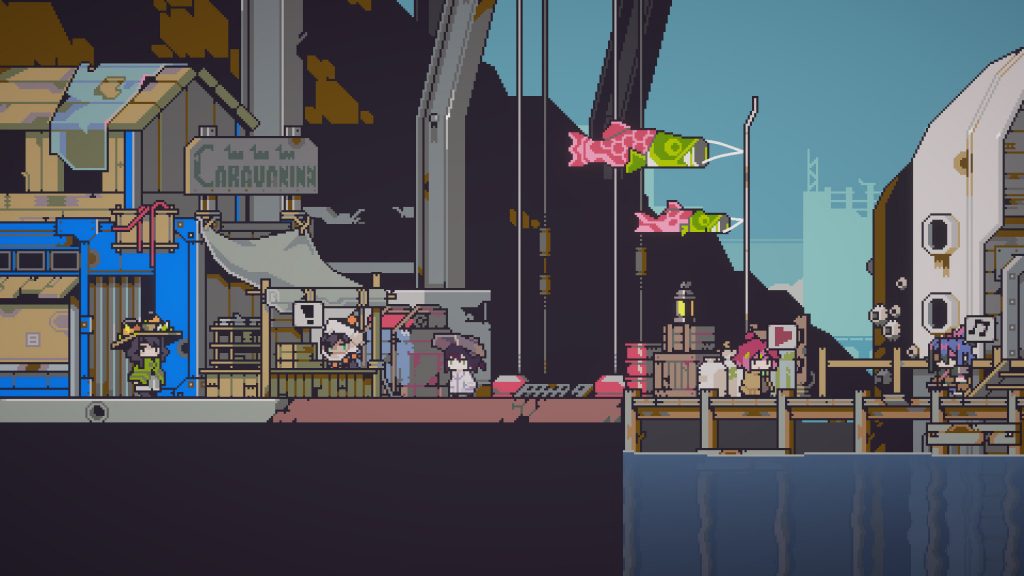
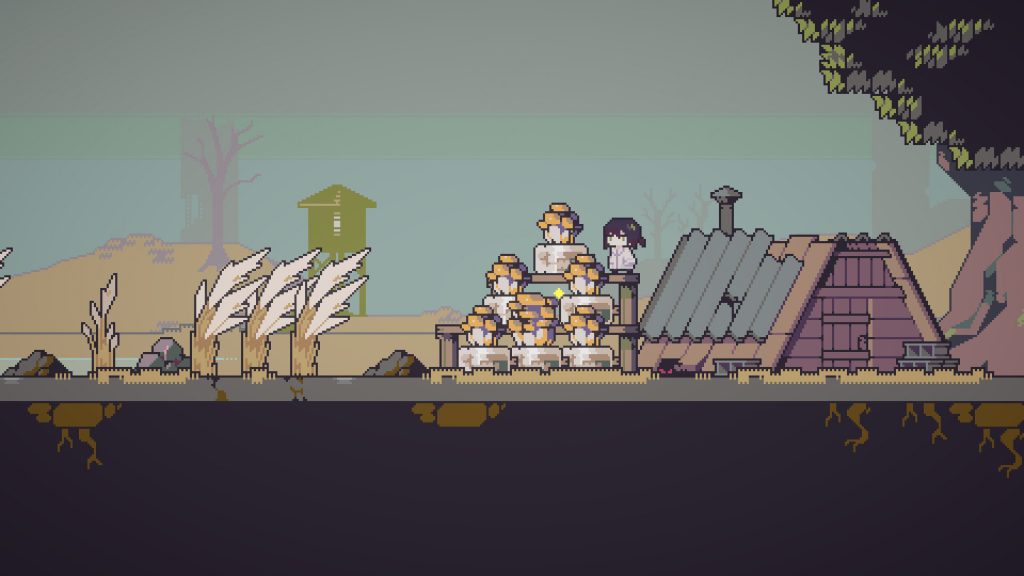
Farm simulation games typically exist at the warm end of the emotional spectrum — the rain falls gently, the crops grow reliably, the neighbors are friendly. Post-apocalyptic games typically exist at the tense or grim end — acid rain, hostile creatures, the constant reminder that things went very wrong and might go wrong again. Doloc Town is doing the work of maintaining both simultaneously: the warmth of watching crops grow and befriending villagers set against the specific melancholy of a world that had to be rebuilt from nothing.
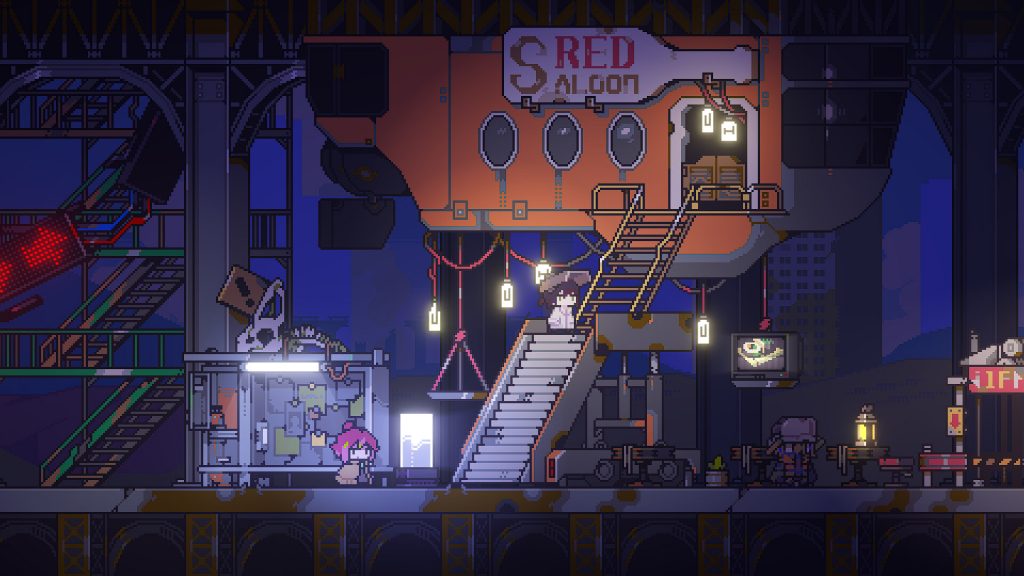
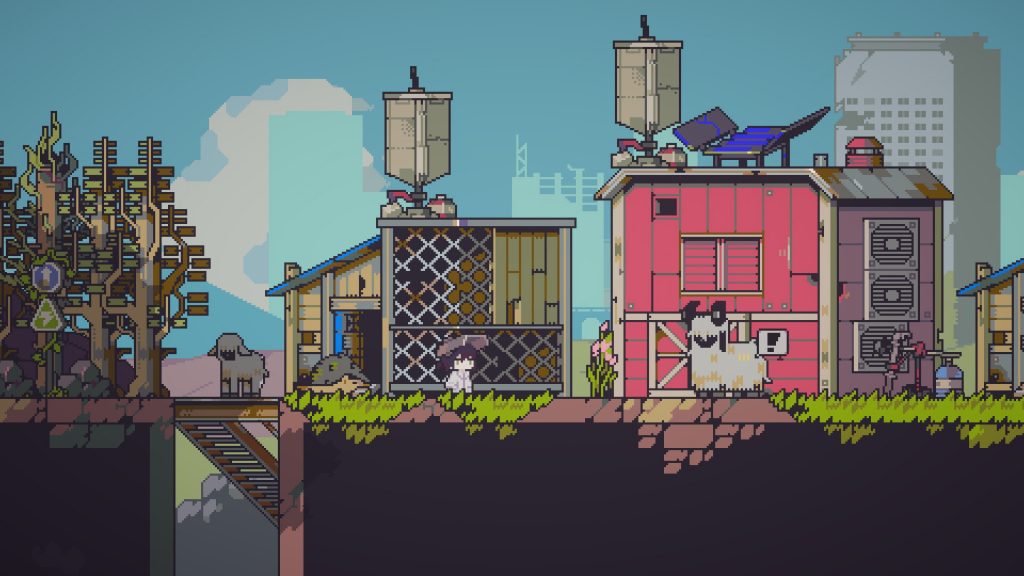
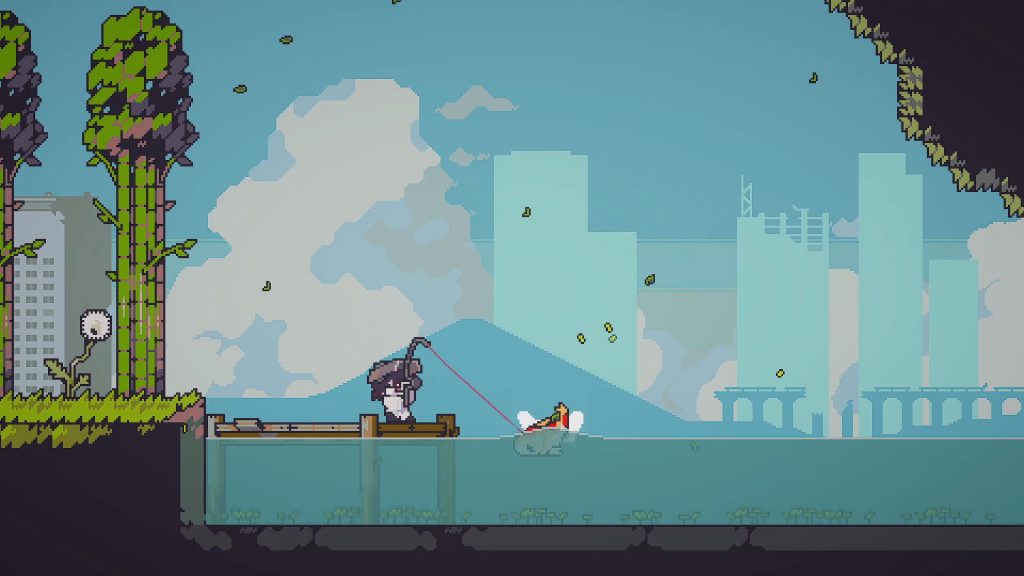
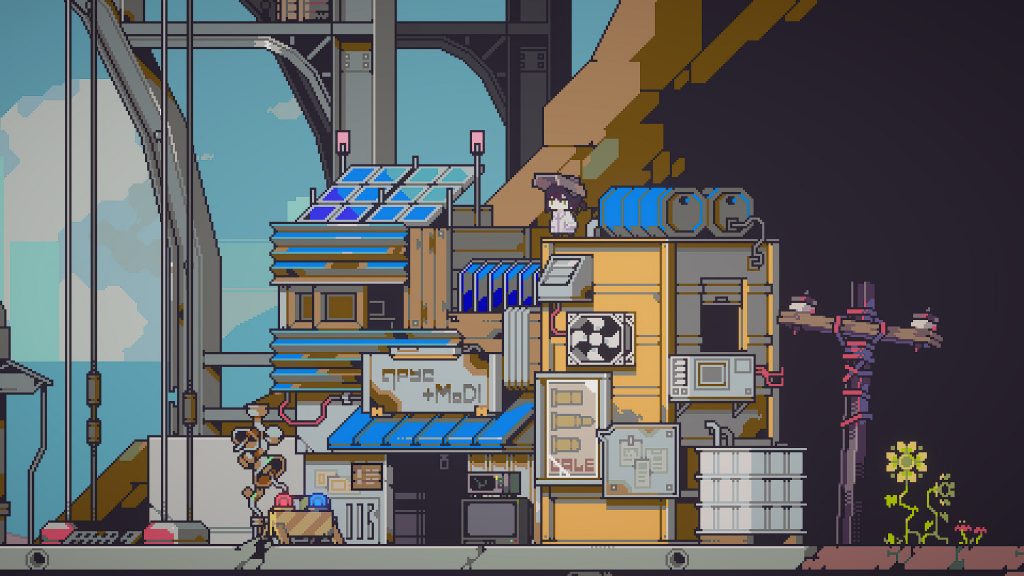
The hand-painted pixel art is the aesthetic mechanism that makes this coexistence possible. Pixel art communicates warmth through the specific quality of its imprecision — the slightly blocky edges, the particular color choices, the way light and shadow are approximated rather than rendered. Applied to a post-apocalyptic setting, this warmth recontextualizes the ruins: these aren’t cold wasteland ruins, they’re ruins that look like they could have homes growing in them again. The visual register insists that recovery is possible before the gameplay has proven it.
One international reviewer captured this precisely: “a game that conveys the consolation that life and hope can grow again even in ruins.” That’s not incidental to the design — it appears to be the game’s central emotional argument.
The Side-Scrolling Farm Design
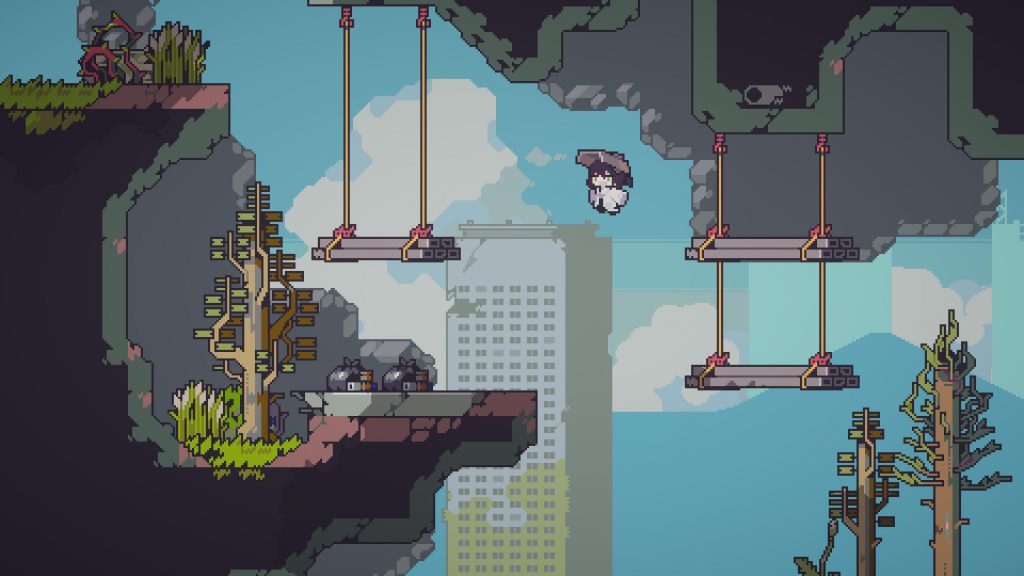
The platform-style side-scrolling structure is Doloc Town‘s most significant mechanical departure from genre conventions. Farming simulation games are almost universally top-down — the bird’s-eye perspective allows the player to survey their fields, plan layouts spatially, and manage the farm as a kind of puzzle of allocated space. Stardew Valley, Story of Seasons, Rune Factory, Farming Simulator — all top-down.
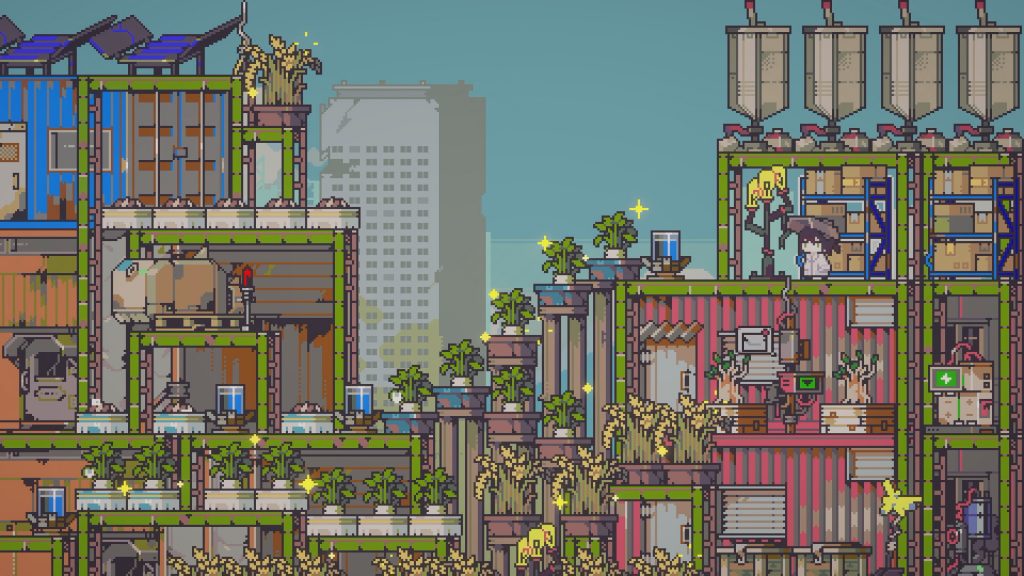
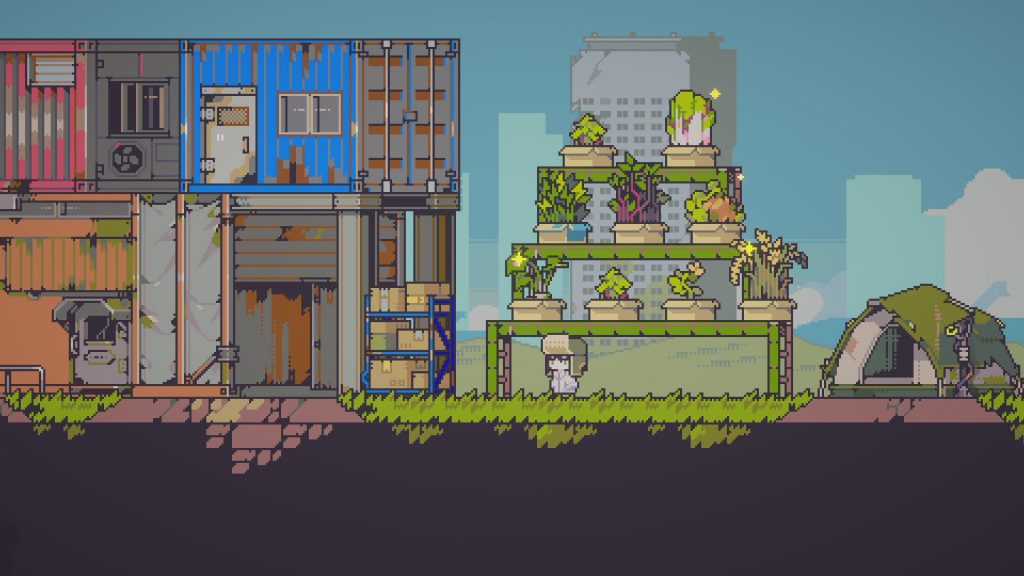
Doloc Town‘s choice to go side-scrolling changes the spatial relationship to the farm entirely. Vertical building becomes the primary design axis rather than horizontal field management. Crops grow up and down as much as left and right. The farm is not a plot of land but a vertical structure, which means the architectural decisions of where to place things are more like building design than field planning.
The metroidvania-style exploration that this enables — exploring the world by moving through it as a character rather than panning a camera across it — gives the game the adventure RPG dimension that makes the “meets Terraria” comparison apt. Discovering ruins, encountering hostile creatures, uncovering the story of what happened before the player arrived: these are experiences that top-down farming games can only gesture toward, but side-scrolling games can deliver through direct traversal.
The drone companion is the exploration tool that extends the player’s reach into areas that direct traversal can’t access — customizable, upgradeable, and presumably capable of investigating spaces that are too dangerous or structurally inaccessible for the player character directly. The drone creates the specific satisfaction of remote exploration: sending something into a space to see what’s there, then acting on what it finds.
The 1.0 Content Additions
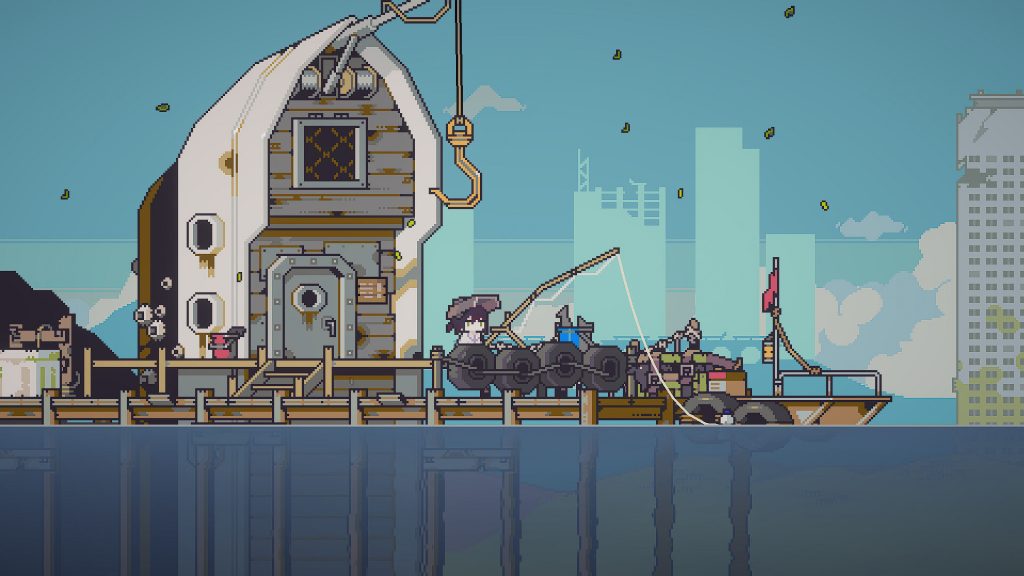
Four major Early Access updates added the content that transformed the launch build into a game capable of sustaining 1,958 reviews at 95% positive. “Pastoral Waves” added livestock and fishing; “Thrive and Tides” added resident interaction and the genetics breeding system; “Harvest Fusion” added village festivals and expanded NPC relationships; the Steam Workshop update added community mod support. The v1.0 completes this trajectory with four specific additions.
Old City Ruins is the new exploration region — the first genuinely new geographic territory since the initial Early Access map. New enemies, new NPCs, and new side quests populate the ruins of what the world was before the machines fought. The narrative value of finally being able to explore the civilization that was lost — rather than only its aftermath — is significant for players who have been following the story through the full Early Access period.
The farm automation system addresses the friction that manual repetition creates in long-form farming games. Planting, watering, harvesting — these are satisfying initially and tedious after sufficient repetition. Automation systems that handle the routine work allow players to focus on the decisions (what to plant, where to expand, how to optimize the farm’s layout) rather than the execution. This is the correct direction for late-game farming simulation — preserving the planning satisfaction while reducing the operational friction.
The main farm’s full expansion to maximum level, alongside two additional farmable areas elsewhere in the world, gives players who have been working toward farm optimization a genuine completion target rather than indefinite open-ended growth.
The Steam Workshop mod support extends the game’s effective content beyond what RedSaw can produce. Mods that add new crops, new buildings, new characters, or new game rules multiply the effective content without requiring development resources — the community becomes a content production partner. For a game with an engaged 95%-positive player community, this is the correct long-term strategy.
The Critical Reception
CGMagazine awarded 8/10, specifically praising the originality of applying side-scrolling farming and crafting to a post-apocalyptic setting. RPGamer highlighted the vertical exploration and building systems as genre-differentiating elements. Game8 noted that the consistent content additions across the Early Access period resulted in a polished complete work at v1.0. The critical consensus aligns with the player rating: this is a game that found something specific to do with familiar genre materials.
The award nominations — IGN China 2025 Most Promising, ChinaJoy × Game Connection Best Simulation Game, IndiePlay Nova Award — reflect the game’s visibility in the Chinese gaming market specifically. RedSaw Games Studio’s Chinese development background is reflected in the Chinese-first language support (full support for Simplified and Traditional Chinese while other languages are in beta), and the Chinese gaming press and award circuit has been the primary recognition pathway.
The Early Access Commitment
The fifteen months between the May 2025 Early Access launch and the August 2026 v1.0 release represent a genuine commitment to the development-through-community-feedback model rather than Early Access as an extended sale period. The four major updates that followed the initial build weren’t patches — they were substantial content additions that responded to what players wanted.
The genetic breeding system for crops is the most technically sophisticated addition: the ability to improve plant characteristics through selective cultivation, which mirrors actual agricultural genetics in simplified game form. That this arrived because the community’s engagement with the farming systems indicated an appetite for more depth is the specific kind of design evolution that Early Access enables when the feedback loop is functioning.
Yao Fan’s framing of the game as “a promise” at Early Access launch is the kind of accountability language that the development choices validate. The game that exists at v1.0 is measurably more complete than what launched in May 2025, and the player ratings held consistent throughout that transformation.
Who Is This For
Strong fit for: farm simulation players who have found top-down farming games satisfying but want a fundamentally different spatial relationship to the farm; players who want post-apocalyptic setting without the constant survival tension — rebuilding optimism rather than surviving crisis; Terraria players who want the vertical exploration and building applied to a farming and social game context; players who specifically enjoy genetic optimization and plant breeding systems; community mod enthusiasts who want Steam Workshop integration; players who followed the Early Access and want the completed story.
Cautious fit for: players who specifically prefer top-down camera perspectives in farming games; anyone who finds side-scrolling platformer controls in a life-sim context unfamiliar and potentially disorienting; players who want the full language support — Korean and other non-Chinese languages are currently in beta rather than full implementation.
Less ideal for: players who dislike farming simulation genres regardless of thematic skin; anyone wanting multiplayer or cooperative options; players who need a complete game at launch rather than Early Access engagement.
The Takeaway
Doloc Town is the product of fifteen months of honest development iteration: a post-apocalyptic side-scrolling farm simulation that used Early Access feedback to become substantially more complete than it launched, accumulated 95% positive ratings from nearly 2,000 reviews in the process, and arrived at v1.0 with a completed story, a new exploration region, an automation system, and mod support that extends the community’s relationship with the game past what the developers alone can produce.
The hand-painted pixel art cozy aesthetic applied to a world recovering from civilizational collapse produces the specific emotional argument that Doloc Town is making: that warmth and growth are possible even in soil that has been through the worst. The v1.0 release is the completed version of that argument.
The acid rain falls on ruins that are slowly becoming something else. The crops are growing. The drone is exploring. The old city’s ruins are finally accessible. And the story that started when the machines went to war has, after fifteen months, found its ending.
$19.99 — $15.99 through August 19. The farm is ready.
Information regarding ‘Doloc Town’
| item | detail |
|---|---|
| Developer | RedSaw Games Studio |
| Publisher | Logoi Games |
| Genre | Adventure / Casual / RPG / Simulation (Side-scrolling farm simulation) |
| Release platform | PC (Steam) |
| Early Access Release Date | May 7, 2025 |
| Official (1.0) release date | August 6, 2026 |
| price | $19.99 (20% off until August 19, $15.99) |
| Supported languages | Beta support for English, Chinese (Simplified/Traditional), and Japanese, Korean, Russian, French, German, and Portuguese (Brazil). |
| Awards | IGN China Awards 2025 Emerging Project Finalist, ChinaJoy x Game Connection Best Simulation Game, 2024 IndiePlay Nova Award Finalist, Participated in Wholesome Games Celebration 2026 |
| User ratings | Overwhelmingly positive (95%, 1,958 cumulative reviews) |
| Steam Page | Shortcut |