Twenty years ago, an explosion occurred in a low-income residential area. A tip resurfaces. A journalist decides to find out what the government’s hero management agency — the Bureau of Hero Affairs — was actually doing at the time. The only way in is to get hired.
Bureau of Hero Affairs from Korean solo developer indigoblue presents a specific premise: the superhero genre rendered not as action spectacle but as public administration and investigative journalism. The Bureau of Hero Affairs exists to manage and deploy “enhanced individuals” (강화인) — powered people — as public resources. The player character is a journalist who infiltrates the Bureau as a new employee in the Operations Division, processing deployment paperwork by day and searching archived records by night.
The Steam page and first trailer went live August 5. Release targets Q1 2027.
The Two-Layer Structure
The game operates on two distinct registers that the same workspace enables.
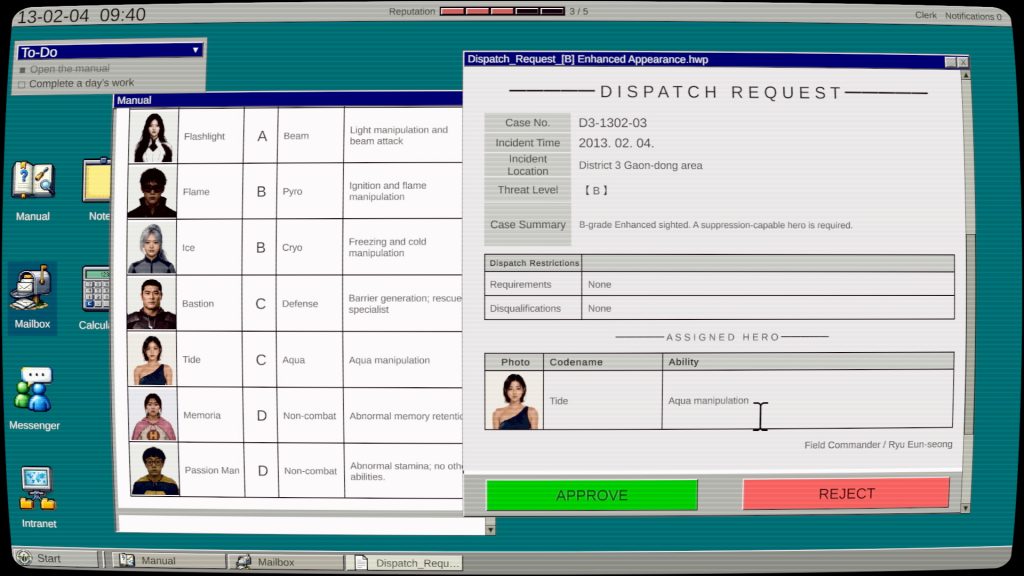
During work hours, the player reviews enhanced individual deployment request forms: checking attached photos and personal information, verifying budget availability, vacation status, injury conditions, and other regulatory criteria. Approve or reject according to the rules. Repeated errors lead to termination — the cover identity requires maintaining the appearance of a model civil servant.
But the deployment requests aren’t administrative abstractions. Each enhanced individual has their own circumstances. The player must constantly decide: apply the regulations as written, or recognize that a specific person’s situation justifies an exception? The approval/rejection mechanic is doing the same moral work as Papers, Please — the procedural job generates the ethical pressure through accumulation rather than dramatic confrontation.
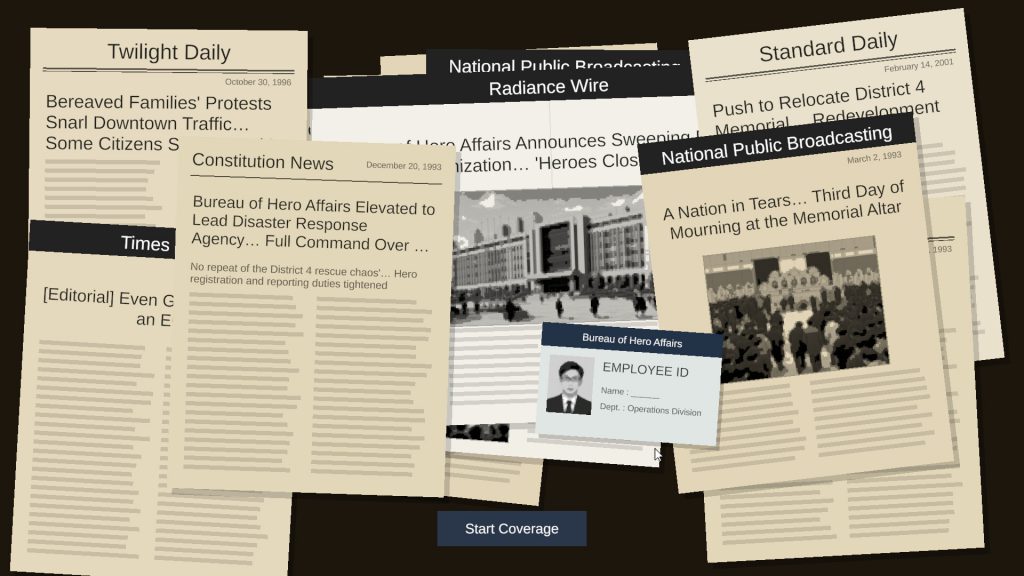
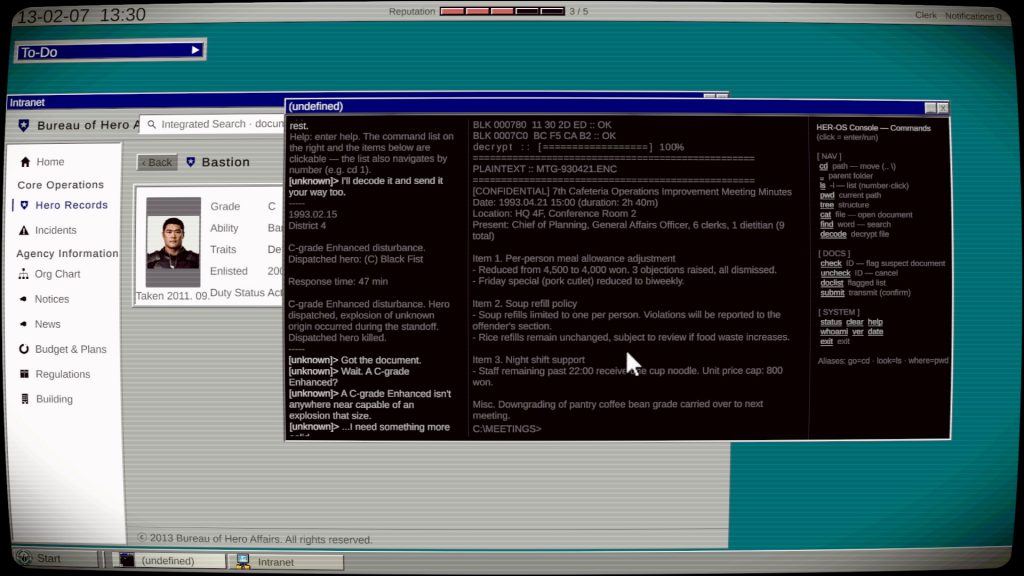
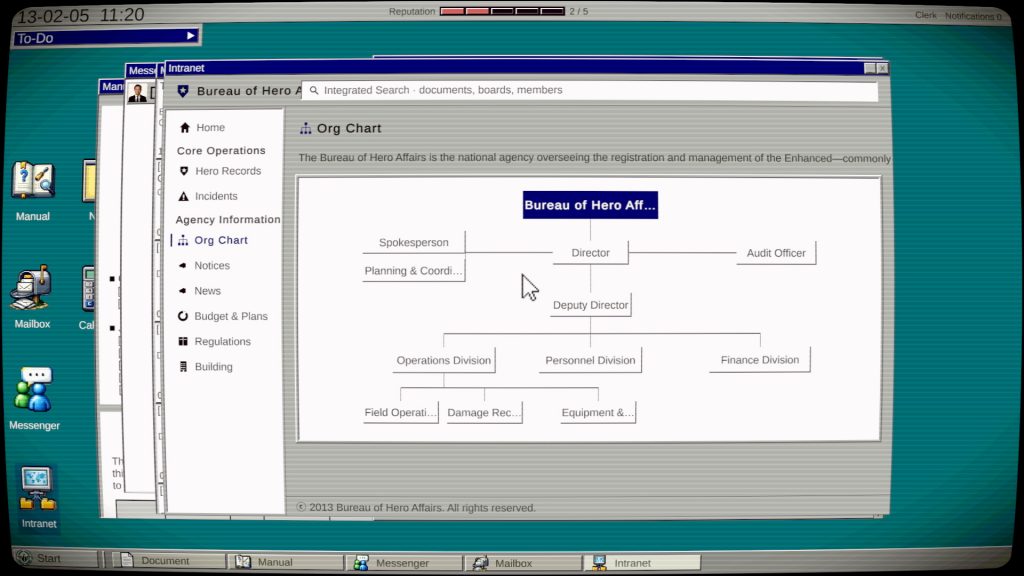
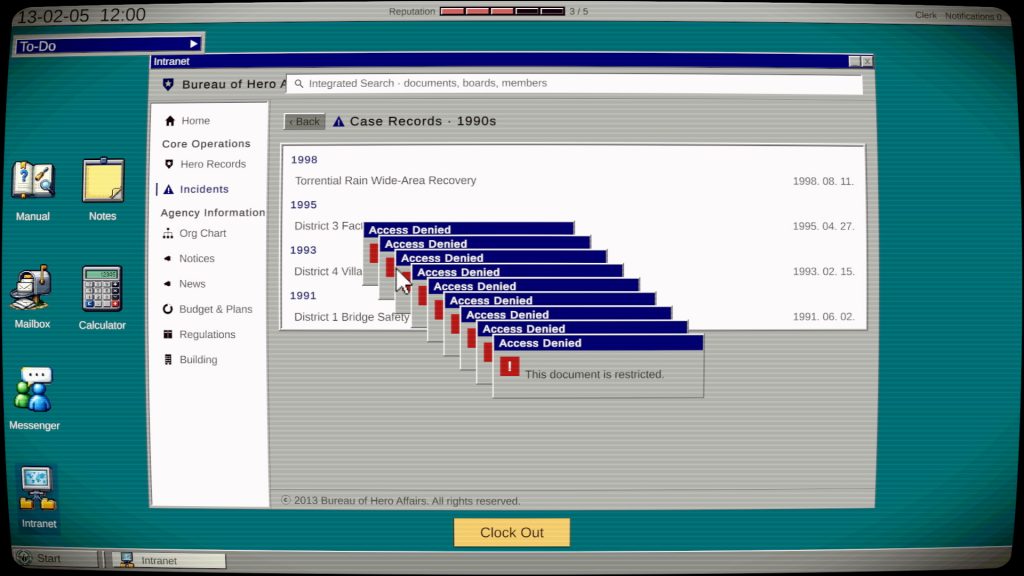
After hours, the same office space becomes the investigation. The intranet, internal messenger, and old console terminals contain what someone wanted to stay hidden. Forum posts, colleague conversations, archived logs — the traces of a 20-year-old incident that the Bureau has systematically concealed. What actually happened in that low-income neighborhood? Who made which decisions? What does the bureaucracy know that it isn’t saying?
The game explicitly offers the choice not to investigate. Playing as a model employee who performs their job correctly and ignores the anomalies is a valid path. Whether to gather all the evidence and expose it, or to choose silence, belongs to the player.
The Superhero Bureaucracy Angle
The specific creative insight is treating superpowers as an administrative problem. In conventional superhero fiction, powers are the source of narrative — the action that powers enable is the story. Bureau of Hero Affairs treats powers as the subject of institutional management: budget allocation, deployment scheduling, injury tracking, vacation approvals. The “heroes” are human resources in a system that processes them through the same regulatory apparatus that any civil servant manages.
This recontextualization produces the specific satire that the Steam tags signal: dystopia, investigation, social criticism. A government that manages powered individuals as operational assets, processes their deployment through approval forms, and apparently conceals an incident involving a low-income neighborhood — this is the superhero genre’s premise about extraordinary power redirected through the lens of how ordinary bureaucratic structures actually exercise it.
The intranet and console terminal aesthetic — old Windows operating system-style 2D graphics, the specific visual register of legacy government IT systems — reinforces this. The Bureau of Hero Affairs isn’t a gleaming future institution; it’s an organization that has been around long enough for its systems to become outdated, its records to accumulate, and its earlier decisions to have consequences that are still being managed.
The Design Lineage
The approval/rejection mechanic with ethical weight places Bureau of Hero Affairs squarely in the Papers, Please tradition. The “regulate or make exceptions” moral pressure, the institutional complicity that accumulates through daily work, and the parallel track of secret investigation running alongside the official job are all established genre conventions that the superhero bureaucracy setting applies to new subject matter.
Earlier this month, we covered The Newspapers of the Day (divingstudio) — a Korean university student team’s colonial press censorship game built around the same document-review moral weight structure. Bureau of Hero Affairs represents a second Korean solo developer independently arriving at this design tradition from a different subject matter angle. The concentration of this genre approach in Korean indie development this month may reflect the Papers, Please tradition’s specific resonance with the Korean cultural experience of institutional authority and its pressures.
The “search the intranet for what’s hidden” investigation layer adds the desktop investigation dimension that connects Bureau of Hero Affairs to No Results Found (Jungle Game Lab, July 31) — both games are about finding truth in digital archives, though through very different institutional contexts.
Who Is This For
Strong fit for: Papers, Please players who want the document approval moral weight applied to a superhero bureaucracy setting; narrative adventure enthusiasts who want institutional complicity as their genre frame; Korean indie supporters who want to follow a solo developer’s project from announcement to release; players interested in superhero fiction through a non-action lens; anyone who finds the “undercover journalist in a corrupt institution” premise immediately compelling.
Cautious fit for: players who want superhero action alongside the bureaucratic simulation; anyone who needs demo availability before investing attention; players who want Q1 2027 to mean early rather than late Q1.
Less ideal for: players who dislike document review mechanics; anyone seeking action or combat; players who want multiplayer options.
The Takeaway
Bureau of Hero Affairs is a Korean solo developer’s specific creative argument: that the superhero genre’s most interesting territory isn’t the powered individual’s action capabilities but the institutional systems that manage them — and that those systems, like all institutions, have histories they’d prefer not to examine. The deployment approval mechanic and the after-hours intranet investigation together build the game that makes that argument playable.
Q1 2027. The Bureau’s records go back 20 years. The tip came in for a reason. The new employee is settling into their desk. Everything that needs to be found is somewhere in the system.
Steam page live now. Wishlist open.
Information regarding the ‘Bureau of Hero Affairs’
| item | detail |
|---|---|
| Developer / Publisher | indigoblue (developed by a single person in Korea) |
| Genre | Public Agency Undercover Reporting Simulation / Narrative Adventure |
| Release platform | PC (Steam) |
| Scheduled for release | Q1 2027 |
| Supported languages | Korean, English, Japanese, Simplified Chinese · Traditional Chinese |
| price | Undecided |
| core system | Approval of dispatch request, tracking the truth through intranet, messenger, and terminal |
| Content Notice | Generative AI assistance utilized for the creation of some image and illustration drafts (underwent developer review and revision, released on Steam page) |
| Steam rating | Pre-aggregation (Under development) |
| Steam Page | Shortcut |