Releasing a game is becoming easier. Helping that game survive, on the other hand, is becoming harder.
Building a Steam wishlist is itself a grueling battle. Even after painstakingly accumulating wishlists, that work doesn’t translate directly into sales. What percentage of your wishlist actually converts into purchases at launch depends heavily on marketing, release timing, and early review reception. In other words, making a game and selling a game are entirely different undertakings.
Does opening a studio and hiring people solve this problem? In fact, it creates new ones. The moment you become a CEO, your role shifts from maker to operator. Payroll runs every month, you have to provide your team with direction and motivation, and the work you started because you loved it transforms into the weight of management — and it’s easy to get crushed under that weight. There’s a reason so many indie developers lament: “I built the company, and then I had no time left to actually make games.” The day employees most eagerly await — payday — becomes the day that torments and pains the founder every month.
Setting aside the characteristic of younger generations to increasingly resist taking on responsibility, solo game development is gradually becoming the dominant pattern. And this choice is no longer “a reluctant second-best option.” Game engines, asset marketplaces, no-code tools, and generative AI are rapidly lowering the entry barriers that solo developers must clear. Unlike the era when a single person had to shoulder design, art, programming, sound, and marketing entirely alone, tools now substantially assist with each of those areas. Solo development will no longer be the exception in the indie scene but the flow itself.
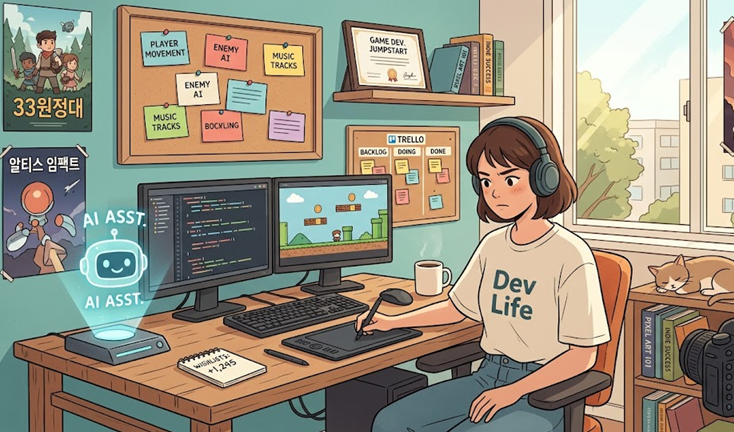
But Solo Development Is Tedious and Difficult
Technology has indeed lowered entry barriers — but that doesn’t mean it has “become easy.” The essence of solo development remains lonely, long, monotonous repetition. There are no colleagues to provide motivation, no superiors to enforce deadlines, and no team to help unblock difficult problems. Every decision is made alone, and every tedious task must be completed alone.
To endure this structural loneliness, you cannot simply start building. You must establish a much more detailed strategy. Below are four principles that make solo development sustainable.
1. Set Goals Built on Clear Genre Understanding
The most common failure in solo development happens because “there’s too much I want to make.” Trying to do everything well in a resource-limited situation quickly leads to finishing nothing.
A good starting point is a complete, precise understanding of the genre game you intend to create. You must first grasp what constitutes the core appeal of that genre, what core paying customers — beyond the mainstream audience — actually expect, and which elements provide the highest return on production investment. Only then should you narrow your development goals to what you can realistically execute.
The French studio Sandfall Interactive’s Clair Obscur: Expedition 33 was made by a core team of approximately 30 people. (The subtitle “33” reportedly derives from the development team size, suggesting how compact and focused the operation was.) What matters isn’t the headcount — it’s the discipline of selection and concentration. Rather than competing through AAA-scale volume or photorealism, they concentrated their limited resources on the clearest and most effective aesthetic concept available to them: art and soundtrack inspired by Belle Époque France, anchored by the precise genre identity of a turn-based RPG. As a result, this debut release from a new studio sold millions of copies within roughly a month and won numerous game awards.
The most common mistake among solo developers is making a “good game” or a “fun game” and then complaining when it doesn’t sell. A beautifully crafted game does not necessarily sell. To generate actual revenue, you must build a game that players cannot resist buying — and simultaneously, you must obsessively connect with a paying audience long before launch.
2. Manage the Project “Visibly” — Even Alone
The biggest reason solo developers fail to make progress is operating without clear scheduling tools, running their timeline and ideas only through their heads. That’s why, precisely because you’re working solo, you must absolutely develop the habit of visually managing tasks and progress through tools like Trello or Notion.
This isn’t just a matter of organization. First, it prevents the worst enemy of solo work: the state of “not knowing where I currently am or what remains.” Second, the act of filling boards and moving cards itself provides a sense of progress that maintains motivation. Third — and most importantly — it becomes an operational foundation that can be carried forward when you eventually add team members or expand into subsequent projects. In other words, even while working alone, you build structures that allow you to “work together eventually.”
3. Release the First Prototype Lightly — and Quickly
The idea of polishing a perfect game alone in your room for years and then unveiling it with a “ta-da!” is the most dangerous approach. The first development prototype and demo should be built lightly around the core concept and functionality, then exposed externally as quickly as possible.
Distribute it to people you know and have them play. Participate in indie exhibitions and showcases, and place your game in front of unfamiliar players. There are two things you gain from this process. One is feedback on problems you couldn’t see yourself. The other is an early market signal regarding whether “people actually find this game fun.” The earlier you receive these signals, the less time you waste pursuing the wrong directions.
4. For Narrative-Centric Games, Make the Creation Process Itself Continuously Public
Solo development of “games emphasizing story and narrative” — currently a major trend — carries particular significance in the AI era. These are areas difficult to mass-produce, where the developer’s distinctive perspective marks the work deeply.
However, this kind of game struggles to attract attention if it suddenly appears just before release. The creation process itself must become content. Exhibition participation, social media updates on production status, and early establishment of a Steam page to gradually accumulate wishlists — all of this must be conducted in parallel long before launch. Connection with users isn’t created on release day; it’s built throughout the entire development period.
Work Alone — but Don’t Become Isolated
The biggest trap of solo development is when the work itself becomes disconnected. That’s why, paradoxically, the more solo you are as a developer, the more important community activity becomes.
Sharing your work with other developers and finding points of connection becomes a channel for information, technical knowledge, and emotional support all at once. Continuously participating in online and offline events, submitting work to exhibitions, and receiving feedback while gradually expanding your goals — building this kind of flow is good. When you set your direction alone, your perspective tends to narrow. When you regularly absorb external responses, both the game and the developer grow together.
Exhibitions and showcases aren’t just venues for promotion. They are coordinates checkpoints — where solo developers regularly connect with the outside world and verify their game’s position in the market.
The era of solo development must not settle into the optimism of “I’m alone, so I can do whatever I want. I can do anything by myself now.” Tools and AI have only lowered the entry barriers; the competition has become fiercer, and the market difficulty of getting noticed has intensified.
That is precisely why what’s needed more than ever is a clear strategy for solo development.
Concentrate — Fully understand your genre and narrow your goals to the one thing you can do best with your resources.
Manage — Operate your project visibly even when working alone, building structures that can scale.
Release early — Quickly publish light prototypes to obtain feedback and market signals.
Connect — Avoid isolation through communities and exhibitions, checking your coordinates regularly.
Make public — Especially for narrative games, use the creation process itself as a point of connection with users.
Delegate — Entrust the framework to tools like RPG Maker, and spend your time on your distinctive strengths.
The persistent effort to work alone without becoming isolated. The posture required of solo developers in the AI era rests precisely on that balance.
Written and supervised by Professor Jung Musik (Associate Professor, Department of Game & Visual Art, Gachon University / Ph.D. in Engineering)
About Professor Jung Musik
Professor Jung Musik is a first-generation Korean game developer who began his career as a founding member of Trigger Soft in 1994, subsequently serving as Director at NCsoft, outside Board director at NASDAQ-listed Gravity, and Vice President at Lunosoft. Since planning and hosting Korea’s first indie game competition in 2003, he has maintained a long-term interest in and support for nurturing Korean indie games. He currently serves as a committee member(Board Director) of the Ministry of Culture, Sports and Tourism Game Rating and Administration Committee, and as Chair of the Content/Digital/Space Subcommittee on Seongnam City’s Special Committee on the Fourth Industrial Revolution, working toward the development of Korea’s gaming industry and the establishment of a healthy gaming culture.