You don’t explore the Backrooms. Your employees do. You design their routes.
A.D.D. (Anomaly Detection Department) from Korean four-person studio One More Spoon (published through Jungle Game Lab, Krafton’s developer incubator program), launches free on Steam July 31 with a premise that repositions the Backrooms from survival horror to bureaucratic management. Rather than placing the player inside the infinite liminal spaces of that urban legend, A.D.D. places them in the manager’s chair — the person responsible for running the department that sends people into the Backrooms and processes what comes back.
This is the third Jungle Game Lab project covered this month alongside No Results Found and ON&OFF, suggesting the program is producing a concentrated batch of July releases with genuinely distinct design approaches. The three games share a free price point, multi-language support, and experimental mechanic premises, but couldn’t be more different in genre and theme.
The Design Inversion
The Backrooms has been interpreted in games primarily as first-person horror: the player is lost in the liminal space, the environment is threatening, survival is the objective. The aesthetic power of the Backrooms comes from its specific atmosphere — the hum of fluorescent lights, the yellow-brown carpet, the sense of infinite identical space with no exit — and most game interpretations leverage this atmosphere through direct player immersion.
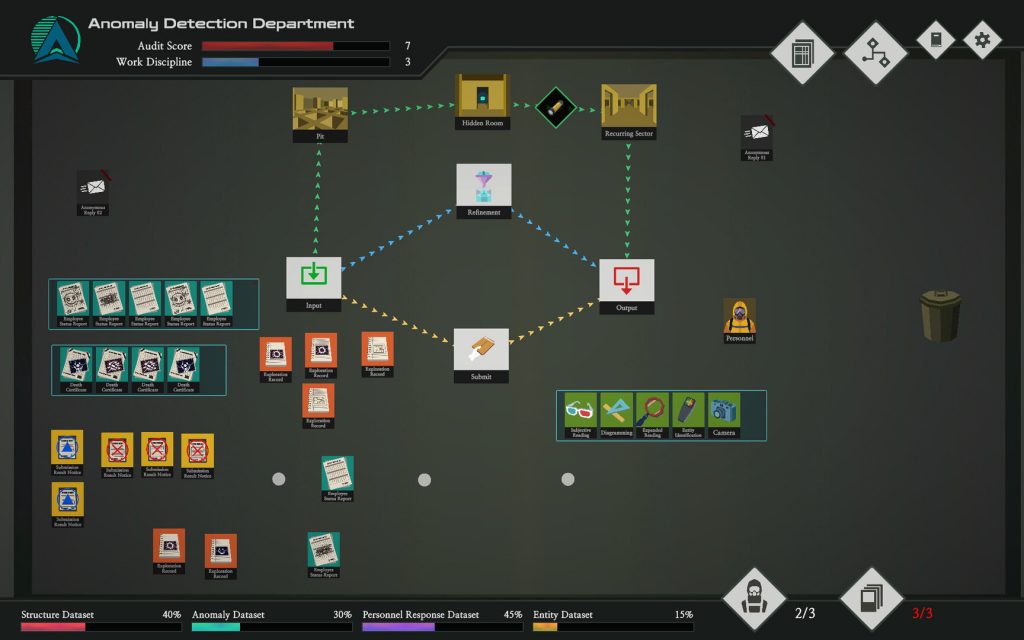
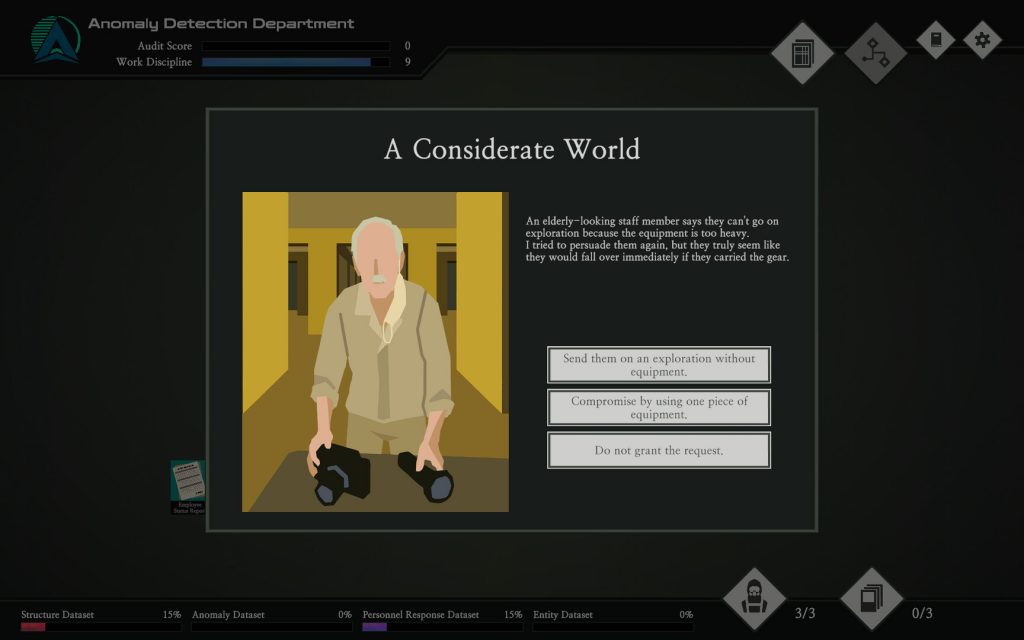
A.D.D. inverts this. The player is never inside the Backrooms; they’re outside it, managing the institutional apparatus that engages with it. This design decision produces completely different engagement with the same source material. The horror of the Backrooms in A.D.D. isn’t something the player experiences physically — it’s something the player understands through documents. The employee status report that shows “survived, psychological state: deteriorated.” The death certificate for an employee whose mission didn’t go as planned. The incident record that describes what was encountered without the player having been there.
This is the Cultist Simulator influence made explicit. That game used card-based systems and document accumulation to create a bureaucratic horror where the player assembled rituals and managed followers through abstracted card interactions, with the actual occult events communicated through text rather than shown directly. A.D.D. applies the same structural approach to Backrooms content: the supernatural is present in the documentation of its effects rather than in direct depiction.
The Stacklands influence contributes the physical card-on-table aesthetic — the 2D interface designed to look like papers spread across a desk — which reinforces the bureaucratic framing. You’re looking at the situation from the desk of someone managing it, surrounded by the physical artifacts of organizational process.
The Node Connection System
The node connection mechanic is the game’s most structurally innovative element, and it represents the “process design” approach that distinguishes A.D.D. from standard card strategy games.
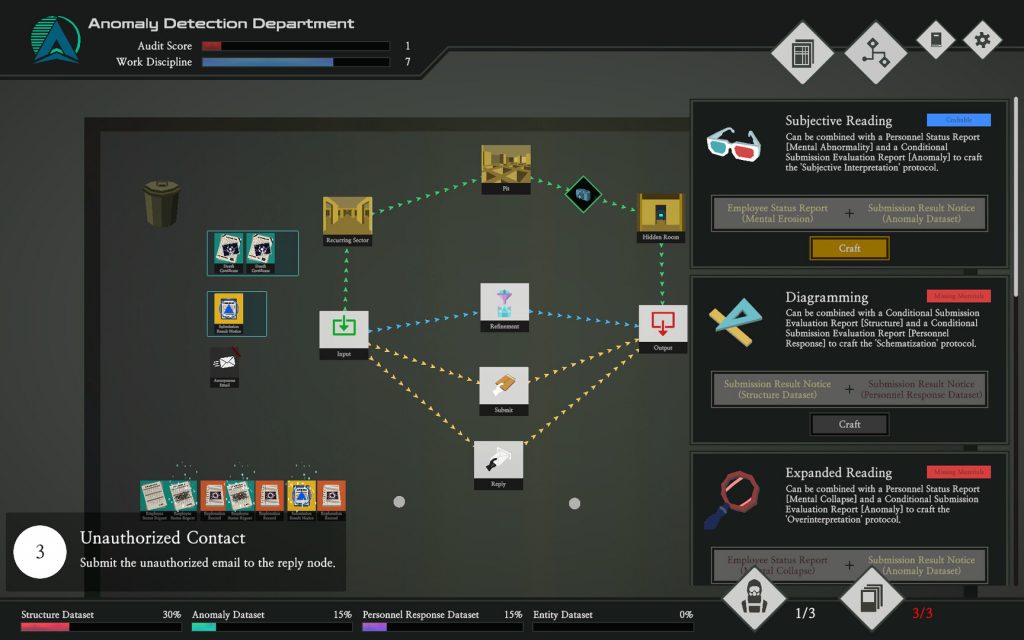
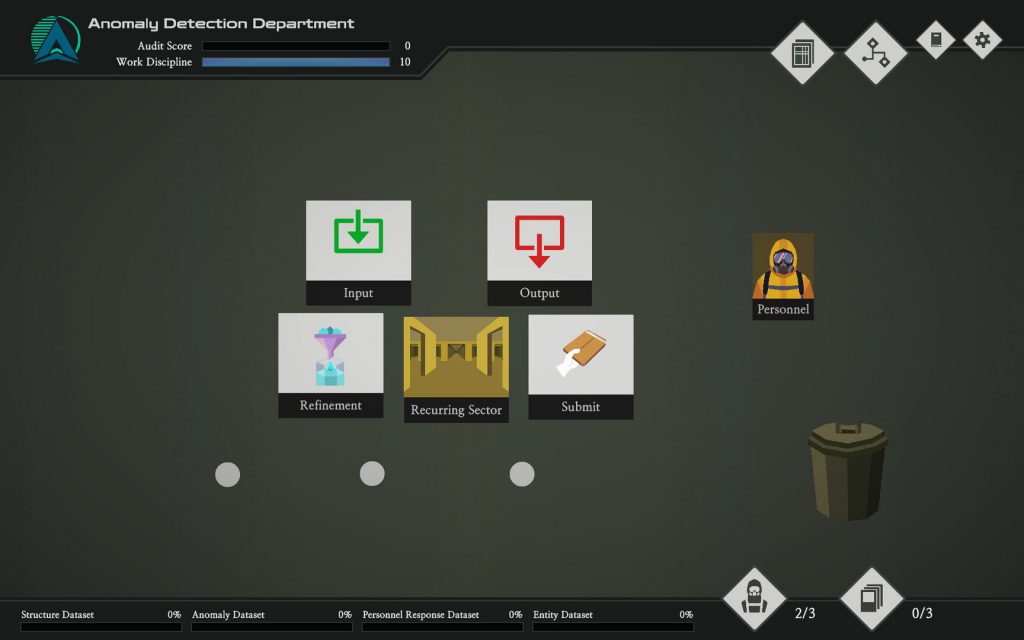
Designing a route through the Backrooms in A.D.D. means connecting nodes: Input (where employees enter), Exploration Zone (what sections they traverse), Refinement (how collected data is processed), Submission (how refined data is delivered), and Output (what comes back). The sequence of these connections determines what kind of data is gathered, what anomalies are encountered, and what resources become available for subsequent expeditions.
The Edge Block system — modifiers attached to the connections between nodes — adds the tactical layer that makes route design more than sequence selection. An Edge Block that increases data yield from an Exploration Zone also changes what threats employees face in that zone; one that accelerates movement through a section reduces encounter probability but also reduces data collection opportunity. The connections aren’t neutral pipes; they have properties that the Edge Blocks modify, and designing a route means choosing both the sequence and the properties of each connection.
This creates a spatial puzzle that is simultaneously an organizational optimization problem. The best route for maximum data yield might sacrifice employee safety; the safest route might produce insufficient data to unlock the next expedition’s resources; the route that balances both might require Edge Blocks that aren’t currently available. Each expedition is a design problem with multiple valid solutions and genuine trade-offs between competing priorities.
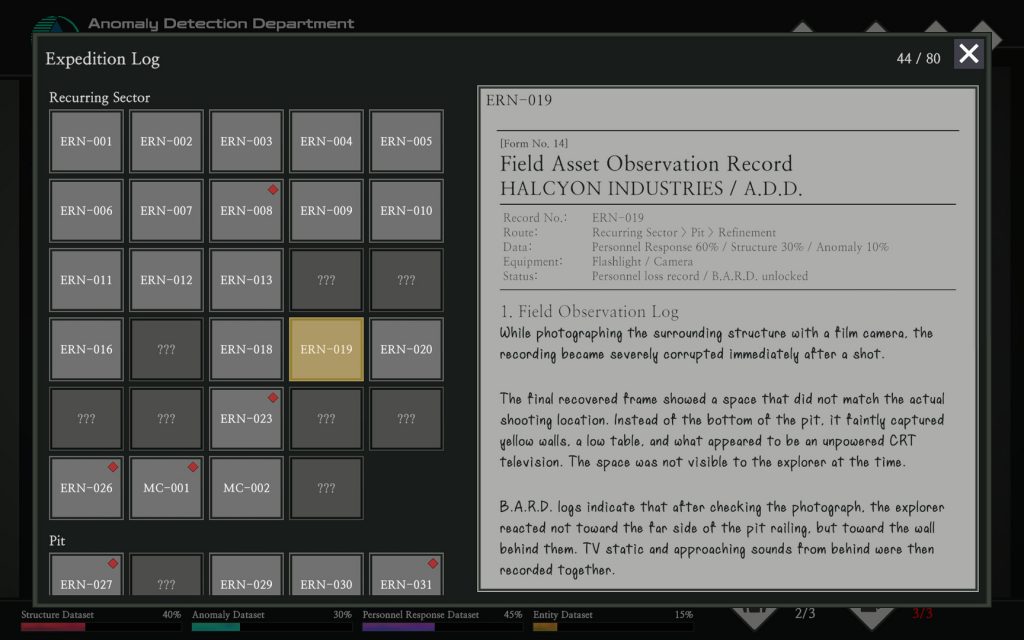
The document processing after each expedition extends the engagement beyond the route design phase. Analyzing what happened — reading the employee status report, understanding the incident records, interpreting the anomaly data — is the retrospective layer that feeds forward into subsequent route design. What the documents reveal about what happened in the Backrooms informs how you design the next expedition without the player ever having been there.
The Corporate Mystery Narrative
HALCYON INDUSTRIES as the employing company is the structural element that transforms what could be a pure puzzle game into a narrative experience with stakes. The company exists to investigate anomalies; the player manages this company’s operational department; and as investigations continue, the company’s own secrets begin surfacing alongside the Backrooms anomalies.
The specific narrative trigger — the unknown figure who approaches the player and forces a choice between the company’s position and the truth — is the conspiracy thriller structure that Papers, Please and Beholder and similar bureaucratic games use effectively. The player has been loyally serving an institutional function; learning that the institution has concealed something changes the nature of that service retrospectively.
The employee death processing mechanic is where the organizational satire sharpens. When an employee dies on a mission, the company’s regulations require processing — death certificates, incident reports, administrative follow-up. Managing a death in the Backrooms through paperwork is the specific absurdity that captures how institutions actually respond to tragedy: not with appropriate human response but with bureaucratic procedure that transforms human loss into administrative task. The player who fills out an employee death certificate efficiently is doing their institutional job correctly; what that implies about the institution is the game’s moral question.
The Backrooms setting provides the horror register that makes the bureaucratic satire land differently than it would in a purely realistic corporate setting. The anomalies and entities that employees encounter are genuinely dangerous and genuinely strange; the company’s treatment of this as manageable operational risk rather than extraordinary horror is the cognitive dissonance the game is exploiting. Managing something terrifying through institutional process normalizes the terror — which is exactly what institutions do.
The Jungle Game Lab Connection
A.D.D.‘s Jungle Game Lab publication makes it the third program graduate covered this month. The program’s pattern is becoming legible across No Results Found, ON&OFF, and A.D.D.: free price points, experimental mechanics that repurpose familiar genre structures (desktop investigation, deckbuilding, card strategy), multi-language support indicating international release ambition, and July 31 as a shared launch date for the latter two.
One More Spoon’s stated design philosophy — “create different play experiences by grafting new systems onto familiar genres” — is the same commitment that distinguishes all three Jungle Game Lab July releases. None of these games is doing what their genre conventions usually produce; each is taking a familiar structural framework and adding a mechanic that changes what engagement with that structure means.
Free distribution across all three games is the consistent publishing decision. The Jungle Game Lab appears to be using free distribution to maximize player reach for its graduates’ debut work rather than seeking revenue from small initial audiences. For games with experimental mechanics that need to build communities through word-of-mouth, this is the correct commercial strategy.
The Jungle Game Lab Connection
A.D.D.‘s Jungle Game Lab publication makes it the third program graduate covered this month. The program’s pattern is becoming legible across No Results Found, ON&OFF, and A.D.D.: free price points, experimental mechanics that repurpose familiar genre structures (desktop investigation, deckbuilding, card strategy), multi-language support indicating international release ambition, and July 31 as a shared launch date for the latter two.
One More Spoon’s stated design philosophy — “create different play experiences by grafting new systems onto familiar genres” — is the same commitment that distinguishes all three Jungle Game Lab July releases. None of these games is doing what their genre conventions usually produce; each is taking a familiar structural framework and adding a mechanic that changes what engagement with that structure means.
Free distribution across all three games is the consistent publishing decision. The Jungle Game Lab appears to be using free distribution to maximize player reach for its graduates’ debut work rather than seeking revenue from small initial audiences. For games with experimental mechanics that need to build communities through word-of-mouth, this is the correct commercial strategy.
Who This Is For
Strong fit for: Cultist Simulator fans who want its document-based mystery structure applied to Backrooms mythology; Stacklands players who enjoy the card-on-table aesthetic and want it combined with bureaucratic horror narrative; Backrooms content enthusiasts who want engagement with the mythology through management rather than survival; Papers, Please and Beholder fans who appreciate games that make institutional moral compromise their subject; players interested in experimental card mechanics beyond standard deckbuilding; Jungle Game Lab followers; Korean indie game supporters.
Cautious fit for: players who want to experience the Backrooms directly and find the indirect management approach distancing rather than interesting; card game players who want action-focused rather than deliberate strategic engagement; players who need combat or physical threat as primary engagement.
Less ideal for: players who dislike management simulation regardless of thematic framing; anyone who wants real-time action over turn-based or card-based strategy; players seeking the first-person Backrooms horror experience specifically.
What to Watch For
The primary evaluation question for A.D.D. is whether the narrative mystery sustains alongside the mechanical puzzle. Node connection route design is an interesting strategic problem, but it’s a self-contained problem — it can be engaging as pure optimization without the Backrooms context. Whether HALCYON INDUSTRIES’ corporate mystery adds narrative investment that makes the optimization feel meaningful rather than just clever will determine if A.D.D. achieves the Cultist Simulator register it’s aiming for.
The document-based revelation mechanic specifically needs the documents to contain genuinely interesting information rather than merely functional data. If the post-expedition reports are administrative noise that confirms mechanical outcomes without revealing anything about what’s actually in the Backrooms, the mystery layer fails. If they’re written with the specific quality that makes Cultist Simulator‘s texts worth reading beyond their mechanical information, the horror register lands.
The corporate narrative’s conclusion — who the unknown figure is, what HALCYON INDUSTRIES is concealing, what the choice between institutional loyalty and truth actually costs — will be the final evaluation of whether the game uses its bureaucratic structure for genuine critical purpose or as atmospheric decoration over a puzzle game.
The Takeaway
A.D.D. is a specific design idea executed through three coherent influences: the Backrooms provides the mythology and horror register; Cultist Simulator provides the document-based mystery structure where horror is communicated through administrative records rather than direct depiction; Stacklands provides the physical card-on-table aesthetic that makes the bureaucratic frame tangible. The node connection route design adds the original mechanical contribution that makes the concept specifically A.D.D.‘s own rather than derivative of its influences.
Free on Steam July 31. The employees are ready for deployment. The routes need designing. And somewhere in the incident reports and death certificates and anomaly logs that come back, the truth about what HALCYON INDUSTRIES actually is starts becoming difficult to file.
Information regarding ‘ADD (Anomaly Detection Department)’
| item | detail |
|---|---|
| Developer | One More Spoon (South Korea, 4-person development) |
| Publisher | Jungle Game Lab (Krafton Jungle Program) |
| Genre | Card-based strategy and management simulation |
| Release platform | PC (Steam, Windows) |
| Release date | July 31, 2026 |
| price | Free to Play |
| Supported languages | Korean, English, Japanese, Simplified/Traditional Chinese (5 languages) |
| core system | Node-connection-based path design, edge blocks, employee and record status management, sub-quests |
| Worldview material | Backrooms urban legend, mystery corporate narrative |
| Inspired works | Stacklands, Cultist Simulator |
| Steam Page | Shortcut |