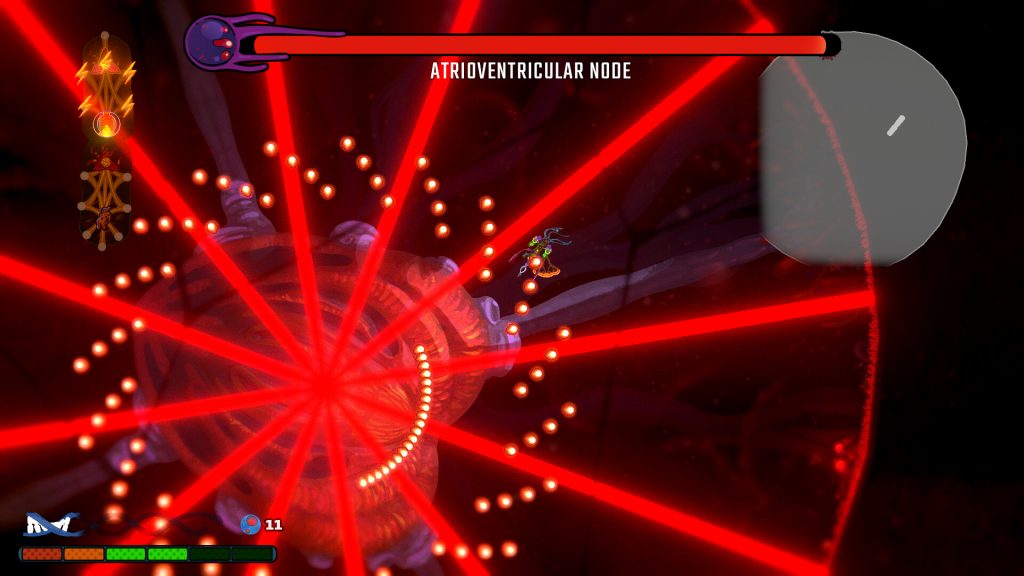
You are the disease. The immune system is the enemy. The macrophages and T-cells flooding the screen with their bullet patterns are doing their job correctly — you are the threat they exist to eliminate. And somewhere in the combination of your chosen pathogen’s traits, the organelles you’ve acquired, and the mutations you’ve accumulated, there’s an evolved form capable of reaching the final boss.
Pathogenic, from two-person studio Aberrant Labs (published by Slug Disco) launched July 16 with a 98% Very Positive Steam rating from 86 reviews — a score that follows a demo that accumulated 715 reviews at 97% positive, making it one of the more comprehensively validated indie releases of the month. PC Gamer called it “the work that best realizes the cell-stage potential that Spore never showed.” DayOne’s reviewer said they were initially drawn by the concept but stayed for “the polished gameplay loop.” These are different kinds of praise that together describe a game that earns attention both conceptually and executionally.
The Perspective Inversion
Playing as the pathogen rather than the defender is doing the same structural inversion we discussed with Ghost Keeper‘s ghost-side horror strategy — the genre shifts from “protect against” to “overcome the defense” by flipping which role the player occupies. But where Ghost Keeper‘s inversion produces dark comedy and strategic satisfaction, Pathogenic‘s inversion produces something with more biological weight.
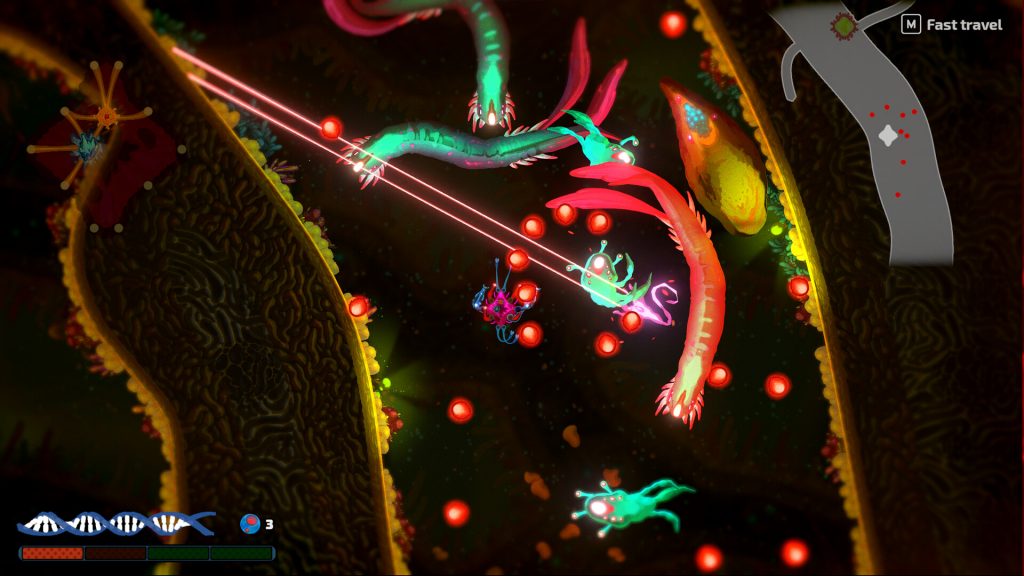
Immune system defenses in Pathogenic aren’t abstract enemies with threatening appearances; they’re cell types that exist for specific purposes that the game accurately names. Macrophages engulf pathogens as their primary biological function; T-cells coordinate adaptive immune responses; the game’s enemy design is doing educational work alongside its mechanical work. Players who complete runs understand more about how the immune response actually operates than they did before playing — not because the game lectures them, but because the enemies are accurately named and the interactions between them follow biological logic.
The seven pathogen types (inspired by real biology) extend this into player-character design. Each pathogen’s traits presumably reflect actual biological characteristics of the pathogen class it represents — different replication strategies, different host interaction modes, different vulnerabilities to immune response types. The evolutionary selection the game enacts through run progression has biological coherence rather than being purely mechanical fantasy.
PC Gamer’s Spore comparison is the most culturally resonant press assessment. Spore’s cell stage was widely considered the game’s most mechanically interesting phase — the top-down eating-and-growing gameplay that preceded the land stage — but it was also the portion that Spore spent the least development time on before transitioning to the game’s later, less successful stages. Pathogenic takes the cell-stage concept seriously as a complete game rather than as an introduction to something else.
The Soft Body Physics
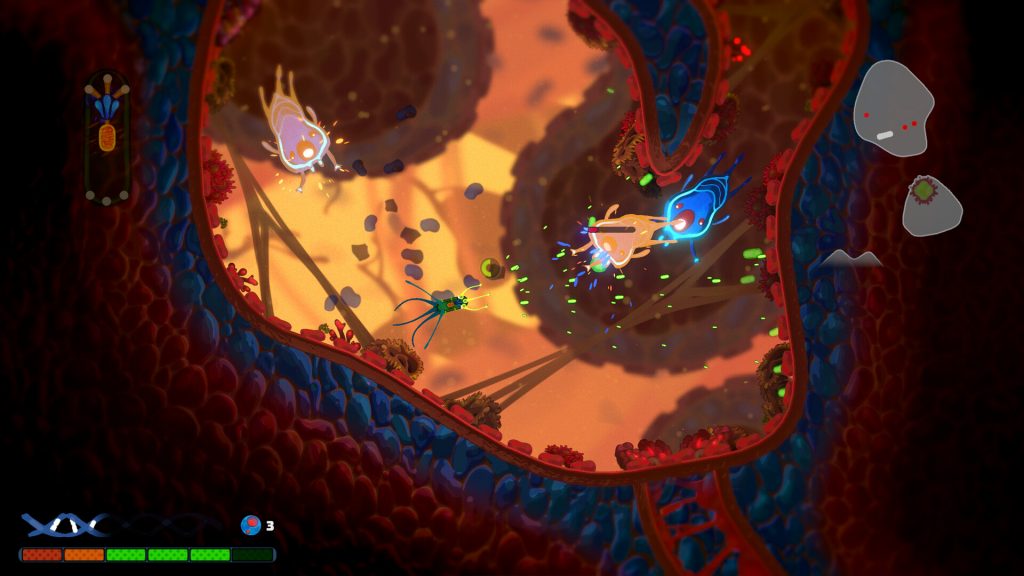
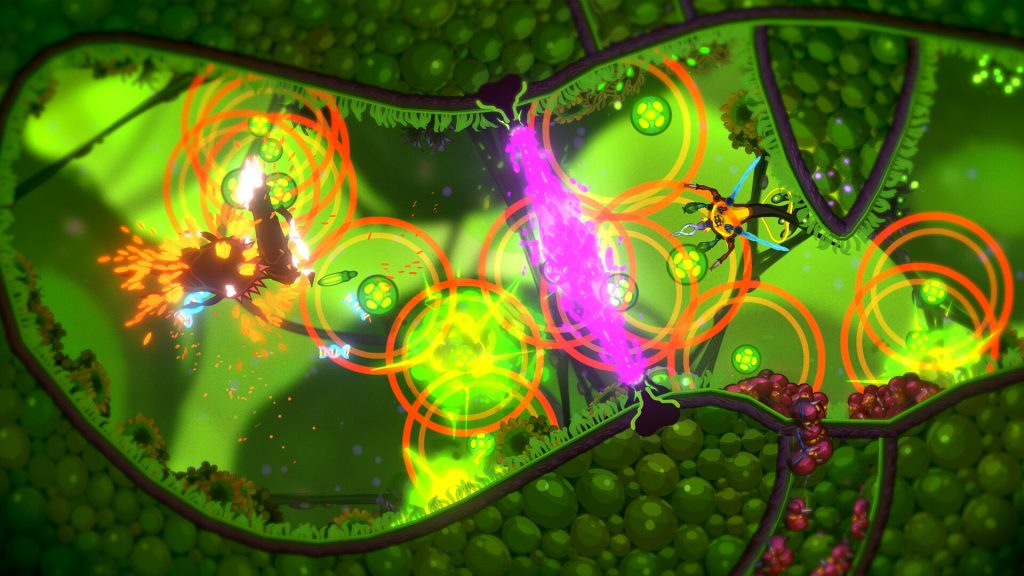
The soft body physics simulation for the game’s immune cells — described by DayOne as “immune cells implemented with an excellent squishy texture as if they’re alive” — is the visual element that most distinguishes Pathogenic from its twin-stick shooter contemporaries. Soft body physics simulates deformable objects that squish, stretch, and wobble in response to forces applied to them, which produces the specific visual quality of biological tissue rather than rigid game objects.
The practical effect is that immune cells in Pathogenic move and react in ways that feel organic rather than mechanical. A macrophage doesn’t translate rigidly across the screen; it deforms as it moves, squishes when it absorbs or is hit, behaves in ways that reinforce its identity as biological matter. This visual coherence — the simulation’s behavior matching the subject matter’s actual physical properties — creates immersion that hand-animated approximations of the same quality couldn’t achieve.
Combined with the hand-drawn microbial world aesthetic, the soft body physics produces the specific visual quality of looking at biological specimens rather than game art. The micro-world has its own visual logic, and the physics reinforces rather than contradicts that logic.


The Rhythm Integration
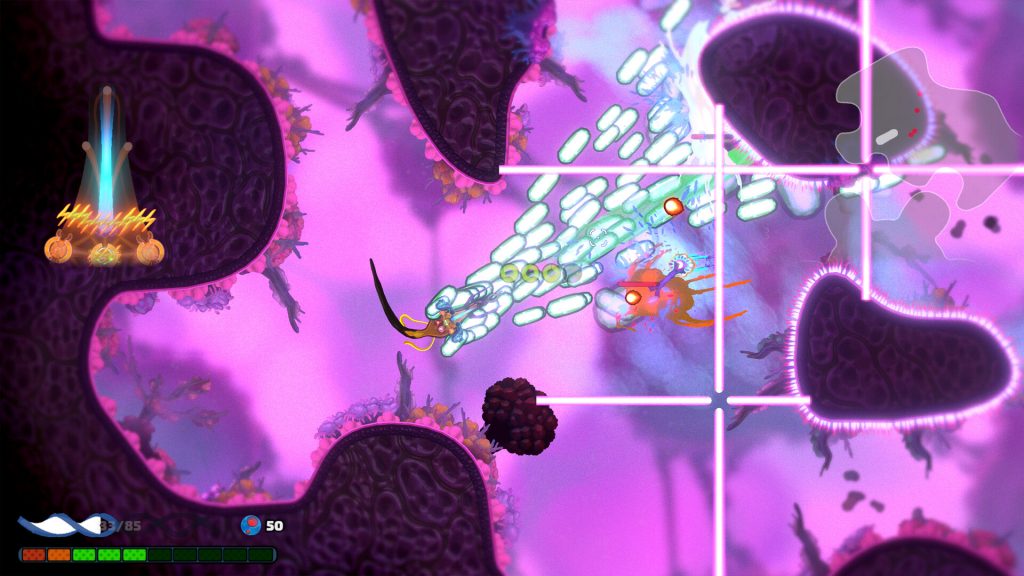
The rhythm-linked combat mechanic — attacks timed to the beat deal bonus damage — adds a precision layer to the twin-stick shooting that pure spatial skill doesn’t require. Players who internalize the soundtrack’s rhythm get rewarded for their attentiveness to audio cues alongside their spatial reaction abilities.
This integration is coherent with the game’s overall design philosophy: nothing in Pathogenic is purely decorative. The music changing stage-by-stage isn’t just atmosphere; it’s information about combat rhythm. The visual design of immune cells isn’t just aesthetic; it’s reinforcing biological identity. The rhythm bonus isn’t just a score mechanism; it’s rewarding the specific engagement with audio that the game’s soundtrack is designed to produce.
The practical implication is that Pathogenic‘s skill expression is multi-dimensional. Pure spatial skill (dodge bullet patterns, position for shots) combines with temporal skill (time attacks to the beat) and strategic skill (build pathogen mutations for synergy). Players who engage all three dimensions perform better than players who engage only one, which creates a learning curve that sustains engagement beyond the initial “understand the basics” phase.
The Procedural Level Design
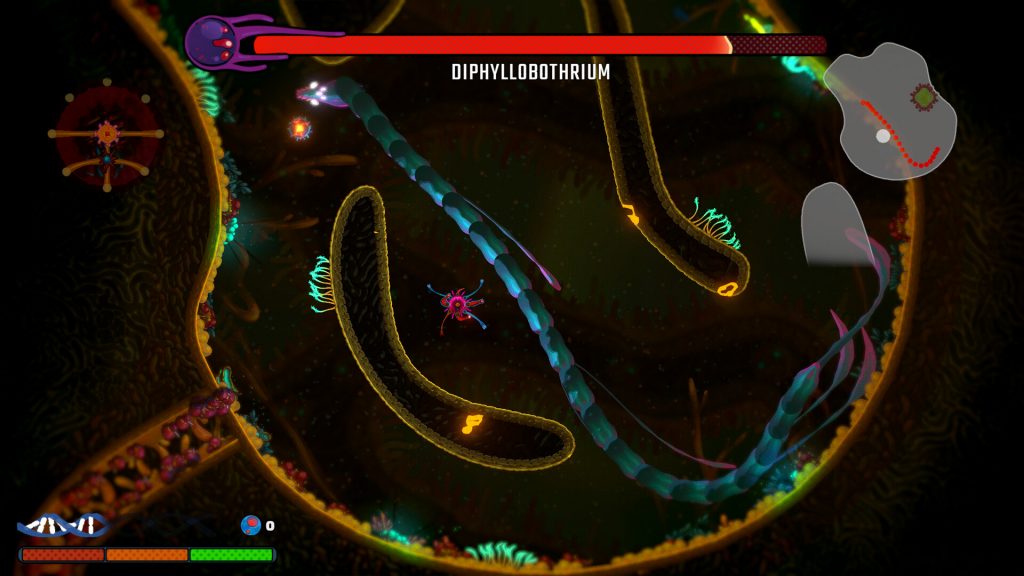
Six procedurally generated levels representing different human organs — intestines, lungs, heart, and others — provide the environmental variety that keeps runs visually and mechanically distinct. Different organs present different environmental conditions: the lung environment might feature different obstacle geometry than the intestinal environment, with corresponding effects on bullet pattern navigation and pathogen movement.
The secret level, accessible by meeting specific conditions post-boss, provides the discovery content that roguelites use to reward thorough engagement. The 15 challenge modes extend the game’s effective lifespan well beyond standard run completion, providing goal structures for players who have mastered the base experience and want specific constraints to push against.
The 120+ organelles and mutations create the built variety that roguelite replayability requires. Whether these options produce meaningfully different run experiences or primarily cosmetic variation in a functionally similar power progression will be one of the primary community evaluations as the player base grows past the initial enthusiast audience.


The Two-Person Achievement
Aberrant Labs building 7 pathogen types, 120+ organelles and mutations, 6 procedurally generated organ environments, soft body physics simulation, rhythm-integrated combat, 15 challenge modes, and Steam Deck optimization as a two-person team is the small-team scope achievement that this coverage has tracked across multiple releases this month — from Holonoptic‘s Kevin Bloch to Phantom Tower‘s Horien Studio to Grapple Bear‘s ProkischDaniel.
The 98% Steam rating specifically validates that the scope achievement is accompanied by quality achievement — the game isn’t just large for two people; it’s good. The demo’s 97% positive from 715 reviews provides the larger sample size that confirms the launch rating isn’t an artifact of a small, enthusiastic early adopter group.
The Steam Deck optimization and low-spec PC performance — frame-stable on minimal hardware, with a Fast mode and separate physics options for portable play — reflect production considerations that extend the game’s accessibility beyond players with high-end PCs. This is the kind of platform thinking that small teams often deprioritize in favor of feature development; that Aberrant Labs prioritized it suggests consideration for their actual player base rather than their ideal hardware environment.
Who This Is For
Strong fit for: twin-stick shooter enthusiasts who want thematic and mechanical substance alongside the action; biology enthusiasts and science communicators who want games that accurately engage with the subject matter they love; Spore cell-stage fans who wanted the concept fully developed into a complete game; roguelite players seeking unusual settings beyond fantasy and sci-fi conventions; rhythm game players who want their audio engagement rewarded in a different genre context; Steam Deck players who want a fully optimized portable experience; fans of Slug Disco’s publishing catalog.
Cautious fit for: players who find the “you are the pathogen” premise uncomfortable on health-association grounds; twin-stick shooter players who want larger enemy counts and simpler systems over the mutation management depth; players who prefer narrative context alongside mechanical engagement.
Less ideal for: players who dislike twin-stick shooters regardless of thematic setting; anyone who wants cooperative or competitive multiplayer; players seeking story-driven roguelites over pure mechanical depth.
What to Watch For
The 98% rating’s stability as the review sample grows from 86 toward hundreds will be the primary commercial signal in the weeks following launch. Games with small initial review samples at high positive percentages sometimes see scores settle lower as the broader audience — who engage with games differently from the enthusiast early adopters — weighs in. Whether Pathogenic maintains its rating trajectory will determine its commercial reach beyond the initial core audience.
The challenge modes’ long-term engagement potential is the other key question. Roguelites with extensive challenge content retain their communities when the challenges are genuinely novel constraints rather than difficulty adjustments. Whether Pathogenic‘s 15 challenge modes create meaningfully different play experiences will determine how long the community remains active.
The Takeaway
Pathogenic is one of July 2026’s most comprehensively validated indie releases — 715 demo reviews at 97% positive followed by launch reviews at 98% positive, with critical press response that identifies both the concept’s specific achievement (realizing Spore’s cell-stage potential as a complete game) and the execution’s specific quality (polished gameplay loop, excellent soft body physics, meaningful rhythm integration).
A two-person team built a biologically coherent microbial world, applied soft body physics to make that world visually alive, integrated rhythm mechanics into combat, and delivered performance optimization for portable hardware. The 98% rating says they got it right.
You are the disease. The macrophages are coming. And if you’ve built the right combination of organelles and timed your attacks to the beat, you might actually reach something vital.
₩10,500 with launch discount. The immune system awaits.
Information related to ‘Pathogenic’
| item | detail |
|---|---|
| Developer | Aberrant Labs (2-person development) |
| Publisher | Slug Disco |
| Genre | Roguelike Twinstick Shooter |
| Release platform | PC (Steam), Steam Deck optimization support |
| Release date | July 16, 2026 |
| price | 10,500 won (20% discount for launch) |
| Steam rating | Very Positive 98% (based on 86 reviews), Demo Stage Overwhelmingly Positive 97% (based on 715 reviews) |
| Content scale | 7 types of pathogens, over 120 types of organelles and mutations, 6 procedurally generated levels, 15 challenge modes |
| Steam Page | Shortcut |