“The fact that there is something you want to make while you are alive — that is enough.”
— Hayao Miyazaki, age 82
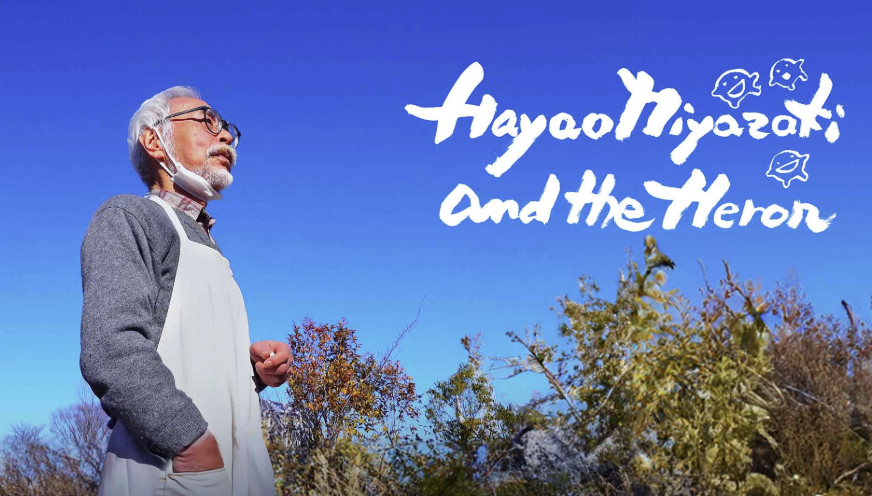
The title of the Miyazaki documentary is itself a question. Borrowed from Genzaburo Yoshino’s 1937 novel, it is the message an adult sends to a boy: whatever world comes, whatever era arrives — how will you live?
The Old Man Picked Up the Pencil Again
At a small desk in Studio Ghibli, Hayao Miyazaki — who had announced his retirement in 2013 — was showing up every morning. His back was bent, his hands not what they once were. He had returned anyway. And to those who asked why, he said simply:
“There is something I want to make.”
‘Hayao Miyazaki and The Heron‘, documented across seven years of filming, is not a record of a genius at work. It is a record of an aging man walking a painful creative path to prove he is still alive — sending off the comrades who surrounded him one by one, continuing through the grief. The camera captures him without embellishment: a master who had been doing this for decades, doubting himself, discarding work, exhausted, and sitting down again the next morning regardless.
What the documentary shows is not glory. It is suffering. And in this age of AI-driven creation — an age that we as creators have already entered whether we chose to or not — that suffering carries more meaning than it might once have.
The Romantic Lie About Creation
We have believed, for a long time, a comfortable fiction about how creativity works. The genius receives inspiration one morning, pours the work out in a torrent, and changes the world.
What the documentary captures is something else entirely. Miyazaki begins without knowing clearly what he wants to make. He stops mid-storyboard and mutters to his staff that something isn’t working. Some days, he spends the entire day at his desk and finishes not a single frame. A master with decades behind him, afraid every day like someone starting for the first time.
This is the truth about creation.
In the AI era, anyone can attempt production with relative ease. That is precisely why creation — as distinct from production — must become something more. Not the product of genius ideas, but the hard-won output of a human who has passed through difficulty. The daily confrontation with the gap between the perfect image in the mind and what the hands can actually produce. The process of narrowing that gap, slowly, imperfectly. The accumulated failures, doubts, and self-questioning that seep into the work — invisibly but permanently. When an audience is inexplicably moved by a particular scene, it is because someone’s suffering was transmitted through it in a language without words.
The Wrong Question
AI’s advancement is astonishing. Code, art, music, story — AI produces all of it faster than humans and, by certain measures, better. In game developer communities, new anxieties surface every day:
Will AI take my place? Can I make something better than AI? How much AI must I use to avoid falling behind?
These questions share an underlying premise: that we must win a competition against AI.
That premise is wrong.
When Miyazaki insisted on hand-drawn animation at the height of CGI’s dominance, it was not because he believed he could defeat CGI. In speed, efficiency, cost — digital had already won, and he knew it. He held the pencil for one reason: what he wanted to make could not be made by efficiency. It required the mark of a human who had carried something through.
The Footwork That Cannot Be Read
Wuxia fiction has a concept called bopbeop — footwork. Not simply fast movement, but a way of moving that the opponent cannot anticipate or read. The way to defeat a stronger enemy is not to become stronger than they are. It is to move in ways they cannot predict.
AI has absorbed everything humanity has made. Millions of games. Countless art styles. Validated game design patterns. AI is the most sophisticated synthesizer of what already exists. But that is simultaneously its power and its boundary.
AI can imitate sensibility, but it cannot carry emotion. It can construct narrative structure, but it cannot hold desire and suffering inside that structure.
The feeling of the first game you ever played. The handwritten letters exchanged with a first love. The faint familiar smell of your grandmother’s hands. The warmth of home after a long journey. The excitement of an unexpected encounter at a rain-soaked bus stop with someone whose face you liked. All of these, tangled together, have built the world that is specifically, irreducibly yours — a world that AI will never possess. Human feeling, human desire, human suffering — the desire produces the pain, and the pain produces the work.
This is the footwork we must claim as our own.
How Shall the Indie Developer Live?
Near the end of the documentary, Miyazaki says that The Boy and the Heron was made for himself. His sins and deficiencies. The memories of not being the father his son needed him to be. The memory of war. The guilt of a survivor. He tried to put all of it inside.
And at the end — after seven years, after the completion of the work he had poured himself into — he said:
“I still don’t know. Whether it turned out well.”
An 82-year-old master, making for the first time his most personal story. Knowing it might be his last. Quietly climbing a staircase of broken glass, day after day, until it was done.
I watched all of that, and then I found myself returning the question to myself — and to you, whoever is reading this.
How shall we, as indie developers, live? And how, precisely, are we living today?
By Professor Jung Musik
Department of Game and Visual Studies, Gachon University / Doctor of Game Engineering
Founder of Indiegame.com
Professor Jung Musik is an Associate Professor in the Department of Game and Visual Studies at Gachon University and holds a doctorate in engineering. He was a founding member of Trigger Soft in 1994 and has since served as Director at NCSoft, outside director at NASDAQ-listed Gravity, and Vice President of Lunosoft. He organized Korea’s first indie game contest in 2003 and has supported the domestic indie game ecosystem for more than two decades. He currently serves as a member of the Korea Game Rating and Administration Committee under the Ministry of Culture, Sports and Tourism, and as chair of the Content/Digital/Space division of Seongnam City’s Fourth Industrial Revolution Special Committee.