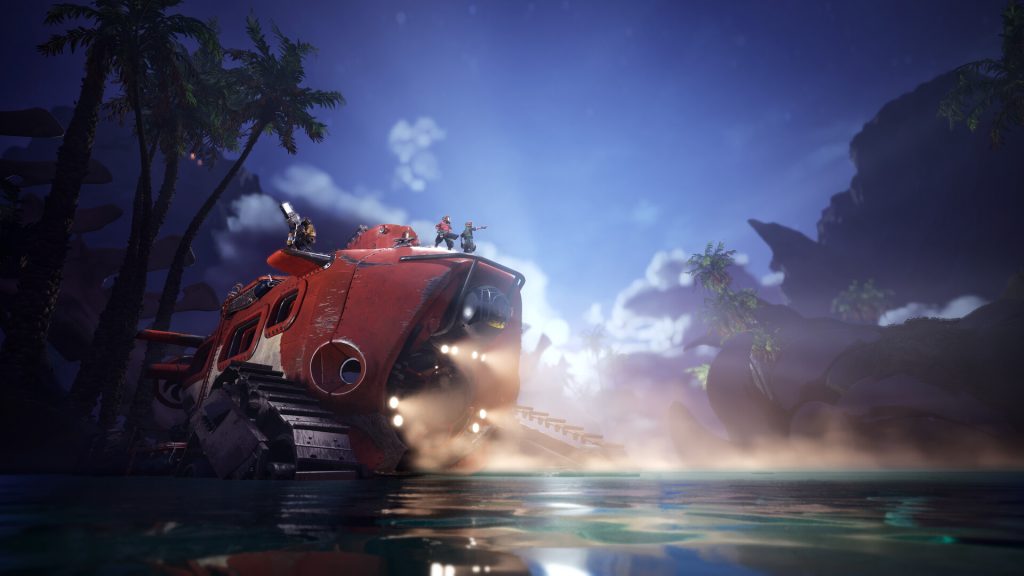
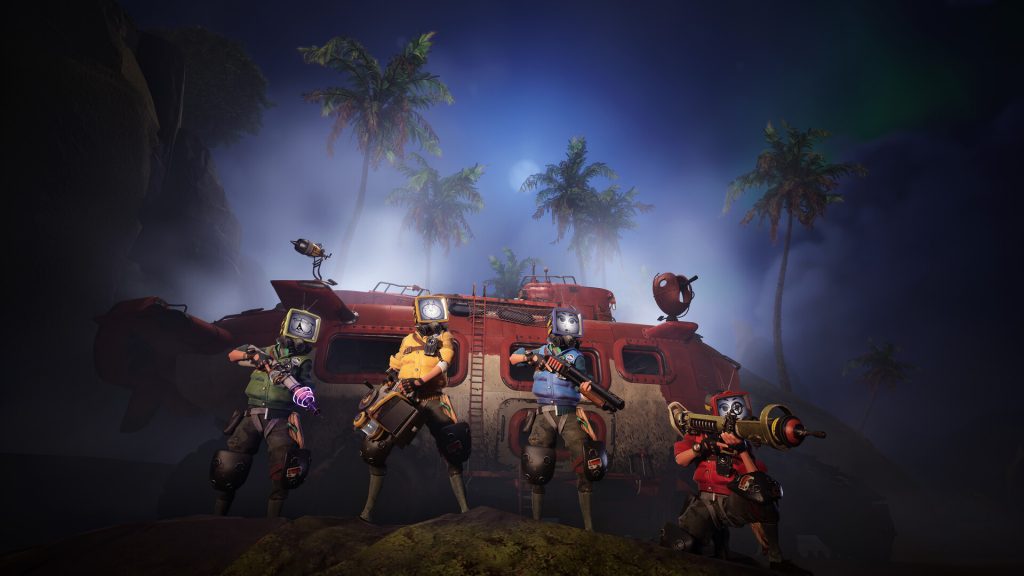
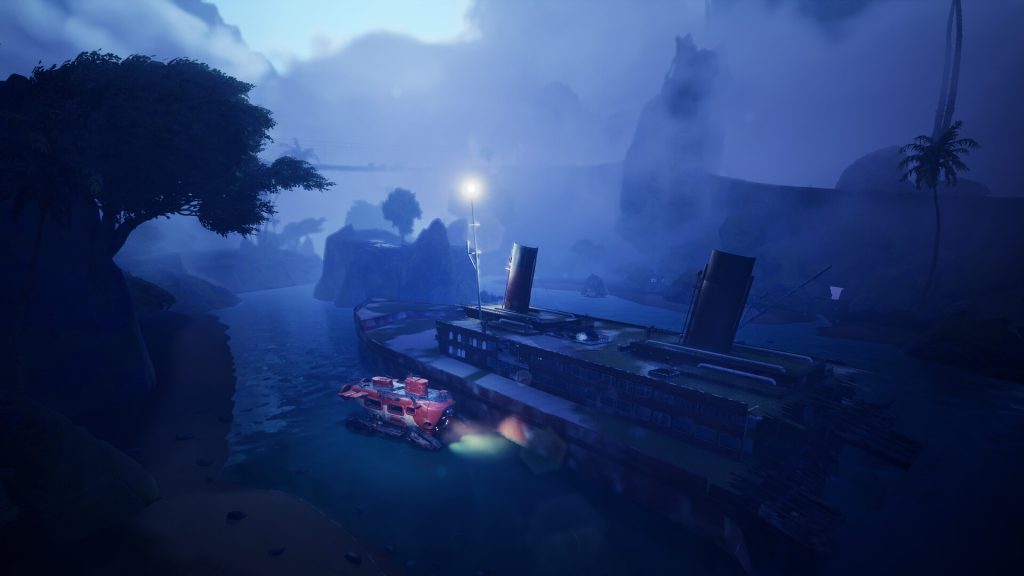
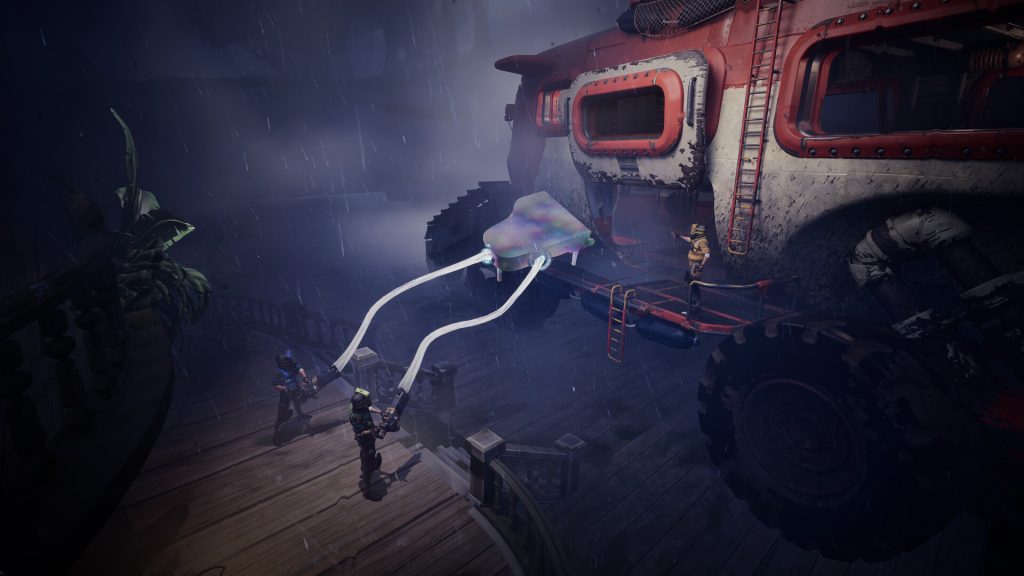
The Bermuda Triangle has a new employer. Trustwell Corporation — mysterious, well-funded, and unconcerned with the supernatural hazards of the region — needs a crew of up to four to retrieve valuable cargo from the fog-covered waters and islands of the Triangle. The cargo is heavy and fragile. The ORCA multipurpose vehicle handles ground, sea, and air. The Scrapjack grappling tool pulls loot and teammates with equal enthusiasm. And the physics engine that governs all interactions between these elements, the environment, and the crew will generate situations that no scriptwriter could have anticipated.
Wreck Runners from Oakland-based Disruptive Games launched July 16 simultaneously across PC, Xbox Series X|S, and PlayStation 5. The studio’s founding pedigree — Diablo II: Resurrected, Tony Hawk’s Pro Skater 1+2, Insomniac Games, LucasArts — represents a specific kind of AAA veteran: developers who have shipped technically sophisticated games with strong physics and feel, and who founded an indie studio to make something they specifically wanted to exist rather than something a publisher’s roadmap required.
The Physics-First Design Philosophy
The most important thing to understand about Wreck Runners is what Disruptive Games has explicitly chosen not to build: scripted events. The team describes their design focus as generating situations from physics interactions and player cooperation rather than pre-authored set pieces. This is a meaningful design commitment, not a marketing phrase.
Scripted events in co-op games are reliable in the sense that they always happen the same way — the bridge always collapses at the same moment, the enemy always appears from the same direction, the dramatic escalation is authored and tested to produce the intended effect. The predictability is both the feature and the limitation: the event is guaranteed to be interesting, and guaranteed to be the same the second time, the third time, the tenth time.
Physics-based emergence produces different qualities. The situations that arise from four players trying to move a heavy, fragile piece of cargo using a vehicle that responds to real weight distribution and momentum, through terrain with actual slopes and obstacles, with weather that affects handling and visibility — these situations are generated rather than authored. They’re different every time because the variables that produce them (exact positioning, exact timing, exact player decisions) are never the same. The crew that drops the cargo because someone applied too much thrust at the wrong moment experienced something that no designer wrote; the crew that discovers their teammate can be Scrapjacked to safety across a gap that seemed uncrossable is improvising a solution that the physics system made possible without anyone having specifically intended it.
The risk of this design philosophy is that it requires the physics system to be robust enough and the scenario design to be varied enough that interesting situations arise reliably rather than occasionally. A physics-emergent co-op game where the interesting moments are rare produces tedium between the memorable incidents; one where interesting moments arise constantly produces the experience of playing a game where anything can happen, which is the specific feeling Disruptive Games is building toward.
The Bermuda Triangle Setting
The Bermuda Triangle is a better setting for this kind of game than it first appears. The real-world mythology of the Triangle — unexplained disappearances, compass failures, unusual atmospheric phenomena, the specific cultural weight of ships and aircraft that vanished without explanation — gives the supernatural threats of the game’s world a referential foundation that players bring to the experience without the game needing to establish it.
The Fog (The Fog), as the environmental modifier that covers the Triangle, captures this mythology mechanically. Dense fog in a physics-based co-op game isn’t just an atmospheric visual choice; it’s a visibility constraint that changes how players coordinate. You can see your immediate surroundings but not the full picture; you know the ORCA is somewhere but can’t see exactly where; you have to communicate verbally about what you’re encountering in ways that clear visibility doesn’t require. The supernatural fog of the Bermuda Triangle becomes a game system that promotes the communication and coordination that co-op extraction games depend on.
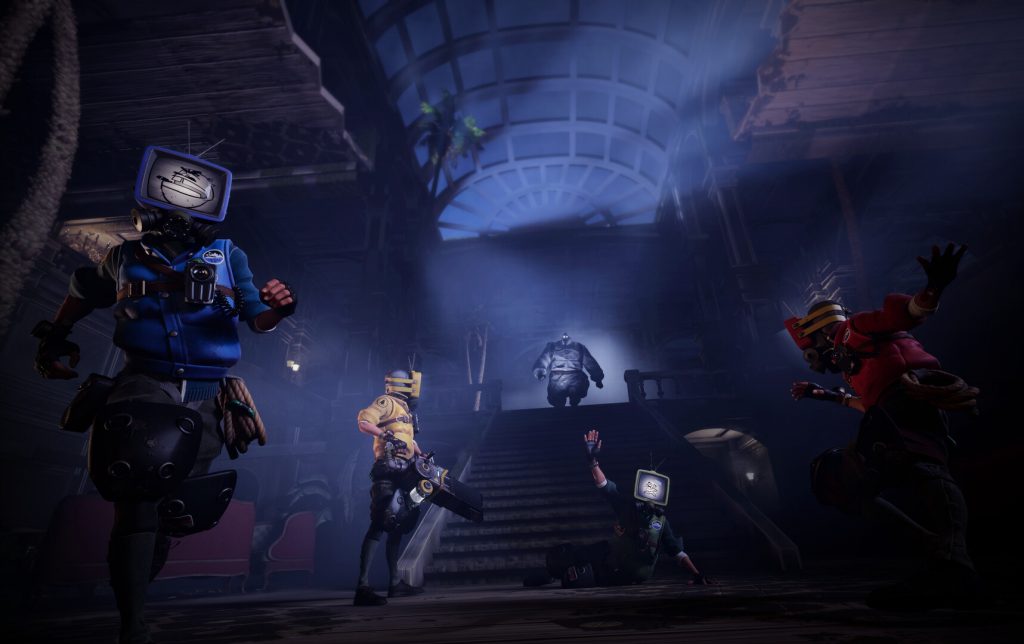
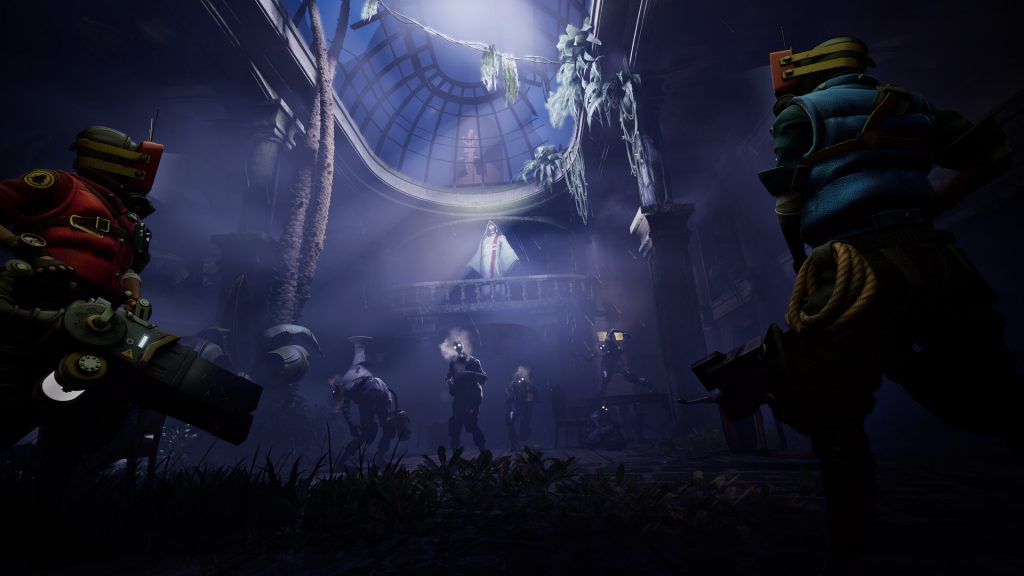
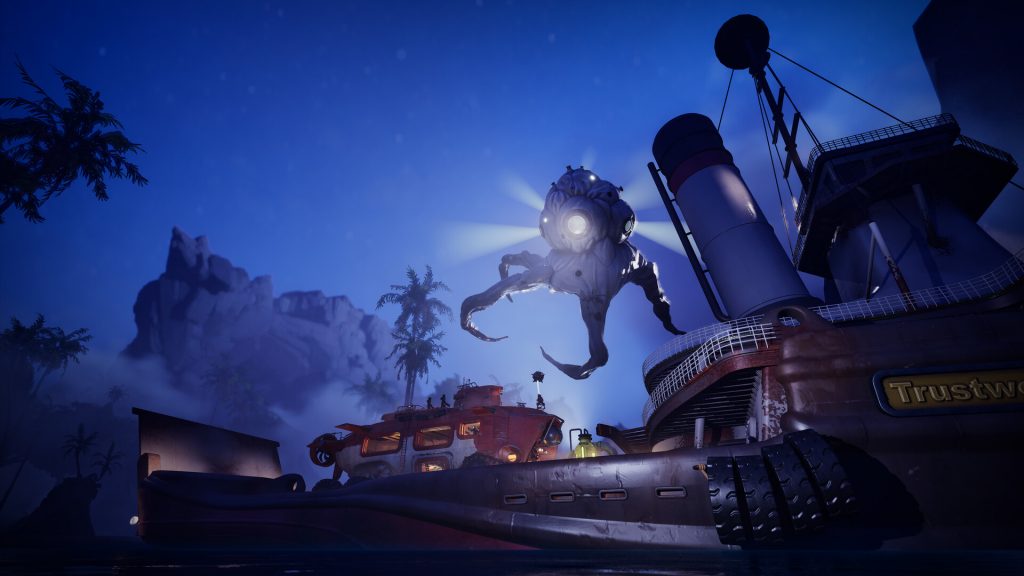
The setting’s visual variety — shipwrecks, abandoned facilities, ancient ruins, supernatural anomalies — provides the environmental diversity that keeps exploration interesting across multiple runs. Different extraction sites present different terrain challenges, different cargo retrieval configurations, and different threats from the Fog’s inhabitants: the mysterious creatures and “presences reminiscent of lost pilots” that occupy the Triangle alongside the environmental hazards.
Trustwell Corporation, as the employer, is the correct cynical framing. The corporation that sends crews into the supernatural Bermuda Triangle to retrieve cargo without explaining what that cargo is, or why it’s in the Triangle, or what the anomalies actually are — this is the satirical corporate horror that co-op extraction games deploy effectively. The crew is expendable labor; the cargo is what matters; the players have signed up for exactly the worst possible paid vacation.
The ORCA and Scrapjack System
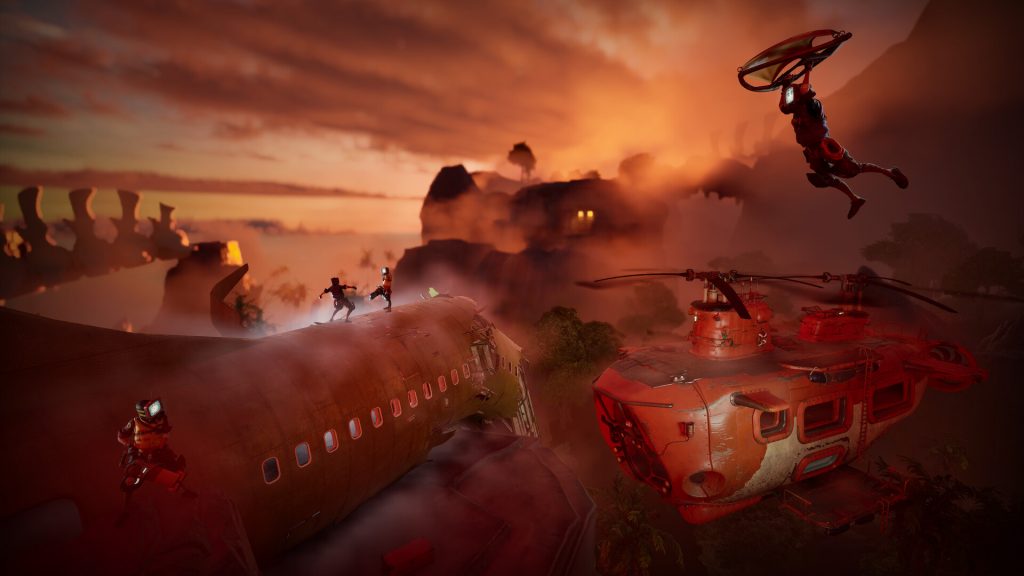
The ORCA multipurpose vehicle’s ground-sea-air mobility is the core traversal system that shapes how the Bermuda Triangle’s varied terrain is navigated. A vehicle that can transition between movement modes has different strategic implications than a fixed-mode vehicle — certain areas might be most efficiently accessed from the air, certain cargo retrieval might require sea-level positioning, certain extractions might demand ground movement for stability.
The physics simulation of a multi-mode vehicle carrying heavy cargo creates the specific moment-to-moment challenge that makes Wreck Runners different from extraction games that use simplified inventory systems. Weight matters. Balance matters. Momentum matters. Putting a heavy piece of cargo on the ORCA changes how it handles; shifting that cargo’s position on the vehicle changes it further; a sudden weather event that affects visibility and control while you’re managing heavy cargo adds the third variable that pushes even coordinated crews to their limits.
The Scrapjack is doing multiple things simultaneously. As a cargo retrieval tool, it’s the mechanism that physically extends the crew’s reach into spaces the ORCA can’t access — pulling items across gaps, drawing cargo to loading positions, extending the retrieval radius. As a teammate rescue tool, it’s the mechanism that prevents individual failures from becoming run failures — a crew member who goes overboard, who is pinned by cargo, or who is positioned wrong for the extraction can be pulled to safety rather than becoming a lost cause.
The Scrapjack’s dual function also creates the co-op comedy and crises that make these moments memorable. The person who Scrapjacks a teammate to safety moments before they would have lost their grip is a hero; the person who Scrapjacks a teammate into a worse position by misjudging the pull vector has created a problem that now requires another solution. Both outcomes are stories.
The Studio Pedigree
The specific combination of games that Disruptive Games’ founding team worked on is revealing. Diablo II: Resurrected required recreating the feel of 2000-era action RPG combat in a modern technical framework — a project entirely about preserving the tactile satisfaction of movement and combat systems that players remembered. Tony Hawk’s Pro Skater 1+2 required similar fidelity to the specific feel of skating physics that defined those games’ identity. Both projects demanded a deep understanding of what makes physical interaction feel right rather than merely function correctly.
Insomniac Games’ backgrounds bring experience with games that specifically excel at physicality — Spider-Man‘s traversal, Ratchet & Clank‘s movement — and LucasArts alumni bring experience with comedic physical interaction and adventure game design sensibility. The studio’s founding teams aren’t veterans of any game; they’re veterans of specific games that share a common emphasis on how physical interaction feels.
This background makes Wreck Runners‘ physics-first design philosophy legible as a deliberate career choice rather than a limitation. These are people who know how to build physical systems that feel satisfying, who chose to found an indie studio specifically to build a game where those systems are the core product rather than supporting infrastructure.
The Mixed Demo Reception
The 60% positive demo rating (20 reviews) and the playtest’s Mixed reception deserve honest examination. A 60% positive rating from 20 reviews is a small and mixed sample — insufficient to draw strong conclusions, but also a signal that the experience isn’t universally immediately compelling.
The nature of physics-based co-op games creates specific evaluation challenges. Playing alone or with random players who aren’t communicating is a fundamentally different experience from playing with a coordinated friend group. The physics emergence that produces memorable moments with four communicating players who share context and humor can produce confusing frustration with players who don’t know each other and can’t coordinate effectively. The emergent situations require interpretive context — “that was hilarious because we all tried the wrong solution simultaneously and it made everything worse” requires participants who agree it was hilarious rather than just frustrating.
The post-launch user comments that the “game is really fun” alongside the Mixed demo rating suggest the demo experience and the full launch experience are different in ways that matter — possibly that the demo doesn’t adequately represent the full experience, or that the game specifically requires the right social context to land well. The Linux compatibility issue affecting some users is a technical problem separate from this, representing a specific platform failure rather than a design evaluation.
The honest assessment is that Wreck Runners is a game whose appeal is heavily dependent on who you play with. The physics-emergent comedy that defines the experience at its best requires participants who are in it together — who find the cargo dropping into the ocean as funny as they find it frustrating, who communicate about what’s happening and collaborate on increasingly creative solutions to the problems the physics system generates. With the right crew, the Bermuda Triangle setting and Trustwell’s mysterious cargo create exactly the kind of sessions that generate stories worth retelling. Without that crew, the same physics system produces different experiences.
Who This Is For
Strong fit for: established friend groups looking for a new co-op extraction experience with genuine physics comedy; players who specifically enjoyed the emergent chaos of Lethal Company or Overcooked and want similar dynamics in an extraction framework; fans of Disruptive Games’ founding team’s previous work who want to see what they build with full creative control; players who enjoy the specific tension of precious cargo that can be damaged in transit; crossplay households where friends play across PC and console.
Cautious fit for: solo players or players without established co-op networks (the physics emergence requires social context to land well); players who want consistently reliable, scripted experience rather than emergent variability; players who find chaotic physics comedy frustrating rather than funny.
Less ideal for: players seeking narrative-driven experiences; anyone who wants precise inventory management over physical cargo handling; players who need high review scores as a confidence threshold before purchasing.
What to Watch For
The long-term question for Wreck Runners is content expansion. Physics-emergent co-op games sustain their communities through new environments, new cargo types, new hazards, and new tools that generate different emergent situations rather than more of the same ones. The Bermuda Triangle setting has inherent content flexibility — different regions of the Triangle, different supernatural phenomena, different Trustwell cargo with different physical properties — but how quickly and substantially Disruptive Games delivers this content post-launch will determine whether the player base remains engaged or disperses.
The Linux compatibility issue needs resolution. A game that launches with platform-specific visual failures on an acknowledged PC platform tells players on that platform that their experience is second-tier, which affects both their current engagement and their willingness to recommend the game to others.
The Mixed demo rating’s relationship to the positive post-launch reception is worth monitoring. If the 60% demo rating reflects a demo that inadequately represents the full experience, post-launch reviews should trend upward as players encounter the complete game rather than the preview. If the divergence between demo and launch sentiment reflects social context dependence rather than content difference, the review pattern will be more variable — higher from players with good co-op groups, lower from players who engaged alone or with poorly coordinated groups.
The Takeaway
Wreck Runners is a bet on emergent physics comedy as the primary entertainment product — a game where the situations the physics system generates with four players are more interesting than any scripted event the developers could have authored. The Bermuda Triangle setting, the ORCA multipurpose vehicle, the Scrapjack dual-function tool, and the heavy, fragile cargo that requires coordination to retrieve are all systems designed to create the conditions for these situations rather than to direct players through predetermined experiences.
The pedigree of the founding team — Diablo II: Resurrected, Tony Hawk, Insomniac, LucasArts — represents developers who understand physical interaction deeply and have chosen to build something where that understanding is the entire product. The Mixed demo reception and positive post-launch sentiment together suggest the experience lands differently depending on who’s playing and how — which is exactly what you’d expect from a game that depends on social context for its best moments.
Trustwell needs the cargo. The Triangle doesn’t give things up easily. The Scrapjack can reach things the ORCA can’t. And somewhere between the physics-driven chaos of four people trying to move something heavy through fog-covered supernatural terrain and the moment when they actually get it on the extraction vessel, there’s the specific kind of fun that you can’t script.
Available now on PC, Xbox Series X|S, and PS5. Crossplay supported. Bring a crew.
Information regarding ‘Wreck Runners’
| item | detail |
|---|---|
| Developer | Disruptive Games (Oakland, California, USA) |
| Publisher | Disruptive Games (Self-publishing) |
| Genre | Co-op Extraction Looter / Physics-based Multiplayer |
| Release platform | PC (Steam), Xbox Series X |
| Release date | July 16, 2026 |
| personnel | Up to 4 players co-op |
| Demo Review | Mixed, 60% positive (20 cases) |
| Crossplay | backup |
| Steam Page | Shortcut |