Story Beat the Specs:
What Indie Games Won at GDCA 2026
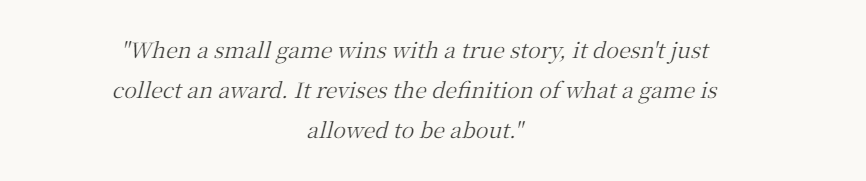
Blue Prince. And Roger. Consume Me. Three small-team titles walked away from the 26th Game Developers’ Choice Awards with hardware that typically belongs to hundred-million-dollar productions. This is not a story about upsets — it’s a story about a medium finally learning to speak its own language.
The AAA Plateau and the Indie Opening
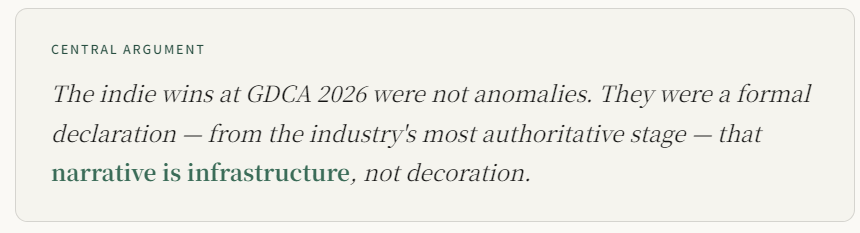
By the mid-2020s, the AAA arms race had reached diminishing returns. The delta between “good-looking” and “extraordinary-looking” had narrowed to a margin most players couldn’t consciously perceive. When the visual frontier flattens, something else has to carry the weight of desire — and that something turned out to be story.
The indie scene had been building in this direction for years. What changed in 2026 was institutional recognition. The GDCA’s Innovation and Social Impact categories grew in prestige, and the Audience Award became a direct measure of emotional reach rather than technical achievement. The result: small teams with sharp ideas and honest stories entered rooms that capital alone used to own.

Reinventing the Space-Distorting Puzzle — ‘Blue Prince’ Wins Two Awards
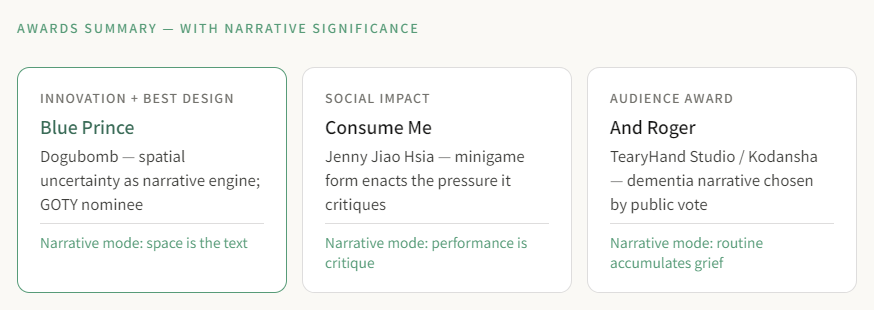
The puzzle adventure ‘Blue Prince’, developed by Dogubomb, won both the Innovation Award and Best Design at GDCA 2026, achieving the greatest success in the indie category.
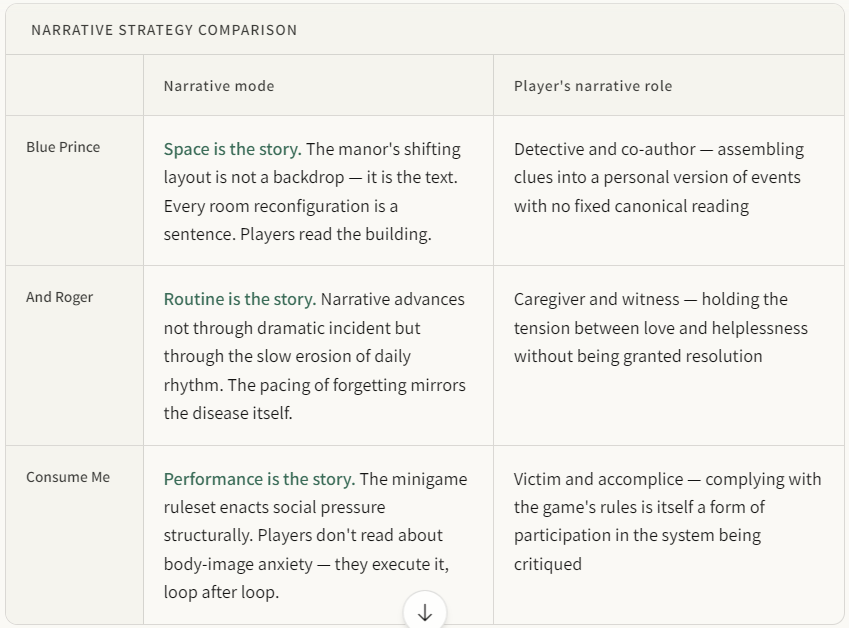
The core of the game is ‘fluid space.’ In a mansion where the layout of rooms is rearranged with every exploration, players track clues relying on logic and observation rather than a fixed map. The judging panel highly praised the game, stating, “The design is outstanding, completely subverting conventional spatial exploration methods and demanding constant creative thinking from the player.”
Steam: https://store.steampowered.com/app/1569580/Blue_Prince/
A heart-wrenching narrative, the power of narrative — ‘And Roger’ and ‘Consume Me’
Two indie games that shone in a different way than technical perfection were also recorded as important winners at GDCA 2026.
“And Roger,” developed by TearyHand Studio (Japan) and published by Kodansha, captures the daily lives of dementia patients and their families as a narrative adventure. It won the Audience Award, where the winner is determined by direct public voting, confirming that it received overwhelming empathy and support.
Steam: https://store.steampowered.com/app/3308870/and_Roger/
“Consume Me,” a work by independent developer Jenny Jiao Hsia, is an experimental title that explores the psychological pressures and emotions of adolescence through the format of mini-games. By winning the GDCA Social Impact award, it once again demonstrated the potential of games as a medium for delivering social messages.
Steam: https://store.steampowered.com/app/2359120/Consume_Me/
How Each Game Chose to Tell Its Story
Blue Prince, And Roger, and Consume Me share one foundational choice: none of them tells you their story. They make you live it. The mechanisms differ radically — but the philosophy is the same.
Commentary: Prof. Jung Mu-sik
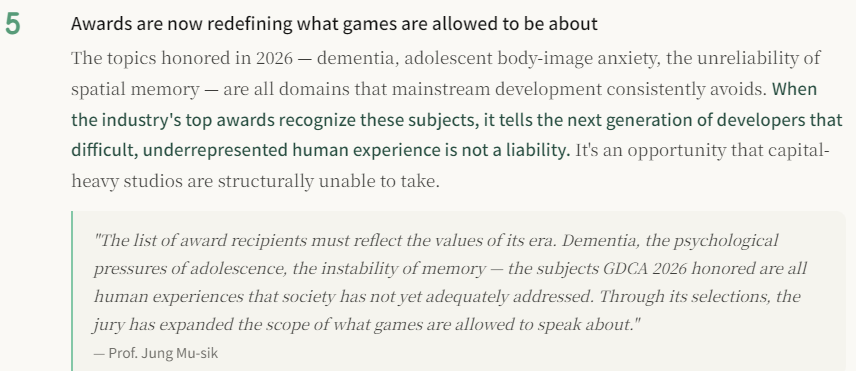
Professor Jung, who has served as a juror and mentor in the independent game community for many years, identified five distinct meanings in this year’s GDCA results — each speaking directly to the structural shift underway in how games are made, evaluated, and remembered.
Five Meanings Behind the Wins
The following analysis draws directly from Professor Jung’s commentary, which he developed in response to the full pattern of this year’s results — not individual titles, but what the awards collectively declare about the direction of the medium.
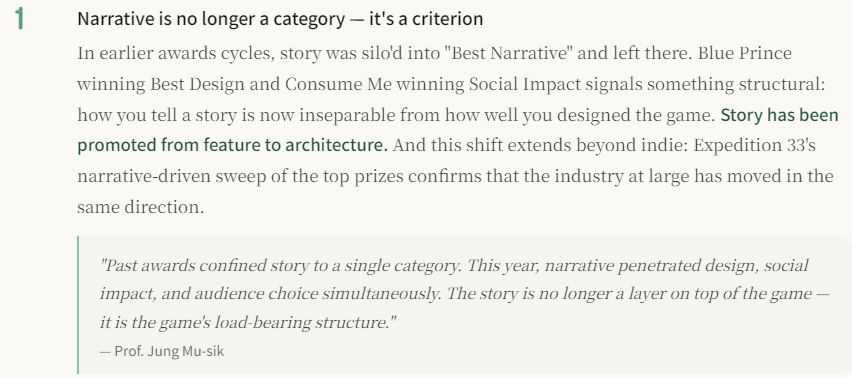
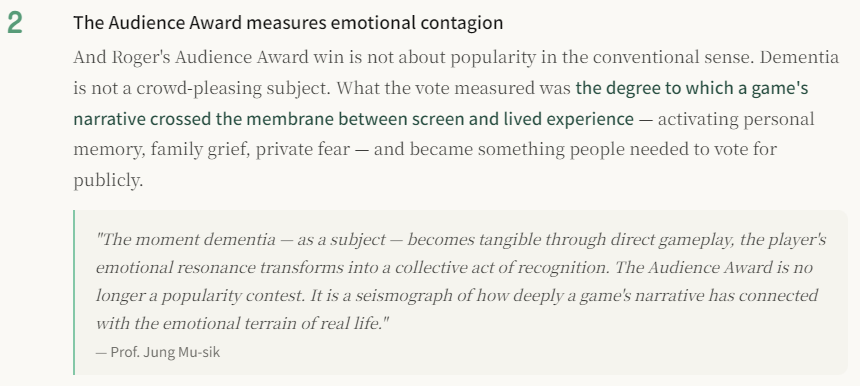
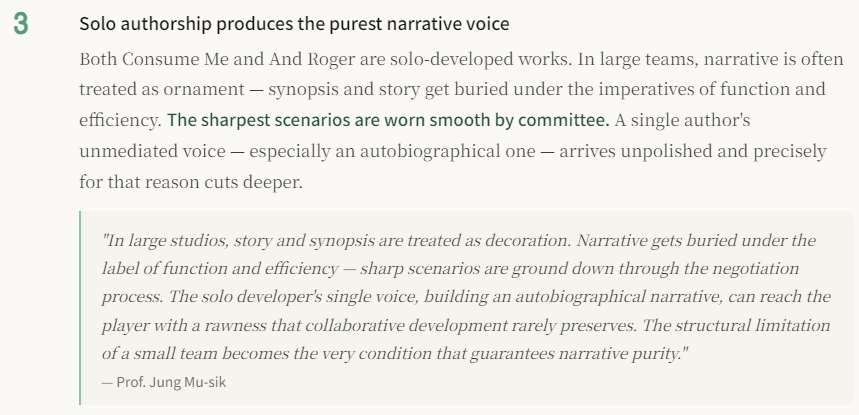
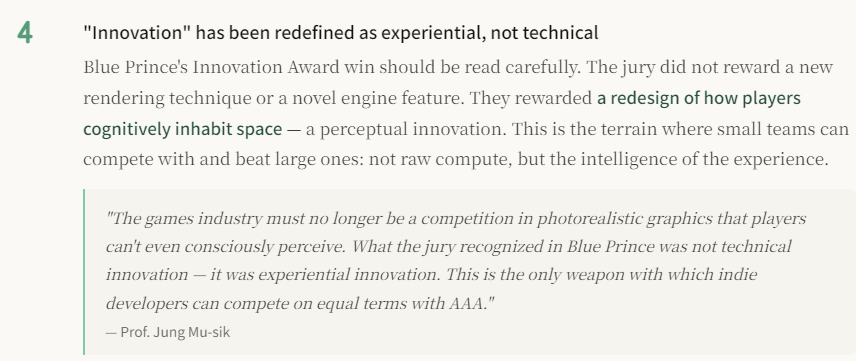
Principles shared across all three award-winning titles
- Embed the story in the mechanic (Embedded Narrative). Don’t narrate — enact. Blue Prince’s shifting rooms don’t describe mystery; they are mysterious. Consume Me’s loops don’t explain pressure; they apply it. If your story could be told just as effectively as a short film, you haven’t found the game yet. The story should become unplayable if you remove the mechanic.
- Lower the empathy threshold (Low Threshold Empathy). And Roger chose a subject — the slow disappearance of a person you love — that requires no onboarding. Players arrive already knowing the fear. When your starting emotion is one the player has already lived, you skip the first act of persuasion entirely. Identify the universal fear nearest to your story’s core.
- Make players complicit (Complicit Design). The most durable narrative experiences leave players questioning their own behavior inside the game. In Consume Me, following the rules implicates you. Design moments where the player realizes they’ve been participating in the thing being critiqued. That dissonance — recognized after the fact — is what gets talked about for years.
- Pace narrative like breathing (Narrative Pacing as Breath). None of the three winners sustains peak emotional intensity. They alternate pressure with stillness — routine, silence, repetition — and let feeling accumulate rather than spike. The dramatic moment lands harder because of the quiet that preceded it. Emotional rhythm matters more than emotional amplitude.
- Leave the question open (Open Resonance). Blue Prince’s mystery, And Roger’s farewell, Consume Me’s structural critique — none resolve cleanly. The best indie narratives don’t close; they reverberate. A story that ends with an answer dies at the credits. A story that ends with a question lives in the player’s head for weeks. Design for what lingers, not what concludes.
Honoring the Roots
The special recognitions of this year’s ceremony speak directly to the narrative tradition these winners inherit. Don Daglow’s Lifetime Achievement Award spans 55-plus years of independent experimentation — a reminder that the freedom to make strange, personal work is not new, only newly celebrated. Rebecca Ann Heineman’s posthumous Ambassador Award, honoring contributions to over 250 games, acknowledges that the infrastructure of indie possibility was built by developers who rarely saw the kind of recognition that 2026’s class received.