The Astroneer universe has been one of indie’s quieter success stories: $87 million in lifetime revenue, 11 million players, and a dedicated community built around the original game’s distinctively gentle take on space exploration. System Era Softworks — now operating as a Devolver Digital first-party studio after a 2023 acquisition reportedly worth up to $40 million — is returning to that universe with something significantly different.
STARSEEKER: Astroneer Expeditions hits Early Access on June 11 across PC, PS5, Xbox Series X|S, and Nintendo Switch 2 simultaneously, with an open beta starting June 4 whose progress carries forward to the full release. It’s one of the larger indie launches of the summer, and the strategic decisions wrapped around it tell you something interesting about where the studio (and Devolver) think the Astroneer IP is going.
[Related Article: New Space Survival Sandbox ‘Starseeker’ Open Beta Pre-registration Begins]
A Sequel That Isn’t a Sequel
The most interesting design decision in STARSEEKER is what it isn’t. Astroneer was a sandbox survival game built around base-building, terrain deformation, and largely solitary or small-group exploration. STARSEEKER keeps the universe but pivots the structure entirely — this is a cooperative multiplayer expedition game, with the ESS Starseeker space station as a persistent hub and planetary-scale missions as the core loop.
That’s a meaningful strategic move. The sandbox-survival space is crowded and competitive (No Man’s Sky, Subnautica, Valheim, Enshrouded, and countless others). The co-op expedition space — somewhere between Deep Rock Galactic‘s mission-based co-op and a lighter MMO structure — is less saturated and arguably better suited to long-tail community engagement. Players come to base camp, team up with new companions, run an expedition, return with loot and progression, and repeat.
For an IP that needs to expand beyond a successful first title without cannibalizing it, this is the right kind of pivot. STARSEEKER doesn’t compete with Astroneer for the same player. It opens a different door into the same universe, aimed at players who want the aesthetic and tone but a more structured, more social experience.
The ESS Starseeker Hub
The hub structure is doing a lot of work in the game’s design. The ESS Starseeker isn’t just a menu — it’s a persistent, evolving space that grows over time. Players upgrade their equipment there, prepare for new expeditions, and meet potential teammates for grouping up. This is the model that successful live co-op games (Destiny, Warframe, Helldivers 2) have used to build community: a physical social space where players exist between missions, not just a lobby they pass through.
For a game targeting long-term engagement across multiple platforms, this structural choice matters. The hub gives players reasons to log in even when they’re not actively expedition-running, and it creates organic team formation that doesn’t depend on external party-finder tools or Discord coordination. Solo play is supported, but the architecture is clearly designed around getting players into groups.
What’s notable for an indie-scale studio is how much infrastructure this requires. Persistent hubs, cross-platform progression, evolving spaces — these are typically AAA-scale features. System Era is operating at a scale that’s bigger than most indie studios but smaller than traditional AAA, and STARSEEKER‘s design ambition reflects that intermediate position.
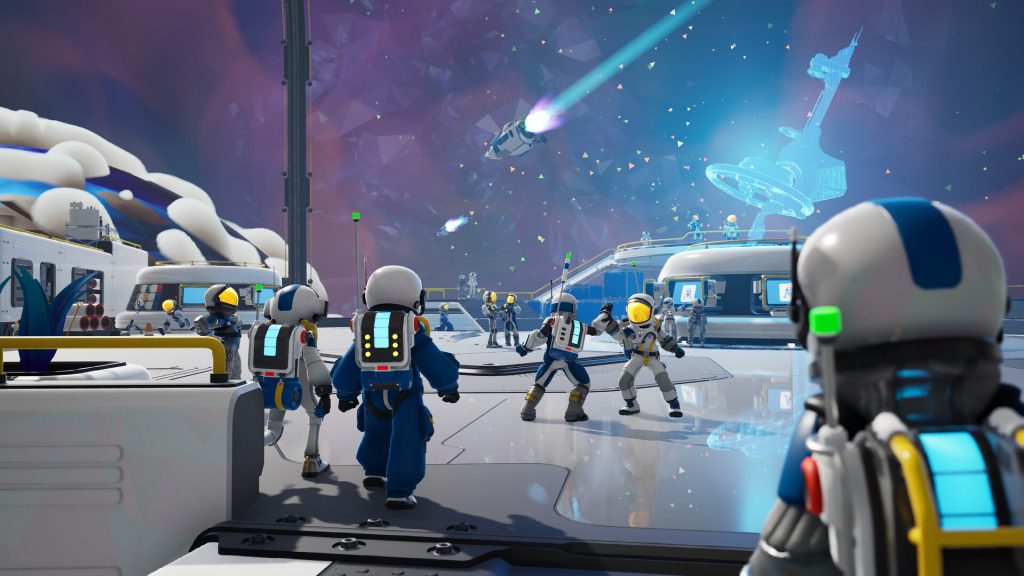
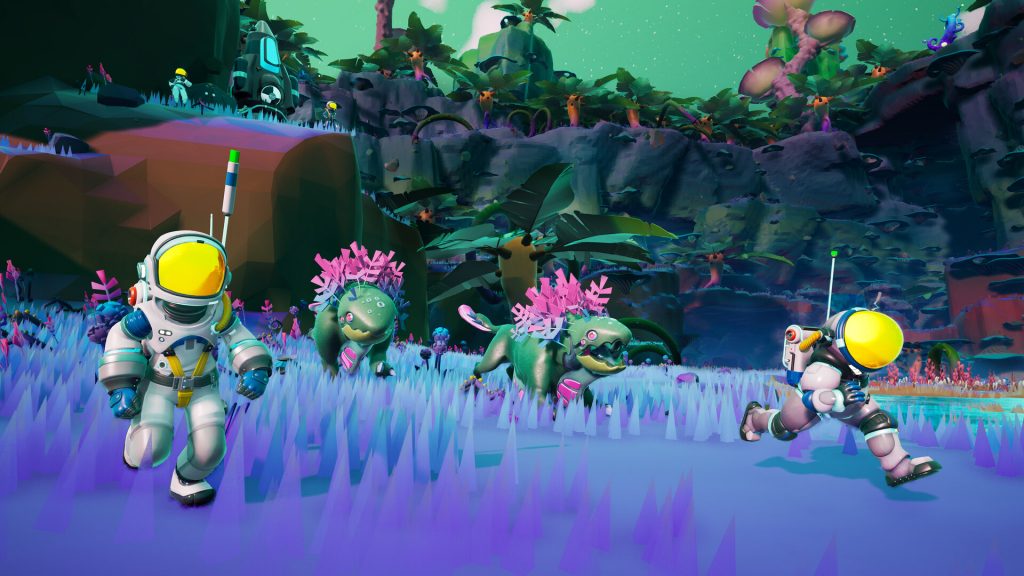
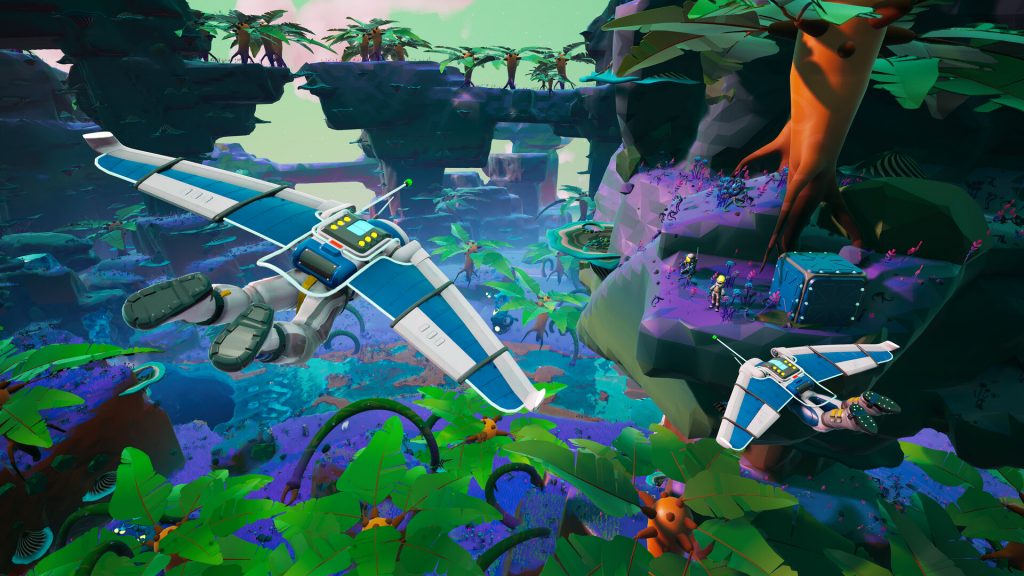
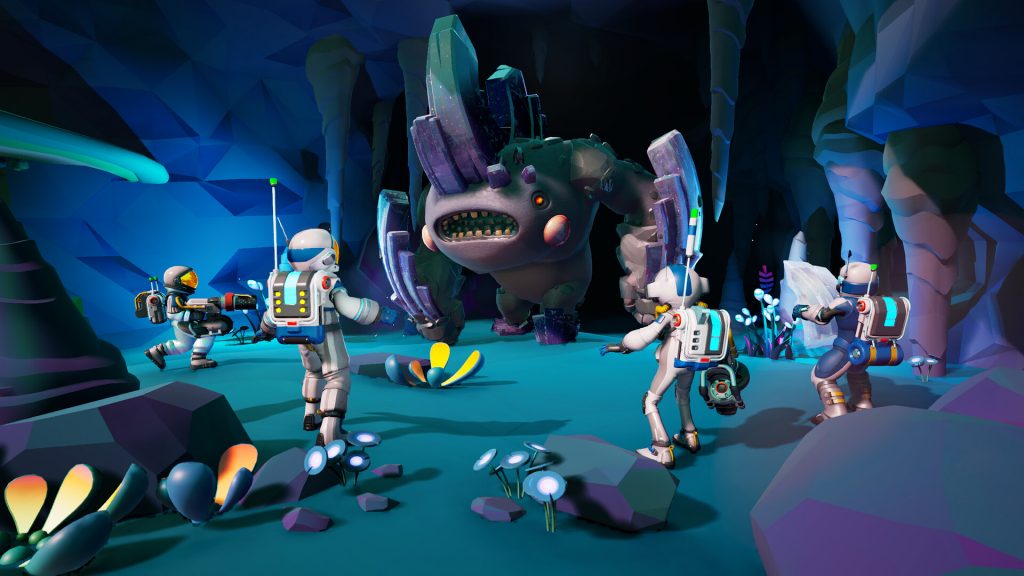
The Aesthetic Carries Over, the Perspective Doesn’t
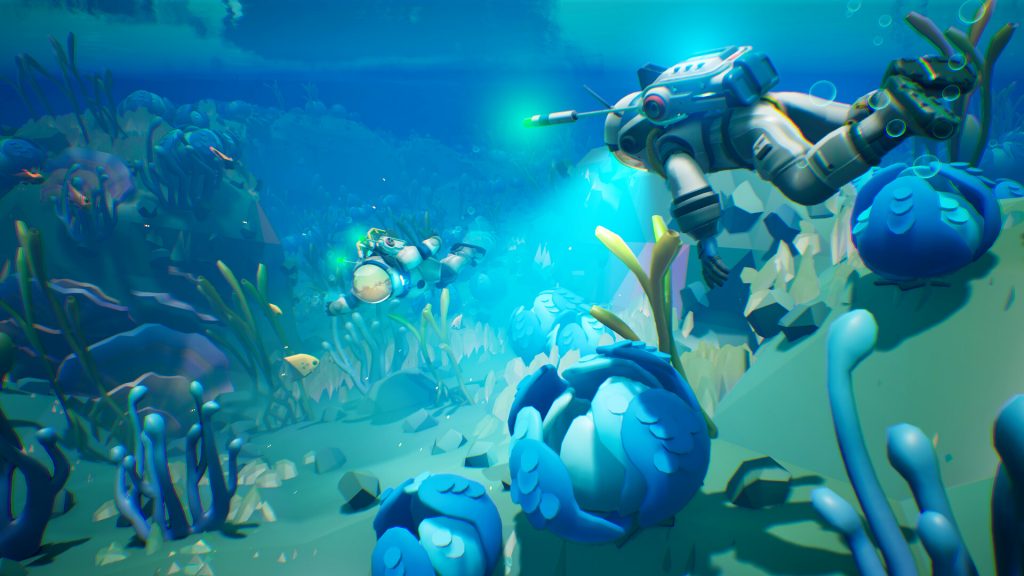
Visually, STARSEEKER keeps the Astroneer trademark: pastel-toned soft colors, rounded sci-fi forms, and the gentle visual register that made the original game distinct from the gritty hardware-fetish aesthetic that dominates most space games. That’s the right call. The aesthetic is one of the IP’s most distinctive assets, and abandoning it would have meant losing what makes the universe recognizable.
The major visual departure is the perspective shift. Astroneer was first-person; STARSEEKER is third-person, which broadens the sense of exploration scale and supports the more action-oriented expedition design. Third-person works better for cooperative play (you can see your character, your teammates, and the spatial relationships between them), and it suits the planetary-scale missions the game is built around — vast planetary surfaces, alien creature encounters, and environmental hazards that benefit from being seen in a larger spatial context.
The sound design pedigree is worth highlighting separately. The studio’s audio team includes veterans from 343 Industries, Disney, EA, Valve, and Ubisoft, and that experience shows in how the game balances the cheerful bustle of the hub with the more tense isolation of planetary exploration. Audio is one of the easiest places for a space game to feel generic; STARSEEKER appears to be putting real resources into avoiding that.
The Open Beta and the Early Access Strategy
The June 4 open beta with progression carrying forward to the June 11 Early Access launch is a smart structural choice. It functions as a soft launch — players who participate in the beta won’t lose their progress when the storefront version goes live, which removes the typical reluctance to invest time in pre-release versions. It also gives System Era a week of broad-scale live testing under real player loads before the paid launch.
For a live-service-adjacent game launching simultaneously across four platforms, this kind of staged rollout is the right approach. The cross-platform launch itself is ambitious — most indie studios stagger platform releases to manage the operational complexity, and System Era’s commitment to simultaneous availability suggests both Devolver’s confidence in the project and the studio’s expanded resources as a first-party operation.
Early access to a $29.99 cooperative game is also a particular kind of bet. It’s higher than the typical indie EA price point, which signals the game is positioning itself closer to the Deep Rock Galactic tier than the experimental indie tier. That price reflects the production scope, but it also raises expectations. Early Access players paying $30 will be more demanding about content depth, server reliability, and post-launch support than players paying $15 for a smaller-scope project.
The Devolver Question
The acquisition context is worth understanding for what STARSEEKER represents. Devolver Digital is best known as a publisher of edgy, experimental, often single-developer indie hits — the kind of catalog that built the studio’s reputation on creative risk-taking. The System Era acquisition was different. They bought a studio with an established commercial hit, a long-term community, and a universe that supports ongoing expansion.
STARSEEKER is the first major release under that acquisition arrangement, and how it performs will shape how Devolver continues to develop first-party operations. A successful launch validates the model and likely accelerates similar acquisitions of mid-tier indie studios with proven hits. A struggling launch raises harder questions about whether the financial structure works at this scale.
For System Era specifically, STARSEEKER is the proof point that the studio can leverage its existing IP into multiple successful products rather than depending on a single title indefinitely. Astroneer alone could have sustained the studio for years, but expanding into a multi-title franchise requires demonstrating that the universe supports more than the sandbox-survival format that built it.
How the Press Has Read It
International coverage has consistently emphasized the strategic pivot to cooperative expedition design as the project’s most interesting angle. Noisy Pixel highlighted the shift in design direction. Gematsu focused on the simultaneous cross-platform launch and the beta-progression carry-over structure. Nintendo Everything singled it out as a notable title from the Nintendo Direct that revealed it.
The Nintendo Direct reveal is itself a meaningful context. Inclusion in Nintendo’s marketing flow signals that STARSEEKER is being treated as a meaningful launch title for Switch 2, which gives the game access to a different audience than the original Astroneer primarily reached. The PC-centric Astroneer audience and the more console-leaning Switch 2 audience are different groups, and STARSEEKER‘s cross-platform launch is positioned to capture both.
Who This Is For
Strong fit for: existing Astroneer players curious about co-op expansion of the universe; Deep Rock Galactic and Helldivers 2 players looking for a softer-toned alternative; players who appreciate the gentle sci-fi aesthetic and want more structured progression than pure sandboxes provide; cross-platform households who want to play together across PC, PlayStation, Xbox, and Switch 2.
Less ideal for: players who specifically loved Astroneer‘s sandbox solitude and have no interest in cooperative play; players who avoid Early Access on principle; anyone looking for grittier or more realistic space-game aesthetics; players who want hardcore PvP or competitive structures.
What to Watch For
Several questions will shape how STARSEEKER lands at and after the Early Access launch.
The first is content depth at launch. Early Access games on cooperative live-service models live or die on whether the launch content sustains player engagement long enough for content updates to extend the experience. The expedition variety, planetary diversity, and equipment progression depth will need to support tens of hours of co-op play before the first major content update.
The second is cross-platform infrastructure stability. Four-platform simultaneous launches with shared progression are technically demanding, and any meaningful matchmaking, sync, or session-stability problems at launch will significantly affect early reception. The open beta will help surface these issues, but the actual launch is when they get fully stress-tested.
The third is monetization structure clarity. The $29.99 base price is the visible cost, but post-launch monetization (cosmetics, season passes, content packs) hasn’t been fully disclosed yet. Live-service co-op games depend heavily on their monetization model, feeling fair to engaged players, and how System Era handles this will significantly affect long-term community health.
The fourth, and most consequential, is whether the cooperative pivot translates the Astroneer community successfully. Existing fans of the original game don’t automatically become fans of a structurally different game in the same universe. STARSEEKER needs to either bring its core audience along or attract enough new players to offset whatever portion of the Astroneer community doesn’t follow.
The Takeaway
STARSEEKER: Astroneer Expeditions is the most strategically interesting indie-adjacent launch of the summer. It represents Devolver’s biggest first-party bet, System Era’s expansion from single-title studio to franchise operator, and a meaningful strategic pivot for an established IP into a different gameplay register.
The execution risks are real — cooperative live-service launches are operationally demanding, cross-platform simultaneity is harder than a single-platform release, and IP expansion always carries the risk of confusing or alienating the existing community. But the foundations are unusually solid for a project of this ambition. System Era has the resources, the universe has the recognition, the design pivot is into a less saturated space, and the open beta strategy is the right way to derisk the launch.
For players already in the Astroneer universe, this is one to wishlist immediately. For players who haven’t engaged with the IP before but are interested in cooperative space exploration, the $29.99 Early Access entry is positioned to deliver substantial play time across the planned development period.
The June 4 open beta is free, and progress carries forward. That’s the fastest way to find out whether STARSEEKER‘s expedition rhythm matches your wavelength — and based on the substantial community already wishlist-watching the project, a lot of players are about to find out at the same time.
STARSEEKER: Astroneer Expeditions Related Information
| item | detail |
|---|---|
| Developer | System Era Softworks (Seattle, USA, founded in 2014) |
| Publisher | Devolver Digital |
| Genre | Cooperative Space Exploration / Multiplayer Action Adventure / Roguelite Elements |
| Release platform | PC (Steam) / PS5 / Xbox Series X|S / Nintendo Switch 2 |
| Early Access Release Date | June 11, 2026 |
| Open Beta | June 4, 2026 (All platforms, progress carried over to the official version) |
| price | $29.99 USD |
| series | Astroneer Universe (11 million players) |
| Key Features | ESS Starseeker Permanent Base / Planetary Objective / 1–Many Co-op / Crafting & Upgrading Equipment |
| First reveal | Nintendo Switch 2 Nintendo Direct (April 2026) |
| Main Keywords | Cooperative Exploration, Space, MMO, Sci-Fi, Astroneer, Survival, Cozy Sci-Fi |
| Korea Official Channel | Devolver Digital Korea X (@DevolverKR) |
| Official Site | starseekergame.com |
| Steam Page | Add to Wishlist |