The year is 2119. The lunar South Pole. Humanity’s last moon colony, New Arcadia, has three hours before collapse. An extremist group called MudBoots — fanatically committed to returning humanity to Earth and abandoning space — has attacked the colony, plunging it into chaos. You’re not here to fight them. You’re here to decide what gets saved and what gets lost forever. Lunar Strike, the in-development hard sci-fi adventure from Belgian studio Cognition Europe, just revealed its new story and gameplay trailer at the Insider Gaming Showcase alongside its first PC playtest, and it’s one of the more genuinely thoughtful sci-fi projects on the 2026 calendar.
This is not another space combat game. Lunar Strike is asking a different question — what do you save when there isn’t time to save everything? — and building an entire experience around the answer.
A Sci-Fi Game That Refuses Combat
The most defining design choice in Lunar Strike is what isn’t in it. There’s no gunplay loop. No space combat. A no-action protagonist with weapons solves problems through violence. The colony is collapsing, the MudBoots are attacking, and the player’s response is to scan, document, preserve, and choose — not to shoot back.
This is a remarkable design commitment in a genre saturated with action-focused space games. The default mode for sci-fi adventures has been combat-centered for decades: from Mass Effect through The Outer Worlds through Starfield, the genre’s commercial gravity pulls toward shooting things. Even narrative-heavy sci-fi games typically include substantial combat as their core verb. Lunar Strike removes it entirely and replaces it with something genuinely unusual — heritage preservation as the central gameplay loop.
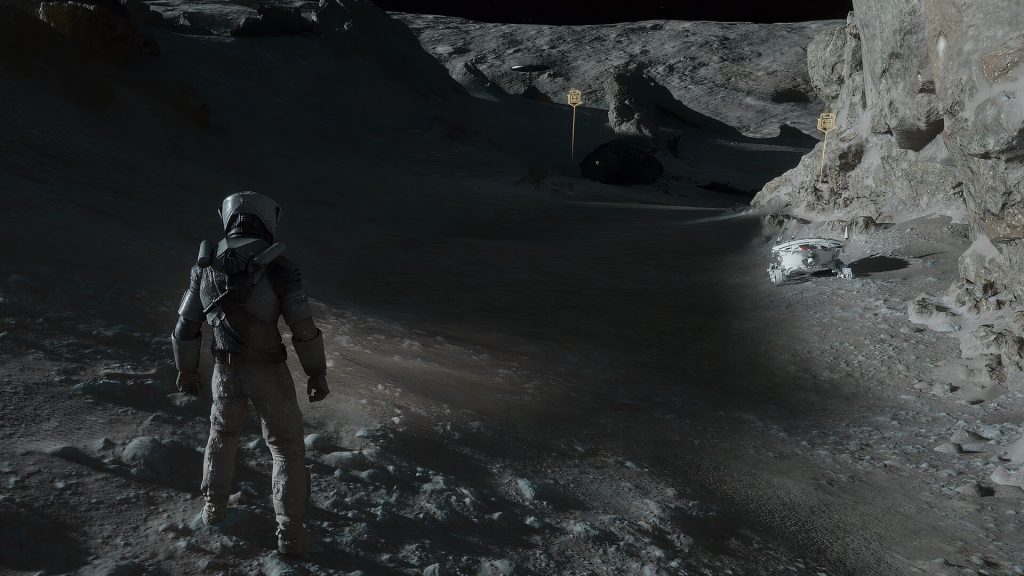
The verb choices reflect the philosophical commitment. 3D scanning. Photogrammetry. Records analysis. Environmental storytelling. These aren’t action verbs; they’re scholarly verbs. The protagonist Bo isn’t a soldier or a survivor in the conventional sense. They’re an archivist — someone whose job is to document what matters about a place before that place ceases to exist.
That framing transforms what would otherwise be a disaster narrative into something more contemplative. The colony’s collapse isn’t a problem to be solved through heroics. It’s a tragedy already in progress, and the only meaningful question is what record of this place will survive its end. The game’s stakes shift from individual survival to collective memory — what stories about humanity’s lunar adventure will outlive the lunar colony itself.
The Three-Hour Constraint
The compressed timeline — three hours before collapse — is essential to the game’s design philosophy. Open-ended exploration games allow players to investigate everything; Lunar Strike explicitly doesn’t. You can’t preserve everything in three hours. You will have to make choices about what gets documented and what gets lost.
This is genuinely sophisticated narrative design. Most games that pretend to offer “meaningful choices” actually let players see all content eventually — the choices affect path, not exposure. Lunar Strike‘s structural constraint means that genuine, irrevocable loss is built into the gameplay. Walking past an artifact to focus on another one isn’t just a preference; it’s a choice that the artifact will be lost forever when the colony collapses.
That kind of designed scarcity creates real ethical weight in the player’s decisions. Do you preserve the colony’s official records — the things historians would expect to matter — or do you preserve the personal artifacts of individual residents? Do you focus on cultural treasures or on the evidence that will tell future generations what actually happened in these final hours? Each choice forecloses other choices, and the player has to bear the weight of what they didn’t save.
This is the kind of structural decision that distinguishes serious sci-fi from genre exercises. Lunar Strike is making an argument about the nature of historical memory: that what survives isn’t necessarily what was most important, but what was most accessible to those who happened to be doing the documenting in the final moments. That argument is embedded in the gameplay rather than just stated through dialogue.


The Science Behind the Setting
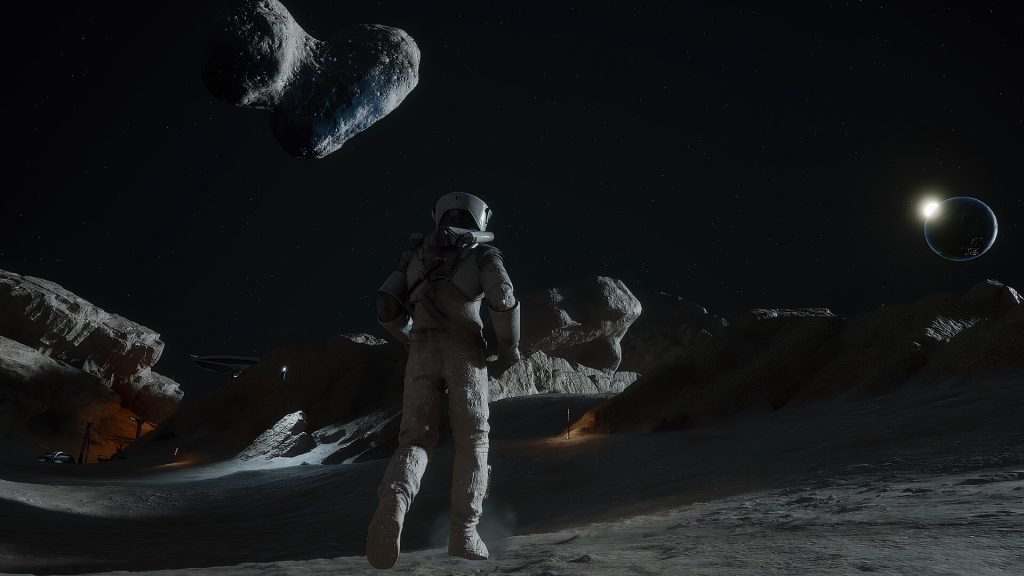
The hard sci-fi commitment extends to genuine scientific accuracy. The game implements actual lunar physics — the 1/6 gravity environment affects movement and object behavior throughout. Realistic propulsion and movement mechanics reflect how lunar landers and rovers actually function. Even lunar dust toxicity is modeled, drawing on real research about the health hazards regolith poses to long-duration moon inhabitants.
This level of scientific rigor is rare in indie sci-fi games. Most projects in the space treat scientific accuracy as flavor — implementing enough realism to feel credible but compromising whenever realism conflicts with gameplay convenience. Lunar Strike appears to be operating closer to the Outer Wilds / Tacoma end of the spectrum, where scientific accuracy is part of the experience rather than a constraint on it.
The 2119 setting is itself thoughtfully constructed. The development team has consulted with space science researchers and cultural heritage experts, and has referenced lunar colonization roadmaps from international space agencies, including ESA, to design a plausible vision of what permanent lunar settlement might look like a century from now. The collapsing colony of New Arcadia isn’t a fantasy moon base — it’s an extrapolation of currently-discussed lunar colonization plans rendered as a place with a future, even if that future is now ending.
The lunar South Pole specifically is the right choice for this setting. Real space agencies are targeting the South Pole for permanent lunar bases precisely because of its access to water ice in permanently shadowed craters. Setting Lunar Strike there gives the project the credibility of being grounded in actual lunar exploration plans rather than generic sci-fi geography.
The Aesthetic of Light and Shadow
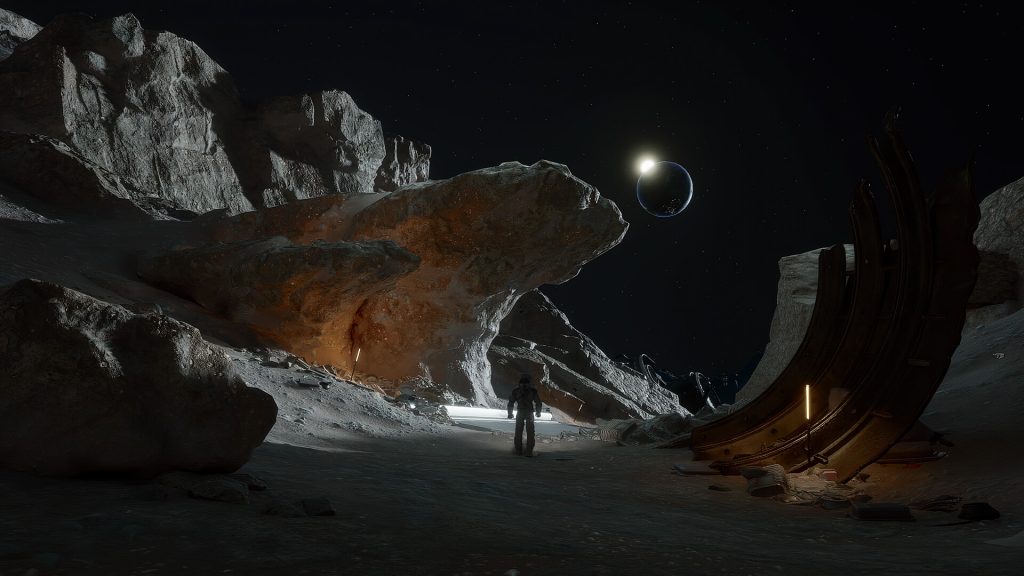
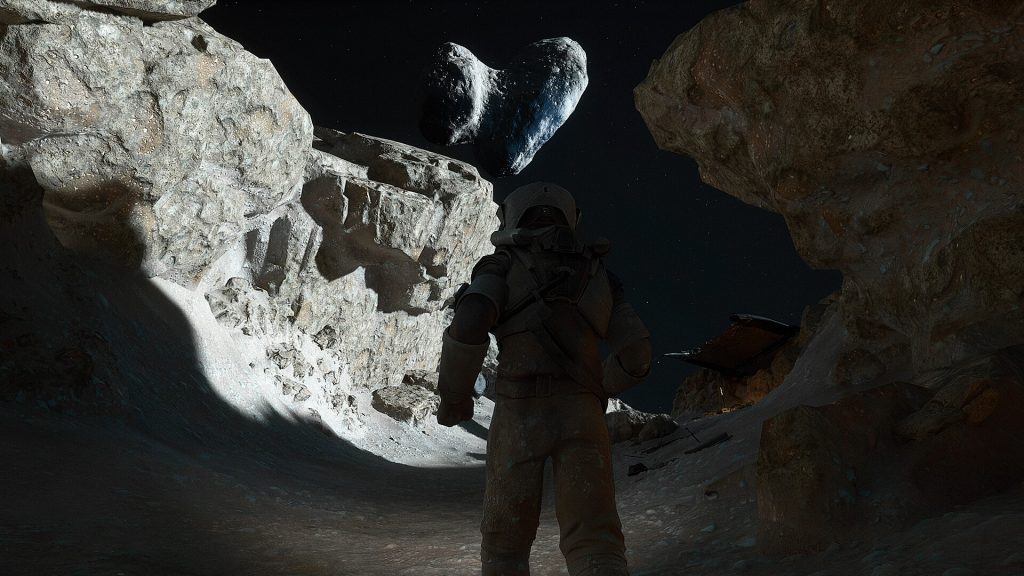
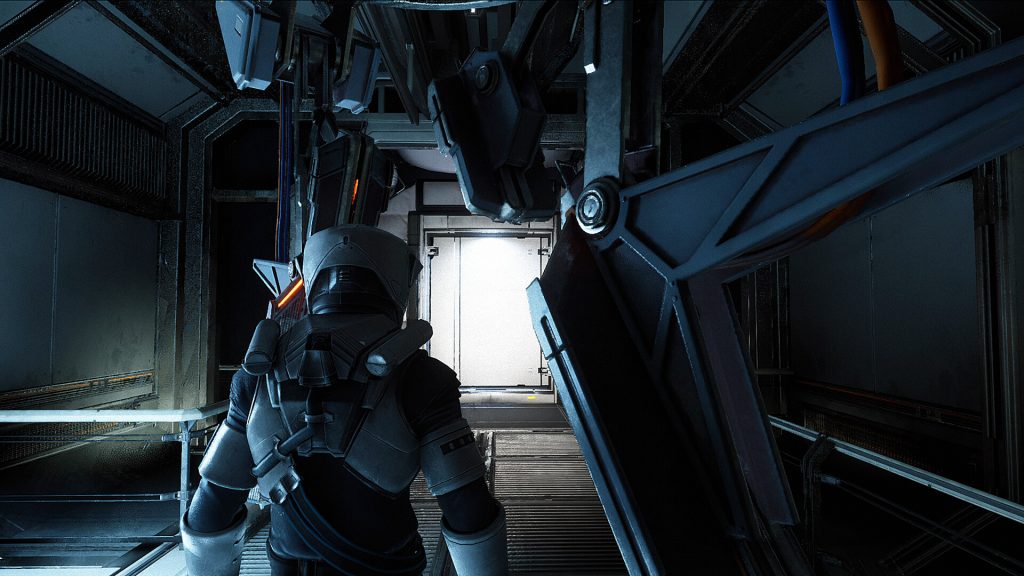
The visual identity is built around the lunar South Pole’s extreme contrasts. Permanently shadowed regions create environments where light and darkness are absolute rather than gradient — surfaces in shadow are completely black, surfaces in light are starkly illuminated. Narrow, enclosed metallic corridors of the colony contrast with the vast lunar horizon visible through helmets and viewports.
This is the right aesthetic for the project’s themes. The literal coldness of the lunar environment — both in temperature and in light quality — supports the emotional register of a story about ending and preservation. The cold metallic interiors emphasize claustrophobia and constraint, while the views of the lunar horizon emphasize the alien vastness of where humanity has tried to build a home.
The audio adds an unexpected emotional dimension. Actor Abbe Tanenbaum’s reinterpretation of Frank Sinatra’s “Fly Me to the Moon” features in the new trailer, and the choice is brilliantly thematic. A song from 1964 — sung as humanity was just beginning to dream of reaching the moon — recontextualized in 2119 as humanity prepares to abandon it carries enormous emotional weight. The hopeful jazz standard of the Space Age becomes, in Lunar Strike‘s context, an elegy for everything that hope built and is now about to be lost.
That kind of tonal layering through music selection signals a project that understands how to use cultural artifacts emotionally rather than just decoratively.
The Arc/k Project Connection
The development context behind Lunar Strike adds significant depth to the project. Lead developer Brian Pope is a writer, director, and entrepreneur — and the founder of the Arc/k Project, a nonprofit foundation focused on digital preservation of human cultural heritage.
This is more than a biographical detail. Lunar Strike is, in essence, a game version of the work Pope does in real life. The Arc/k Project uses 3D scanning, photogrammetry, and digital archival techniques to preserve cultural heritage sites and artifacts at risk of loss or destruction. Lunar Strike applies those exact techniques to a fictional context — letting players experience the urgency and ethical weight of digital preservation work directly.
The collaboration with cultural heritage experts that informed the game’s design isn’t theoretical expertise being applied externally; it’s the developer’s actual professional domain being expressed through interactive media. That kind of authentic-expertise foundation typically produces games with substance that pure speculation can’t match.
The project also functions as a kind of medium-spanning argument for the importance of cultural preservation. Players experiencing Lunar Strike aren’t just playing a game — they’re being invited to think about what cultural memory is, why it matters, and what happens when it’s lost. The game is implicitly making a case for the work Pope does professionally, but through experience rather than advocacy.
The Artemis II Timing
The release timing of Lunar Strike coincides with NASA’s Artemis II mission — humanity’s first crewed lunar orbital flight in over 50 years. This timing is more than coincidental. The game’s design is part of a broader moment when lunar exploration is returning to public consciousness, and the cultural conversation about humanity’s relationship with the moon is intensifying.
That contextual resonance gives Lunar Strike a different kind of relevance than most sci-fi games. While other lunar games are essentially genre fiction set on the moon, Lunar Strike engages with the actual political, scientific, and cultural questions surrounding lunar exploration. What kind of presence should humanity have on the moon? What gets preserved and what gets discarded? What happens when the dream meets the reality of long-term lunar habitation?
The presence of MudBoots — an extremist group demanding humanity return to Earth — also engages with real ideological debates around space exploration. There are voices in contemporary discourse arguing that humanity should focus on Earth-based problems before expanding into space, just as voices are arguing the opposite. Lunar Strike doesn’t reduce this to a simplistic conflict, but it does engage with the question seriously rather than ignoring it.
How the Press Has Read It
Pre-release coverage has consistently emphasized the project’s unusual genre positioning. Lunar Strike‘s appearances at Gamescom 2025 and PC Gaming Show: Most Wanted built initial visibility, and the Insider Gaming Showcase reveal has solidified its profile as one of the more anticipated narrative adventures of 2026.
The framing that has consistently emerged in coverage is the recognition that Lunar Strike is doing something genuinely different — not just sci-fi without combat, but sci-fi that engages with cultural memory and ethical choice as its central subject matter. That positioning has helped the project stand out in a crowded sci-fi space.
Who This Is For
Strong fit for: Tacoma and Outer Wilds fans drawn to thoughtful sci-fi without combat focus; players interested in hard sci-fi that engages with actual space science; Firewatch fans who appreciate environmental storytelling; anyone interested in cultural preservation, digital archives, or museum work; players who appreciate ethical choice systems with genuine weight; followers of indie projects with strong directorial vision.
Cautious fit for: players who specifically want action gameplay even in narrative-heavy games; anyone who finds slower-paced exploration games frustrating.
Less ideal for: players seeking traditional sci-fi adventure with combat and conflict; anyone uninterested in cultural heritage themes or scientific accuracy; players who prefer fantasy or soft sci-fi over hard sci-fi rigor.
What to Watch For
A few questions will shape Lunar Strike‘s reception when it arrives.
The first is whether the three-hour timeline structure actually delivers meaningful choice weight. The design promises irrevocable preservation decisions — whether the implementation creates genuine ethical engagement or settles into checklist completion will determine whether the game’s most distinctive feature works.
The second is the 3D scanning and photogrammetry gameplay loop. The verbs are unusual for a game; whether they feel satisfying as core gameplay or whether they read as repetitive depends entirely on execution. The first PC playtest will start providing answers.
The third is narrative pacing across the compressed timeline. Three hours of game time isn’t necessarily three hours of real time — Lunar Strike will need to structure its narrative beats to land emotionally within the constraint without feeling rushed.
The fourth is the MudBoots’ integration into the experience. The extremist group provides the catalyst for the colony’s collapse, but they’re not the focus of gameplay. How they appear in the experience — as background threat, as encounters to navigate around, as moral counterpoint — will significantly affect the game’s tone.
The Takeaway
Lunar Strike is one of the most genuinely ambitious sci-fi indie projects on the 2026 calendar. The hard sci-fi rigor, the unusual heritage-preservation gameplay loop, the connection to actual cultural preservation work through the Arc/k Project, the compressed timeline creating real ethical weight, the thoughtful aesthetic and audio choices — all of it adds up to a project with substance behind its premise.
Cognition Europe is making the kind of game that justifies independent development. A major publisher would almost certainly have insisted on adding combat, broadening the appeal, softening the ethical sharpness. The fact that Lunar Strike exists in its current form — committed to its specific vision rather than compromising for market accessibility — is exactly why the indie space matters.
For players drawn to thoughtful sci-fi, this is one to wishlist immediately. The summer 2026 release window is closing, the first PC playtest is starting now, and the project has been clearly defined enough through its showcase appearances that interested players can evaluate fit. Whether Lunar Strike lands as a major narrative adventure of the year or as a more niche success will depend on execution across the next few months of development.
Information regarding ‘Lunar Strike’
| item | detail |
|---|---|
| Developer | Cognition Europe (Zavantem, Belgium) |
| Genre | Hard Sci-Fi Narrative Adventure / Exploration / Story Driven |
| Release platform | PC (Steam) / PS5 / Xbox Series X |
| Scheduled for release | Summer of 2026 |
| background | ‘New Arcadia’, a permanent lunar colony in Antarctica in 2119 |
| hero | Tech-Enhanced Archivist ‘Bo’ |
| core system | 3D Scanning · Photogrammetry Heritage Preservation / Environmental Storytelling / Ethical Choice |
| Scientific implementation | 1/6 Gravity / Lunar Dust Toxicity / Orbital Dynamics / Lunar Rover Physics |
| Affiliated organizations | Arc/k Project (Non-profit foundation for the digital preservation of cultural heritage) |
| Public history | Gamescom 2025 / PC Gaming Show: Most Wanted / Insider Gaming Showcase 2026 |
| Main Keywords | Hard SF, Moon Colony, Heritage Preservation, Archive, Exploration, Ethical Choice, Dystopia |
| Official Channel | Discord · YouTube · X · Instagram |
| Steam Page | Go to Wishlist |