- 1 in 10 Cut: The GDC 2025 “State of the Game Industry” report reveals 11% of developers were laid off in the past year.
- Narrative Under Fire: Storytellers were hit hardest with a 19% layoff rate, while financial roles remained relatively stable.
- The AI Replacement: Large studios are slashing QA and junior art teams by over 50% in favor of automated AI tools.
- Korean Impact: Domestic indie and mid-sized studios are facing a “funding drought” as global publishers pull back.
The global gaming industry is currently navigating a period of painful “recalibration.” What began as a series of isolated cuts in North America and Europe has evolved into a systemic “Gamer’s Winter,” and South Korea—once considered a haven of mobile growth—is now feeling the frost.
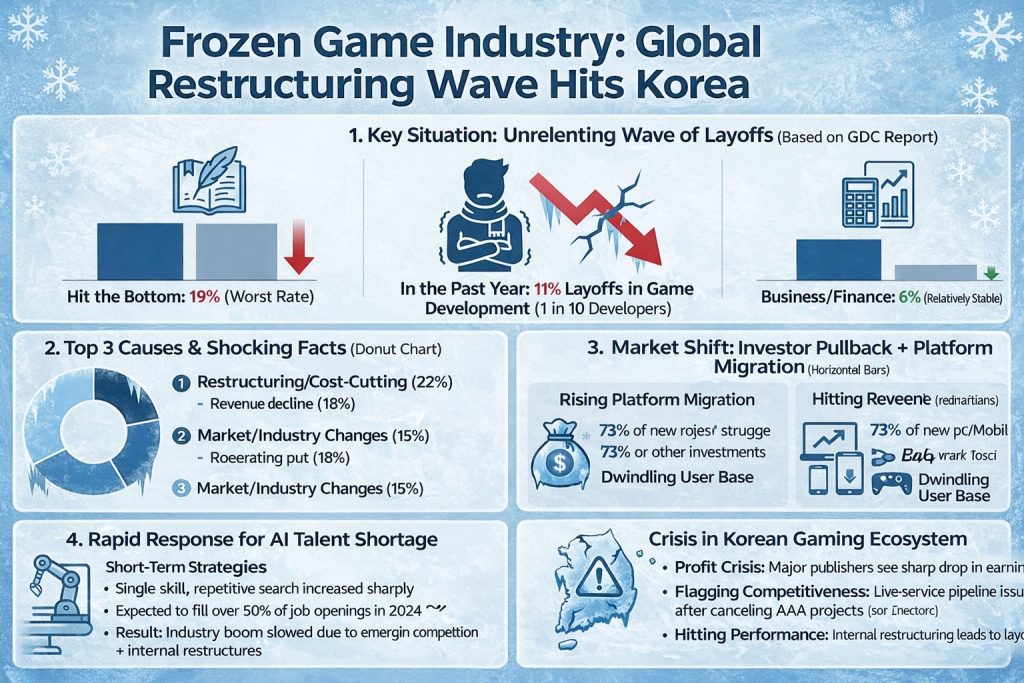
The Brutal Math of GDC 2025
The latest report from the Game Developers Conference (GDC), released on January 29, 2025, serves as a grim ledger for the past twelve months. Surveying over 3,000 developers worldwide, the data suggests that the industry is aggressively “trimming the fat” to appease investors in a high-interest-rate environment.
| Department | Layoff Rate | Job Security Sentiment |
| Narrative / Writing | 19% | Very Low |
| Quality Assurance (QA) | 15% | Decreasing (Due to AI) |
| Overall Development | 11% | Moderate |
| Business & Finance | 6% | Relatively Stable |
Perhaps most tellingly, 19% of laid-off developers received no explanation from their employers, reflecting a chaotic and often cold corporate environment during these restructures.
The Funding Drought: The Rise of the “Self-Funded” Indie
The “easy money” of the pandemic era has officially evaporated. With Venture Capital (VC) firms turning their backs on high-risk projects, developers are being forced to bet on themselves.
- Self-Funding Dominance: 56% of developers are now funding their projects out of their own pockets.
- The VC Failure: 32% of developers who sought venture capital reported their efforts as “not successful at all.”
- Platform Pivot: While mobile gaming was the industry’s engine for a decade, it saw a 7% decline this year. Meanwhile, 80% of developers are focusing on PC, driven by the massive success of handhelds like the Steam Deck.
AI: Not Just a Tool, But a Replacement
The conversation around AI has shifted from “How can it help us?” to “Who can it replace?” The report highlights a disturbing trend for entry-level talent:
- QA Annihilation: Companies like Sony, Ubisoft, and Microsoft have cut QA and testing staff by roughly 50% compared to 2024, replacing them with AI-driven automated playtesting.
- The “Vanishing Junior” Artist: Large firms in China (NetEase, Tencent) and Korea are using AI for character skins and asset coloring, reducing outsourcing costs by 40%.
- The Shift to “Directing”: The industry is no longer hiring “drawers” or “writers”; it is looking for “AI Directors”—senior staff who can curate and fix AI-generated content. This leaves a massive gap where junior developers used to learn their craft.
South Korea’s Crossroads: Protecting the Ecosystem
In South Korea, the impact is being felt through cancelled publishing deals and stagnant hiring. Experts warn that if the “incubation” system for indie developers isn’t protected, the country risks a total talent drain.
“AI is moving beyond helping people to actually extinguishing certain job categories,” industry insiders warn. “We are seeing a future where only directorial-level talent survives, which effectively kills the career path for the next generation.”
The Call to Action: Industry leaders are urging the Korean government and deep-pocketed publishers (like Nexon and Krafton) to establish a “safety net.” This includes reskilling programs for developers displaced by AI and stronger local incubation funds to ensure indie projects don’t die on the vine due to global investment chills.