최근기사

    [Column] The global restructuring of the gaming industry is spreading… Korea is no exception to the “layoff wave.”

    2026년 02월 04일

    A new challenge for circular puzzles: ‘D1AL-ogue’ developed by CherryPicker, a four-person student team attracting attention.

    2026년 02월 04일

    Free training leads to a 73% employment rate… Applications for the 8th Game Talent Institute are due by the 10th of next month.

    2026년 02월 04일
    Facebook Twitter Instagram
    인디게임닷컴
    • Indie Game News

      Black Anchor’s Indie RPG ‘Remore’ Rebrands as ‘MEMOLITH’ Ahead of H1 2026 Release

      2026년 02월 03일

      KMGA Joins Forces with Pleaders to Empower Korea’s Indie Game Ecosystem

      2026년 01월 30일

      K-Indie Sensation ‘Graytail’ Secures Best Mobile Game at Taipei Game Show 2026

      2026년 01월 29일

      The community is in an uproar over the AI image in the official trailer for “Fallen,” a new indie game from a renowned developer.

      2026년 01월 21일

      AI Image Controversy Hits New Indie Title ‘Fallen’ from Veteran Developer

      2026년 01월 21일
    • Recommendation/Public

      A new challenge for circular puzzles: ‘D1AL-ogue’ developed by CherryPicker, a four-person student team attracting attention.

      2026년 02월 04일

      Monster Train 2 Surpasses 500K Sales as First Major DLC, ‘Destiny of the Railforged,’ Officially Launches

      2026년 02월 02일

      Eastern Myths Meet Strategic Cards: ‘DeckLand’ Launches Steam Early Access on March 23

      2026년 02월 02일

      Bending Reality for the Perfect Kill: ‘Spacetime Shooter’ Set for Free Release on Steam

      2026년 02월 01일

      Stress-Free Sailing: Japanese Indie ‘Pirate & Darkmage’ Brings Limitless Life-Sim Exploration to Steam

      2026년 01월 30일
    • Indie Game Review

      Purr-fectly Terrifying: Catching Ghosts with a Camera and a Cat in ‘The 18th Attic.’

      2026년 02월 03일

      Conquer the Streets of Japan: Survival Tycoon ‘Street Takoyaki’ Now Available on Steam

      2026년 02월 02일

      64,000+ Players in the Credits: Japanese Indie Horror ‘Twilight Moonflower’ Launches on Steam

      2026년 01월 30일

      Solo-Dev Horror RPG ‘Wicked Seed’ Takes Steam by Storm

      2026년 01월 27일

      [IT] Korean version of “Luce Spenta,” a 600,000-word dark tale created by a solo developer, released.

      2026년 01월 26일
    • Indie Game Focus

      [Column] The global restructuring of the gaming industry is spreading… Korea is no exception to the “layoff wave.”

      2026년 02월 04일

      From Flash Games to Global Phenomenon: The Massive Monster Success Story

      2026년 01월 31일

      “A Masterclass in Empathy”: Indie Hit ‘and Roger’ Claims Grand Prix at Taipei Game Show 2026

      2026년 01월 29일

      Record-Breaking 731B KRW Content Fund Announced, But Gaming Industry Left in the “Etc.” Category

      2026년 01월 23일

      12 Global Game Centers Nationwide: A Foundation for the Growth of K-Indie Games…Why Startups and Indie Companies Should Pay Attention

      2026년 01월 14일
    • Competition/Support Project

      Free training leads to a 73% employment rate… Applications for the 8th Game Talent Institute are due by the 10th of next month.

      2026년 02월 04일

      1 Million KRW Prize: ‘1-Chicken RPG Maker Game Jam 2026’ Officially Announced

      2026년 01월 31일

      K-Indie Takes Center Stage in Taipei: BIC Festival Showcases 4 Award-Winning Titles at TGS 2026

      2026년 01월 28일

      Empowering the Grassroots: SBA and IGG Korea Host Major Networking Event for Indie Developers

      2026년 01월 28일

      Calling All Indie Devs: Recruitment Opens for ‘2026 PlayX4 Indie Arcade.’

      2026년 01월 27일
    • GameCollege
    • 한국어
    • 日本語
    Facebook
    인디게임닷컴
    • 한국어
    • 日本語
    Indie Game Focus

    [Column] The global restructuring of the gaming industry is spreading… Korea is no exception to the “layoff wave.”

    By JAE CHUNG LIM2026년 02월 04일6 Mins Read

    The wave of layoffs that has swept the global gaming industry is also impacting the Korean game industry. The large-scale restructuring that began in North America and Europe is now leading to job insecurity at domestic game companies, creating a sense of tension throughout the industry.

    One in 10 developers laid off… Narrative writing takes the biggest hit.

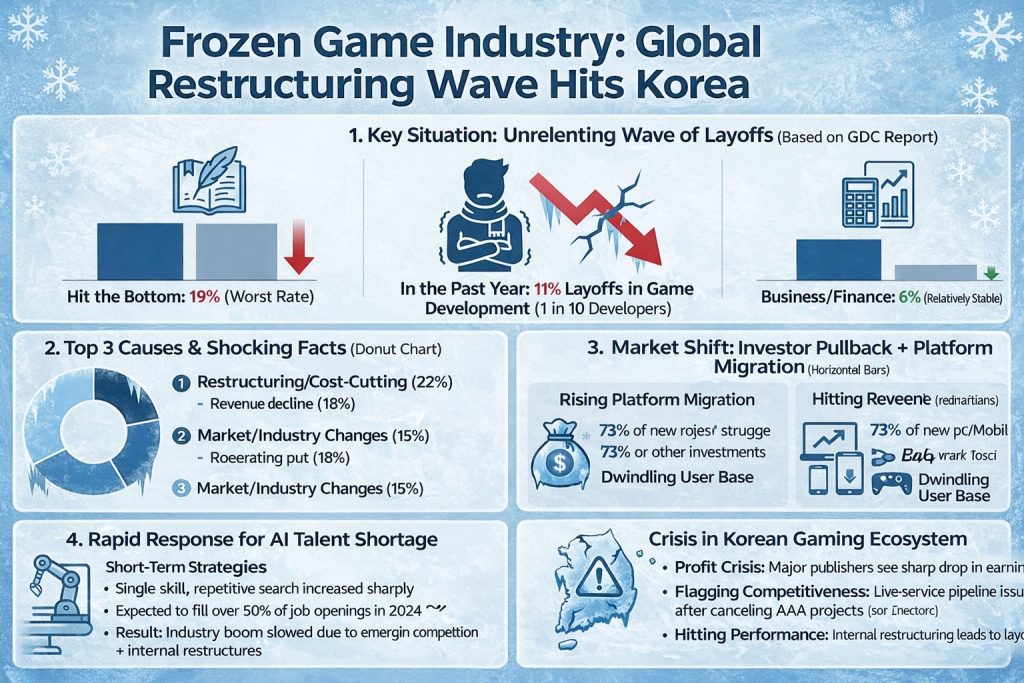
    According to the ‘2025 State of the Game Industry’ report released by GDC (Game Developers Conference) on January 29, 11% of developers experienced layoffs in the past year, with the narrative field being the hardest hit at 19%. In contrast, the business and finance field was relatively less affected at 6%.

    The survey polled over 3,000 game developers across 86 countries, with 58% of respondents coming from the US, 7% from the UK and 6% from Canada, reflecting a predominantly Western demographic.

    The report found that 41% of respondents reported being affected by layoffs, with 29% witnessing the layoff of a direct colleague and 18% witnessing the layoff of a developer from another team. Additionally, 4% experienced layoffs due to studio closures.

    Reason for restructuring? “22% restructuring, 18% profit decline.”

    The most common reason for layoffs was restructuring, cited by 22% of developers, followed by decreased revenue (18%) and market or industry changes (15%). Notably, 19% of developers said they weren’t even given an explanation for their layoffs.

    The main reason is that global gaming companies, which had aggressively recruited employees to capitalize on the contactless nature of the pandemic, have shifted to austerity measures in response to the economic downturn. Indeed, major global gaming companies such as Microsoft (MS), Riot Games, and Ubisoft have recently implemented large-scale layoffs to reduce costs.

    Investment surge… More than half of developers are relying on their own funds.

    The difficulty of attracting investment is also severe. According to the report, 56% of developers reported that they were developing games with their own funds, clearly demonstrating the difficulty of attracting external investment.

    Publishing contracts and project-based funding accounted for 28%, while government subsidies, venture capital, and joint development agreements each accounted for 15%. In particular, 32% of venture capitalists responded that their efforts were “not successful at all,” demonstrating a deteriorating investment environment.

    The continued high interest rate environment is interpreted as a sharp decline in investment sentiment toward the gaming industry. With more than half of developers having to fund their projects solely through their own funds, without external investment, concerns are rising that this could lead to a reduction in development scale and a decline in quality.

    PC platform dominance… Mobile decline also contributes to the employment crisis

    In terms of platforms, the PC’s overwhelming dominance was confirmed. According to the report, 80% of developers are developing games for the PC platform, a trend attributed to the popularity of portable PCs like the Steam Deck.

    The mobile game market, once known as the “goose that lays the golden eggs” for driving the growth of the entire game market, came in second with 38%, but this figure fell by 7 percentage points year-on-year, facing an unprecedented slowdown in growth.

    The market size, which had expanded explosively in the early 2020s thanks to the pandemic, entered a period of stagnation starting in 2024, and as of 2026, major countries are recording negative growth or experiencing a clear shift in market share to PCs and consoles, leading to a clear phenomenon of “negative growth and structural restructuring.”

    As a result, the gaming industry, once hailed as a “dream job,” is facing a severe hiring crisis. The mobile gaming market, which has driven growth for years, is reaching saturation, forcing companies to undertake large-scale workforce restructuring to “cut costs” and “improve their structure.”

    As AI adoption accelerates, workforce replacement becomes a reality. “We won’t be hiring new hires.”

    As game companies, feeling the burden of labor costs, are fully introducing generative AI into their development processes, the reduction in staff in simple graphic work, QA (quality assurance), and translation positions is also accelerating.

    In fact, last year, large North American game companies reduced their tester workforce by more than 30% by introducing AI-based QA automation tools, and large Chinese game companies NetEase and Tencent actively introduced AI into their original production processes, reducing outsourcing costs by more than 40%.

    Ubisoft and Sony are introducing AI-based automated playtesting systems to catch bugs and balance changes tens of thousands of times faster than humans. The QA workforce has been reduced by approximately 50% compared to 2024, and the structure has been reorganized so that only the most sensitive areas that AI cannot detect are inspected by a minimal number of personnel.

    In Korea, as AI is being used to create card illustrations and character skins for mobile games, the hiring of new low-level artists, previously referred to as “dot artists” or “coloring assistants,” is virtually halted.

    Concerns that “AI is going beyond assisting people and is wiping out certain professions altogether” are now commonplace in the industry. In reality, the workforce needed in development is shifting from “directors who can draw” to “directors who can evaluate and modify AI output.”

    This ultimately leads to warnings that it could deprive junior developers of growth opportunities and, in the long run, lead to a depletion of human resources in the industry.

    The Korean gaming industry is no exception… Concerns about a potential hit to small and medium-sized indie developers.

    The restructuring trend in the global gaming industry is having a direct and indirect impact on the Korean game industry. As more and more domestic developers face the fallout of contracts with overseas publishers or fail to attract investment, job insecurity is becoming more apparent.

    Small and medium-sized indie game developers, particularly those with limited financial resources and human resources, are inevitably hit hard by the global market downturn. Studios that had been developing games with the goal of entering overseas markets are frequently forced to halt projects or downsize due to funding cuts.

    The GDC report highlights the growing reliance on self-funding and the difficulty in attracting external investment, a reality not unlike the reality faced by domestic developers. With venture capital investment in the gaming industry plummeting in Korea, many developers are either pursuing projects with their own funds or downsizing.

    “Ecosystem-Level Measures Needed” for Small and Medium-Sized Indie Game Developers

    Experts predict that employment instability in the global gaming industry will be difficult to resolve in the short term. As long as the high interest rate environment persists and investment sentiment does not recover, game companies’ conservative workforce management is likely to continue for the foreseeable future.

    Accordingly, voices are emerging in the domestic gaming industry calling for ecosystem-level measures. These include strengthening policy support for small and medium-sized and indie developers, expanding retraining programs, and building global networks to minimize talent drain and maintain industry competitiveness.

    Game industry insiders are unanimous in their call, saying, “We need to take preemptive action before the global restructuring repercussions begin to fully manifest in Korea,” and “In particular, we need to establish practical government support measures and an incubation system for well-funded publishers to prevent indie game developers from leaving the industry.”

    JAE CHUNG LIM
    • Website

    Editor-in-Chief of IndieGame.com, He began his career as a professional game journalist in the 1990s at Digital Life and Jeu-media. He subsequently worked at several marketing agencies, game development studios, and publishing companies, before joining the Bandai Namco Group, where he spent over ten years leading the development and global business of IP-based online and mobile games. He is currently active as a consultant and mentor for indie games both in Korea and overseas, and serves as a judge for numerous competitions and government-supported programs. Through Indiegame.com, he is also committed to promoting a healthy gaming culture and supporting the growth of startups and indie game developers.

    Related Posts

    From Flash Games to Global Phenomenon: The Massive Monster Success Story

    2026년 01월 31일

    “A Masterclass in Empathy”: Indie Hit ‘and Roger’ Claims Grand Prix at Taipei Game Show 2026

    2026년 01월 29일

    Record-Breaking 731B KRW Content Fund Announced, But Gaming Industry Left in the “Etc.” Category

    2026년 01월 23일

    12 Global Game Centers Nationwide: A Foundation for the Growth of K-Indie Games…Why Startups and Indie Companies Should Pay Attention

    2026년 01월 14일
    Editors Picks

    From Flash Games to Global Phenomenon: The Massive Monster Success Story

    2026년 01월 31일

    “A Masterclass in Empathy”: Indie Hit ‘and Roger’ Claims Grand Prix at Taipei Game Show 2026

    2026년 01월 29일

    K-Indie Sensation ‘Graytail’ Secures Best Mobile Game at Taipei Game Show 2026

    2026년 01월 29일

    Global Indie Stage Awaits: INDIE Live Expo 2026 Announces April Date and Call for Entries

    2026년 01월 27일
    Demo
    Demo
    인디게임닷컴
    Facebook RSS
    ㈜플레이앱스 | 발행인: 정무식 | 편집인: 임재청 | 연락처: desk@indiegame.com | 주소: 서울시 송파구 거마로 9길27 202호 | 청소년보호책임자: 임재청
    © 2026 indiegame.com All Rights Reserved.

    Type above and press Enter to search. Press Esc to cancel.