On August 19, a two-person Korean indie team with no marketing budget released a paid mobile game. Ten days later, it was No. 5 on Google Play’s Popular Paid Arcade chart in Korea — without a single advertisement placed, without an established IP, without any external promotion. On August 31, it was still No. 6.
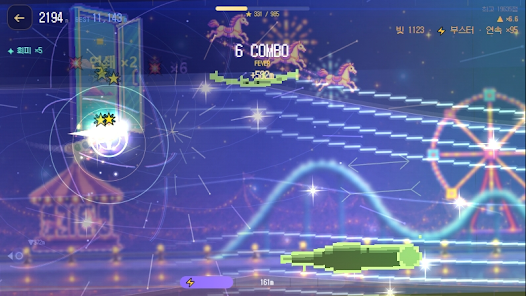
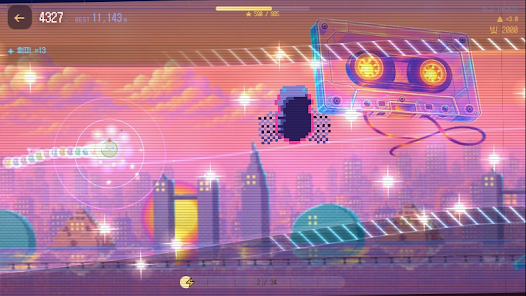
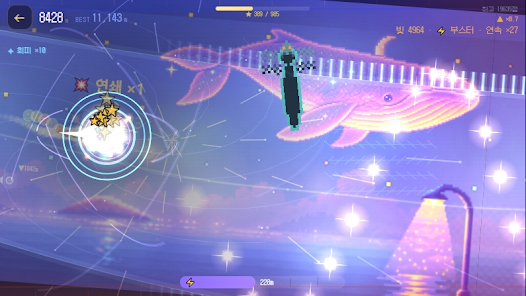
This doesn’t happen often. The chart positions that matter in mobile gaming are typically dominated by established IP, franchise recognition, or significant marketing spend. Parallax: Orbit has none of these. What it has is a design that is genuinely novel: a one-button runner where hitting an obstacle doesn’t end the game — it triggers an optical illusion quiz whose correct or incorrect answer determines whether you survive.
The Illusion-as-Survival-Mechanic Design
Standard runner games punish obstacle contact with immediate death or a significant setback. The tension is pure — avoid the obstacle or lose progress. Parallax: Orbit intercepts this moment and inserts a different kind of challenge: you hit the obstacle, an optical illusion appears, and your perceptual accuracy in the next few seconds decides whether you continue.
The 13 optical illusions included in the game are drawn from established cognitive and perceptual psychology research: the Poggendorff illusion (a line appears misaligned when crossing a barrier), the Müller-Lyer illusion (lines of equal length appear different depending on their arrowhead direction), the Hering illusion (straight lines appear curved due to radial background patterns), the Jastrow illusion (identical shapes appear different in size depending on orientation). These are phenomena that researchers have studied for over a century — not invented for the game, but recruited from cognitive science into game mechanics.
The design implication is that the illusion quiz is not a random trivia round. It is specifically testing the perceptual processing that the illusion is designed to confound. A player who knows about the Müller-Lyer illusion intellectually may still fail the in-game quiz because the perceptual bias operates pre-consciously — knowing that two lines are actually equal doesn’t reliably make you see them as equal.
This is the game’s genuine creative insight: it’s not testing what you know. It’s testing how your visual system processes information in real time, under the specific pressure of having just hit an obstacle.

The Orbit Map Visualization
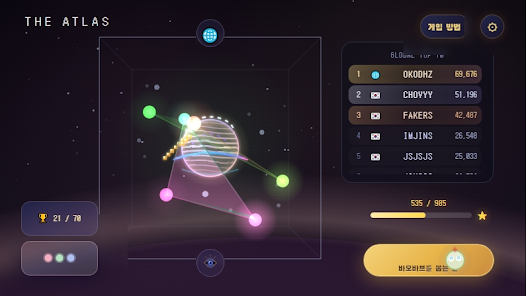
After each run, the player’s illusion responses — which illusions they passed, which they failed, how quickly they responded — are converted into an individual “Orbit Map”: a visual representation of their perceptual choices rendered as color and trajectory form.
The team is explicit that this is not a psychological diagnostic tool. The Orbit Map is a visualization of one run’s choices and reactions, not a personality assessment. The player who tends to respond quickly to the first impression will generate a different orbit shape than the player who is reconsidering before responding — but the game is making no claims about what those shapes mean about the person.
The value of the Orbit Map is reflective rather than diagnostic: it gives players a visual artifact of their perceptual processing in a way that numbers alone wouldn’t, and it creates the “shareable result” dimension that mobile games use to generate word-of-mouth. A distinctive Orbit Map that looks like the player’s specific pattern of visual choices is more interesting to share than a distance score.
The Team Behind It
One NEUTWORK founder studied psychology and cognitive science at Ewha Womans University and completed a master’s degree in cognitive science at Seoul National University before working as a game-type digital therapeutics (DTx) designer. The other studied game engineering at Korea Polytechnic University and spent 13 years as a game designer at Pearl Abyss and Krafton.
This is the specific team composition that makes Parallax: Orbit work as more than a novelty. The cognitive science background provides the understanding of which optical illusions are robust, well-validated, and produce reliable perceptual challenge across different viewers — not every optical illusion meets this standard. The game design background provides the understanding of what makes a challenge feel fair rather than arbitrary, what pacing works for mobile sessions, and how to convert scientific phenomena into game mechanics that players engage with rather than analyze from a distance.
The combination produced a game that is both scientifically grounded and mechanically coherent — the illusions aren’t decorative, and the runner isn’t a throwaway vehicle for the quiz.

The No-Marketing Chart Climb
No. 5 on the Google Play Paid Arcade chart from a new IP, with no advertising spend, within 10 days of launch is the specific commercial outcome that demonstrates genuine organic discovery. In mobile gaming’s current landscape — where discovery is increasingly dependent on algorithmic amplification of existing momentum or paid user acquisition — reaching chart position through pure player-to-player sharing indicates a game that people find genuinely worth telling others about.
The ₩2,900 price point (one-time purchase, then no further monetization of any kind) removes the friction that free-to-play monetization creates for recommending a game: when someone shares Parallax: Orbit, the recipient’s full experience is available for ₩2,900 with no subsequent extraction.
Who This Is For
Strong fit for: mobile gamers who want a paid game with no post-purchase monetization; players interested in cognitive science and perceptual psychology in interactive form; runner game enthusiasts who want a novel mechanic beyond obstacle avoidance; players who enjoy the “shareable result” dimension of games that generate individual visual artifacts; anyone looking for a short-session mobile game that repeatedly reveals something new about their own perception.
Cautious fit for: players who want extended session length over the runner’s inherent short-session structure; anyone who finds optical illusion challenges more frustrating than interesting; players who want narrative content alongside the arcade mechanic.
Less ideal for: players who dislike one-button runner mechanics; anyone wanting multiplayer beyond the global leaderboard; players seeking visual complexity over the game’s minimalist aesthetic.
The Takeaway
Parallax: Orbit is the specific kind of mobile game that chart positions can occasionally validate before reviews can accumulate: a genuinely novel mechanic, a team whose backgrounds make the novelty coherent, and word-of-mouth strong enough to reach No. 5 without marketing spend. The cognitive science of optical illusions as survival mechanics is an idea that required a cognitive science researcher to identify the right illusions and a veteran game designer to make them work in a game — and the chart result suggests that combination produced something people find worth sharing.
₩2,900. No ads. No in-app purchases. The illusion appears. Your visual system processes it before your reasoning can intervene. The answer you give determines whether the run continues.
Available now on Google Play.
Information regarding ‘Parallax: Orbit’
| item | detail |
|---|---|
| Developer | NEUTWORK |
| Publisher | NEUTWORK (Self-publishing) |
| Genre | One-button Runner, Casual Arcade, Cognitive & Perceptual Quiz |
| platform | Android (Google Play) |
| Release date | August 19, 2026 |
| price | 2,900 won (No ads, in-app purchases, or loot boxes after initial purchase) |
| language | 6 languages including Korean and English |
| result | Ranked 5th in Google Play’s ‘Popular Paid Arcade Games’ (as of August 29) |
| Google Page | Shortcut |