A cat with a gun, shooting at trees. That’s the entire pitch — and it has now grossed more than ₩20 billion (roughly US$14 million) in four months.
Idle Cat Gunner: Shooter RPG, developed by small Korean indie studio Yusu Games and published by Neptune, crossed that cumulative revenue mark this week, according to the publisher. Daily revenue, which sat at around ₩7 million when Neptune took over publishing, peaked at ₩350 million. Three quarters of all revenue now comes from outside Korea.
The Loop Is the Product
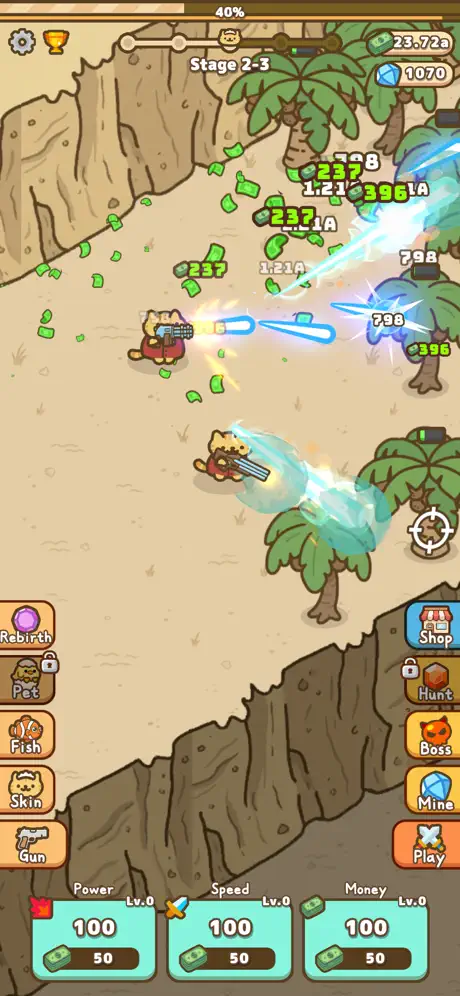
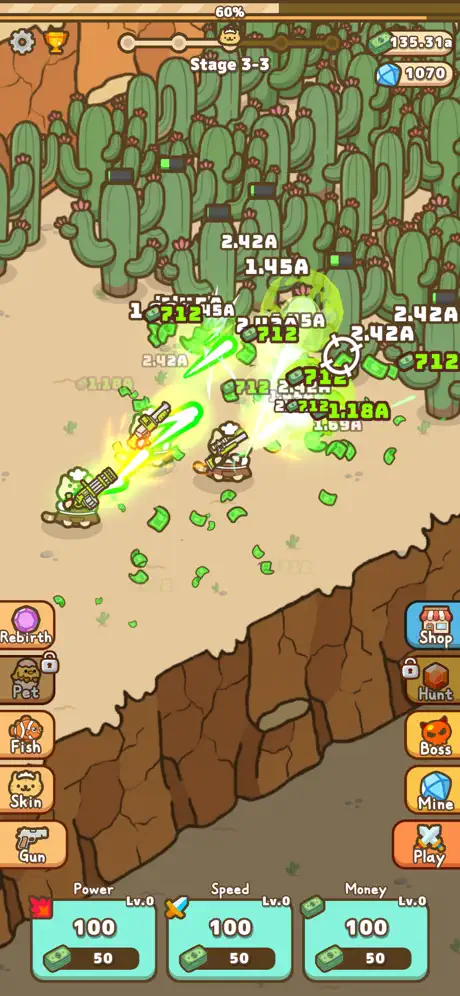
The game is about as stripped-down as idle RPGs get. Your cat shoots trees, trees drop resources, resources make your cat stronger. Hit a threshold, “reincarnate” for a permanent stat boost, and start the climb again. Controls are simple; the growth curve is the whole show.
When Neptune signed on, it identified the late game as the weak point and added an “Exploration” mode to give long-term players somewhere to go. It also layered in new monetization and its in-house ad-tech stack — which, judging by the numbers, is where much of the acceleration came from.



Small Team, AI-Assisted — With Few Details
Yusu Games built the title with a small team and used AI during development. How, where, and how much hasn’t been disclosed. For our AI-disclosure tracker, this goes in the “AI used, scope unspecified” column.
Neptune took over publishing in June. The company named hybrid-casual publishing one of three new business pillars this year, absorbed its subsidiary Triplla to bring development in-house, and launched an external publishing label, Flick, in March. Idle Cat Gunner is the first major win to come out of that push with an outside indie partner.

The Numbers (As Reported by Neptune)
- Retention: 50% Day-1, 25% Day-7, based on first-month new users after the publishing deal
- ROAS: peaked at 157%
- Daily revenue: ~₩7M at signing → ₩350M peak (roughly 50x, peak-to-start)
- Overseas share: 75% of revenue as of September
- US market: average daily revenue up to 16x higher than before marketing scaled up
Neptune CEO Kang Yul-bin framed the title as the first case that proves the hybrid-casual publishing model in hard numbers, adding that the company wants to position itself as a partner that helps small developers succeed globally. Neptune says it will keep leaning on Yusu Games’ fast development and decision-making for continued content updates.

An Expert’s Caution: The Cost Behind the Topline
Professor Jung Musik of Gachon University’s Department of Game and Film calls the numbers genuinely impressive — but warns indie developers not to get lost in them.
“Four months to ₩20 billion, with a ₩350 million peak day, is a remarkable result,” he said. “But I hope indie developers don’t become fixated on revenue figures alone. Once a game’s revenue potential is proven, scaling it up through a publisher’s marketing isn’t especially hard. What developers need to understand clearly is the structural limit: as the cost of acquiring paying users keeps rising, even games on the top-grossing charts frequently spend more than half their revenue on marketing during aggressive scale-up phases.”
So what should indies actually take from this? “It may sound a little clichéd,” Jung added, “but the lesson is that they paired a proven subject — cats — with the idle genre to generate early traction. On top of that, the developer made aggressive use of AI to respond quickly to shifts in the market. That’s the part worth paying attention to.”
Neptune’s own figures illustrate the point. A peak ROAS of 157% means that, at that moment, every ₩1 of ad spend returned about ₩1.57 in revenue — so roughly 64% of ad-attributed revenue was going straight back into ads. Add platform fees (typically 15–30%) and the developer–publisher revenue split, and ₩20 billion in gross bookings looks very different from what lands in the studio’s account. Industry-wide, analyst Matthew Ball estimates mobile publishers spend around 32% of net revenue on user acquisition on a weighted-average basis — but new titles in a scale-up push routinely run well above that.
Who This Is For
Players who enjoy low-friction idle progression with a reincarnation loop — and, more pointedly, small Korean teams weighing whether to hand monetization and user acquisition to a publisher with an ad-tech engine.
What to Watch For
Every figure here comes from Neptune. The ₩350 million is a single-day peak; average daily revenue hasn’t been released. The “50x” growth compares a peak against a starting baseline, which flatters the curve. Marketing spend and net margin haven’t been disclosed at all. And D7 retention of 25% is solid for the genre but tells us little about how the game holds at month three or six.
The Takeaway
The split-the-work model — indie team builds, publisher scales — keeps producing hits, and Idle Cat Gunner is a clean example of what happens when a sticky core loop meets aggressive UA and monetization tuning. But topline revenue is the easiest number to grow and the least informative one for a small studio. Whether this is a durable title or a well-optimized, expensive spike is the real question, and only longer-term data — including what it cost — will answer it.
Information regarding ‘Idle Cat Gunner: Shooter RPG’
| item | detail |
|---|---|
| Developer | Yusu Games |
| Publisher | Neptune |
| Genre | Idle Shooting RPG · Hybrid Casual |
| platform | mobile |
| Start of publishing | June 2026 |
| Key Features | Idle Growth, Reincarnation, Exploration |
| Cumulative sales | Surpassing 20 billion won |
| Highest daily sales | 350 million won |
| Proportion of overseas sales | 75% (as of September 2026) |
| Key Indicators | Day 1 retention rate 50%, Day 7 retention rate 25%, ROAS max 157% |
| Reactions and evaluations | Cumulative sales surpassed 20 billion won in just 4 months after launch (based on Neptune’s announcement) |
| Google Store Page | Shortcut |
| Apple Store Page | Shortcut |