The ‘demon king’ of indie teams is usually money.
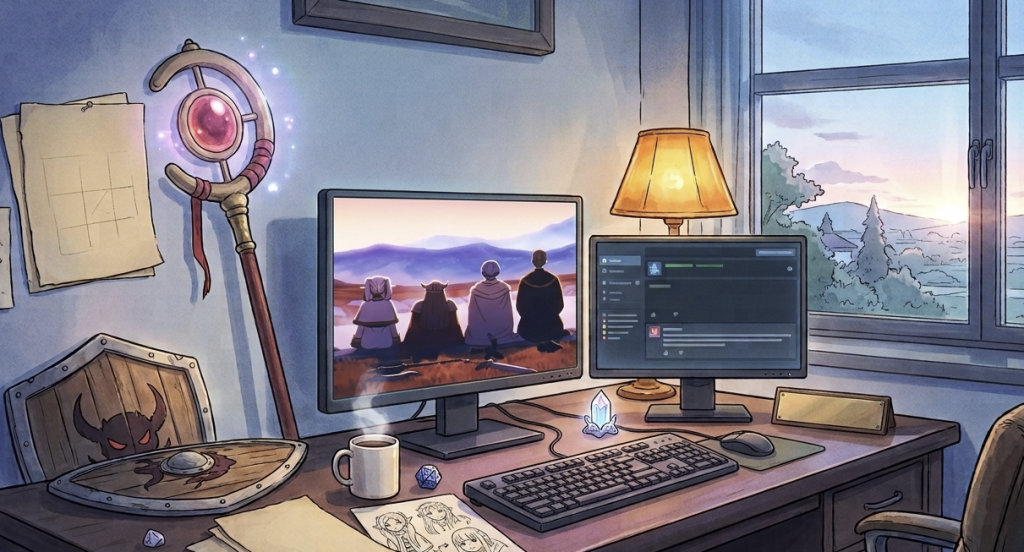
The goal of many indie game teams resembles a party of adventurers in a fantasy world: to subdue monsters and defeat the Demon King—in other words, to become famous and achieve great success, and ultimately to make money.
Of course, the purpose of running a company is clearly to pursue profit, and if you look around the game industry, there are certainly lucky teams that succeed instantly like winning the lottery. And just like the naive adventurer party in a fantasy novel, most indie teams vaguely expect publishing contracts and external investment while developing a game, and above all, harbor their own expectations that they can achieve great success with the game they are currently making.
A world where the map has changed
However, the reality is already different. According to the data analytics service Gamalytic, among the approximately 13,000 games released on Steam in 2025, more than 60% failed to generate even $1,000 in revenue, and about 40% failed to recoup even the $100 Steam listing fee. While the number of games released by AI is increasing explosively every moment, the number of users willing to open their wallets to purchase games is not growing.
In this environment, it is nearly impossible for indie developers to make money through half-baked and premature releases, and even well-made games that have invested significant capital and effort have a much higher chance of failure. To put it more bluntly, for indie developers, the moment money becomes the goal, most first game development projects become a failed journey.
What is the purpose of our game development?
Most fantasy stories race toward the moment the Demon King is defeated. The protagonist overcoming extreme situations, gathering companions, and finally standing before the final boss—that is the climax and the end of the story.
However, *Frieren of the Funeral* takes a completely different trajectory. The work begins with the hero’s party returning to the royal capital after defeating the Demon King. In other works, the first episode opens right where the ending credits would typically be rolling.
This story, in which Frieren, an elf mage who has lived for over a thousand years, retraces the journey she once took with her old companions, offers a realistic and grounded approach to heroic narratives. Above all, it is a fantasy masterpiece that portrays, with a lyrical yet delicate emotional tone, just how precious the small adventures shared with the companions by one’s side truly are.
The same applies to game development. Even without bringing up the tragic fates of countless lottery winners whose windfalls ended up ruining their lives, indie game development and the team’s goals must not be consumed by publishing, attracting investment, generating revenue, or obsessively designing monetization schemes.
Two reasons why sales should not be the goal
First, it is a matter of probability.
Being an indie is about selection and focus. Even if we fully concentrate on the simplest goals of content and entertainment, it is extremely difficult to be chosen by users amidst games from numerous major studios and sophisticated developers, as well as already proven masterpieces and blockbusters. Everyone wants to make money and relentlessly researches their own strategies. Yet, only a tiny minority are selected. Just as it is difficult for an amateur to beat a professional, it is equally challenging for an indie to generate dramatic revenue in today’s highly advanced market.
Second, it is the problem of shackles.
Publishing contracts and investments entered into when a game is still in a premature and unpolished stage, without its true value being properly recognized, all become shackles in the long run. Undervalued assets, unfavorable terms, and the pressure to adapt to someone else’s schedule rather than your own game. In rushing to defeat the Demon King quickly, you end up losing the identity and direction of your own party.
Adventure has meaning in itself.
Every adventure has meaning because I am with a companion right beside me.
Frieren, who refuses to give up the magic book inside the treasure chest even if it means being bitten by a mimic, and her companions often find it absurd that she is willing to take risks to collect seemingly useless magic.
However, as the story progresses, those ‘useless magics’ create moments that connect people. And above all, Frieren’s journey of realizing the value of companionship through adventure demonstrates a worth that can never be explained by efficiency alone.
The same applies to indie development. Things that seem inefficient by market logic, unconventional mechanics unique to the team, consistently uploaded development logs, and replies left for each and every user can become that team’s own ‘unique magic.’ The value of indie games that major players cannot imitate comes precisely from these moments.
What needs to be found first is not revenue, but ‘users’.
Therefore, indie developers should prioritize securing users for their game over revenue. Having users who enjoy your story and communicate with you—that is the starting point.
In the villages along the path Frieren walks once again, there are traces left by Himmel and his party decades ago. They are not grand and great battles, but small acts of kindness used to help the villagers. The people connected to them remember them, and that memory ultimately keeps the hero’s story alive.
The same applies to early users and small communities. They are the people who will remember your game and wait for your next story. If you have created a clear reason for users to enjoy your game, you can generate as much revenue as you want thereafter.
What is the significance of our development today?
The advice I always give to the CEOs of mid-sized game development companies and indie development teams is to “make today’s development with your team meaningful.” True happiness for an indie team does not come after signing a publishing contract, securing investment, or generating revenue.
Therefore, if you are an indie developer, today’s development with your colleagues must be enjoyable, or at least meaningful. Above all, we must be able to enjoy the very act of creating a new world together with users through the game. This is because, even if we fail to defeat the Demon King on this journey, whether it ends in failure or not ultimately depends on what our purpose was.
Written by: Professor Moo-Sik Jeong (Associate Professor, Department of Game & Video, Gachon University / Ph.D. in Engineering)
Who is Professor Jeong Mu-sik?
He is a first-generation Korean game developer who started as a founding member of Trigger Soft in 1994 and served as a director at NCSoft, an outside director at NASDAQ-listed company Gravity, and a vice president at Runosoft. Since planning and hosting Korea’s first indie game contest in 2003, he has maintained a long-standing interest in and support for the nurturing of domestic indie games. Currently, he serves as a member and director of the Game Rating and Administration Committee under the Ministry of Culture, Sports and Tourism, and as the head of the Content/Digital/Space subcommittee of the Seongnam City Special Committee on the 4th Industrial Revolution, striving for the development of the domestic game industry and the establishment of a sound culture.