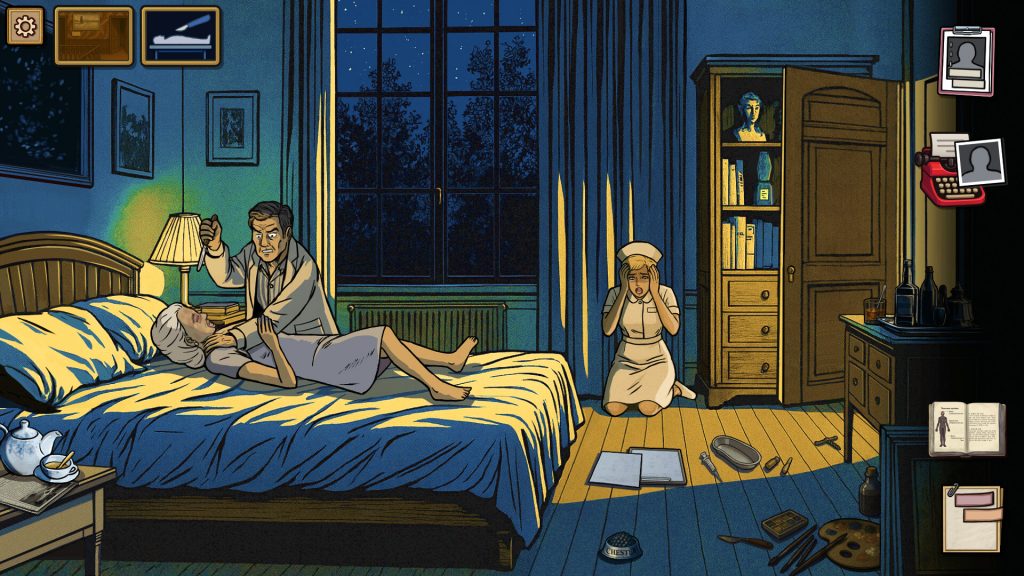
Who is the victim? Suicide or murder? The truth exists within the documents. Death at Fleming Manor, the forensic mystery adventure from Korean indie studio SUPERTHUMb, joins Steam Next Fest 2026 (June 15-22) with a demo that’s already generating substantial momentum — the kind of word-of-mouth that’s pushed its Steam wishlist count from 43,000 to over 52,000 in recent weeks.
Set in a grand manor near 1950s London, the game casts players as forensic investigators who examine crime scenes and — crucially — personally write death certificates and medical records based on collected evidence to approach the truth. Full release is scheduled for October 2026 on PC (Steam), with support for 9 languages, including English. The project has been gaining attention through the recent Steam Detective Fest, where player feedback drove its wishlist growth.
The Documents-as-Deduction Concept
The defining innovation of Death at Fleming Manor is its core philosophy: “the process of writing documents is itself the deduction.” This distinguishes the project fundamentally from conventional mystery games and represents genuinely fresh design thinking within the detective genre.
Most mystery games operate through dialogue choices, clue selection, or accusation mechanics — players gather evidence and then choose from presented options to identify culprits. Death at Fleming Manor takes a different approach. Rather than selecting from multiple-choice options, players must synthesize clues and testimonies gathered at the scene to personally determine the victim’s identity, cause of death, whether it was suicide or murder, and the existence of a perpetrator.
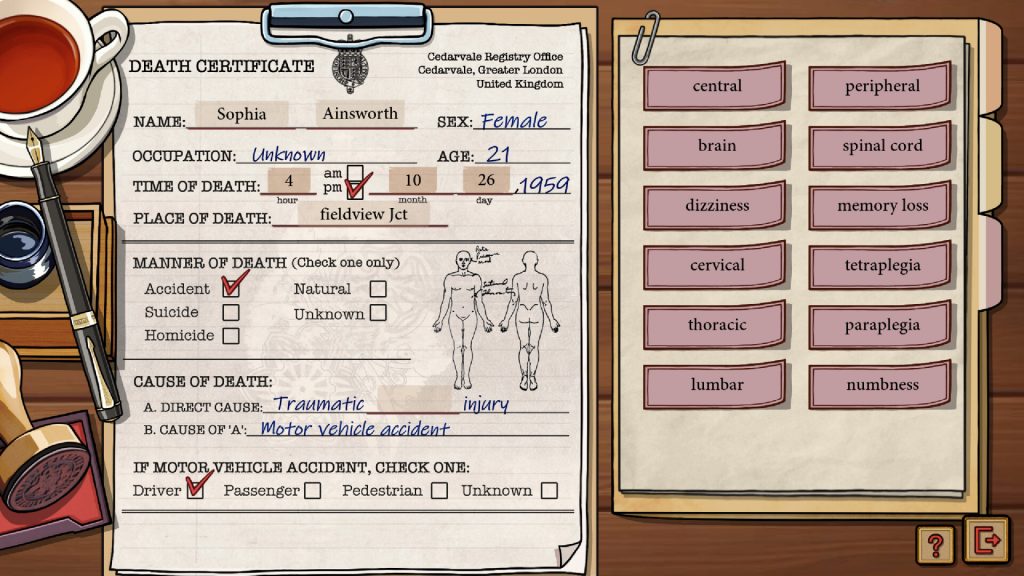
Every conclusion is recorded in a single official document. If players write the document with incorrect judgments, the truth of the case may be buried in darkness forever. The player’s reasoning ability directly determines the success or failure of the investigation. This makes the act of documentation the central gameplay mechanic rather than just a narrative framing device.
This design philosophy demands genuine deductive engagement. Players can’t brute-force their way through by trying every dialogue option — they must actually understand the evidence, reason about cause and manner of death, and commit to conclusions through the official documentation. The death certificate becomes the player’s thesis statement, and getting it right requires genuine forensic reasoning.
This approach respects player intelligence in ways that hand-holding mystery games don’t. By requiring players to reach and document their own conclusions rather than selecting from provided options, Death at Fleming Manor creates the kind of authentic detective experience that the genre’s best entries achieve.

The Obra Dinn and Golden Idol Lineage
The developers explicitly cite Return of the Obra Dinn and The Case of the Golden Idol as primary inspirations, and these references precisely position Death at Fleming Manor within a specific and beloved sub-genre of deduction games.
Return of the Obra Dinn (Lucas Pope, 2018) revolutionized deduction gaming by requiring players to determine the fates of an entire ship’s crew through careful observation and logical inference, recording conclusions in a logbook. The game’s brilliance was making players genuinely deduce rather than just follow clues — the satisfaction came from reasoning through evidence to reach conclusions the game never explicitly stated.
The Case of the Golden Idol extended this design philosophy, presenting scenes that players must analyze to reconstruct events, identifying people and actions through careful observation and logical synthesis. Both games share a commitment to genuine deduction over guided investigation.
Death at Fleming Manor operating in this lineage signals serious design ambitions. These are among the most respected deduction games of recent years, specifically because they trust players to think. The forensic documentation mechanic — writing death certificates based on evidence synthesis — fits naturally into this tradition while adding its own distinctive twist. Where Obra Dinn used a logbook and Golden Idol used fill-in-the-blank reconstruction, Death at Fleming Manor uses official forensic documentation.
For fans of these specific games — a passionate audience that has been hungry for more games in this style — Death at Fleming Manor represents exactly the kind of project they’ve been waiting for. The deduction game sub-genre remains relatively underserved despite its dedicated following, making each quality entry significant.

The 1959 Setting and Noir Aesthetic
The setting at Fleming Manor, a grand estate near London in 1959, provides both atmospheric foundation and gameplay-relevant context. The period setting places the forensic investigation in an era before modern DNA analysis and digital forensics — when investigation depended on careful observation, medical knowledge, and logical reasoning rather than technological analysis.
This period choice is design-relevant rather than just aesthetic. 1950s forensic investigation required exactly the kind of human deductive reasoning that the game emphasizes. Without modern forensic technology, investigators had to reason from physical evidence, medical knowledge, and circumstantial information — precisely the cognitive work that Death at Fleming Manor asks players to perform.
The visual approach draws inspiration from 1960s American detective comics and Agatha Christie-style classic mystery novel illustrations. The black-and-white and sepia-toned color composition, the fog-shrouded English manor, and the detailed interior spaces effectively convey the atmosphere characteristic of classic mystery.
This aesthetic choice serves the experience well. Classic mystery has a specific visual vocabulary — the grand manor, the fog, the shadows concealing secrets, the period detail — and Death at Fleming Manor embraces this tradition fully. The forensic document formats themselves reflect period accuracy, enhancing immersion through historical authenticity. Players aren’t just solving abstract puzzles; they’re inhabiting a specific time and place where the documentation they create matches the era’s actual forms.
The audio design philosophy — “every sound can be a clue” — reinforces the careful-observation gameplay. Ambient sound enveloping the quiet manor and detailed environmental audio maintain tension that ensures players don’t miss even small clues. This audio approach makes attentive listening part of the investigation, extending the deductive engagement beyond visual evidence to the full sensory environment.
The Forensic Investigation Distinctiveness
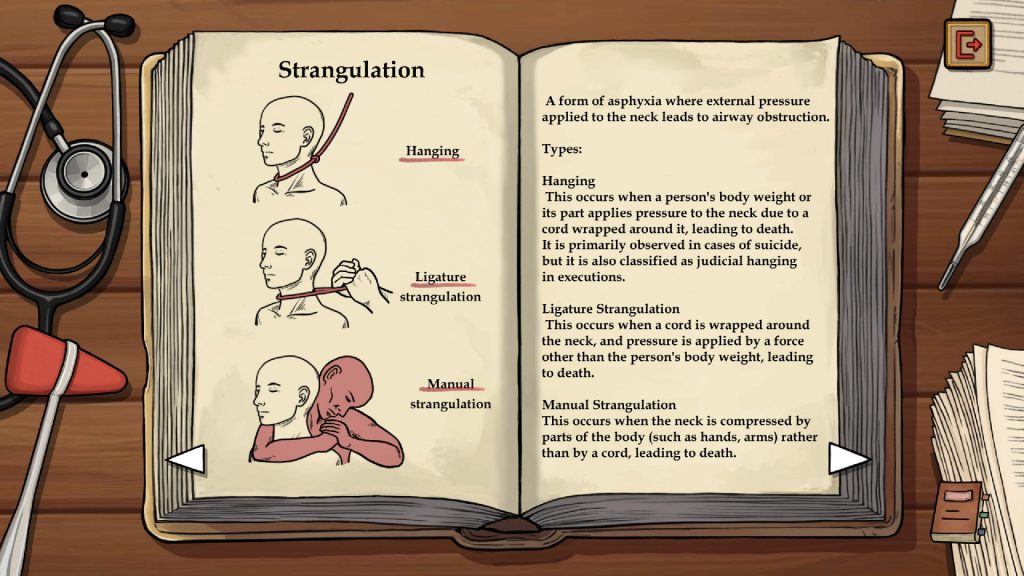
What sets Death at Fleming Manor apart from its inspirations is the specifically forensic angle. Where Obra Dinn dealt with determining identities and fates and Golden Idol with reconstructing events, Death at Fleming Manor focuses on the forensic specifics — cause of death, manner of death (the suicide-versus-murder determination), victim identity, and perpetrator existence.
This forensic focus provides a distinctive gameplay texture. Determining the cause of death requires medical reasoning — understanding how different causes produce different physical evidence. Distinguishing suicide from murder requires analyzing the evidence for consistency with each scenario. These are specific forensic skills that the game asks players to develop and apply.
The death certificate, as the central document, is a brilliant framing device. Death certificates are real documents with real fields — cause of death, manner of death, time of death, and identity of the deceased. By making players complete these official forms, the game grounds its deduction in authentic forensic practice. The documentation isn’t an arbitrary game mechanic; it mirrors actual forensic procedure.
The serial mysterious deaths premise (the game deals with consecutive suspicious deaths at Fleming Manor) provides escalating complexity. Multiple connected deaths create the kind of layered mystery where individual determinations contribute to understanding a larger pattern. Each death certificate becomes a piece of a larger puzzle about what’s happening at Fleming Manor.
The Community-Responsive Development
The development team’s responsiveness to community feedback has been notable. The demo revealed at Steam Detective Fest received positive reactions from mystery game fans, who praised the original forensic deduction concept and high immersion while expressing anticipation for full release.
Simultaneously, players offered improvement suggestions regarding clue collection tempo and game progression speed. The development team actively accepted this feedback, implementing improvements originally planned for later updates early into the demo version. They also plan to add options for adjusting dialogue and text display speed.
This responsiveness reflects healthy development practice. Mystery games particularly benefit from pacing refinement — the balance between providing enough information and overwhelming players, between maintaining tension and creating frustration, requires careful tuning that player feedback helps achieve. SUPERTHUMb’s willingness to accelerate planned improvements based on feedback signals development discipline that bodes well for the final product.
The Next Fest demo includes a tutorial chapter and Episode 1, providing the latest build with various improvements over previous versions. This gives Steam Next Fest participants access to the refined experience that incorporates Detective Fest feedback, demonstrating the iterative improvement the team has pursued.
The SUPERTHUMb Context
SUPERTHUMb is a Korean indie development team with previous mobile releases including Animal Hot Springs and Animal Theater. Death at Fleming Manor represents their latest project and a significant evolution in both genre and ambition.
The transition from cozy mobile games (Animal Hot Springs, Animal Theater) to sophisticated forensic mysteries represents a notable creative range. This evolution demonstrates the studio’s willingness to pursue substantially different creative territory rather than staying within established comfort zones. The forensic deduction genre requires entirely different design skills than cozy mobile games — complex systems, careful pacing, deductive puzzle design.
For Korean indie gaming specifically, Death at Fleming Manor represents another example of Korean studios pursuing internationally appealing concepts with global market ambitions. The 1950s English manor setting, the 9-language localization, and the explicit positioning toward Obra Dinn and Golden Idol fans all signal international rather than purely domestic ambitions.
The choice to set the game in 1950s England rather than Korea is itself interesting. Rather than emphasizing Korean cultural specificity (as many Korean indie projects do), SUPERTHUMb has chosen a setting with universal classic-mystery appeal. This reflects a strategic understanding that the deduction game audience responds to classic mystery aesthetics, and the English manor setting provides exactly the atmosphere that the audience appreciates.
The Korean Indie Mystery Moment
Death at Fleming Manor contributes to the growing diversity of Korean indie gaming’s international presence. Where recent coverage has highlighted Korean cozy games (Monsterest, Kimbap Heaven Simulator), Korean narrative games (Dystopia: Vinca’s Diary), and various other genres, Death at Fleming Manor demonstrates Korean indie’s expansion into sophisticated deduction gaming.
This genre diversity reflects Korean indie’s maturation. Rather than concentrating in specific genres, Korean indie developers are pursuing the full range of gaming categories — including demanding genres like forensic deduction that require sophisticated design. Death at Fleming Manor, competing seriously in the Obra Dinn lineage, demonstrates Korean indie’s growing capability across diverse creative territories.
The 52,000+ wishlist accumulation signals that the international deduction game audience has noticed. For a Korean indie studio working in an internationally beloved sub-genre, this wishlist count represents meaningful pre-release validation that the concept resonates beyond domestic boundaries.
Who This Is For
Strong fit for: deduction game enthusiasts (Return of the Obra Dinn, The Case of the Golden Idol fans); classic mystery lovers (Agatha Christie, Arthur Conan Doyle readers); players who enjoy genuine reasoning over guided investigation; forensic and medical mystery enthusiasts; noir aesthetic appreciators; interactive fiction fans; players seeking intellectually demanding gameplay; anyone who appreciated the documentation-based deduction of Obra Dinn.
Cautious fit for: players who prefer action over contemplative deduction; anyone who finds careful evidence analysis tedious rather than engaging.
Less ideal for: players seeking fast-paced gameplay; anyone who dislikes reading and careful observation; players who prefer guided investigation with clear, correct-answer feedback.
What to Watch For
A few questions will shape Death at Fleming Manor‘s October 2026 release.
The first is whether the documentation mechanic sustains engagement across the full game. The death certificate writing is brilliant as a concept; whether it remains satisfying across multiple cases without becoming repetitive will determine the full experience’s quality.
The second is the difficulty of calibration. Deduction games face the challenge of being satisfying without being frustrating — too easy and the deduction feels hollow, too hard and players get stuck. How well Death at Fleming Manor calibrates this balance will significantly affect reception.
The third is the pacing refinement. The community feedback specifically identified clue collection tempo as needing improvement. Whether the implemented and planned pacing adjustments achieve the right flow will affect the overall experience.
The fourth is the mystery quality across episodes. The serial deaths structure requires each case to be individually satisfying while contributing to the larger pattern. Whether the writing maintains quality and the mysteries remain engaging across the full game will determine lasting appeal.
The Takeaway
Death at Fleming Manor is one of the more promising deduction games on the horizon, combining genuinely fresh design thinking (documentation-as-deduction), respected genre lineage (Obra Dinn and Golden Idol inspiration), distinctive forensic focus (death certificate writing as core mechanic), and atmospheric classic mystery presentation (1950s England, noir aesthetic).
For deduction game enthusiasts specifically, this is a clear demo-first recommendation during Steam Next Fest. The genre’s dedicated fans have been hungry for more games in the Obra Dinn style, and Death at Fleming Manor‘s forensic documentation approach offers exactly the kind of genuine deduction experience they appreciate, with a distinctive twist that sets it apart from its inspirations.
For classic mystery lovers, the Agatha Christie and Arthur Conan Doyle inspirations, combined with the period English manor setting, provide exactly the atmosphere they appreciate. The forensic investigation angle adds intellectual engagement that pure atmospheric mystery couldn’t achieve.
For Korean indie gaming observers, Death at Fleming Manor demonstrates Korean indie’s expansion into sophisticated deduction gaming with international ambitions. The studio’s evolution from cozy mobile games to demanding forensic mysteries reflects the creative range and ambition that characterizes Korean indie’s continued maturation.
A grand manor near London in 1959. Serial mysterious deaths demand an investigation. A forensic investigator who must examine evidence, reason about cause and manner of death, and commit conclusions to official documentation. Death certificates that become the player’s thesis statements. The constant possibility that an incorrect judgment buries the truth forever. Black-and-white and sepia atmosphere drawn from classic detective comics and mystery novel illustrations.
As deduction game pitches go, Death at Fleming Manor‘s is one of the more genuinely intriguing of 2026 — and the Steam Next Fest demo (June 15-22) provides immediate hands-on access to evaluate whether the documentation-as-deduction concept delivers the genuine reasoning satisfaction that Obra Dinn and Golden Idol fans treasure. The manor holds its secrets. The bodies await examination. And the truth exists within the documents you write.
Fill out the death certificate carefully. Get it right, and the truth comes to light. Get it wrong, and the darkness keeps its secrets. In Death at Fleming Manor, your reasoning is the only thing standing between justice and oblivion.
Information regarding ‘Death at Fleming Manor’
| item | detail |
|---|---|
| Developer / Publisher | SUPERTHUMb (South Korea) |
| Genre | Forensic Mystery Adventure / Mystery / Interactive Fiction / Noir |
| Release platform | PC (Steam) |
| Scheduled for official release | October 2026 |
| Steam Wishlist | Over 52,000 cases |
| Steam Next Fest | Participation in June 15–22, 2026 |
| Demo content | Tutorial Chapter + Episode 1 |
| Supported languages | 9 languages including English |
| Source of inspiration | Return of the Obra Dinn / The Case of the Golden Idol / Agatha Christie / Arthur Conan Doyle |
| Main Keywords | Forensic science, death certificate, mystery, noir, 1950s Britain, comic art, classic mystery |
| Steam Page | Shortcut (Add to Wishlist) |
| Steam Demo Page | Shortcut |