Cozy game sequels are dangerous territory. The genre lives or dies on tone, and the studios that nail tone once often struggle to find it again when the pressure of expectations gets involved. Spellgarden Games — the small team behind 2023’s Sticky Business, which has accumulated over 4,000 Overwhelmingly Positive reviews on Steam — has come back swinging anyway. Their new game, Thrifty Business, launched May 18 to a 95% Positive opening reception, and the most common note from press and players is the same one: this one’s actually better.
That’s a sentence the studio probably didn’t expect to hear, and one worth taking seriously.
A Thrift Store You Actually Want to Build
The premise is exactly what the title says. You run a thrift store. You buy mystery boxes of secondhand goods — kitchen items, clothing, books, household oddities — and you don’t get to pick what’s inside. You open them, you decide what’s worth shelving, and you arrange it however you want.
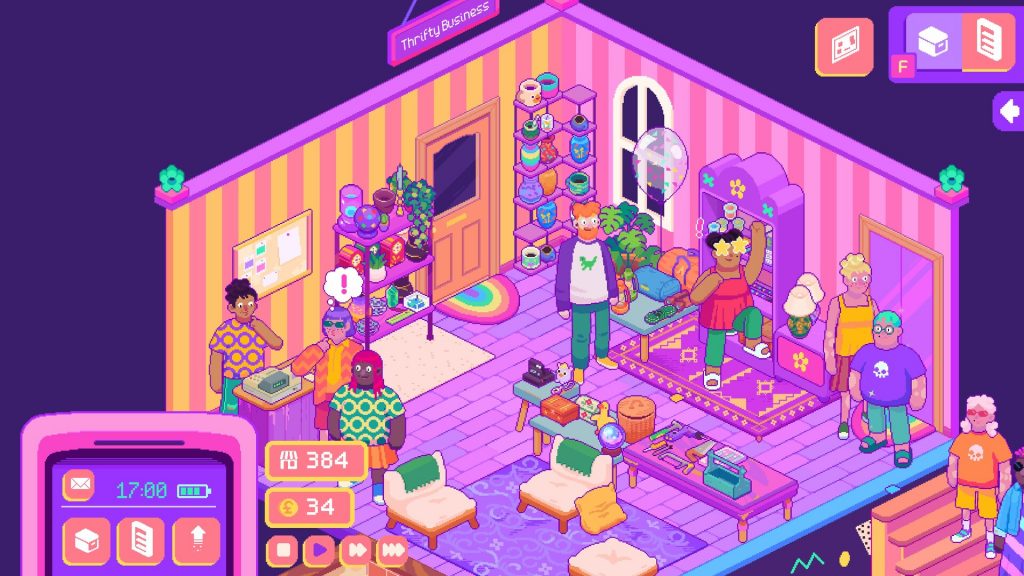
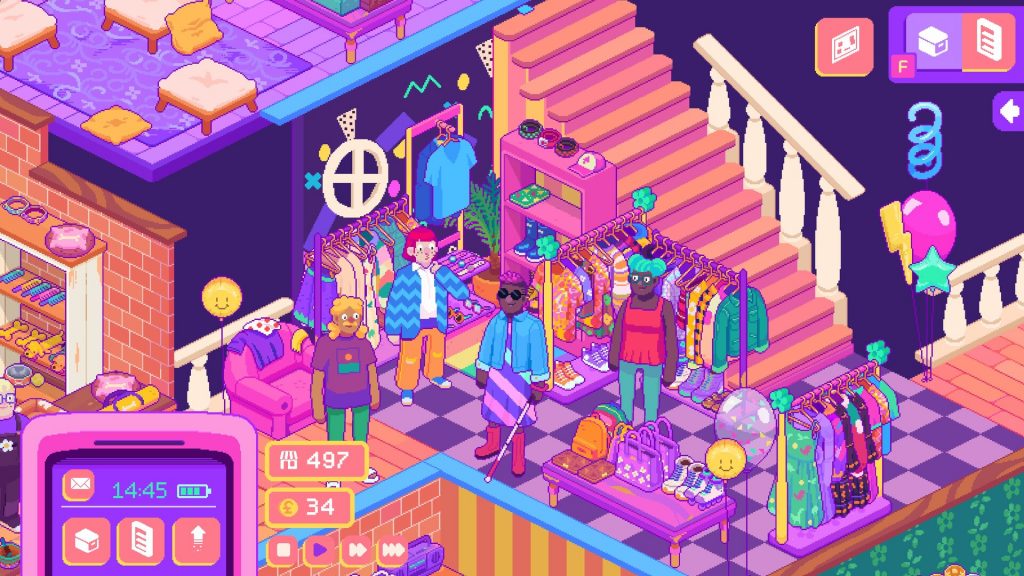
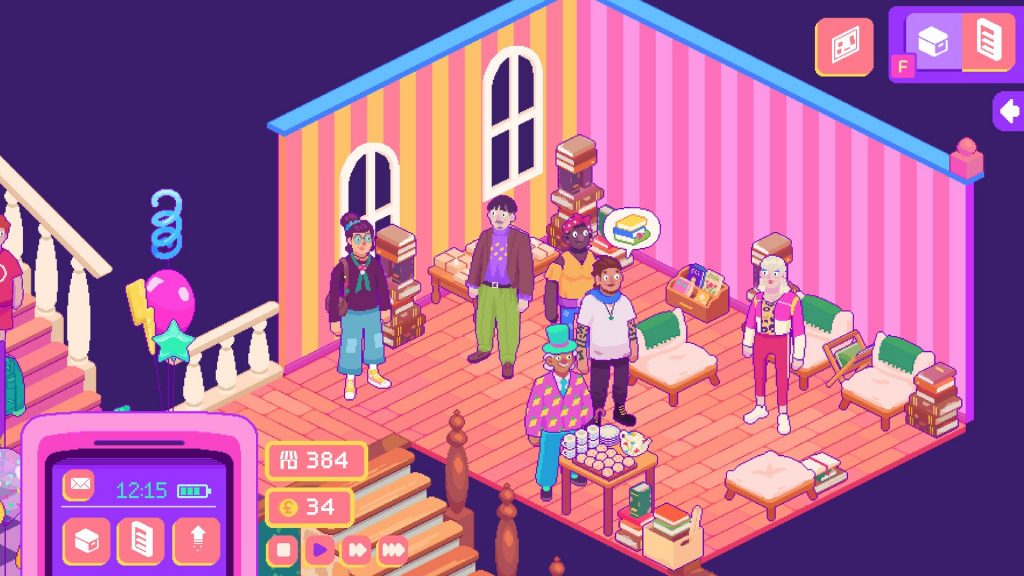
That last part is where the game lives. Spellgarden’s signature “maximalist aesthetic” — colorful, layered, deliberately overstuffed — translates beautifully to a thrift store setting in a way that Sticky Business‘s sticker shop couldn’t quite reach. The sticker design was about isolated objects on a clean canvas. A thrift store is about everything together: shelves, racks, displays, themed corners, the visual chaos of a well-loved local shop where every inch has a personality. The setting is doing more design work than the previous game’s setting did, and the team clearly knows it.
500+ hand-drawn items, an isometric perspective, and a confidently ’90s pixel palette do the rest. The shop you build becomes yours legibly within a few hours — not just because of the layout, but because the act of curation forces you to make taste decisions. What goes in the witch’s corner? What belongs in the colorful zone you’ve quietly set aside for queer customers? Which weird book do you display face-out and which do you spine-shelve? These choices accumulate into something that feels like an actual store rather than a placement puzzle.
The Mystery Box as a Design Engine
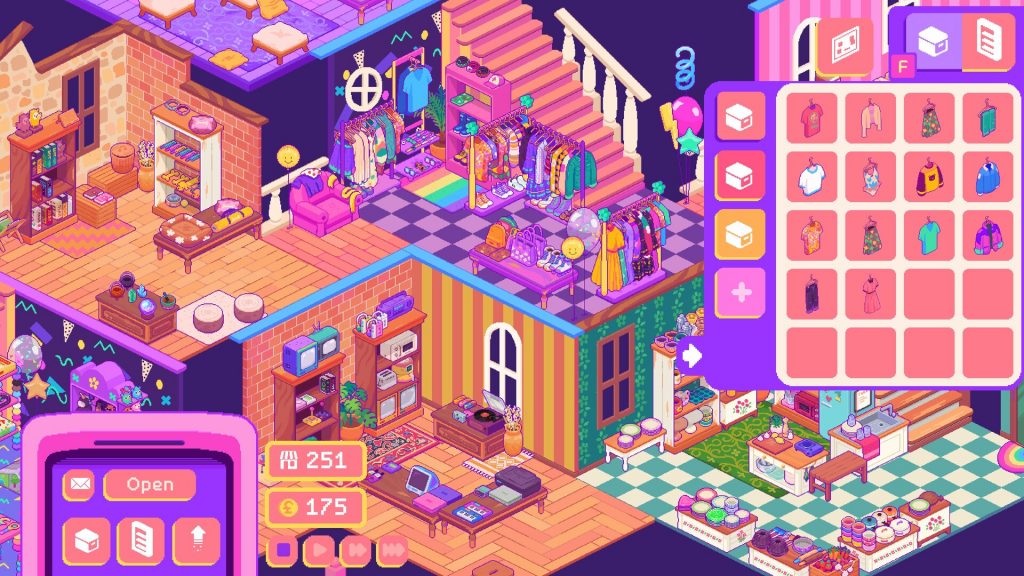
The decision to randomize incoming inventory is the smartest mechanical choice in the game. You buy a category — clothing, books, kitchenware — and you open the box without knowing what’s inside. It’s a small loop, but it gives every restocking session a tiny kick of anticipation that pure-purchase systems can’t replicate.
It also solves the design problem cozy shop games tend to stumble into. When players can pick exactly what they sell, the curation challenge collapses; you just optimize for what’s profitable. Thrifty Business keeps the constraint honest. You work with what arrives, you make it look good, and the creative satisfaction comes from arrangement rather than acquisition.
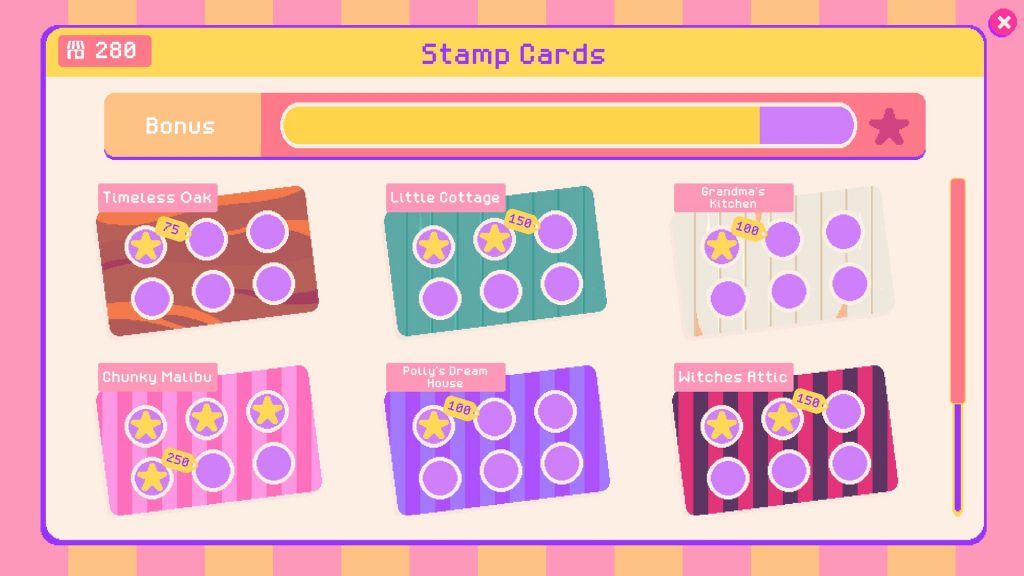
The theme-based layout system layers community points and progression rewards onto this, which sounds like it could undercut the freeform feel, but mostly doesn’t. The rewards are gentle enough to suggest direction without turning interior design into a checklist.
A Store That’s Actually a Community Space
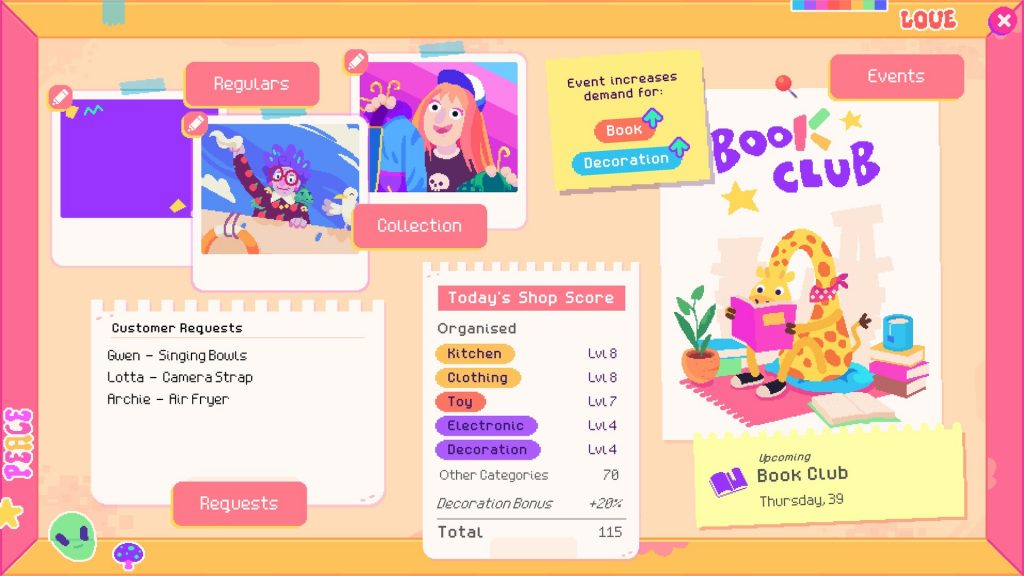
This is where Thrifty Business meaningfully departs from its predecessor. The shop isn’t just a retail space — it’s a community hub. You can host book clubs, queer date nights, grief support groups, and other events that draw recurring customers and slowly turn the store into a neighborhood fixture.
It’s a small structural choice with surprisingly large emotional consequences. Most cozy shop sims position the player as a service provider to anonymous customer demand. Thrifty Business positions the player as someone holding space for a specific community. The shop becomes a place where people show up to be around other people, and the player’s role shifts from optimizing transactions to maintaining something that matters to a small group.
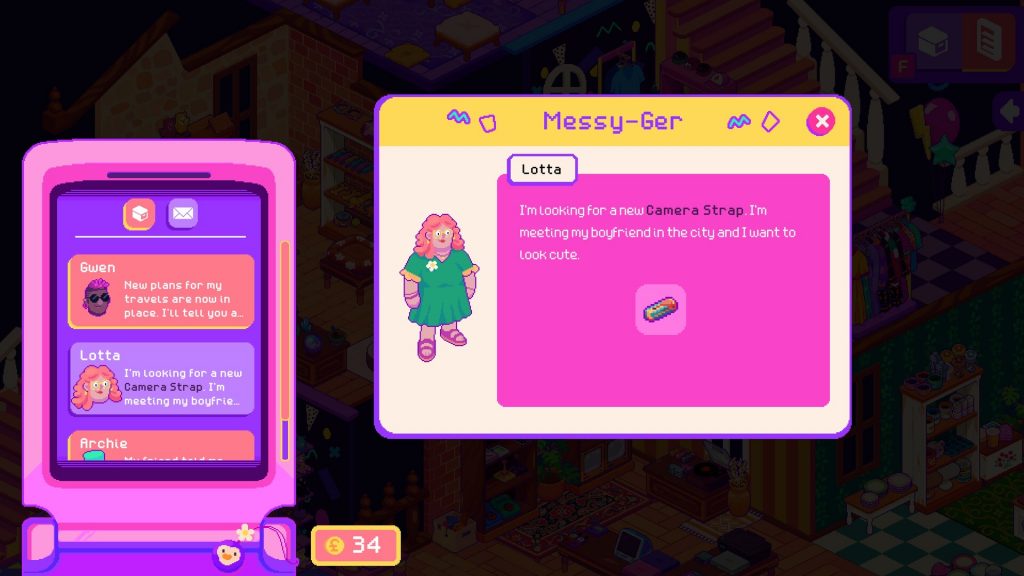
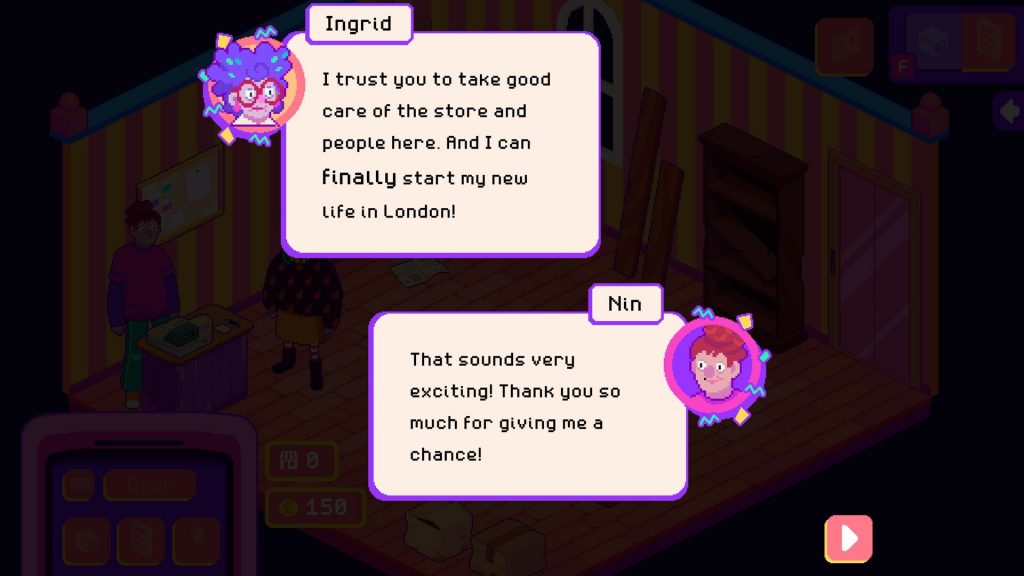
The regular system reinforces this. Some characters carry their own narrative arcs that surface through dialogue, special orders, and repeat visits. The writing ranges from light and warm to unexpectedly affecting, and the studio’s restraint shows: nothing is pushed too hard, and the heavier moments earn their weight by not arriving every five minutes.
The inclusion of a grief support group as a standard event option is particularly notable. That’s not a cozy genre default. It’s a signal about what kind of game Spellgarden wanted to make — one that takes seriously the role that physical neighborhood spaces play in actual community life, including the harder parts.
Where It Stumbles
It would be dishonest to write this review without flagging the most consistent criticism. GameSpew and others have noted that the game’s structural loop — buy boxes, sort, stock, sell, repeat — eventually reveals its repetitiveness, particularly as the shop scales up. More space means more shelves to fill, which means more boxes to open and sort, and the satisfaction curve of that loop is not infinite.
The counter to that criticism, which the same reviewers acknowledged, is that Thrifty Business is best played in short sessions rather than marathon runs. As an hour-here-and-there cozy game, the repetition reads as comfort. As a 60-hour deep-dive, it becomes more visible. Knowing which kind of player you are matters more here than for most games in the genre.
There’s also a fair question about whether the community event system has enough mechanical depth to sustain interest across the full game. The events are charming and well-written, but they function more as flavor than as systems you optimize around. Players hoping for deeper management complexity may find the event layer lighter than they expected.
These aren’t dealbreakers. They’re calibration notes for who the game is really for.
How It Compares to Sticky Business
The “Thrifty Business is better than Sticky Business” line is worth taking apart, because it’s an unusual thing to say about a sequel from a small studio.
The case for it: the setting gives the maximalist aesthetic more room to breathe, the community-space framing adds emotional weight the original couldn’t reach, and the regulars-with-narrative-arcs system is a meaningful step up from the original’s customer interactions. The mystery box system also adds a small but real loop of anticipation that wasn’t there before.
The case against it: Sticky Business had a focus and tightness that Thrifty Business‘s broader scope occasionally dilutes. Players who specifically loved the sticker-design specificity of the first game may find the thrift store’s wider remit less satisfying for the same reasons it’s more emotionally resonant.
Both opinions are defensible. What’s clear is that this isn’t a coast on the success of the original. Spellgarden built something with genuine new ambition, and it shows.
A Studio Worth Following
Spellgarden Games is five people — Kathrin, Sophie, Zoë, Kasimir, and Malin — and Thrifty Business is their third release, following Sticky Business (2023) and Ritual of Raven. The team first revealed Thrifty Business at the Wholesome Snack showcase in December 2025 and has been communicating openly with their community throughout development, which is reflected in how the game feels: considered, inclusive, and shaped by the kind of small details that come from listening.
The inclusive sensibility runs through the whole project. The queer date night events, the diverse regulars, the gentle handling of harder emotional material — none of it is performed. It’s just there, woven into the game’s understanding of what a community space actually looks like. Community reactions reportedly include players buying the game to celebrate their own graduations, which is the kind of off-script response cozy games earn only when they feel genuinely warm rather than just aesthetically warm.
Who Should Play It
Strongly recommend for: fans of Sticky Business, cozy game players who want emotional substance alongside the comfort, anyone drawn to community-space narratives, players who enjoy maximalist visual design and decorating without pressure.
Less ideal for: players who need clear progression goals, anyone who finds restocking loops tedious rather than meditative, players who want deeper management complexity than the game is interested in providing.
The Verdict
Thrifty Business is what a cozy sequel should be: confident enough to expand the scope, careful enough not to lose the tone, and emotionally smarter than its predecessor in ways that matter. The 95% Positive launch reception isn’t a fluke or a fanbase carryover. It’s a fair reflection of a small studio doing exactly what small studios should do — making a follow-up that’s recognizably theirs while genuinely growing.
There’s a real conversation to be had about whether the repetition holds up across long playthroughs, and that’s a fair question. But for the way this game wants to be played — in unhurried sessions, returning to a space you’ve built for people you’ve come to recognize — Thrifty Business delivers something the cozy genre doesn’t always manage: actual warmth, not just the aesthetic of it.
Information regarding ‘Thrifty Business’
| item | detail |
|---|---|
| Developer / Publisher | Spellgarden Games (Kathrin, Sophie, Zoë, Kasimir, Malin) |
| Genre | Cozy Shop Management Simulation / Life Simulation / Casual |
| Release platform | PC·Mac (Steam) / Steam Deck Official Verification |
| Release date | May 18, 2026 |
| price | $12.99 (10% off until June 1: $11.69) |
| Steam Review | Very positive 95% (96 items) |
| Art style | 90s Vibe Colorful Pixel & Hand-Draw / Isometric |
| Content | 500+ Items / Events (Book Club · Queer Date Night, etc.) / Custom Interior |
| Developer’s previous work | Sticky Business (2023) · Ritual of Raven |
| Language support | 9 languages, including Korean, English, French, German, Spanish, Japanese, Chinese, and Portuguese |
| Main Keywords | Cozy, second-hand shop, vintage, community, 90s, organizing, LGBTQ+ inclusion |
| Official Channel | Discord · Bluesky · TikTok · YouTube · X |
| Steam Page | Shortcut |