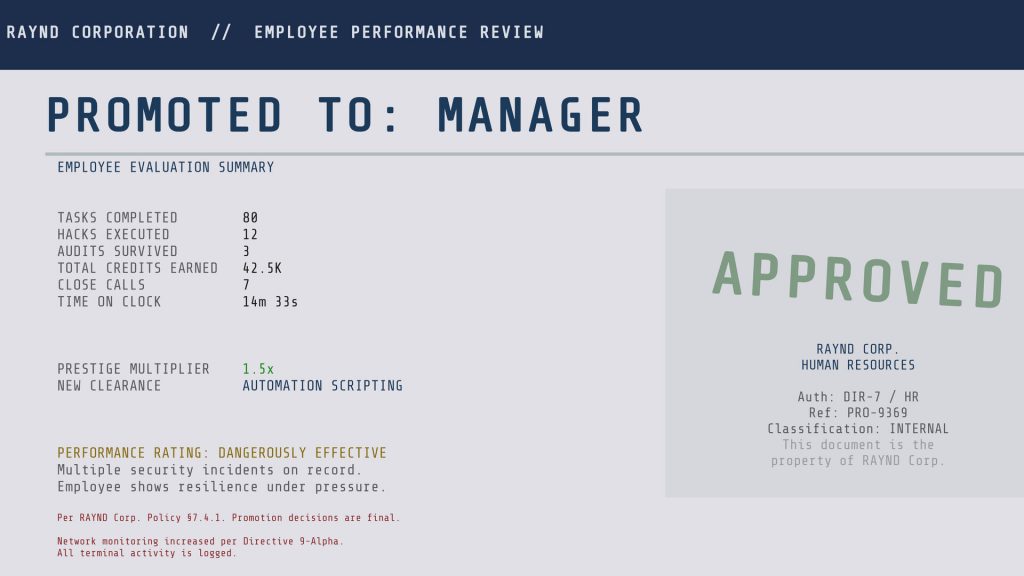
By day, you submit reports, sync databases, and survive performance reviews at RAYND CORPORATION. At night, you log in to a different terminal and start stealing the company’s data. Remain At Your Desk, the debut commercial release from New York-based solo developer Jared D., is a cyberpunk incremental clicker built around that double life — and based on the newly released demo, it’s one of the more conceptually ambitious entries the genre has seen in a while.
The demo dropped on Steam May 19, and a full release is targeted for the back half of 2026.
The Genre, Reframed
Incremental clickers are an unusual genre to build a narrative project around. The form tends toward pure mechanical satisfaction — numbers going up, automation layers stacking, prestige resets opening new optimization puzzles. Story is typically decorative. Remain At Your Desk takes the opposite approach: the incremental structure is in service of a corporate dystopia, and the clicking becomes the lived texture of the dystopia itself.
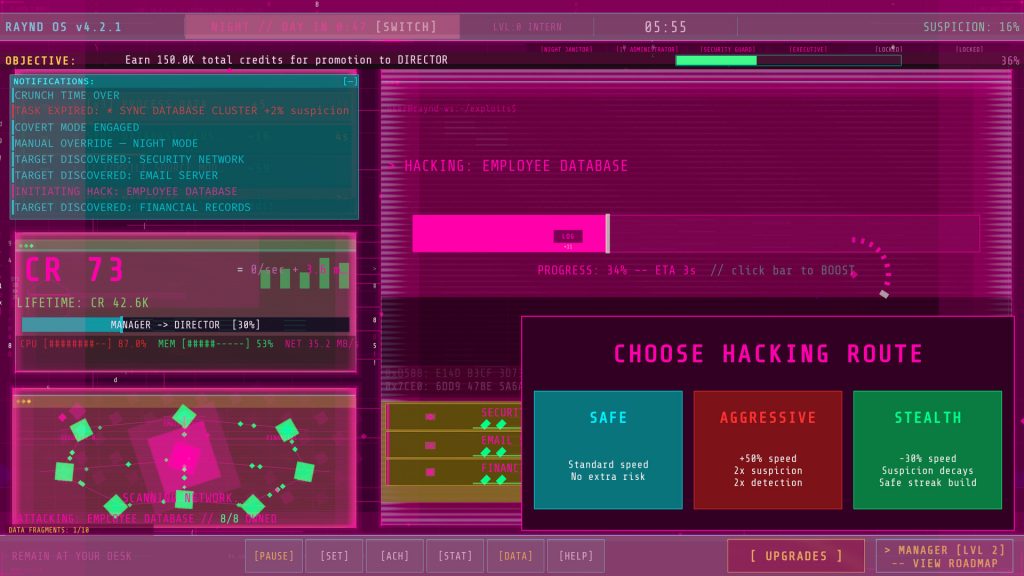
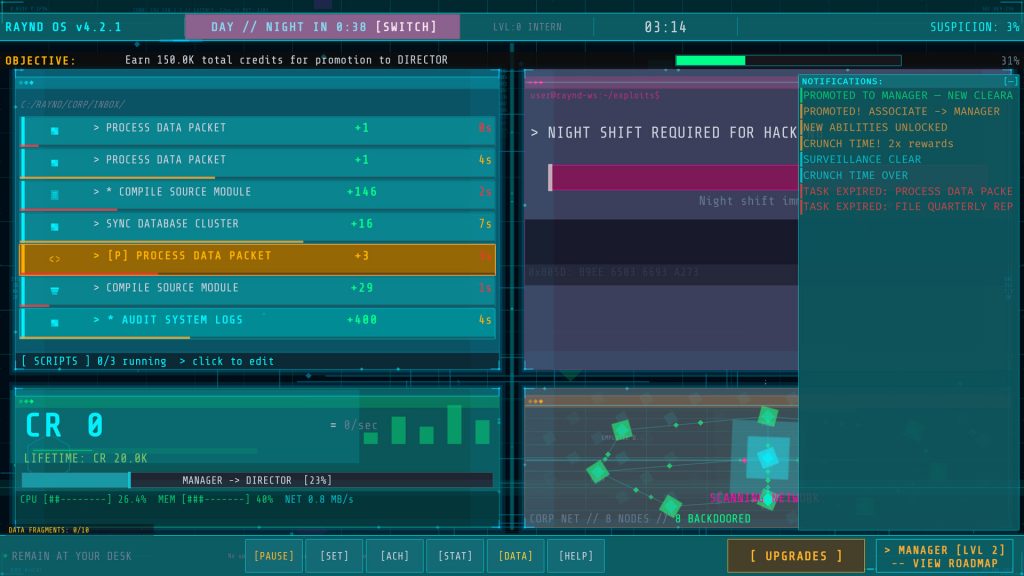
The day/night split is the central design move. Daytime is cold, regulated, bureaucratic — a sterile terminal UI rendering the daily indignities of corporate compliance into a working interface. Reports get submitted. Databases get synced. Performance gets reviewed. Then the screen shifts at night into a darker hacking terminal where you pick infiltration paths, route around firewalls, and pull data out of the same company you spent the day serving.
What’s smart about this isn’t just the contrast. It’s that both halves are real systems with real consequences for each other. The corporate work generates the credits that fund automation and upgrades; the hacking generates the rarer Intel currency that powers a separate upgrade tree. The economies feed different parts of the progression structure, which means optimizing for one half of your life eventually requires optimizing for the other. The double life isn’t narrative flavor. It’s a load-bearing mechanic.
The Persona System Is the Hook
The cleverest piece of design in the demo is the persona system. When you hack, you do it disguised as someone — a janitor, an IT administrator, a consultant — and each persona carries different stats, risks, and access patterns. The temptation is to lean on whichever persona is strongest, but staying in one identity too long raises your exposure: people start to notice, suspicion accumulates, and audit risk climbs.
That tradeoff turns persona selection into a continuous strategic problem rather than a one-time build choice. You’re not picking the best class; you’re rotating through identities like an actual operative, balancing efficiency against the friction of staying unrecognized.
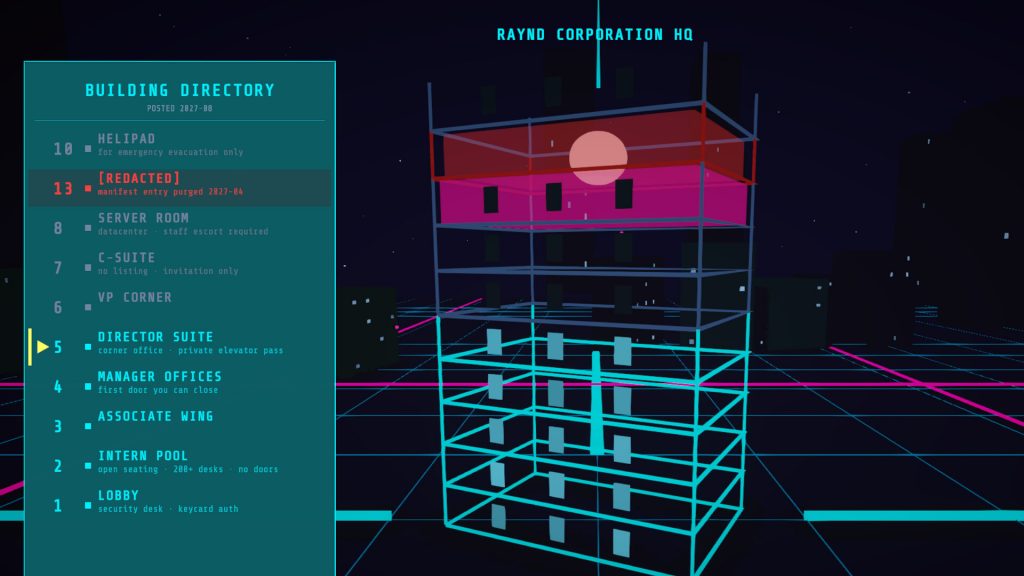
When suspicion does climb too high, the game asks you to handle it the way a corporate insider would — falsifying reports, deleting logs, paying off witnesses to make memories disappear. A single failed audit can collapse your character from senior position back down to intern status, which is one of the more thematically resonant fail states in recent memory. You don’t die. You just get demoted into the surveillance machine you were trying to outmaneuver.
Information as Currency
The other system worth highlighting is the dossier mechanic. Repeated hacks on the same target accumulate information that persists across resets. Email servers reveal internal relationships. Security networks reveal surveillance blind spots. Executive data reveals how the corporate machine actually functions underneath the public-facing hierarchy. None of this is consumable; it stays with you, becoming permanent leverage that shapes future runs.
This is a genuinely interesting reframing of the prestige loop. Traditional incrementals reset you to zero with accumulated multipliers. Remain At Your Desk resets you to zero with accumulated knowledge — and the knowledge is the multiplier. It maps the genre’s core mechanic onto something that feels like espionage rather than abstract optimization, and it gives long-term play a thematic continuity most incrementals can’t manage.
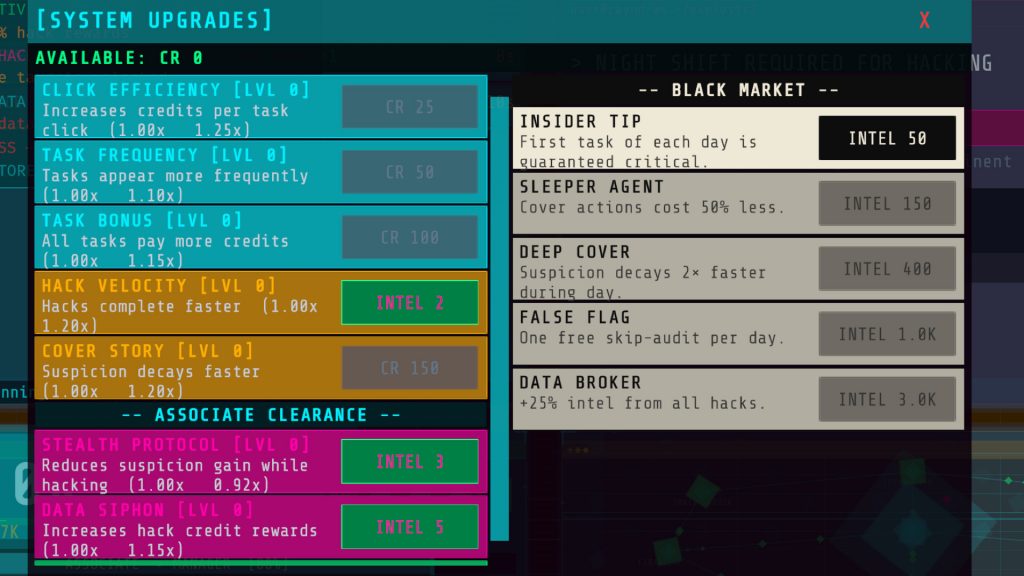
The Black Market, which opens after promotions, layers on top of this: Intel can be spent on permanent upgrades that survive resets. The combination of consumable currencies (credits), persistent information (dossiers), and reset-proof upgrades (Black Market purchases) gives the progression system more texture than its minimalist UI initially suggests.
CONDUIT
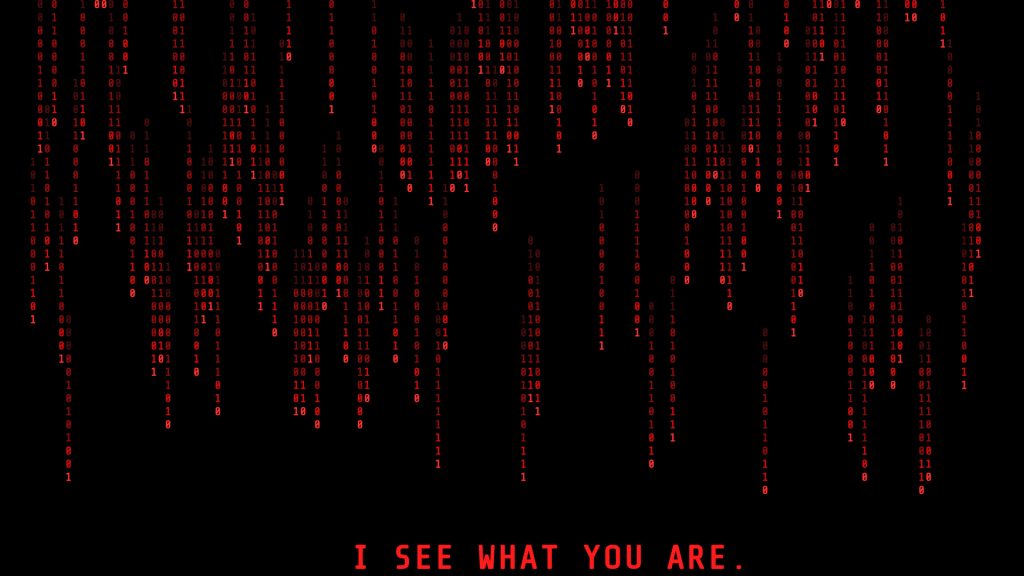
The mystery at the center of the game is an entity called CONDUIT. According to the developer, something already exists inside the network before the player arrives — and at some point, it starts talking to you. Its messages are positioned as the core narrative thread running underneath the incremental loop.
This is the kind of design swing that either works brilliantly or feels tacked on, and the demo is short enough that the jury is genuinely out. What it suggests is intent: Jared D. isn’t just shipping a clicker with cyberpunk skin. There’s a story here about who actually controls the network, who sees the players as they see each other, and what it means to be the second consciousness inside someone else’s system. Whether the full game delivers on that ambition is the open question.
A Solo Dev With Unusual Credentials
Jared D. runs Crunch Moonkiss Studios as a one-person operation out of New York. Remain At Your Desk is his first commercial release, but he isn’t coming from nowhere — he’s an award-winning film composer, and he scored the game himself.
That detail shows. The soundtrack does meaningful work in selling the day/night contrast: the sterile rhythms of corporate compliance audio against the tense, more textured score that emerges during hacking sessions. Composer-developers are rare in indie, and the genre advantage is visible. The game’s sonic identity is sharper than most solo projects manage, and it covers for the deliberately minimalist visual style.
The 1,000+ wishlist milestone in the first month is genuinely impressive for a solo cyberpunk incremental — a niche-within-a-niche pitch — and the international press coverage (Korea’s Indiegame.com, Taiwan’s GNN, Japan’s Gamebiz, the DayOne podcast) suggests the project has caught attention beyond the usual indie circuit. The press kit prepared in 10+ languages is the kind of detail that tells you the developer is thinking globally from day one, which most solo projects don’t.
What the Demo Shows
The 35–50 minute demo takes players through the third promotion and gives a clear picture of the core systems: persona selection, suspicion management, dual currency economy, the daytime/nighttime structure. It’s enough to test whether the game’s wavelength matches yours, and based on early reception, the answer is yes for most players who try it.
What the demo doesn’t yet reveal is whether the systems sustain. Incremental games depend on the late-game experience — the moment when the loop either reveals new depth or starts feeling thin. With CONDUIT positioned as a late-game narrative driver and the dossier system designed for long-term accumulation, there’s reason to think the structure is built for the long haul. But “reason to think” isn’t proof, and that’s where the full release will earn its score.
Who This Is For
Strong fit for: fans of Papers, Please who want their bureaucratic dread with a hacking layer; incremental players who’ve been quietly hoping the genre would take narrative seriously; cyberpunk fans who appreciate text-based aesthetics over visual maximalism; anyone who liked Uplink or remembers what it felt like to play a hacking game where the fiction actually mattered.
Less ideal for: players who want active gameplay rather than menu-driven progression; anyone allergic to incremental structures; players who need traditional visual fidelity rather than terminal minimalism.
The Takeaway
Remain At Your Desk is doing something genuinely uncommon: applying narrative seriousness, mechanical specificity, and thematic intent to a genre that usually settles for mechanical satisfaction alone. The demo is short, the full game is months away, and the open questions about whether the late-game holds up are real. But the foundation is one of the more thoughtful solo projects in recent memory, and the persona system alone is the kind of design swing that justifies attention.
For players who follow cyberpunk, hacking sims, or incremental games — or anyone curious about what happens when a film composer decides to make a game about double lives in a surveillance state — the demo is the fastest way to find out whether this lands for you. It’s free, it’s specific, and it knows what it wants to be.
Full release targets the second half of 2026. Worth wishlisting and watching.
Information regarding ‘REMAIN AT YOUR DESK’
| item | detail |
|---|---|
| Developer / Publisher | Crunch Moonkiss Studios (New York, USA / Solo Developer) |
| Genre | Cyberpunk Incremental Clicker / Hacking Simulation / Text-based Strategy |
| Release platform | PC (Steam) |
| Demo release date | May 19, 2026 |
| Scheduled for official release | second half of 2026 |
| Demo content | 35~50 minutes (up to the 3rd promotion) |
| First month wishlist | 1,000+ cases (Solo development) |
| Art style | Minimalist Terminal UI / Cyberpunk Text-based |
| core system | Persona System / Suspicion Management / Dual Economy (Credit·Intel) / Leverage·Black Market / Conduit Narrative |
| Developer Background | Film Composer (Award-winning) / Compose your own soundtrack |
| Language support | 10 languages, including English, Korean, Japanese, Chinese (Simplified and Traditional), and German |
| Main Keywords | Cyberpunk, Hacking, Incremental, Disguise, Double Life, Corporate Dystopia, Persona |
| Official Channel | Discord · X · YouTube · Instagram · TikTok |
| Steam Page | Go to Wishlist |