Most games set in the Three Kingdoms period make you a hero — Guan Yu charging through enemy lines, Zhao Zilong cutting through a battlefield alone, Zhuge Liang orchestrating strategy from his command tent. Mega Squad Survivors (난세무쌍: 서바이버즈) from Korean indie studio Plotrick makes a different choice entirely. You play as Hua Tuo — the legendary physician of the Three Kingdoms era, not a warrior at all — and your role isn’t to fight but to keep your fighters alive.
That single design decision gives Mega Squad Survivors a structural distinctiveness that dozens of Three Kingdoms games lack. The free demo launched June 15 through Steam Next Fest 2026, targeting full Steam release later this year.
The Hua Tuo Design Choice
Hua Tuo’s historical reputation was as the greatest physician in Chinese antiquity — the surgeon who allegedly performed operations under anesthesia in an era before modern medicine, who treated generals and emperors alike, whose medical knowledge was generations ahead of his time. He is not a figure associated with battlefield glory. He is the person who keeps the glorious alive.
Making Hua Tuo the protagonist transforms the bullet heaven format in interesting ways. In standard Vampire Survivors-like games, the player character is the focal point of combat — everything emanates from them, and their survival is the game’s sole condition. In Mega Squad Survivors, Hua Tuo remains important but becomes something closer to a commander and medic. The generals do the fighting; Hua Tuo does the sustaining.
This creates a decision structure absent from most bullet heaven games. When a general falls in combat, their Bond (인연/絆) effects deactivate — the synergies they contributed to disappear. Hua Tuo can revive them by physically traveling to their memorial stone, reactivating those Bonds. But reaching that stone means moving through dangerous territory, away from whatever safe positioning you’ve established. Every revival is a calculated risk: Is the Bond contribution worth the exposure?
This tension between medical duty and personal safety is surprisingly evocative for a bullet heaven game. The physician protagonist isn’t just flavor — it’s a mechanical structure that forces a specific kind of moral and strategic calculus that standard combat protagonists never need to make.
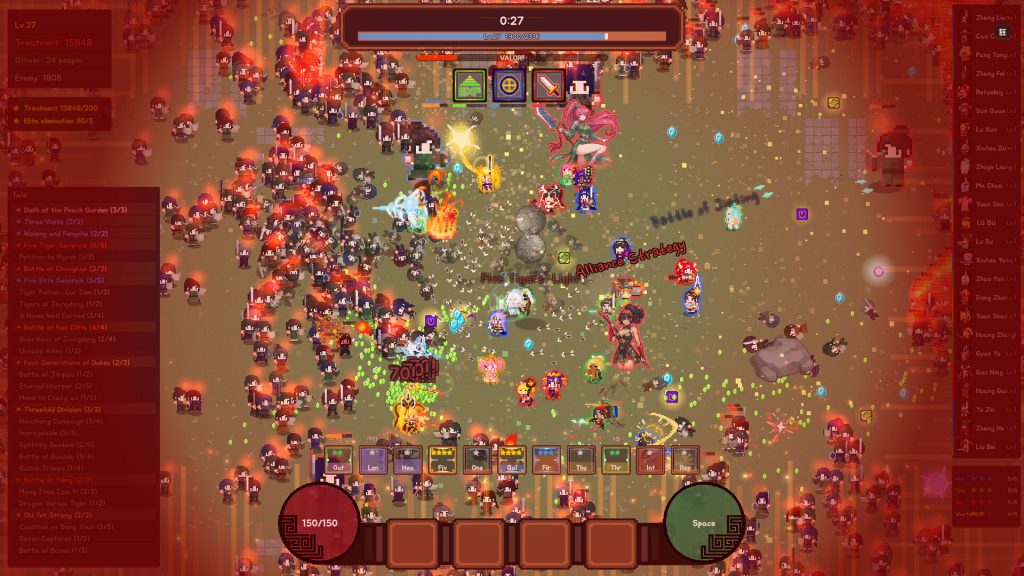
The Bond System
The Bond system (인연, a Korean and Chinese term meaning deep personal connection or karmic tie) is Mega Squad Survivors‘ most ambitious design feature, and the one that most clearly distinguishes it from the crowded bullet heaven field.
Eighteen Bonds are available, each based on famous moments or relationships from Three Kingdoms history. The Peach Garden Oath — Liu Bei, Guan Yu, and Zhang Fei’s legendary brotherhood — provides one set of synergies. The Five Tiger Generals — Liu Bei’s most celebrated commanders — provide another. The Battle of Red Cliffs, one of Chinese history’s most famous military engagements, where the allied Wu and Shu forces defeated Cao Cao’s vast army, provides another.
For players familiar with Three Kingdoms history, this system provides genuine recognition rewards. Assembling the Five Tiger Generals isn’t just a mechanical build decision — it’s recreating one of the era’s most iconic military groupings and watching the historical significance translate into combat power. The Bond system makes cultural knowledge mechanically useful, which is exactly the kind of design that can attract audiences who are both genre enthusiasts and cultural enthusiasts simultaneously.
For players without a Three Kingdoms background, the Bonds still function as strategic build targets — they just lack the additional layer of historical resonance. The game appears accessible regardless of prior knowledge, but rewards deeper engagement for those who bring it.
The fragility of Bonds — they disappear when the contributing general falls and return only when Hua Tuo performs the revival — gives them persistent tactical significance throughout each run. Bonds aren’t just draft-phase decisions; they’re dynamic states that require maintenance through active play.
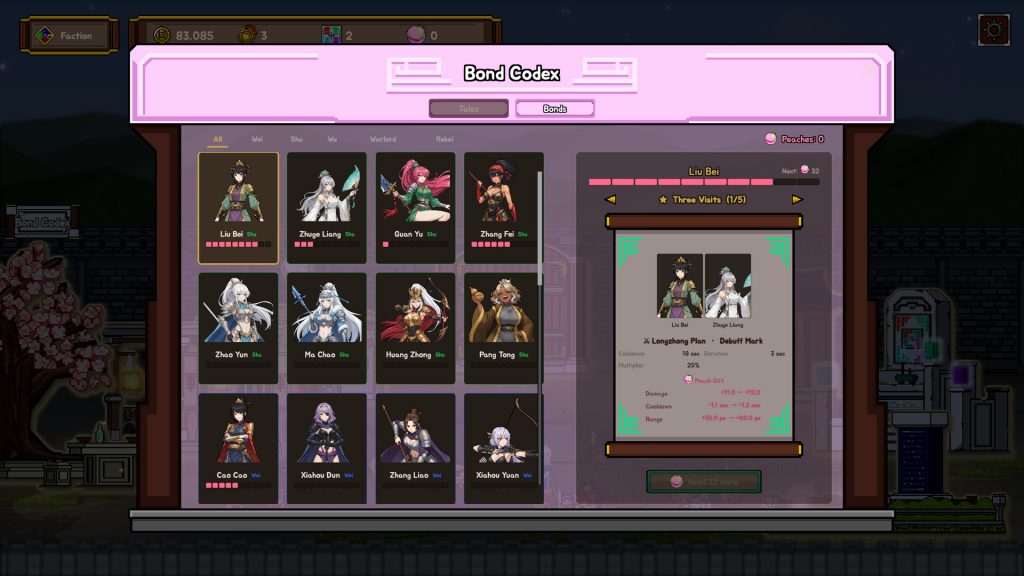
The General Roster
The 50 generals use gender-swapped anime-style character design — the game’s most immediately controversial creative choice, at least in terms of Three Kingdoms purist reception. Guan Yu, Zhao Zilong, Lu Bu, Zhuge Liang, and their historical peers appear as animated women with distinct visual personalities and combat styles.
This design approach has well-established precedent in Japanese game culture (the Koihime Musou franchise pioneered Three Kingdoms gender-swap anime aesthetics in the 2000s) and has found significant audiences across East Asian markets. For players who engage with this aesthetic convention, the character designs provide the kind of visual appeal that drives character investment in roguelite formats. For players outside this convention, it may feel jarring against the historical source material.
What matters mechanically is that each general brings distinct weapon types, combat styles, and abilities that feed into the Bond system. The visual design is one layer; the question of whether each general feels mechanically distinct and strategically meaningful is another, and the demo’s 50-general roster provides substantial content for evaluating this.
The five faction synergies — Wei, Shu, Wu, Warlords, and Righteousness — add another strategic axis. Building around faction composition provides a different optimization path than building around historical Bonds, and the interaction between faction synergies and Bond synergies creates the kind of layered strategic decision-making that distinguishes deep roguelites from shallow ones.
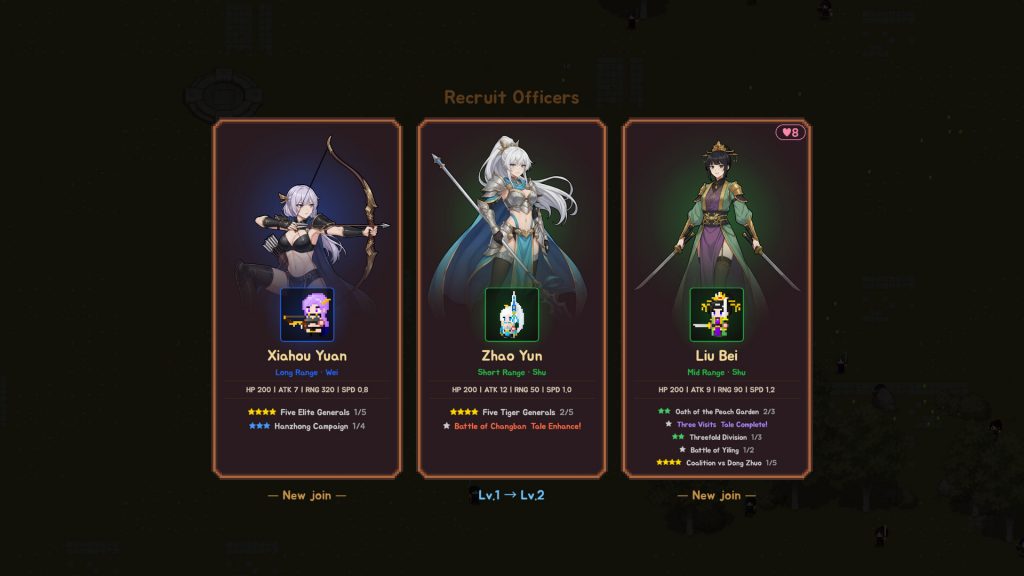
The 200+ Skill Depth
200+ skills combined with 50 generals, 18 Bonds, 5 faction synergies, and 4 permanent growth paths through monument enhancement suggest substantial build variety. The demo’s three-stage scope (approximately 15-minute runs, up to 3 hours of content) provides a reasonable evaluation of whether this variety translates into genuinely different playthroughs or whether the builds converge toward a small number of dominant strategies.
The four-path permanent growth system addresses one of roguelite’s most important long-term engagement questions: what persists between runs? Monument enhancement providing four distinct growth trajectories lets players develop their overall power in meaningfully different directions across the meta-game, which should sustain replayability beyond individual run variety.
The enemy variety — standard enemies, elite monsters, bosses, and raid bosses — structures run progression in ways that prevent the mid-run plateau that some bullet heaven games experience. Raid bosses specifically suggest either optional challenge content or late-run escalation events that test completed builds against more demanding encounters.
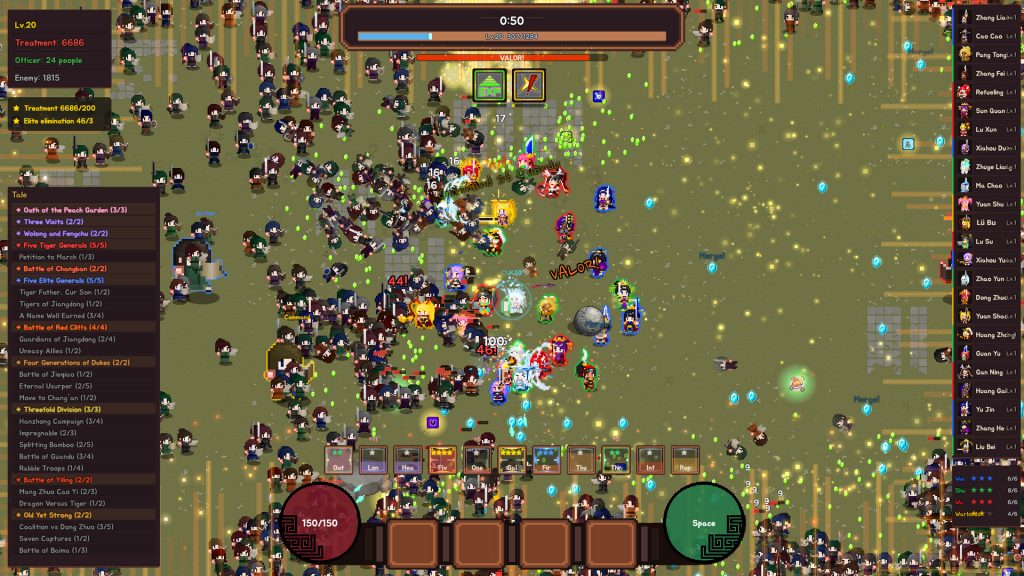
The Audio Update
The Steam Next Fest demo includes a significant quality-of-life update: sound design and background music are being introduced to the game for the first time. Battle cries, explosive skill effect sounds, and period-appropriate BGM for Three Kingdoms atmosphere have been added, alongside improvements to Bond activation visual and camera direction.
This timing — adding audio specifically for the Next Fest demo — reflects smart marketing prioritization. Visual builds and mechanical systems can communicate through screenshots and written descriptions; audio requires actual play. Getting players to experience the completed audiovisual package during the game’s highest-visibility showcase period is exactly the right move for demonstrating how far the project has come.
The Bond activation visual improvements are particularly significant. Bond synergies are the game’s most distinctive design feature — how they look and feel when activated contributes substantially to whether the system feels rewarding. Strong visual feedback for Bond activations should increase the satisfaction of successfully assembling historical combinations.
The K-Indie Three Kingdoms Space
Korean indie gaming has been gradually building broader genre coverage across recent years, and Mega Squad Survivors represents an interesting entry into territory that Korean developers haven’t as frequently occupied. Three Kingdoms is a setting deeply embedded in East Asian cultural consciousness — Korean, Japanese, and Chinese audiences all have significant historical and cultural familiarity with the material, though through different lenses and with different emphases.
Plotrick’s approach — Korean studio, East Asian cultural material, Japanese visual aesthetic conventions, multi-language launch including Chinese and Japanese — positions the game as genuinely pan-East-Asian rather than specifically Korean. The Five Languages support from launch (Korean, English, Japanese, Simplified and Traditional Chinese) reflects serious regional market ambitions.
The bullet heaven format specifically has demonstrated strong appeal across East Asian mobile and PC markets, and Mega Squad Survivors‘ combination of an accessible format with culturally resonant material gives it natural entry points across multiple regional audiences.
Who This Is For
Strong fit for: bullet heaven / Vampire Survivors-like enthusiasts seeking culturally distinctive variations; Three Kingdoms history and culture enthusiasts; players who appreciate anime aesthetics applied to historical material; roguelite build enthusiasts who enjoy strategic depth (50 generals, 200+ skills, 18 Bonds); Where Giants Fall fans who appreciated manual tactical decisions added to bullet heaven format; East Asian gaming culture followers; players who enjoy gender-swap anime aesthetic conventions in historical settings.
Cautious fit for: Three Kingdoms purists who may find the gender-swap aesthetic approach incongruous with historical source material; bullet heaven players who prefer minimal strategic complexity over deep build systems.
Less ideal for: players who avoid bullet heaven / auto-attack formats entirely; anyone uninterested in Three Kingdoms cultural material; players who prefer realistic aesthetics over stylized anime design.
What to Watch For
A few questions will shape Mega Squad Survivors‘ 2026 release.
The first is whether the revival mechanic sustains meaningful tension across full runs. The physician-revives-fallen-generals loop is the game’s most distinctive design element — whether it consistently creates genuine strategic dilemmas or whether it becomes either trivially easy (always safe to revive) or trivially punishing (never worth the risk) will determine if the core innovation fulfills its potential.
The second is the Bond system balance. Eighteen Bonds across 50 generals creates enormous combinatorial space; ensuring that multiple Bonds remain viable rather than a few becoming dominant will require careful tuning. The demo provides initial evaluation, but full-release balance is typically where bullet heaven games either succeed or frustrate deeply.
The third is the cultural reception breadth. The gender-swap anime aesthetic will appeal strongly to certain audiences and alienate others. How Mega Squad Survivors navigate this depends partly on how well the gameplay earns its own appreciation independent of the aesthetic, and partly on the specific communities Plotrick targets in their marketing.
The fourth is pacing across the 50-general roster. Introducing 50 distinct characters across runs requires careful encounter design to ensure players encounter meaningful variety without overwhelming complexity. Whether the demo and full game pace character introduction well will affect engagement.
The Takeaway
Mega Squad Survivors is one of the more genuinely conceptually distinctive bullet heaven games on the 2026 horizon, combining a culturally rich setting (Three Kingdoms at full historical depth), an unconventional protagonist choice (Hua Tuo the physician rather than any warrior), a mechanically innovative Bond system (18 historical synergies that can be broken and restored through active play), and substantial strategic depth (50 generals, 200+ skills, 5 faction synergies, 4 permanent growth paths).
For bullet heaven enthusiasts specifically, the Steam Next Fest demo provides approximately 3 hours of content for evaluating whether the historical Bond system and physician protagonist create the genuinely differentiated experience the design suggests. The Where Giants Fall trend of adding active decision-making to auto-attack bullet heaven continues here, but Mega Squad Survivors embeds those decisions in cultural and historical rather than purely mechanical terms.
For Three Kingdoms enthusiasts, the game offers one of the more unusual entries in the long history of Three Kingdoms gaming — not recreating famous battles but using famous relationships as the building blocks of a roguelite build system, and choosing as protagonist the figure most responsible for keeping those famous warriors fighting.
Hua Tuo stands on a battlefield where his generals are outnumbered by thousands. Somewhere ahead, Guan Yu has fallen — and the Brotherhood of the Peach Garden has gone quiet. Does the physician cross the dangerous ground to revive him, reactivate the Bond, restore the historical connection? Or does the current position hold without the synergy?
That’s the question at the heart of Mega Squad Survivors. It’s a more interesting question than most bullet heaven games ask. And the Three Kingdoms historical weight gives it an emotional resonance that pure mechanical design couldn’t generate.
The battlefield is vast. The generals are waiting. And one physician has to decide which fallen warrior is worth the risk to save.
Information regarding ‘Mega Squad Survivors’
| item | detail |
|---|---|
| Developer / Publisher | Plotrick / Lee Dong-hwan |
| Genre | Romance of the Three Kingdoms Bullet Hell Roguelite / Bullet Heaven / Strategy Action |
| Release platform | PC (Steam) |
| Scheduled for release | 2026 (Demo currently available) |
| Steam Next Fest | Participation from June 15–22, 2026 |
| Demo content | 3 Stages / Unlock 50 Generals / Includes Permanent Growth / Approx. 3 Hours (Approx. 15 Minutes per Round) |
| Language support | Korean · English · Japanese · Simplified Chinese · Traditional Chinese |
| Relationship System | Synergy based on 18 famous scenes from the Three Kingdoms (Oath of the Peach Garden, Five Tiger Generals, Battle of Red Cliffs, etc.) |
| longevity | 50 people (Gender-swapped beautiful girl versions of famous Three Kingdoms generals) |
| Faction Synergy | 5 factions (魏, Xu, Wu, Lui, Wei) |
| Skill count | 200 types+ |
| Permanent growth | Ganghwa Monument Route 4 |
| Main Keywords | Romance of the Three Kingdoms, Snake Scrolls, Hua Tuo, Bonds, Beautiful Girl, Legion, Roguelite, Bullet Hell |
| Steam Page | Go to Wishlist/Demo |