A landmark study has revealed that extended gaming hours do not necessarily lead to “over-indulgence” (addiction) or disease. Furthermore, cases of gaming over-indulgence were found to be largely temporary phenomena that resolve naturally without external medical intervention.
Published on December 23, 2025 (and updated for 2026), the “2020–2024 Research Manual on Game Users” is South Korea’s largest-ever longitudinal study. Over five years, the Korea Creative Content Agency (KOCCA) and the Ministry of Culture, Sports and Tourism tracked the habits of children, adolescents, adults, and parents. This research combined panel studies with clinical cohort studies utilizing fMRI (functional Magnetic Resonance Imaging) to secure empirical biological data.
Key Findings: The Transience of Over-indulgence
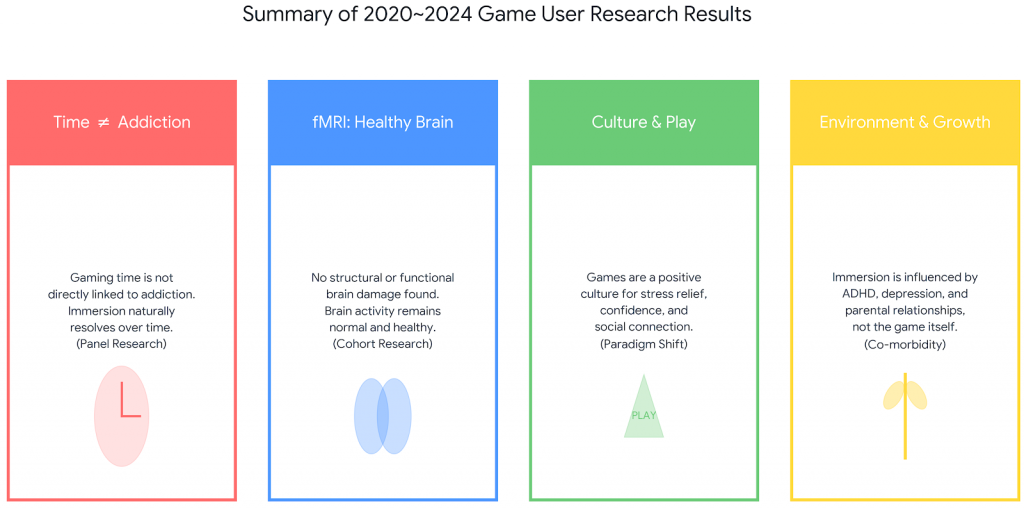
The most significant discovery of the five-year study is the temporary nature of gaming overindulgence.
- Zero Chronic Cases: Among the thousands of participants tracked, not a single individual remained in the “over-indulgence” group for the entire five-year duration.
- Natural Recovery: Users who fell into periods of excessive gaming naturally returned to normal usage levels over time without clinical treatment.
“This suggests that over-indulgence is likely a passing phase rather than a chronic disease,” the researchers noted. “As such, we must be extremely cautious about introducing medical diagnostic codes for gaming.”
Scientific Evidence: No Brain Damage Detected
While critics have long claimed that gaming “rots the brain” or causes structural damage, the study’s fMRI analysis provided no such evidence.
- No Structural Changes: There were no observed changes in brain structure or functional impairments directly caused by gaming.
- Biological Indicators: Using objective biomarkers, the medical cohort study failed to find any direct causal link between game use and brain dysfunction.
The Root Cause: Environment, Not the Game
The study highlights that the real drivers of problematic gaming are an individual’s psychological state and living environment, rather than the game itself.
- Comorbidities: Risk of over-indulgence was significantly higher in individuals already suffering from ADHD (Attention Deficit Hyperactivity Disorder) or depression.
- Protective Factors: Adolescents who maintained positive relationships with parents and friends showed a remarkably low risk of over-indulgence, regardless of how many hours they spent playing games.
- Academic Myths: No direct correlation was found between the amount of time spent gaming and academic performance.
A Call for a “Cultural Frame”
Based on these findings, the research team is urging a total shift in social perception. They argue for a move away from the “Pathological Frame” (viewing gaming as a disease) toward a “Cultural Frame” (viewing gaming as a healthy form of play).
Instead of rigid regulations like playtime limits, the study suggests that the most effective solutions are:
- Autonomous Environments: Empowering users to regulate and control their own gaming habits.
- Family Communication: Fostering open dialogue between parents and children regarding digital media.
Re-evaluating Global Policy
This study serves as a scientific rebuttal to the WHO’s inclusion of “Gaming Disorder” in the ICD-11. Experts believe these findings will provide a critical turning point for reviewing current regulations, such as youth gaming restrictions and the controversial medical coding of gaming behavior.
2020-2024 Game User Research Commentary_KOR ver_.pdf