The school corridors look ordinary at first. Uniforms, lockers, fluorescent lighting. But the students wandering those halls are ghosts, and the building itself has slipped into something that is neither the living world nor the dead one — the 중음계 (Jungeum-gye), the intermediate realm of Korean afterlife mythology. Welcome to Sucheon Academy. Bring your own build system.
Newcore Games, the Korean indie studio behind The Devil Within: Satgat, has officially announced 7Trials — a top-down hack-and-slash action roguelite combining Korean traditional afterlife mythology with contemporary urban occult aesthetics. The announcement arrives with a Steam wishlist page but no confirmed release date. Development is supported by the Korea Creative Content Agency’s console game production fund.
The Studio Pedigree
Newcore Games’ development history provides essential context. Founded in 2020, the studio’s most significant work is The Devil Within: Satgat (2024) — a stylish action game grounded in Korean historical mythology that received strong critical attention domestically and internationally, demonstrating that Korean cultural material can achieve genuine global audience resonance when executed with sufficient craft.
The studio’s award history reflects sustained industry recognition. The Korean Game Awards Indie Game Prize validates domestic quality standards. The Bandai Namco GYAAR Contest win represents international recognition from one of gaming’s most significant publishers — a signal that the studio’s work meets quality bars beyond the Korean market. The Epic MegaGrants selection confirms the technical and creative ambition that Unreal Engine’s parent company found worth supporting.
This track record matters for evaluating 7Trials. Newcore Games isn’t speculating about whether Korean cultural material can find international audiences — they’ve established this through Satgat. CEO Lee Man-jae’s announcement statement explicitly acknowledges this: “Through The Devil Within: Satgat, we confirmed that Korean subject matter can be sufficiently appealing to global players. This project more deeply integrates the Korean afterlife worldview into the action genre where we have the most confidence.”
The Jungeum-gye Setting
The world of 7Trials is built around a concept from Korean afterlife mythology that has no direct English equivalent. 중음계 (Jungeum-gye) refers to an intermediate state between life and death — roughly analogous to concepts like limbo or purgatory in Western traditions, but specific to Korean Buddhist-influenced folk belief systems. It’s the transitional space where souls exist in the 49 days after death before their final disposition is determined.
The setting choice is elegant in how it uses this mythological framework. Sucheon Academy — framed as Korea’s most prestigious exam-prep institution — transforms into the Jungeum-gye, creating a space that is simultaneously intensely familiar (high school) and deeply wrong (the intermediate realm of the dead). Students in uniforms become ghosts. The anxiety of exam culture becomes the anxiety of the afterlife.
This setting does cultural work that foreign genre-fantasy settings can’t. Korean players will immediately recognize both the exam-preparation school archetype (입시학원, the cram school, is a deeply embedded Korean cultural institution) and the 49-day afterlife tradition. International players encounter a genuinely fresh setting — the high school-as-limbo premise is immediately comprehensible across cultures, while the specific Korean mythological grounding gives it a distinctive texture.
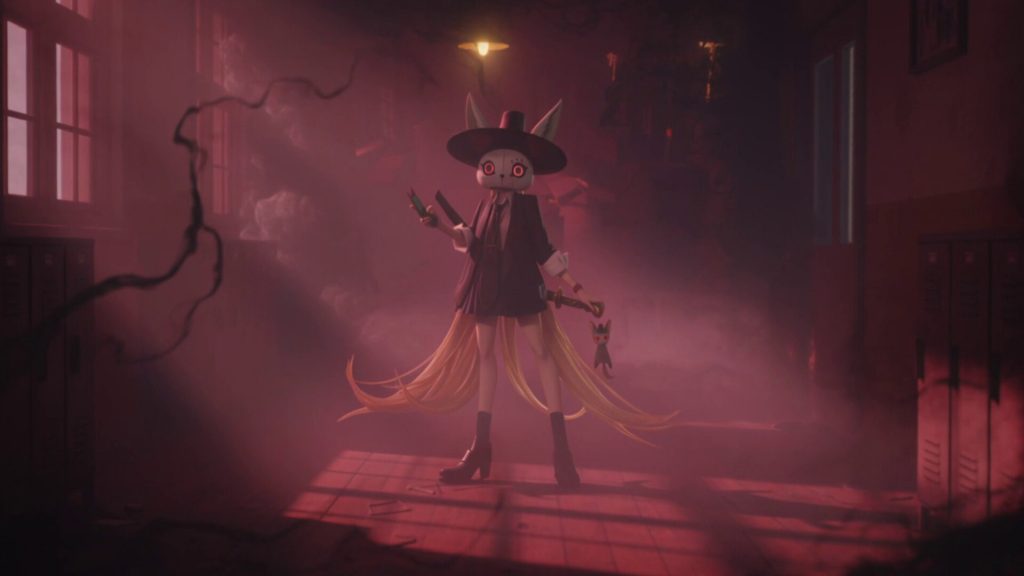
The protagonist, Yeouibi, is contracted as a temporary 차사 (death messenger) to ㈜Yeomra Solutions — literally “Yeomra Solutions, Inc.” This naming choice is doing specific tonal work. Yeomra is the ruler of the Korean underworld (directly analogous to the Chinese deity Yanluo Wang, the King of Hell). Presenting the afterlife bureaucracy as a corporate entity with a stock-company designation (주식회사, abbreviated ㈜) is the kind of deadpan Korean dark comedy that works extremely well in games — the mundane corporate structure overlay on the supernatural setting creates the same dissonance that makes works like Disco Elysium or Control effective.
The 3-Layer Build Architecture
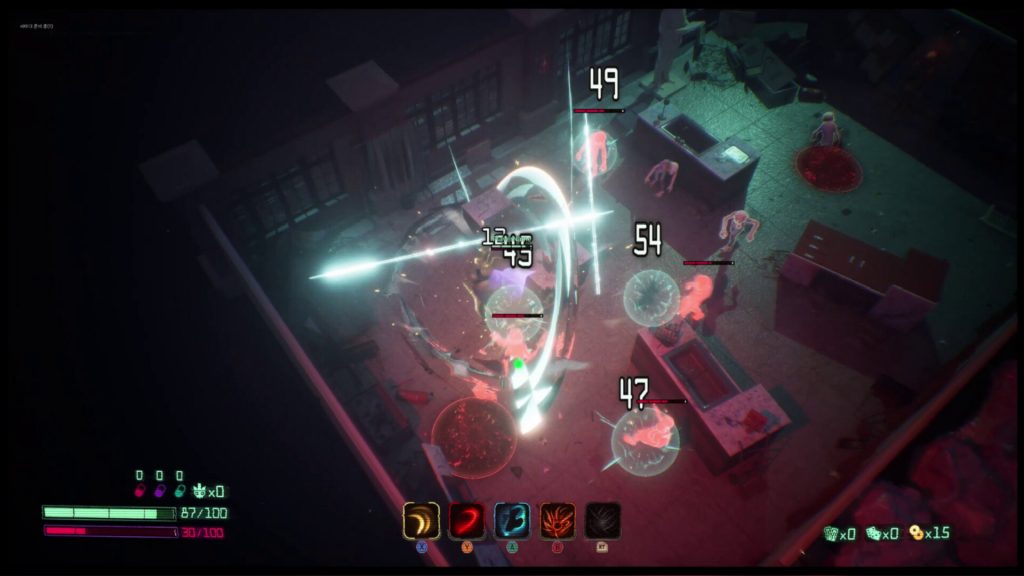
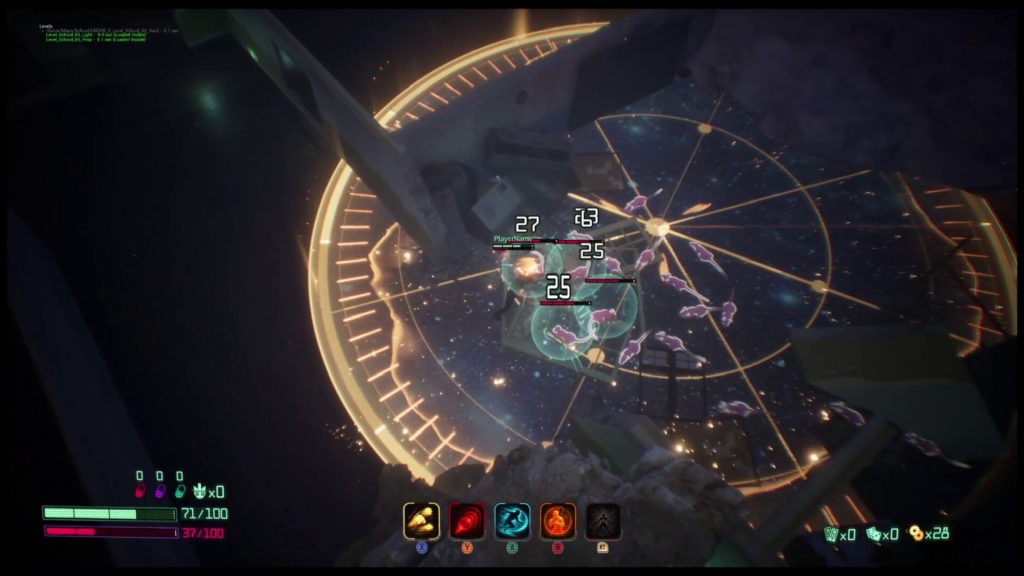
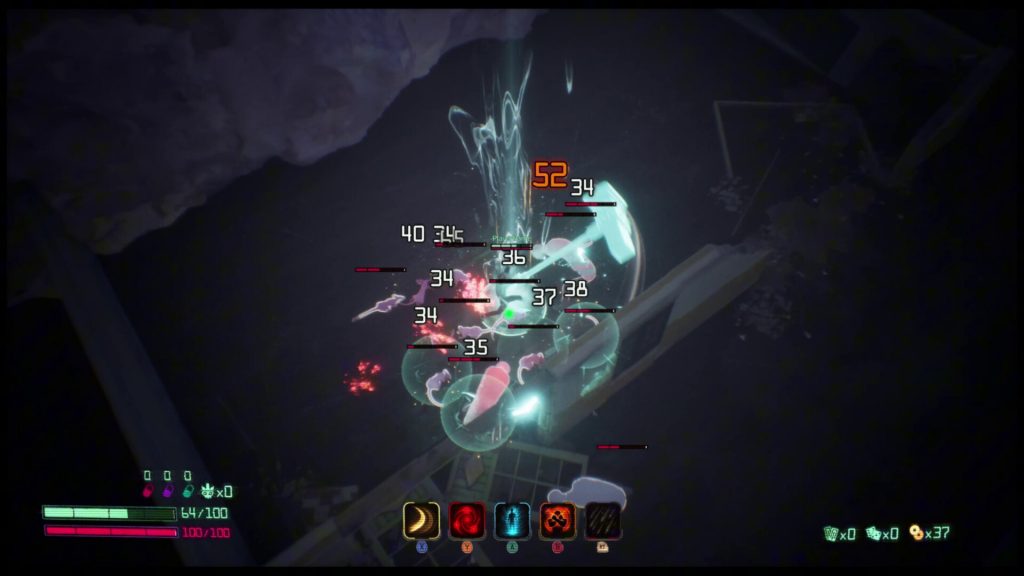
The Spell · Offering · Fate system represents 7Trials‘ most substantive design ambition. Understanding how each layer functions explains how the developers arrive at their claim of thousands of possible builds.
Spell (주술) establishes the combat foundation: combo attacks, special abilities, mobility skills, counterattacks, and ultimate abilities. These are the active skills that define what a character fundamentally does — the base form of the combat style.
Offering (제물) modifies Spells at the attribute and form level. The same Spell becomes something different depending on which Offering is applied — fire, ice, lightning, darkness, or other attributes that change how attacks behave, what they look like, and what enemy states they create. A close-range combo with a fire Offering becomes something categorically different from the same combo with a darkness Offering.
Fate (운명) adds the third layer that multiplies the combinatorial space further. Where Spells define what and Offerings define how, Fate presumably defines under what conditions and with what consequences — the passive and conditional layer that ties together into coherent strategies.
The arithmetic here is straightforward: if there are X Spells, Y Offerings, and Z Fate cards, the build space is approximately X × Y × Z combinations, each producing meaningfully different combat behavior. The developers’ claim of thousands of builds requires relatively small numbers in each category — even 10 Spells × 10 Offerings × 10 Fate cards produces 1,000 combinations, and each layer likely has substantially more options than 10.
This build system architecture reflects the roguelite genre’s evolution toward greater build variety and expression. Where early roguelites provided relatively limited build space, contemporary titles like Hades, Dead Cells, and Risk of Rain 2 have expanded build diversity significantly. The 3-layer Spell-Offering-Fate system suggests Newcore Games is targeting the deeper-build end of the roguelite spectrum.
The 49-Day Trial Structure
The “49 days of trials” framing isn’t arbitrary — it’s directly drawn from the Jungeum-gye mythology. In the Korean Buddhist-influenced afterlife tradition, the 49-day period after death is when a soul’s fate is determined through a series of trials before ten judges. The deceased faces judgment on the 7th, 14th, 21st, 28th, 35th, 42nd, and 49th days — which maps naturally to the game’s title “7Trials” (seven trials across the 49 days, one every seven days).
This mythological framework gives the roguelite structure narrative coherence. Dying and repeating isn’t mechanical randomness — it’s the soul experiencing the trials again, refining their approach across repeated attempts until they can pass. The roguelite loop becomes the literal afterlife trial process. This kind of thematic-mechanical alignment, where the genre conventions and the narrative premise reinforce each other, is exactly what distinguishes thoughtful game design.
CEO Lee Man-jae’s specific mention of “completing your own combat style through 49 days of repeated trials” confirms this mythological framework as intentional design rather than incidental setting.
The Urban Occult Aesthetic
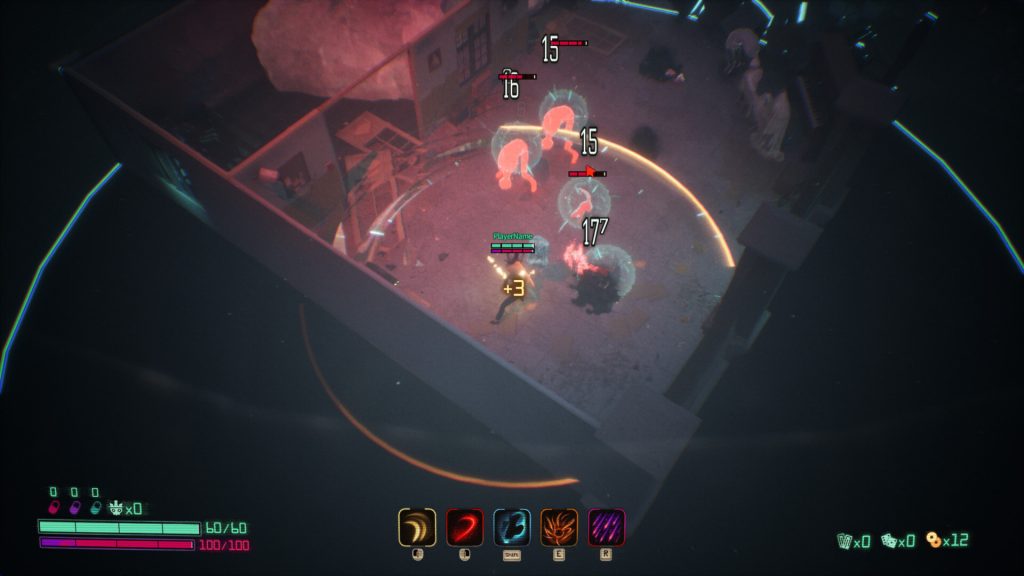
The combination of Korean traditional afterlife mythology with “urban occult” aesthetics creates a specific visual and tonal register that Newcore Games is positioning as distinctively their own. Urban occult as a genre (prominent in manga, anime, and Korean webtoons) involves supernatural phenomena operating within contemporary urban settings — the ancient and the modern existing simultaneously in cities, the mythological intruding into the mundane.
Applied to Korean traditional mythology, this produces visuals that are distinct from both pure historical Korean aesthetics and pure contemporary K-pop aesthetics. A death messenger in a school uniform. Corporate paperwork for afterlife contracts. Traditional spirit entities in modern building environments. The aesthetic tension between old and new, sacred and bureaucratic, creates the visual identity that Newcore Games is betting will travel internationally.
The Unreal Engine 5.4 technical foundation enables visual density that previous generations couldn’t achieve. Newcore Games demonstrated visual competence with Satgat‘s stylish action presentation; 7Trials, building on that experience with more powerful technology, suggests the urban occult aesthetic will be executed at high technical quality.
The 4-Player Cooperative Dimension
The up-to-4-player online cooperative play adds a social dimension that single-player roguelites lack. Different builds combining in multiplayer creates the team synergy design space — a fire-specialized player working alongside a darkness-specialized player produces combined effects neither could achieve solo.
This cooperative dimension also affects how 7Trials will be discovered and marketed. Co-op roguelites have proven more streamable and more socially shareable than solo experiences — the emergent moments of combined builds achieving unexpected results, the coordination required for difficult encounters, and the communication dynamics of cooperative play all generate content that individual players want to share.
The build system’s depth becomes more interesting in co-op contexts. In solo play, players optimize their own build; in co-op, players must think about how their build complements teammates’ choices. The Spell-Offering-Fate system’s combinatorial space opens further when applied to team compositions.
The Korean Indie Ecosystem Context
Newcore Games’ development path through the Korean indie ecosystem reflects institutional support that distinguishes the Korean indie development environment from many other national scenes. KOCCA’s console game production support provides funding specifically for console-targeted development — a signal that Korean institutional support is thinking about export markets (console platforms have a stronger international presence than PC-only titles).
The combination of KOCCA support, Bandai Namco GYAAR recognition (connecting the studio to Japanese gaming industry relationships), and Epic MegaGrants provides the kind of multi-source institutional backing that enables ambitious development without requiring publisher advance funding. This support structure has been a recurring element in Korean indie’s growing international presence.
Who This Is For
Strong fit for: The Devil Within: Satgat fans following Newcore Games’ continued development; action roguelite enthusiasts seeking culturally distinctive settings; Korean mythology and folklore enthusiasts; urban fantasy fans drawn to contemporary-supernatural aesthetic combinations; co-op roguelite players who enjoy team build synergy; players who found Hades‘ Greek mythology setting appealing and want similar treatment of East Asian mythology.
Cautious fit for: players who prefer fully revealed release dates before wishlisting; anyone who found Satgat‘s difficulty level too demanding and are uncertain whether 7Trials will be more accessible.
Less ideal for: players who specifically avoid roguelite structure; anyone uninterested in Korean cultural settings; players seeking pure narrative experiences over action gameplay.
What to Watch For
Several questions will shape 7Trials‘ development toward its unannounced release.
The first is how the 3-layer build system is communicated and tutorialized. Thousands of build combinations are only valuable if players can navigate them meaningfully. Whether the Spell-Offering-Fate system has sufficient accessibility for new players while retaining depth for optimization-focused players will determine how broadly the game engages.
The second is how the Korean mythology is handled for international audiences. Satgat demonstrated Newcore Games can present Korean historical material accessibly without over-explaining it. 7Trials‘ mythological depth — Jungeum-gye, 차사, Yeomra — requires the same balance of specificity and accessibility.
The third is the co-op implementation quality. 4-player cooperative roguelites have specific technical demands (build balance across players, network synchronization for fast-paced action, server infrastructure). Whether Newcore Games achieves the technical quality required for satisfying co-op will significantly affect this dimension of the game.
The fourth is the visual execution at full development. The urban occult aesthetic is ambitious; whether Unreal Engine 5.4 and Newcore Games’ team deliver the visual identity their announcement suggests will be one of the key factors in international press attention.
The Takeaway
7Trials is among the Korean indie announcements most worth watching in the near term, combining established studio pedigree (Satgat‘s proof of concept for Korean mythology in action games), ambitious design scope (Spell-Offering-Fate 3-layer build system, thousands of builds, 4-player co-op), distinctive cultural grounding (Korean Jungeum-gye mythology, the 49-day trial structure), and the kind of institutional validation (KOCCA, GYAAR, Epic MegaGrants) that signals professional development infrastructure behind the ambition.
For Korean indie scene observers, 7Trials represents Newcore Games’ effort to build on Satgat‘s commercial and critical foundation by attempting a more ambitious scope — more complex build systems, cooperative play, and deeper mythological integration. The studio has demonstrated they can execute Korean cultural material accessibly for international audiences; whether they can execute it at this larger scale remains to be seen.
Sucheon Academy’s corridors stretch on. Ghosts in uniforms drift past. Somewhere in the building, the 49-day trial awaits — and each death is just another opportunity to refine the build before trying again. Yeouibi, temporary death messenger, contracted employee of ㈜Yeomra Solutions, has work to do.
The school bell rings. The intermediate realm awaits. And one of Korean indie gaming’s most anticipated unannounced projects has just made itself known.
Information regarding ‘7Trials’
| item | detail |
|---|---|
| Developer / Publisher | Newcore Games (Gyeonggi-do, established in 2020 / CEO Lee Man-jae) |
| Genre | Top-down hack-and-slash action roguelite |
| Release platform | PC (Steam) + Console (Undisclosed) |
| Scheduled for release | Undecided (Currently adding to Steam Wishlist) |
| engine | Unreal Engine 5.4 |
| background | South Korea’s top entrance exam academy, ‘Seocheon Academy,’ transformed into a middle scale |
| hero | Yeoubi (A temporary Grim Reaper contracted with the underworld enterprise Yeomra Solutions Co., Ltd.) |
| core system | 3-Layer Build System with Sorcery, Sacrifice, and Fate Cards / Up to 4-Player Co-op |
| Developer’s previous work | I Am Zombie (2020) / The Devil Within (2024) |
| Awards | Korea Game Awards Indie Game Award / Bandai Namco GYAAR Contest / Epic MegaGrants |
| Support Program | Selected for the Korea Content Creative Agency Game Production Support Project (Console Type) |
| worldview | Korean Traditional Afterlife Folktales × Urban Occult |
| Main Keywords | Korean afterlife, urban occult, Chasa, roguelike, top-down, build, cooperative, meso-tone realm |
| Official Channel | X · YouTube · Discord |
| Steam Page | Go to Wishlist |