- Selected as Honoree in the Art & Tech category… Won for the second consecutive year following the CES 2026 Best Innovation Award
- Research achievements based on AI convergence technology and industry-academia collaboration… 9 graduate students participated in technology development
‘ANAMOFIT,’ an AI-based 3D anamorphic content creation system developed with the participation of researchers from the Department of Game and Video at Gachon University (President Lee Gil-yeo), and ‘SPACESYNC,’ a real-time data-responsive interactive media facade, were each selected as Honorees in the Art Tech category of the ‘CES 2027 Innovation Awards.’
With two technologies selected side by side in the same field, Gachon University achieved the feat of winning a CES Innovation Award for two consecutive years, following the Best of Innovation award for ‘STORYSYNC’ at CES 2026 last year.
This achievement is the result of industry-academia collaboration that combines the university’s AI convergence research capabilities with the company’s experience in content production and commercialization. ANAMOFIT was jointly developed by Gachon University and the AI agent company Persona AI, while SPACESYNC was jointly developed by Gachon University and Damgara & Next Step Studio.
A research team led by Professors Kim Jeong-yun and Kang Ho-seong of the Department of Game and Video, Professors Jeong Yun-hyeon and Choi Jae-yong of the Department of Artificial Intelligence, and Professor Lee Su-hyeon of the Department of Computer Engineering at Gachon University, along with nine graduate students (Yu Jeong-eun, Lee So-jin, Kim Su-hyeon, Ahn Ha-il, Kim Ye-jin, Kang Ji-yun, Choi Jun-seo, Chu Dong-hyeok, and Lim Ju-han), participated in the technology development, and Professor Kim Dong-jo and designer Lim Ji-ye of Sunchon National University also participated as visiting researchers.
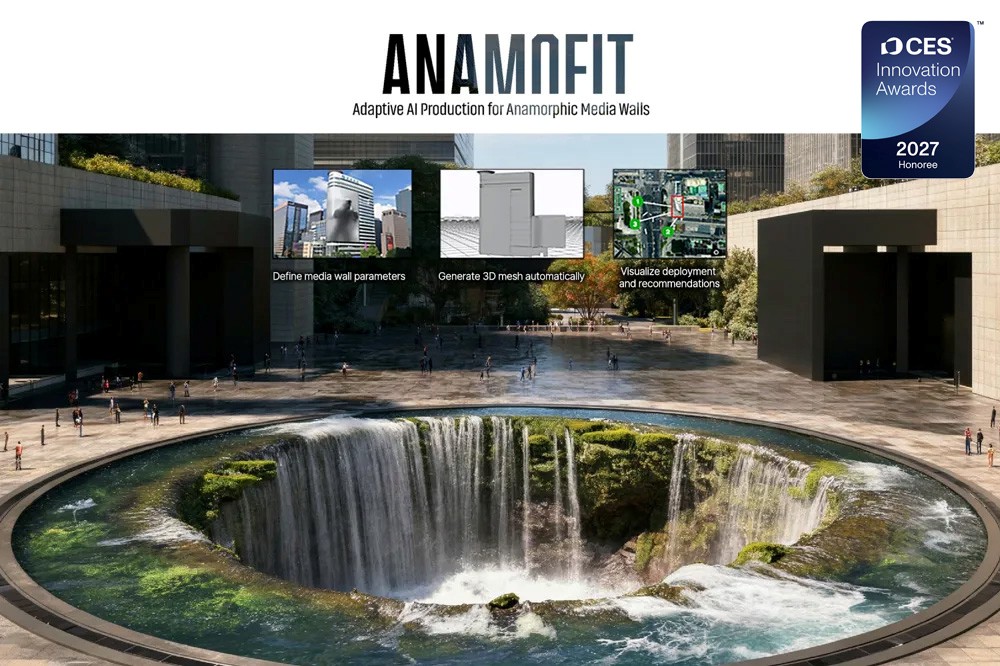
ANAMOFIT is an AI-based system that produces 3D anamorphic video by reflecting the shape, size, curvature, resolution, and viewing position of irregular media walls installed in buildings or exhibition halls.
Previously, videos had to be produced based on a standard screen and then modified separately to suit the actual display environment; however, this system is designed to reduce repetitive work by connecting the entire production process—from media wall modeling to AI-based image and character generation, video distortion correction, and final output—into a single unit.
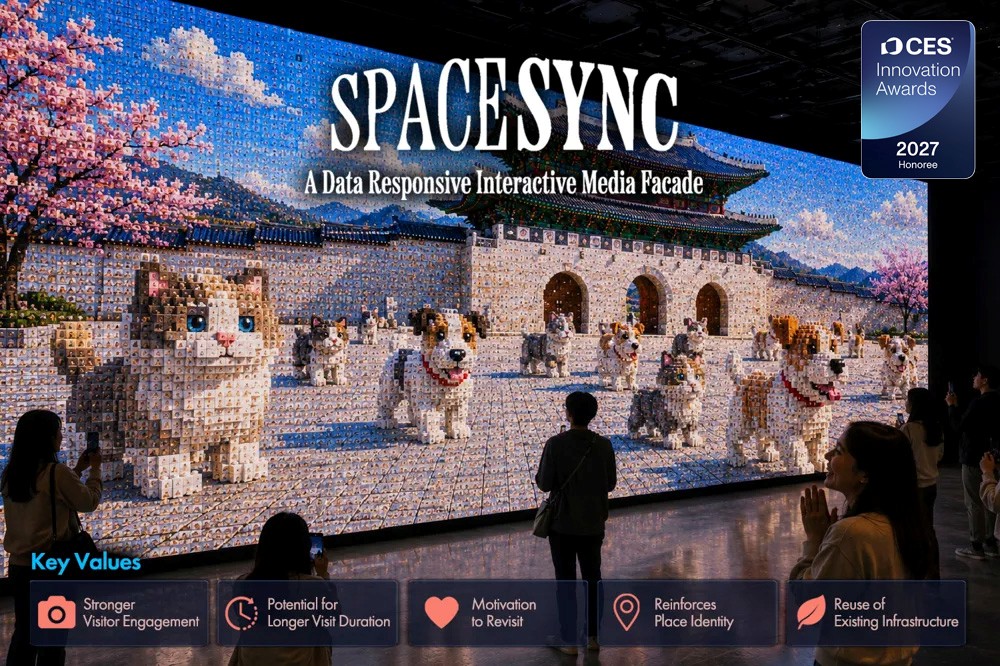
SPACESYNC is a technology that reconstructs photos transmitted by visitors into photomosas depicting local landscapes or landmarks, and reflects on-site environmental and urban data, such as humidity, wind speed, wave height, air quality, noise, and crowd density, into the video in real time.
It can adjust the color, light, and movement of the video according to data changes and output it tailored to display characteristics, making it suitable for use in tourist attractions, cultural facilities, and public media spaces.
Both technologies were advanced and expanded into commercialization based on the results of government-supported research and development. ANAMOFIT was developed based on the Generative AI Leading Talent Training Project of the Ministry of Science and ICT and the Institute of Information and Communication Technology Planning and Evaluation (IITP), while SPACESYNC was developed based on the Cultural Technology (CT) Professional Training Project of the Ministry of Culture, Sports and Tourism and the Korea Institute of Planning and Evaluation for Cultural Technology.
Subsequently, for both technologies, technology development, training of specialized personnel, and commercialization were pursued by linking them with the IP Star Scientist Project and the Gyeonggi Regional Growth Talent Development System (Anchor) Project.
This award is highly significant as it represents the achievement of industry-academia collaboration, combining faculty research guidance, graduate students’ participation in technology development, and the company’s experience in manufacturing and commercialization. In particular, it is regarded as a prime example of talent development that links research and education, given that graduate students participated in R&D projects reflecting actual industrial demands and their results were recognized on the international stage.
Professor Kim Jeong-yun of Gachon University said, “It is meaningful that ANAMOFIT and SPACESYNC were jointly selected as Honorees in the Art Tech category at CES 2027, following the STORYSYNC Best Innovation Award at CES 2026,” adding, “It is significant in that graduate students and faculty participated in technology development together with companies and visiting researchers, and their achievements have been recognized internationally.”
He added, “Going forward, we will continue to foster specialized talent capable of integrating generative AI with game and video technologies by linking graduate education, R&D, and corporate collaboration, and strive to ensure that research results are disseminated to the industrial field.”