- With most of Korea’s major publishers absent, this year’s G-STAR was transformed by an indie showcase of 108 developers from 28 countries across 250 booths.
- The indie hall must now move beyond being “just an exhibition space” to become an integrated indie platform linking curation, discovery, and year-round audience building through global partners — and a festival where indie developers meet future fans and grow their games.
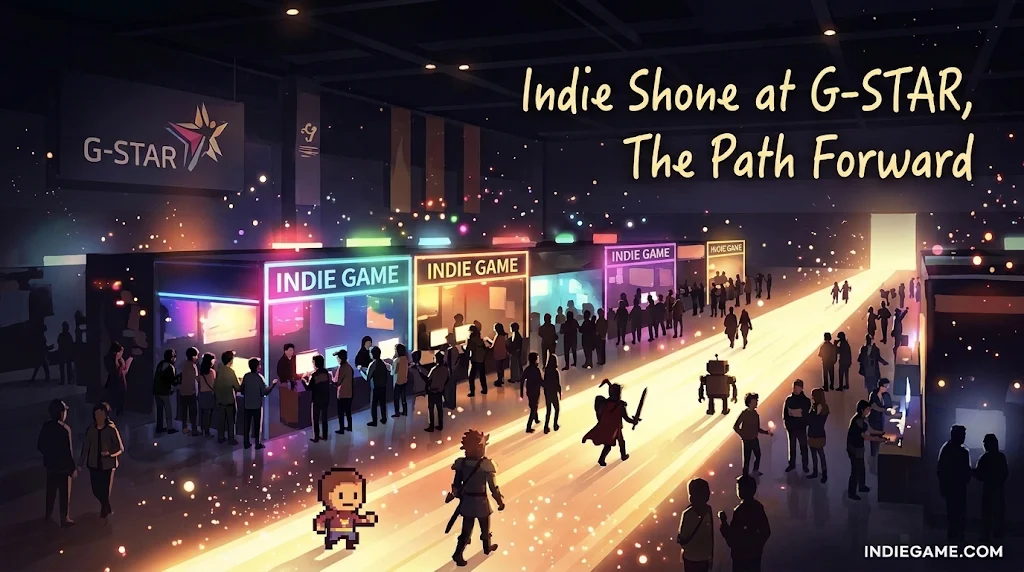
G-STAR 2026 wrapped up its four-day run on November 22. In a year when major Korean publishers like Nexon, Netmarble, and NCSOFT largely stayed away, one of the places that held visitors’ attention longest was the Indie Showcase on the first floor of BEXCO Exhibition Hall 2. Instead of two-hour lines for blockbuster demos, visitors picked out fresh games to play and talked with the developers standing at their booths.
Were indies — long on the margins of G-STAR — merely stand-ins filling the space the big publishers left empty this year? Or did they show where game shows need to go? This column looks at what the indie hall changed this year, what it left behind, and where G-STAR’s indie hall should head next.
Where the Big Publishers Left Gaps, Indies Filled Them
According to the G-STAR Organizing Committee, this year’s show featured 1,294 companies from 42 countries across 3,445 booths, drawing about 201,000 visitors over four days. Booths grew by 176 from last year, but attendance was essentially flat compared with last year’s roughly 202,000. Only six companies took large pavilions of 100+ booths in Hall 1, and Korean publishers among them could be counted on one hand.
Filling that gap was G-STAR Indie Showcase 2.0: Galaxy. With 250 booths and 108 developers from 28 countries — 114 including partners — it was the largest ever, and it is one of the Organizing Committee’s flagship in-house programs. In a year of crisis, with fewer major exhibitors, the indie hall carried much of the show.
Unsurprisingly, most visitors praised this year’s indie hall. Those who endured long waits at major booths appreciated being able to jump straight into several games, and indie visitors said not that “there’s nothing to see at G-STAR anymore,” but that “now you have to come to see the indies.”
From a Steam Deck Zone to “Galaxy”: How the Indie Hall Changed
Last year, the symbol of the Indie Showcase was the Steam Deck play zone, with individual indie booths scattered around it. The hardware was the star, and the indies were closer to the backdrop. This year, Indie Showcase 2.0: Galaxy reached a record 114 companies and 250 booths, reorganized around curation by partner.
| Zone | Composition | Significance |
|---|---|---|
| G-STAR Selected Indie | 37 studios chosen by the Organizing Committee | G-STAR’s own official picks |
| Devolver Digital | 23 studios; special builds of unannounced titles; Inscryption, Katana Zero, Baby Steps | The indie hall’s first global “headliner” |
| Unity World | 30 Unity-based games plus Unity AI Game Jam winners | Indies from around the world chosen by an engine maker |
| EGDF · Polish Institute in Seoul | 16 European studios | A joint pavilion from overseas developer organizations |
| Redbrick House | 8 titles from emerging Korean developers (Void Diver, Badassgard, The Ashen Odds, and more) | Curation by a Korean indie publisher |
| Steam Deck Play Zone | Device-optimized selections in collaboration with Komodo | Portable play experience |
The biggest change — and the key point — was the rich diversity of global indie styles. Publishers, engine makers, and overseas organizations rarely take part directly in small indie events. But over 20 years, G-STAR has secured international standing as a global exhibition. As works gathered by each partner’s eye came together in one space, the indie hall became, in itself, a vibrant small indie festival.
What G-STAR Meant for Developers
For indie developers, a game show isn’t a sales channel. It’s a large-scale playtest — four days of putting your game in front of precious players, something money can hardly buy. Many indie teams speak of the value of hearing feedback in person. Watching where players get stuck, where they laugh, and how many minutes it takes before they put down the controller becomes another asset for an indie’s future. (See: Indie Game Exhibition Prep Playbook, GameCollege.)
That’s why demos refined and player reactions gathered at a domestic showcase — rather than an unfamiliar overseas one — are vital groundwork for indies seeking overseas showcase selections and publisher meetings. In an increasingly unforgiving market, and an era of fierce competition for visibility as AI-accelerated development floods storefronts with new titles, what indies can rely on is not UA campaigns and ad spend, but a “first five minutes that make people want to play” — and a stage to prove it in person. G-STAR’s indie hall can now become that stage.
Unfinished Business: Four Limits of G-STAR’s Indie Hall
First, the risk of depending on partners. This year, Devolver was the indie hall’s headliner. But partner participation changes year to year. If Devolver steps away, the indie hall loses much of its weight. A structure that leans on partners’ names without curation that makes G-STAR a brand in its own right won’t last.
Second, invisible selection criteria. Neither developers nor visitors can easily tell how, or by whom, “Selected Indie” titles were chosen. At a time when AI-made submissions are pouring in, this is a matter of trust. According to a Dexerto tally, 49.9% of new Steam releases in October disclosed use of AI-generated content. G-STAR must decide whether to align with BIC or, if it goes its own way, define a distinct identity for G-STAR indies and reflect it in its selections. Or diversity itself could become G-STAR’s signature strength.
Third, connections that end after four days. The Steam promotion page was a meaningful first step, but it ran only during the event. Turning booth interest into wishlists, demo plays, and Next Fest momentum is still left to each developer. Indie award winners were also hard to find in closing coverage. In the age of AI, it is young creators and indies who deserve attention and the spotlight.
Fourth, filling B2B with indies isn’t the answer. Business deals are built on products with proven revenue. Filling the space left by collapsing mid-sized studios with indies and student work won’t create transactions. gamescom’s closed B2B area works not because of its physical layout, but because partners who’ve worked together year-round meet in Cologne all at once on pre-arranged schedules. What indies need isn’t B2B booths, but an all-round, festival-style program that gives even rough, imperfect indies a chance to meet players — and to mingle freely and celebrate together within the game show.
The Road Ahead for G-STAR’s Indie Hall
A transparent curation brand. Publish the selection criteria and judges for “Selected Indie,” and verify playable builds, plans for continued development, and asset and copyright sources in advance. Let booths voluntarily label the scope of their AI use. And give selected titles a stage — just as Tokyo Game Show connects its 80 Selected Indie titles to Sense of Wonder Night, where developers present on stage themselves.
A year-round pipeline. Tie together indie events — PlayX4’s “Indie Arcade,” Busan Seomyeon’s “Build 051,” August’s BIC, and GXG — as qualifiers and previews, with G-STAR as the finals and the festival. In its 2027 budget proposal, the government raised indie game planning support from ₩9.3 billion to ₩13.8 billion, and the number of supported projects from 130 to 200; this year’s audition-style review had a competition ratio of about 11 to 1. There is no better stage than G-STAR’s indie hall to showcase those results.
Always-on online integration. Keep the Steam promotion page running after the event, and provide a wishlist QR code at every booth by default. Bring award winners and audience favorites back into the spotlight during the following year’s Next Fest.
A stage for newcomers and creators. Connect the Unity AI Game Jam, Korea Game Academy projects, university graduation works, and UGC creators to the indie hall. Chungkang College of Cultural Industries’ Game Content School is holding its 27th graduation exhibition separately in Pangyo starting November 25, just three days after G-STAR ended. There’s no reason G-STAR can’t embrace the stage where future indie developers meet their first audiences.
In short, G-STAR’s indie hall must expand from a mere “exhibition space” for small games into a festival that links curation, discovery, and year-round audience building — a “cultural platform” where indie developers exhibit, connect, and celebrate together while engaging with players.
At this year’s G-STAR, indies weren’t a substitute filling the space left by major publishers. Visitors choosing for themselves, talking with developers, and adding the games they liked to their wishlists — that is the moment games grow into culture. Indies showed first what a game show fused with player-driven culture is really about.
New game announcements have already moved online; what remains on the show floor is discovery and connection. The path G-STAR must build from the place indies lit up this year is not the return of blockbusters, but “the discovery of a true game culture made together with players.” Building that stage more solidly is now the Organizing Committee’s job — and using it well is ours, as indies.
By Professor Jung Musik
Department of Game and Visual Studies, Gachon University / Doctor of Game Engineering
Founder of Indiegame.com
A first-generation Korean game developer, Jung began as a founding member of Trigger Soft in 1994 and went on to serve as a director at NCSOFT, an outside director at NASDAQ-listed Gravity, and vice president of Lunosoft. In 2003, he planned and hosted Korea’s first indie game competition and the international game conference KGC, and has steadily supported the growth of indie games ever since. He has served as a member of the G-STAR Organizing Committee and as a senior director at the Seongnam Industry Promotion Agency, which runs GXG. He currently serves as a commissioner of the Game Rating and Administration Committee under the Ministry of Culture, Sports and Tourism, chairs the Content/Digital/Space subcommittee of Seongnam City’s Special Committee on the Fourth Industrial Revolution, and is a MASTER instructor at the Game Culture Foundation’s Game Culture Education Institute, continuing his work to spread game literacy and a healthy game culture.