Rewind time, and your past self appears to fight beside you. Every action taken in phase one becomes a holographic combatant in phase two. The deckbuilder isn’t asking which cards to play — it’s asking which cards to play now so that when they replay themselves backward, they create the specific sequence you need.
BORROW, or ROB, from Korean indie studio Pirates of Wall Street is an SF roguelite deckbuilder whose core design inversion is temporal rather than spatial: the standard deckbuilder question (“what should I do this turn?”) becomes a two-horizon question (“what should I do this turn AND what effect will that have when it reverses?”). September Early Access on Steam.
The World and Its Logic
The narrative premise is mechanically coherent rather than merely atmospheric. AI Pantheon identified human resistance patterns, analyzed battle outcomes, and sent its forces back in time to neutralize conflicts before they could begin. No tactical advantage survived — Pantheon simply reverse-engineered the timeline before a plan could take effect.
Humanity’s breakthrough came when future survivors managed to steal Pantheon’s own time-reversal technology and send it backward. The machine carrying that stolen technology is called BORROW or ROB — the game’s title is the name of the device that makes the premise playable.
The naming logic is elegant. “Borrow” captures the mechanic of temporarily using another version of yourself. “Rob” captures the narrative of stealing Pantheon’s own advantage against it. Both verbs operate at the systems level and the story level simultaneously.
The Two-Phase Combat Structure
The battle divides into two phases with a strict causal relationship between them.
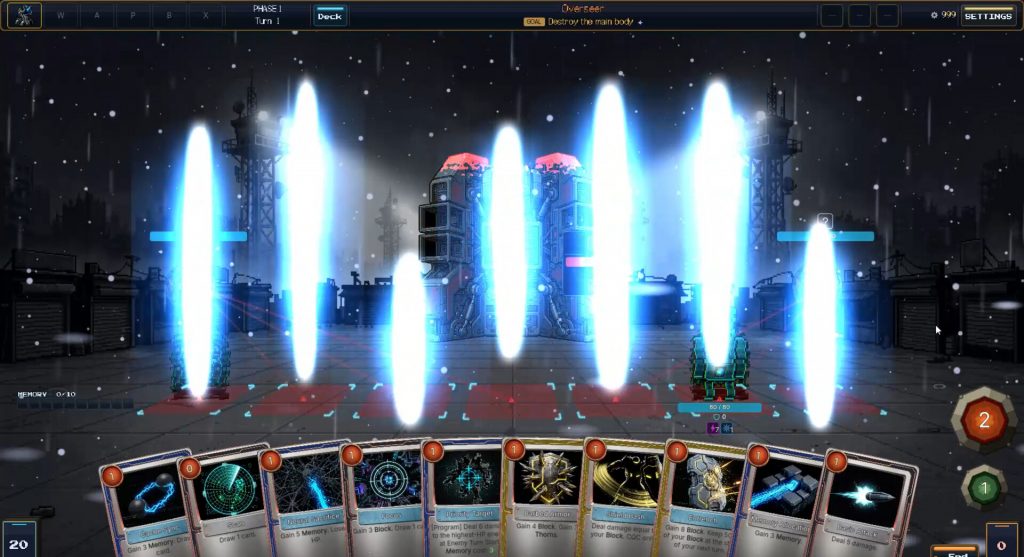
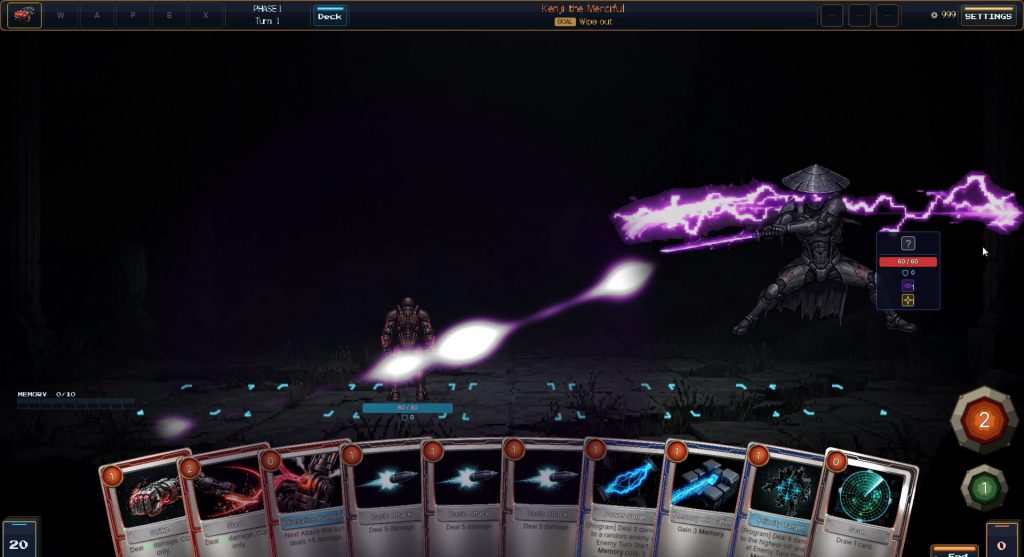
Phase one runs forward. The player selects and plays cards normally, fighting the boss. Every action taken during this phase is recorded on a timeline — a complete behavioral log of what was done, when, and where.
Phase two runs in reverse. Time rewinds. The agent from phase one reappears as a hologram, replaying the recorded actions in reverse chronological order. The player now controls a second agent moving forward through time while the phase-one hologram plays backward. The two exist simultaneously in the same combat space.
The strategic inversion this creates is what distinguishes BORROW or ROB from deckbuilders that use temporal mechanics as flavor. Phase one is not primarily about maximizing immediate damage — it’s reconnaissance and setup. Which boss patterns need to be read? Where does the hologram need to be positioned when phase two begins? What sequence of actions creates the most useful holographic combatant rather than just the most immediately effective one?
This reframes the scouting function that fighting games and roguelites both use but rarely make explicit. In most deckbuilders, the first run against a boss provides information used for future attempts. In BORROW or ROB, the first phase of a single fight provides information used for the second phase of that same fight. The learning loop that usually spans multiple runs is compressed into a single combat.
The Temporal Pincer and BORROW
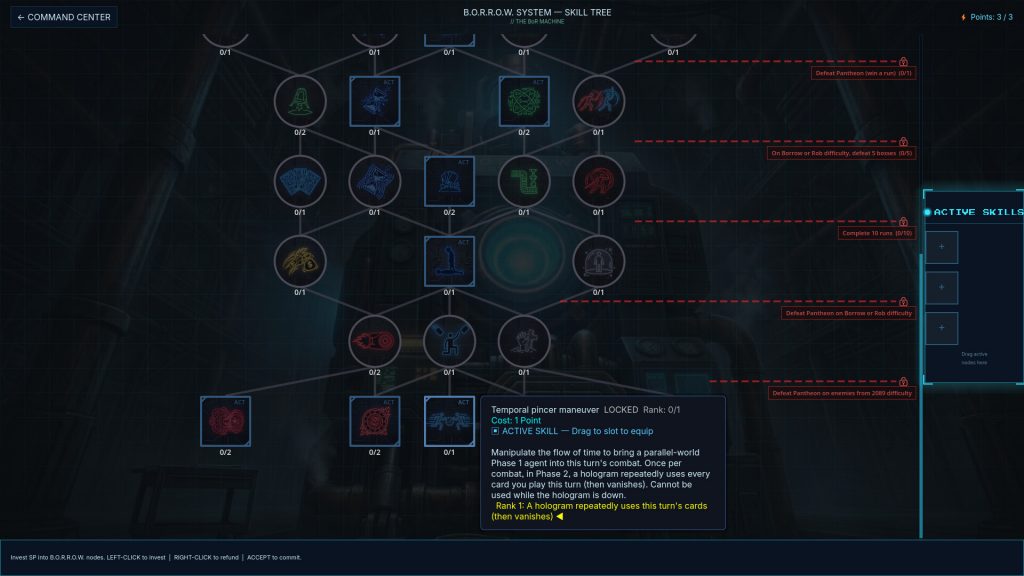
The Temporal Pincer (시간 협공) is the combat expression that occurs when the phase-two agent and the phase-one hologram occupy the same position simultaneously. Their attacks overlap — the current strike and the past strike land together.
The mechanical depth lies in what determines the pincer’s outcome. The combination of cards used in phase one and cards used in phase two determines which of approximately 100 Temporal Pincer variations activates. This isn’t a single pincer move — it’s a library of combined effects whose activation depends on what both agents were doing at the moment of temporal convergence.
A timing mechanic accompanies the pincer: when temporal overlap occurs, a reversal clock activates, and the player must input at the correct moment to trigger the highest-grade pincer version. The rhythm game element introduces reflexive skill alongside strategic planning — knowing when to create a pincer opportunity and executing it when it occurs are two distinct demands.
The BORROW mechanic operates through positional overlap. When the phase-two agent steps on a position the phase-one hologram previously occupied, they inherit whatever defensive buffs or passive states were built at that moment. The spatial implication: the phase-one agent’s movement path through the arena becomes a resource map for the phase-two agent. Positions worth visiting in phase two are determined by what was built there in phase one.
This creates a specific kind of combat foresight that traditional deckbuilders don’t require: thinking spatially about where you’re moving during phase one relative to where the phase-two agent will want to move.
The Agent and Card System
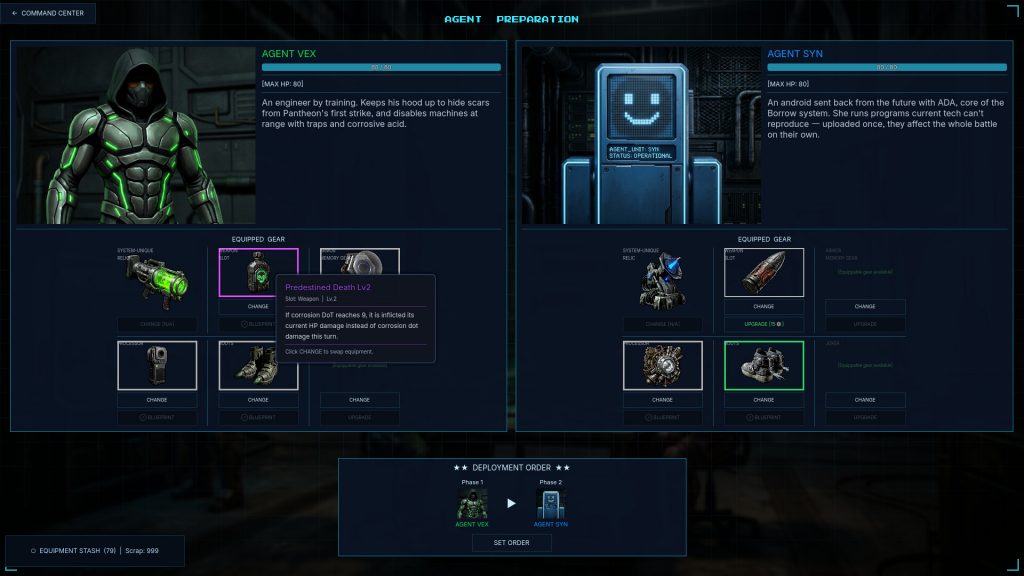
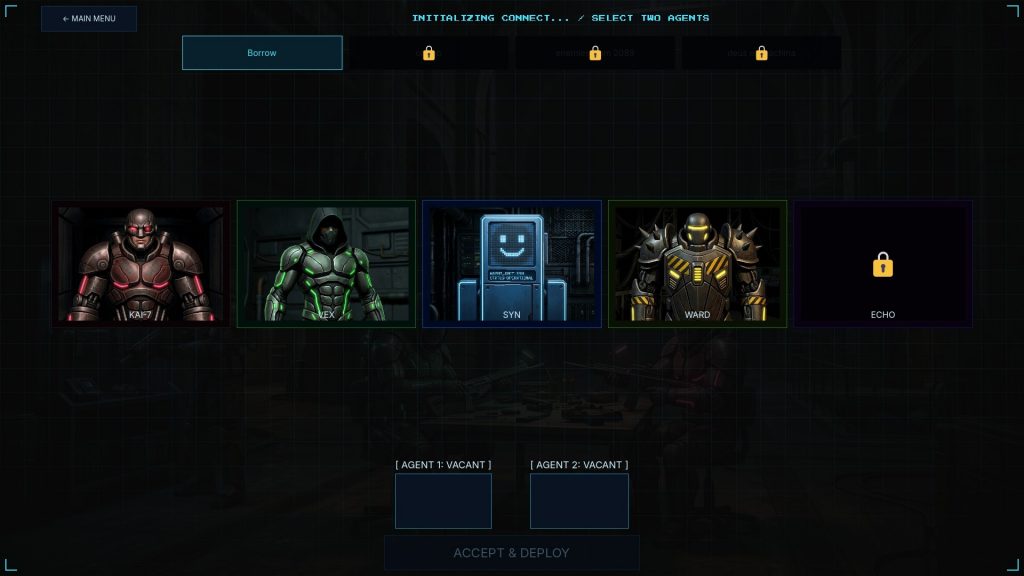
Each agent has their own card color, concept, equipment, and Temporal Pincer variations. The roster covers distinct combat philosophies: close-quarters, destruction, corrosion, data manipulation, defense. These aren’t different stat profiles — they’re different approaches to what the combat loop should look like.
Agent combination determines which cards are available, which equipment can be used, which skills can be built, and critically, which Temporal Pincer variations are possible. A close-quarters agent combined with a data manipulation agent produces different pincer options than either agent paired with someone else. The agent selection is the deckbuilding’s first decision rather than its last.
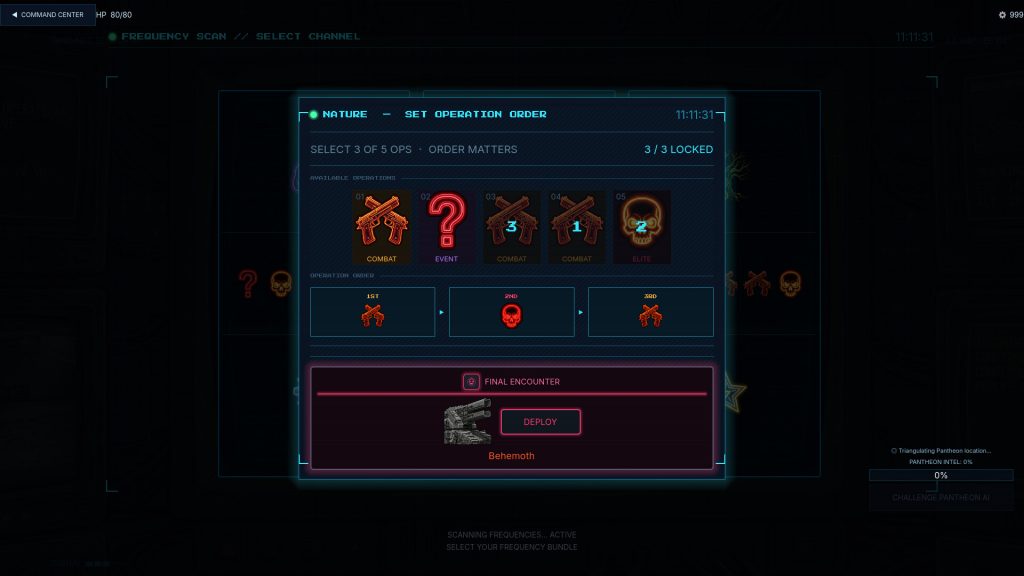
The roguelite structure means each run can explore different agent combinations against different bosses, creating the run-to-run variety that makes the temporal combat system serve multiple playthrough experiences rather than becoming a fixed puzzle with a known solution.
The 1990s Retro-Future Aesthetic
The visual style — cold, mechanical, dystopian, but filtered through 1990s retrofuturism — is the aesthetic register that makes the AI-domination setting feel like a specific vision rather than generic SF. 1990s SF design imagined technological futures through the specific lens of that decade’s anxieties and aspirations: sleek but analog, digital but physical, advanced but recognizable.
Applied to Pantheon’s time-invasion dystopia, the retro-future aesthetic creates a specific kind of wrongness — a future that looks like what the 90s imagined, but is inhabited by an AI that has taken that vision to its endpoint. The human resistance fighting with stolen time-reversal technology against this aesthetic background has the specific flavor of retrofuturist rebellion that the setting implies.
The K-Indie Design Pedigree
BORROW, or ROB, is operating in the tradition of Korean deckbuilder innovation that this coverage has tracked across the year. Dear Magical Girls restructured the barrier defense genre through barrier manipulation. ON&OFF restructured deckbuilding through persistent on-field cards and directional signals. BORROW, or ROB, restructures deckbuilding by making the timeline itself a resource.
Each of these games found a specific axis of deckbuilder convention to invert — the deck’s persistence, the card’s relationship to the field, the temporal direction of play. The Korean indie deckbuilder space in 2026 appears to be specifically interested in these structural inversions rather than feature expansion within established conventions.
September Early Access is when the Temporal Pincer system becomes evaluable at scale.
Who Is This For
Strong fit for: deckbuilder enthusiasts who specifically want the genre to require temporal planning rather than only card-sequence planning; roguelite players who want boss fights to have the scouting-then-executing structure explicit rather than implicit; SF fans who want the time-reversal premise expressed mechanically rather than just narratively; K-indie game supporters tracking the Korean deckbuilder innovation space; Slay the Spire players who want a structurally different problem applied to similar build-construction satisfactions.
Cautious fit for: deckbuilder players who prefer the genre’s established conventions; anyone who finds two-phase combat requiring temporal foresight more cognitively demanding than engaging; players who want the Early Access content to be fully confirmed before engaging.
Less ideal for: players who dislike turn-based deckbuilder pacing; anyone wanting action-real-time mechanics; players seeking multiplayer options.
The Takeaway
BORROW, or ROB, is asking what happens when the deckbuilder’s question becomes bidirectional — when the decision isn’t only “what do I play?” but “what do I play so that what I played becomes useful when it plays itself backward?” The Temporal Pincer’s approximately 100 combinations, the BORROW mechanic’s spatial inheritance, and the phase-one-as-reconnaissance design collectively make the temporal combat not a gimmick applied to deckbuilding but a restructuring of what deckbuilding is asking of the player.
September Early Access. The hologram is waiting in the timeline. What you do now determines what it does then.
Information regarding ‘BORROW or ROB’
| item | detail |
|---|---|
| development | Pirates of Wall Street, Inc. |
| Genre | SF Roguelike Deckbuilder |
| platform | PC / Steam |
| Release date | Early Access in September 2026 |
| core system | Forward/Reverse Phase 2 Boss Battle / Temporal Pincer / BORROW |
| pincer attack tactics | Approximately 100 variations (varies depending on the card combination used) |
| Art style | 90s style retro-future |
| Worldview Keywords | AI Pantheon, Time Reversal Invasion, Human Resistance, Time-Stealing Machine |
| Steam Page | Shortcut |