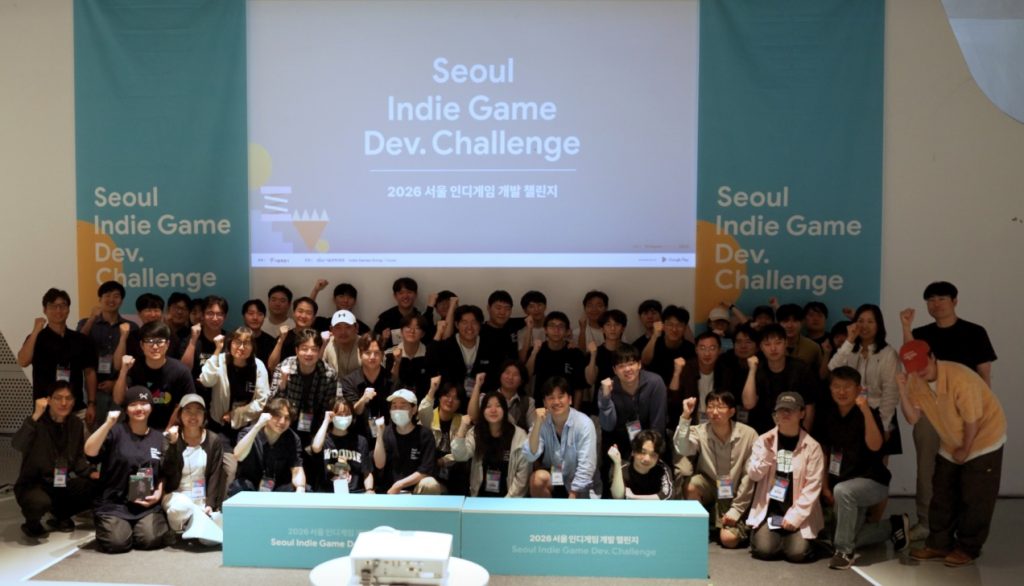
The 2026 Seoul Indie Game Development Challenge ran June 26-28 at the DPP Igansumun Exhibition Hall, producing 11 game prototypes from 46 developers across 11 selected teams over 72 hours without breaks. Co-organized by the Seoul Metropolitan Government, Seoul Business Agency (SBA), and Google Play Indie Games Group (IGG) Korea, the event was explicitly designed as something different from a standard game jam — a commercialization-focused intensive program rather than a creative sprint with prizes.
The design intent is worth understanding. Traditional game jams prioritize creative output over market viability: the constraint is time, the goal is a playable build, and the evaluation is often community voting or jury appreciation of the concept. This challenge added a parallel track: 7 of the 11 teams presented investor pitches to Korean venture capital firms and publisher representatives on the final day, seeking actual investment and commercialization pathways rather than just peer recognition.
The five thematic keywords — Seoul, traditional palace (고궁), school, repetition, cooperation — were announced at the start of the event rather than in advance, ensuring that all teams began from the same creative starting point. The Seoul framing is the specific public-purpose element: the program is explicitly aimed at developing indie games that can carry Seoul’s cultural identity into global markets, connecting the city’s cultural promotion to the indie gaming ecosystem.
NC AI’s VARCO AI platform support during the event — providing both technical guidance and development credits for teams to use generative AI tools during the sprint — reflects the current state of game development where AI-assisted asset creation has become a practical production tool rather than a distant concept. Teams working under 48-hour constraints benefit most directly from tools that accelerate work that the human developer would otherwise need more time to complete.
The peer voting feedback session on the final day produced something valuable beyond the competitive dimension: 11 small teams each understanding how 10 other small teams responded to their work, under the specific condition that the people evaluating them had just spent 72 sleepless hours in the same building doing the same thing. That context produces a specific kind of informed, empathetic feedback that external evaluation rarely provides.
The Post-Event Support Structure
The most substantive aspect of this challenge’s design is what happens after the 72 hours end. The support pipeline connects the event outputs to multiple commercialization pathways simultaneously:
Google Play IGG Korea offers selected games exhibition space at BIC 2026’s IGG joint booth and Google Awards nomination consideration — connecting the prototypes to Korea’s most prominent indie gaming showcase and to international platform visibility.
Smilegate provides STOVE platform user voting and feedback, plus expansion support for teams developing their prototype toward full commercial release — combining market validation with development resource support.
Tumblbug offers one-on-one crowdfunding guidance and 2 million won in marketing support to all 11 participating teams — giving every team a specific mechanism for finding their initial commercial audience regardless of whether they receive VC investment.
GES 2026 exhibition space at DPP in September provides a venue to present developed work publicly — a concrete next step for teams to work toward.
This layered support structure reflects an understanding that the bottleneck for indie games isn’t usually the initial creative output — 48 hours can produce a compelling prototype — but the sustained support needed to develop that prototype into something commercially viable. By building the post-event pathway into the program’s design rather than treating the event as self-contained, the Seoul Indie Game Development Challenge is trying to address the gap between “impressive game jam project” and “game that reaches players.”
SBA’s Moon Gu-seon described the goal plainly: ensuring that “the unlimited potential of indie games confirmed in this challenge shines in the global market and leads to tangible results.” The post-event support infrastructure is the mechanism for attempting that translation.
What 11 Prototypes in 72 Hours Means
Eleven teams, 46 developers, 72 hours, five thematic keywords, one exhibition space with high pedestrian traffic on the final day — these are the conditions under which the event operated. The output of 11 playable prototypes reflects both the genuine creative capacity of organized indie developers under constraint and the production efficiencies that modern game development tools, including AI assistance, enable.
None of those 11 prototypes is a finished game. All of them are beginning points — concepts proven to be buildable, mechanics demonstrated to work at basic implementation, ideas shown to be interesting enough that other developers spent time playing with them. Whether any of them become games that reach players will depend on decisions and work that extend far beyond the 72-hour window.
But the pipeline that begins at this event is longer than most game jam pipelines. BIC 2026, the Google Awards, the STOVE platform, Tumblbug funding guidance, GES 2026 — these are real subsequent steps, not hypothetical opportunities. The developers who left DPP on June 28 left with relationships, feedback, and concrete next-step pathways that most game jam participants don’t receive.
That’s the event’s specific contribution to Seoul’s indie gaming ecosystem: not 11 finished games, but 11 started development journeys with more support behind them than they’d have had otherwise.