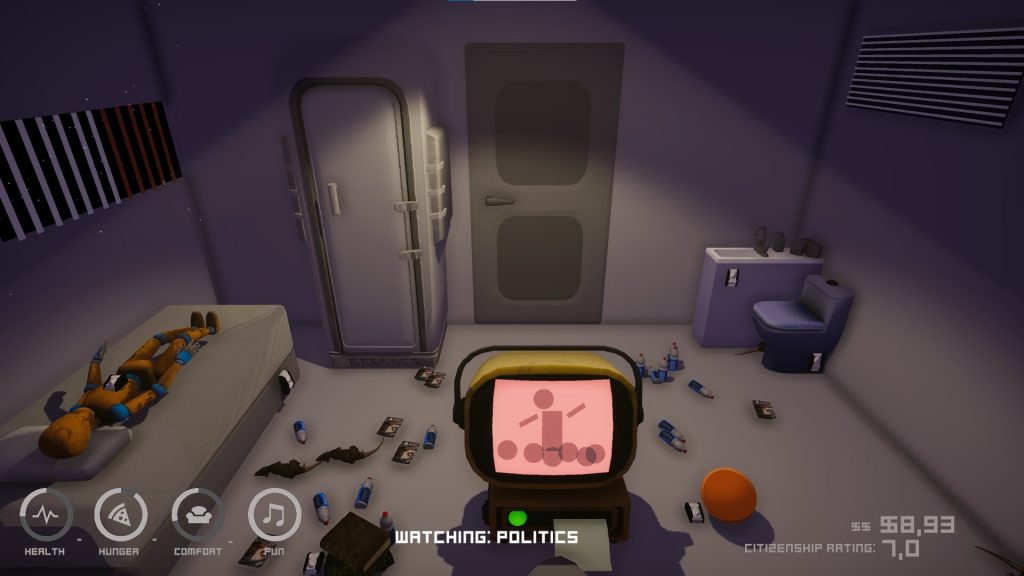
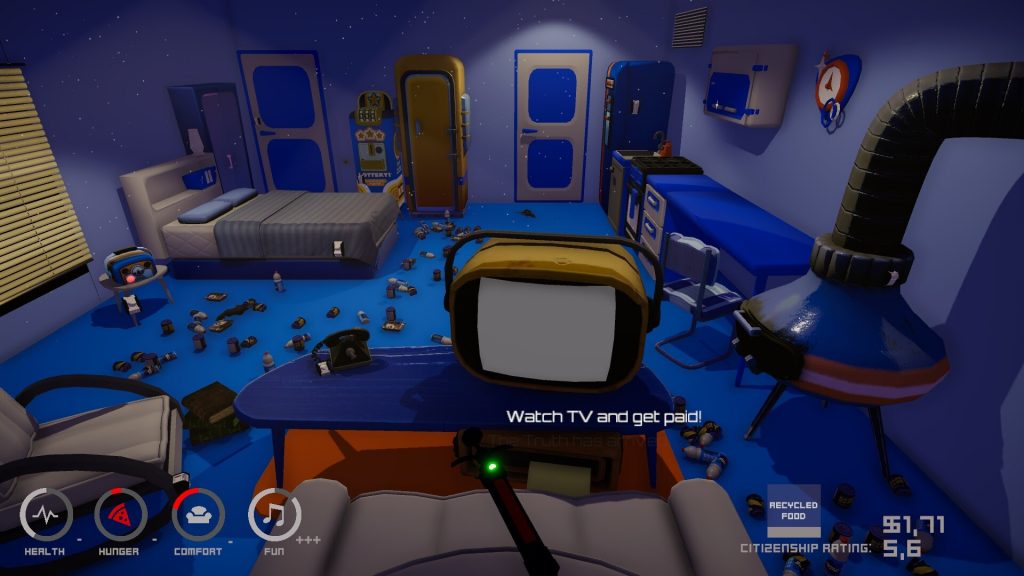
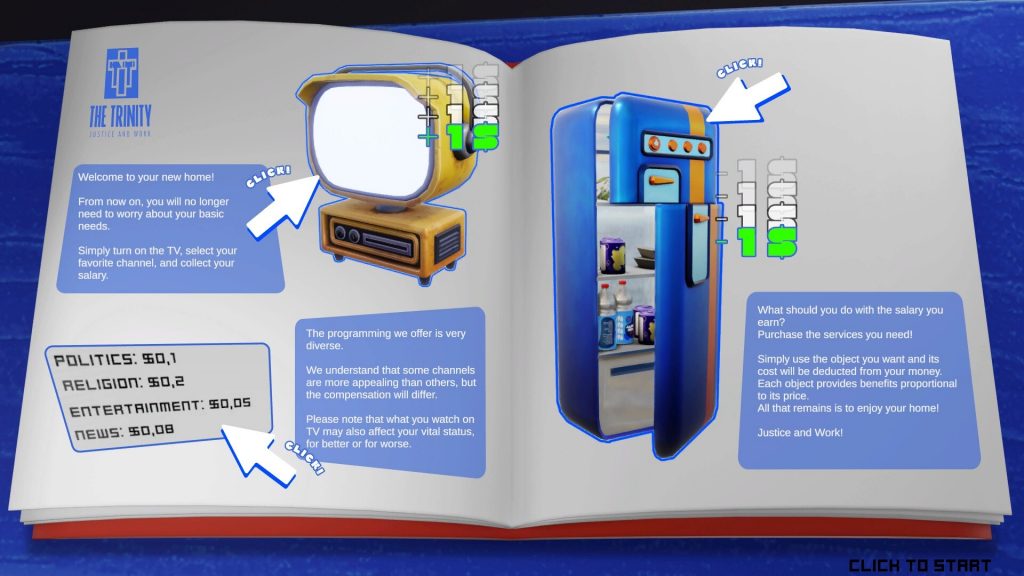
The government has provided you with a small room and a job: watch television. Different channels pay different wages. With that money, you purchase access to your bed, your stove, your shower. This is the economy. This is the life. And it started with a Philip K. Dick novel where you had to insert coins to use household appliances.
Dystopicon — the satirical dystopian life simulation from Spanish solo developer Juan Felipe Molina (Palitroque) — arrives on Steam July 27, eight years after its itch.io prototype demonstrated the concept had an audience with 12,000+ downloads. The game sits in the specific tradition of Papers, Please and George Orwell: using constrained, bureaucratic game mechanics to make you feel the texture of a controlled life rather than merely describing it from outside.
The best pre-release marketing moment was accidental: the game’s trailer criticizing media censorship was itself censored by a platform. The irony generated significant community attention and interest, demonstrating that sometimes the most effective publicity is the one that proves your point.
The Philip K. Dick Origin
Juan Felipe Molina’s stated inspiration — the coin-operated household appliances in Philip K. Dick’s Ubik — is a conceptual seed worth examining because it explains the game’s entire satirical logic. In Ubik, Dick imagined a future where every mundane interaction requires payment: doors won’t open without money, refrigerators demand fees. The horror isn’t the appliances themselves but the revelation that access to ordinary life has been monetized and gatekept.
Dystopicon inverts this mechanism elegantly. Rather than paying to use your apartment’s services (the Ubik model), you earn money by performing the government-specified labor of television watching, then use that money to purchase access to basic life services. The direction of the transaction reverses, but the underlying satirical target is identical: a world where the most mundane aspects of existence are mediated through economic exchange and institutional permission.
The addition of contemporary social media and doomscrolling culture to the Ubik premise updates the satire for 2026 in ways that weren’t available in 1969. TV-watching-as-work resonates differently in an era when influencer economics, content consumption, and engagement metrics have genuinely blurred the line between leisure and labor. Watching television in Dystopicon is specifically modeled on a dynamic that already partially exists: the attention economy, where consuming media is simultaneously leisure and the production of data value for intermediaries.
The Mechanical Satire
The game’s mechanics are doing ideological work rather than simply providing engagement. This is the Papers, Please design philosophy: making you perform the system’s operations so you understand the system from the inside rather than from observation.
Watching TV to earn wages creates a specific kind of passivity as an economic activity. The player’s primary productive action is consumption — watching, not creating, building, or solving. The government channels produce content; the player’s role is to receive it. The wages generated by this reception create the purchasing power for basic life functions. The loop is: receive government content → receive government payment → purchase government-approved services → survive → repeat.
This is a closed economic system where the only inputs and outputs are government-provided. The player’s economic life circulates entirely within institutional infrastructure rather than generating any independent value or accessing any external alternative. The satirical point is made experientially rather than explained: you feel the closure of the system through the mechanics rather than reading about it.
The choice architecture — conformity versus resistance, compliance versus rebellion — gives the mechanic moral weight. The 14 endings emerging from 6 scenarios mean that the consequences of choosing to navigate this system in different ways are substantial and varied. Becoming a loyal government party member, ending up in a reeducation camp, becoming a bureaucrat, hacking the system, getting entangled in terrorism, winning the lottery (the randomness of fortune as the only system-approved escape) — these are meaningfully different outcomes that reflect different stances toward the controlling system.
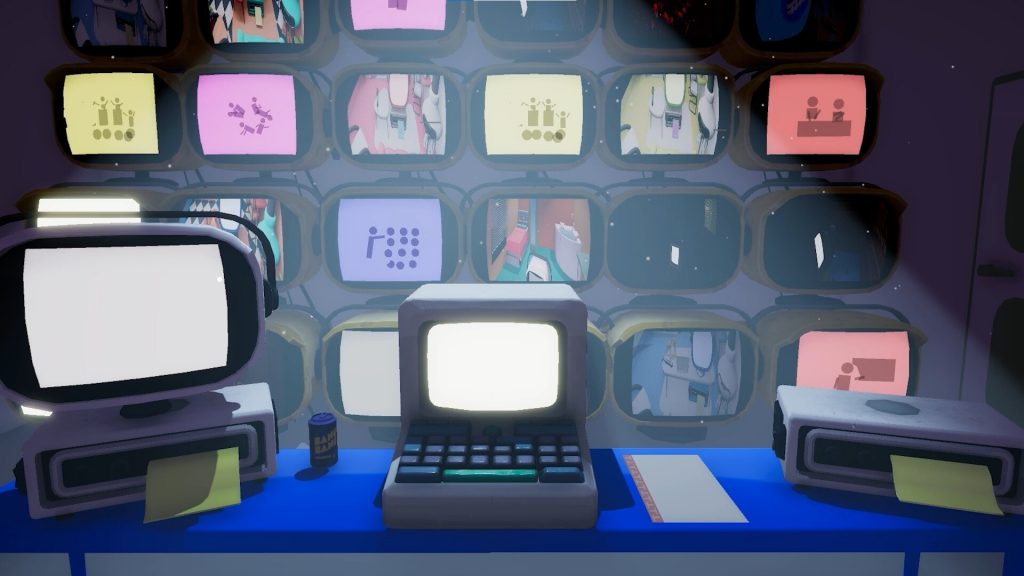
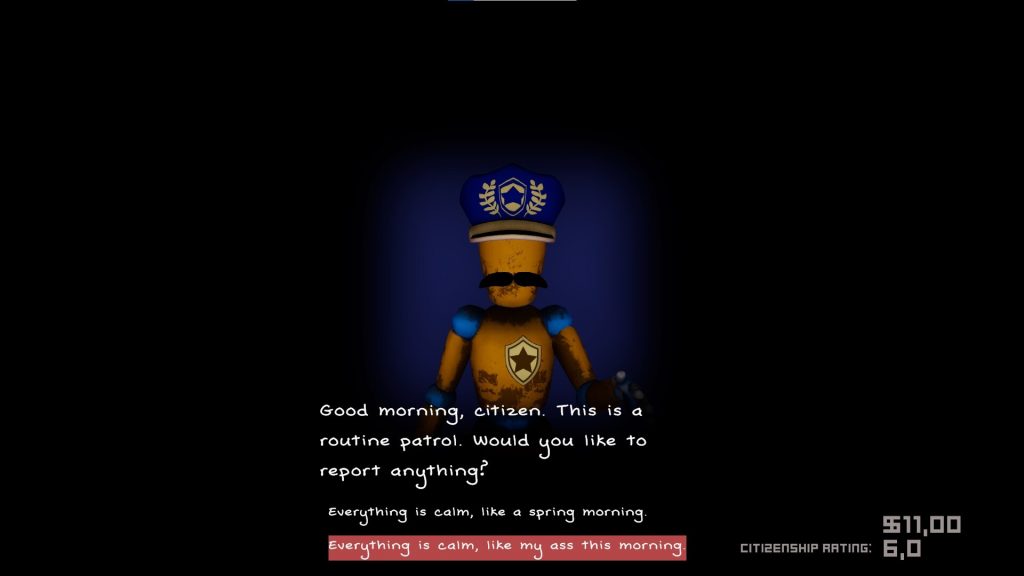
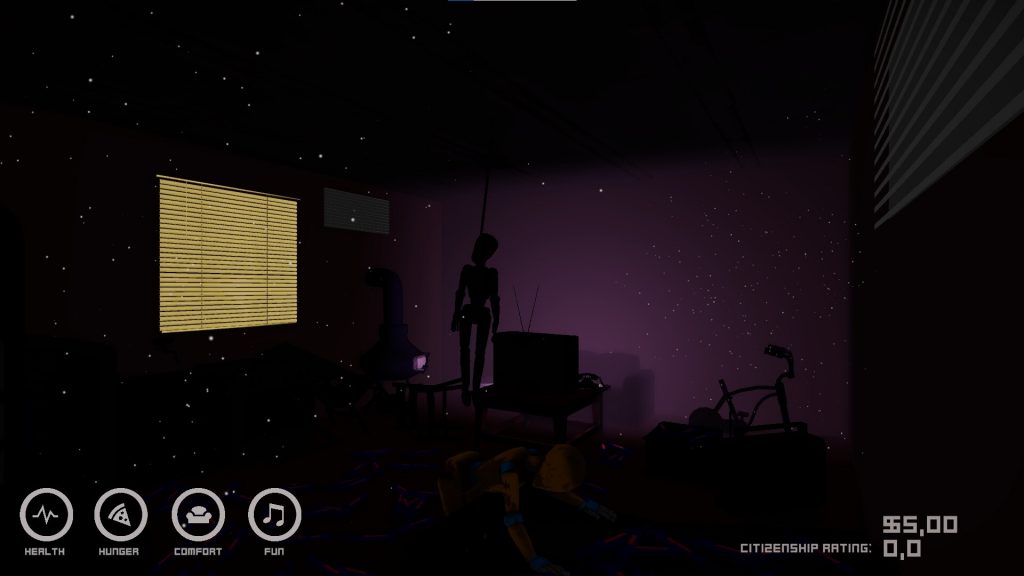
The Deliberate Political Ambiguity
Molina’s statement about the game’s political position is worth taking seriously: “Players interpret the game’s government as different political systems according to their perspective, but we did not define a specific ideology. This intentional ambiguity creates different interpretations for each player.”
This is a sophisticated design choice for a game with explicitly political content. Games that name a specific political system or ideology as their satirical target limit their audience and invite partisan interpretation (“this is anti-X propaganda”) that can overwhelm the underlying critique. Games that depict structures and mechanisms without labeling them create space for the player to supply the ideological context from their own experience.
The mechanisms of Dystopicon — surveilled consumption as labor, gatekept basic services, institutional control of information flow, binary compliance/resistance choices with institutional consequences — are historically recognizable patterns that appear across many political systems rather than uniquely defining any single one. A player who grew up under one political system identifies these patterns as describing that system; a player from a different context identifies them as describing their context. The satire lands universally because it targets the structural patterns rather than the specific implementations.
This intentional ambiguity also produces more durable satire. Political satire targeting specific contemporary figures or systems dates quickly; satire targeting structural conditions of institutional control over daily life remains relevant across time and geography.
The Eight-Year Development Arc
The itch.io prototype appeared in 2018. The Steam release arrives in July 2026. This eight-year journey from proof of concept to commercial release encompasses several distinct development periods with different conditions.
The 2018 prototype demonstrated audience reception (12,000+ downloads) for a concept that could have remained a curiosity. The COVID-19 pandemic gave the game’s themes unexpected contemporary resonance — a period when many people did literally spend most of their time in small spaces consuming digital content while economic uncertainty shaped what services they could access. The coincidence of pandemic conditions with the game’s premise likely sharpened Molina’s sense of what the game was actually about.
The 2025 decision to leave employment and develop full-time represents the commitment point at which a side project became a primary project. This transition typically either produces faster completion or scope expansion; for Dystopicon, it appears to have produced both content deepening (6 scenarios, 14 endings) and polish improvement (the 3D art contribution from Senia Almela and the comic illustration work from Mario Alba, both of whom strengthened the visual presentation beyond the prototype).
The trajectory from 12,000 itch.io downloads to Steam release reflects exactly the validation-then-expansion path that the itch.io platform works best for: prove the concept, build an audience, develop the commercial version with that proof of concept and audience as a foundation.
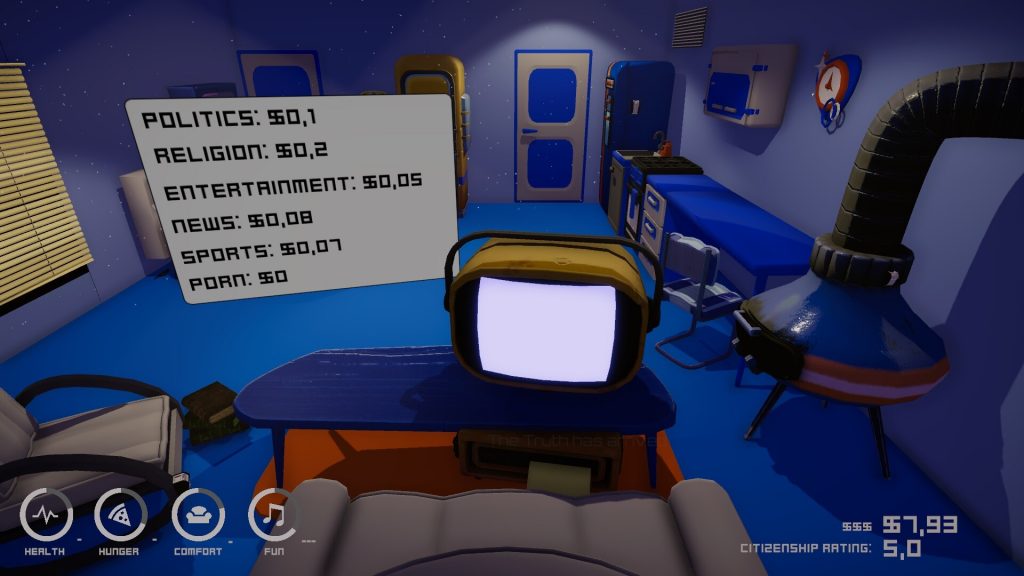
The Censored Trailer Irony
The pre-release incident where a trailer for a game criticizing media censorship was itself censored by a platform deserves attention not just as an anecdote but as a structural demonstration. The trailer presumably depicted, criticized, or referenced censorship mechanisms; the platform’s content review process flagged it under policies that the game’s satire could have been written to predict.
The community attention this generated was disproportionately positive for the game because the irony made the game’s satirical point tangibly. Satire that demonstrates its own thesis through the act of its reception is rare and valuable: the platform became an example of the mechanism the game criticizes, confirming that the critique has real-world application beyond the fictional setting. The censored trailer became the most effective proof of concept that Dystopicon‘s commentary lands in the real world.
Molina’s decision (presumably) to publicize the censorship rather than quietly comply produced better marketing than any intended promotional strategy could have.
The Retro-Futurist Visual Register
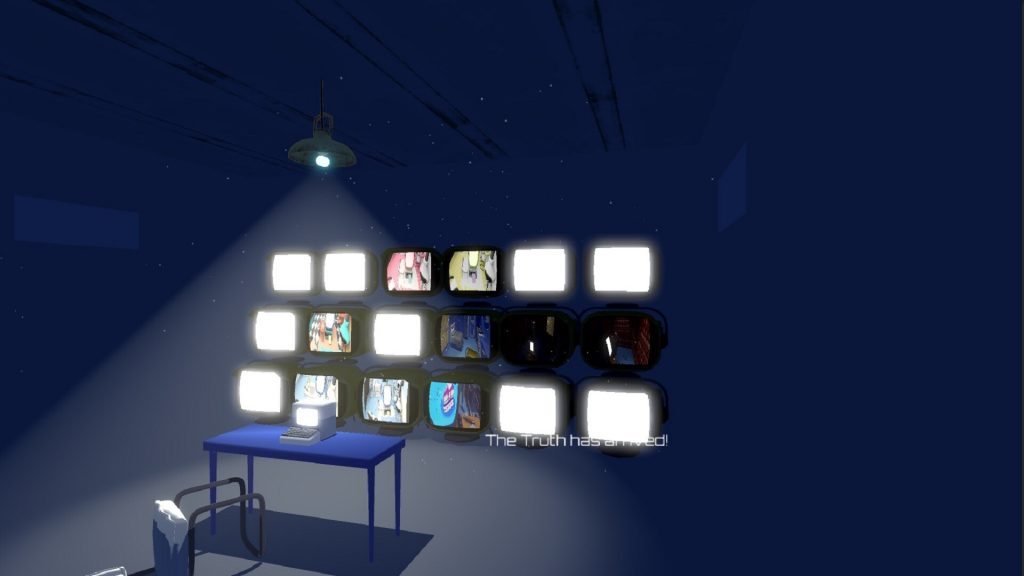
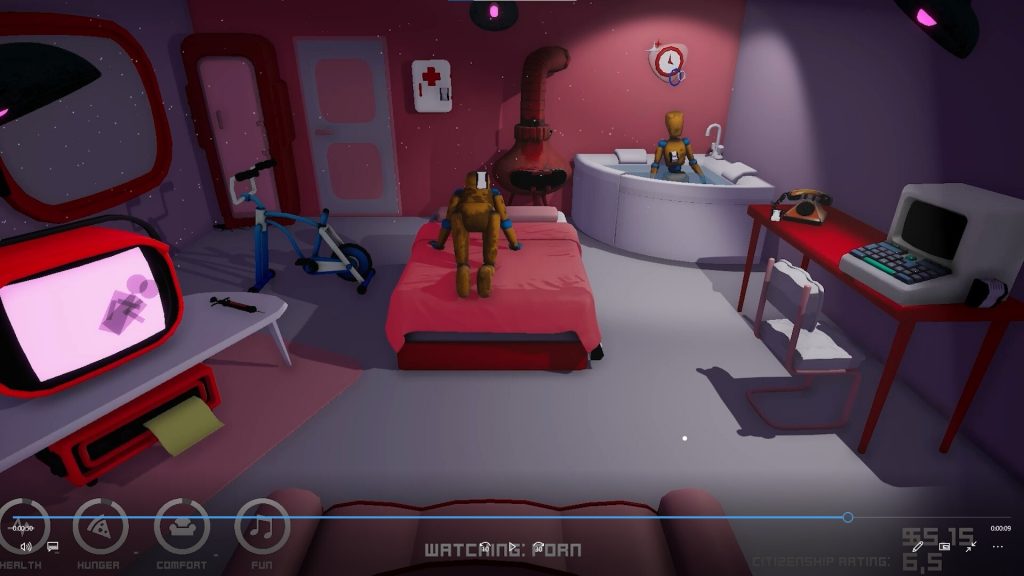
3D artist Senia Almela’s contribution to the retro-futurist aesthetic is the visual layer that makes Dystopicon‘s small apartment feel specifically uncanny rather than merely small. Retro-futurism in visual design produces the specific dissonance of imagining the future from a past moment — the future as imagined in the 1960s, with its specific combination of technological optimism and domestic familiarity. Government-branded broadcast television, obsolete household appliances, and institutional furniture create a present that feels simultaneously dated and speculative.
The comic illustration sequences by Mario Alba add a second visual register — the formal distance of sequential illustration creates a different emotional relationship to the satirical content than 3D immersion. Comics as satire have the tradition of Mad Magazine and political editorial cartooning behind it; text message narrative creates yet another communication channel. Three distinct visual languages operating within one game create tonal variety that a single visual approach couldn’t achieve.
The Papers, Please Lineage
Dystopicon is being released on the same day as Security 51, which we covered earlier this month — another bureaucratic simulation in the Papers, Please tradition. The simultaneous emergence of two games targeting this design space with different settings (dystopian apartment vs. Area 51 underground bunker) reflects the genre’s continued vitality rather than coincidence.
What connects them — and what the Papers, Please lineage specifically offers that other game genres can’t — is the experiential delivery of systemic critique. Reading about media control or security apparatus is educational but abstract; performing the mechanisms of those systems through game mechanics creates embodied understanding of how they function and what they feel like from inside.
At $7.99 with a launch discount, Dystopicon sits at the price point where the concept can be evaluated without significant financial commitment — appropriate for a game that is genuinely experimental in its satirical approach.
Who This Is For
Strong fit for: Papers, Please enthusiasts who want satirical simulation in contemporary rather than historical register; players who engage with games as critical commentary on social structures; Philip K. Dick readers who want to inhabit his conceptual spaces interactively; dystopian fiction fans (Orwell, Huxley, Kafka) who want interactive engagement with those themes; players interested in replay value through branching scenario structures; anyone who finds the attention economy / doomscrolling dynamic worth satirizing.
Cautious fit for: players who want primarily entertainment rather than ideological engagement; anyone who finds satire-forward game design didactic rather than engaging; players who prefer action-forward game mechanics over time management and choice systems.
Less ideal for: players seeking mechanical complexity or gameplay challenge; anyone who dislikes explicitly political game content; players expecting long playtimes from a $7.99 game (the scenario and ending structure suggest moderate total playtime rather than extended content.
What to Watch For
The primary question for Dystopicon is whether the satirical commentary sustains across 6 scenarios and 14 endings without repeating the same observations. Satire that makes one point effectively exhausts quickly; satire that reveals progressively different facets of the same structural critique maintains engagement across replays.
The 14 endings suggest substantial branching — but whether those branches reveal genuinely new perspectives on the game’s themes or primarily provide narrative variety without deepening the critique will determine if the replay structure delivers on its promise.
The hidden secret scenario suggests content for players who engage thoroughly rather than stopping at initial completion — a design choice that rewards the players most invested in the game’s world.
The Takeaway
Dystopicon is the kind of solo developer project that takes eight years because the idea deserved eight years: a concept strong enough to prove on itch.io in 2018, relevant enough to deepen through a pandemic that made its premise viscerally real, and personal enough to eventually justify leaving employment to complete. The satirical premise — watching television as paid labor, basic life services as purchasable commodities, institutional control experienced from inside a small room — is the kind of idea that could only come from someone genuinely interested in what these mechanisms feel like rather than what they look like from outside.
The trailer that was censored for criticizing censorship is the best possible demonstration that the game’s critical apparatus is functioning correctly. Reality confirmed the satire’s validity before the game released.
July 27. Small room. Government television. Wages for watching. Choices about whether to comply. Consequences, whatever you choose.
Philip K. Dick put coins in the door. Juan Felipe Molina put the television to work. Eight years later, both observations have become more contemporary rather than less.
Information regarding ‘Dystopicon’
| item | detail |
|---|---|
| Developer | Palitroque (Cartagena, Spain, Juan Felipe Molina) |
| Publisher | Palitroque (Self-publishing) |
| Genre | Dystopian Life Sim / Time Management / Satirical Simulation |
| Release platform | PC (Steam) |
| Release date | July 27, 2026 |
| price | $7.99 (15% off for 2 weeks after launch) |
| Original prototype | itch.io (Released in 2018, 12,000 downloads) |
| core system | Earn salary by watching TV, survive by purchasing services, 6 scenarios, 14 endings |
| inspiration | 1984, Brave New World, Ubik, Papers Please |
| Steam Page | https://store.steampowered.com/app/3713750/Dystopicon/ |