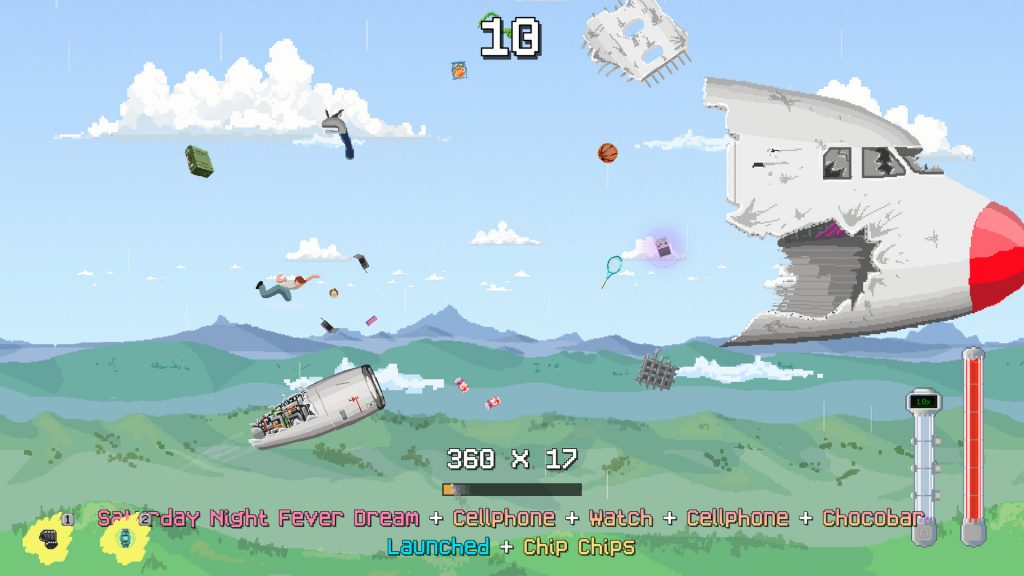
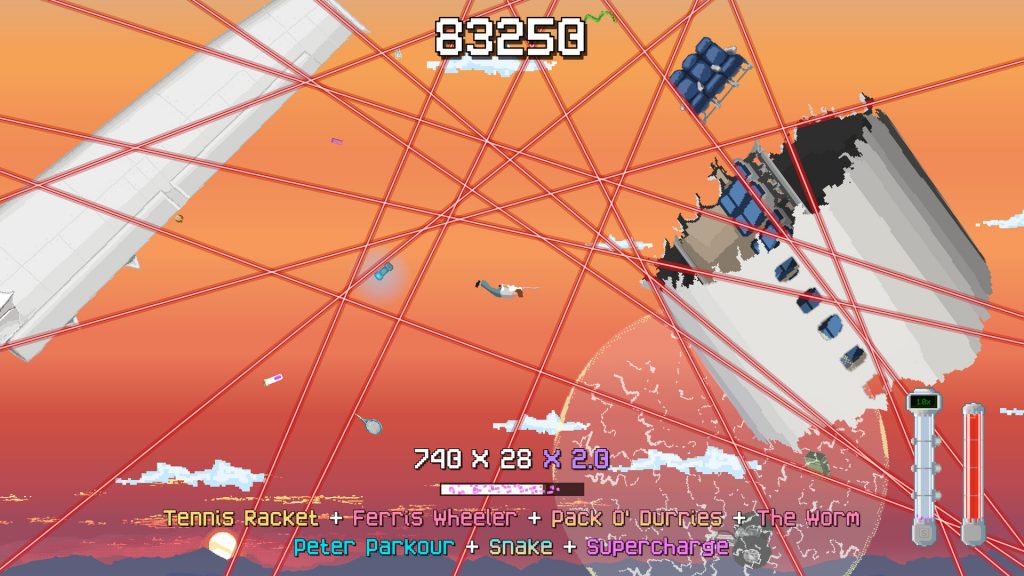
A plane explodes mid-flight. One survivor falls toward the ground. You have 60 seconds. In that 60 seconds, you’ll do backflips, somersault through scattered debris, grab passengers’ belongings out of the air, dodge bullet-hell projectiles, and chain combos like a 90s arcade game refused to acknowledge its own death. FREEFALL ’95, the debut release from three-person Melbourne studio S-Bend Games, is the kind of game whose pitch is so confidently absurd you immediately want to play it — and the demo’s 100% Positive reception suggests the execution is matching the concept.
The full release lands June 1 on Steam.
A Premise That Earns Its Absurdity
Most games with high-concept premises struggle to make the concept actually drive the gameplay. FREEFALL ’95 doesn’t have that problem. The 60-second freefall isn’t a framing device for traditional mechanics — it is the mechanics. You’re falling. You’re going to land. The only question is what happens in the time between those two facts, and the answer is: as many tricks, combos, item grabs, and stylish maneuvers as you can physically execute.
This is a smart design choice for several reasons. First, the time pressure is intrinsic to the concept rather than imposed on it. You don’t need a timer UI to create urgency — gravity does the work. Second, the short loop makes failure cheap and retries instant, which is exactly the right rhythm for a score-attack game. Third, the constrained scope forces design depth into the mechanics themselves rather than into content volume. Every level is the same 60-second proposition, which means every level has to find new ways to be interesting within those 60 seconds.
The combo system is where that depth lives. Backflips, somersaults, worm tricks, item collection — chaining them all together produces the exponential score growth that score-attack games depend on. The system looks simple on first contact and reveals layers as you play: power-ups, abilities, side quests, and the strategic decisions about which items to grab in which order all combine into something that rewards skill development across runs.
The Tony Hawk DNA Is Real
Calling FREEFALL ’95 a “Tony Hawk descendant” isn’t a stretch — it’s the project’s explicit lineage. The Tony Hawk’s Pro Skater and SSX Tricky inspirations show in everything: the combo-chain emphasis, the trick-list approach to scoring, the soundtrack sensibility, and the way style and substance intertwine into the same mechanical surface.
What makes the borrowed DNA work is that FREEFALL ’95 isn’t just transposing Tony Hawk’s structure into a different setting. It’s adapting it to a vertically constrained, time-limited, bullet-hell-adjacent context that produces a fundamentally different rhythm. Tony Hawk runs are about navigating space; FREEFALL ’95 runs are about navigating time. The verbs translate. The feel doesn’t.
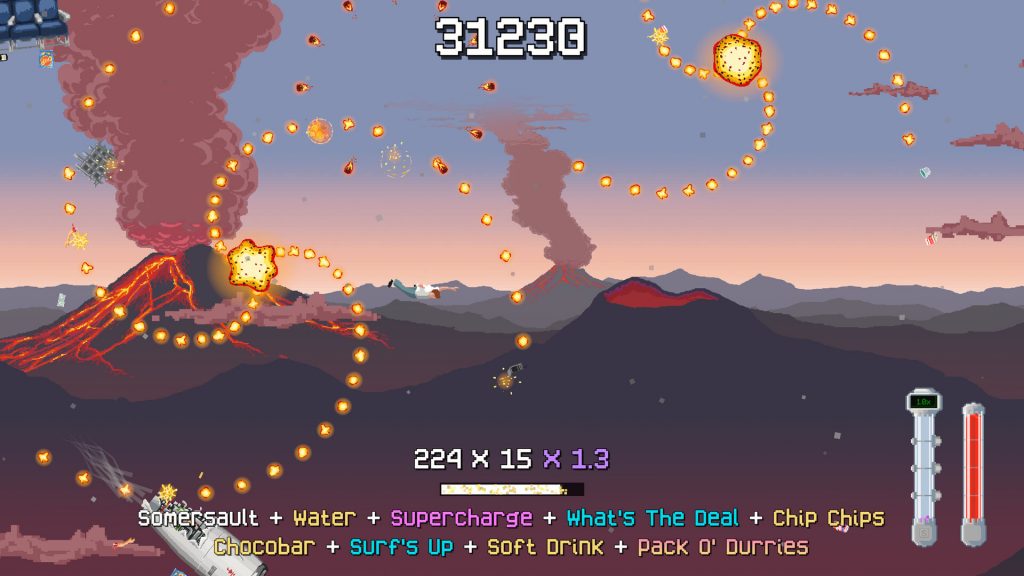
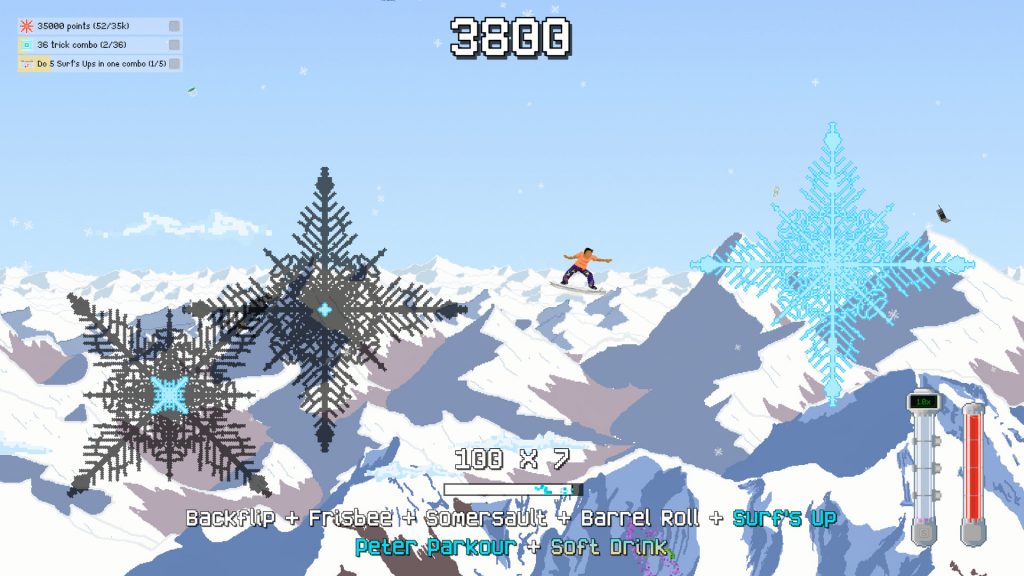
The bullet-hell layer is the smartest addition. Ice blasts, lightning, fire projectiles, and other environmental hazards mean you’re not just optimizing for trick volume — you’re optimizing for trick volume while staying alive. The dual-attention demand is what elevates FREEFALL ’95 from pure style nostalgia into a genuinely modern arcade game.
The Time Loop Twist
The structural surprise — and the design choice that turns FREEFALL ’95 from a score-attack toy into something with longer legs — is the time loop framing. After each fall, the player wakes up back on the plane. The loops aren’t just retry mechanisms. They’re narrative.
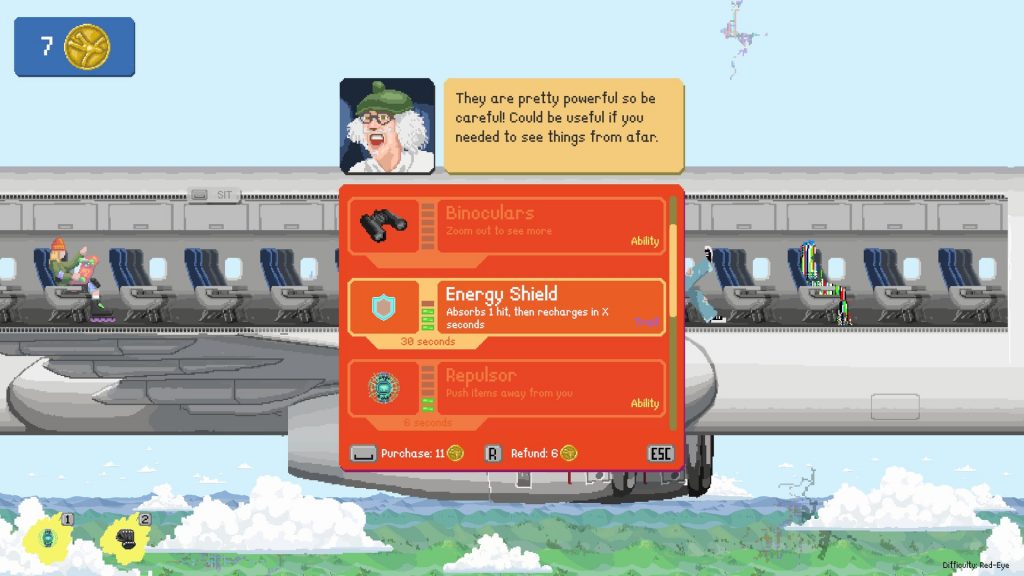
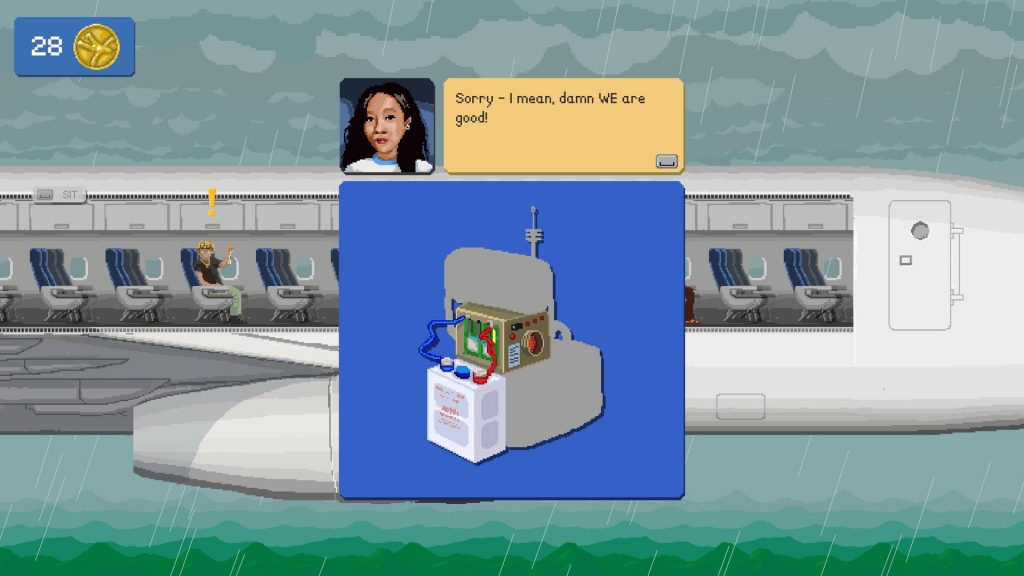
Inside the plane, between falls, you can talk to other passengers, take quests, and spend coins earned in previous runs on items and upgrades. As you unlock new levels, the story expands. The cause of the explosion, the secret behind the loop, the reasons certain passengers are on this specific plane — all of it gradually reveals itself across the repeated falls.
This is a meaningfully ambitious narrative structure for an arcade trick game, and it’s what separates FREEFALL ’95 from being a ’90s aesthetic curiosity. The roguelike DNA — runs that accumulate persistent currency and meta-progression, story that unfolds across iteration — meets the 90s arcade DNA in a way that produces something neither genre has quite seen before.
It also solves the genre’s longevity problem. Pure score-attack games depend on intrinsic skill motivation to keep players engaged past the first few hours; many players bounce when the only progression is their own improvement curve. The time loop narrative gives players who need external progression hooks something to chase, without diluting the score-attack joy for players who’d be happy chasing leaderboards forever.
The 16-Bit Aesthetic and Its Black Humor
Visually, FREEFALL ’95 commits fully to the 16-bit arcade register. Pixel art that evokes classic cabinet games, exaggerated blood splatter when things go wrong, and a 90s-styled soundtrack that completes the sensory package. The aesthetic is doing double work — selling the nostalgia and creating the tonal license for the dark humor that runs through the whole project.
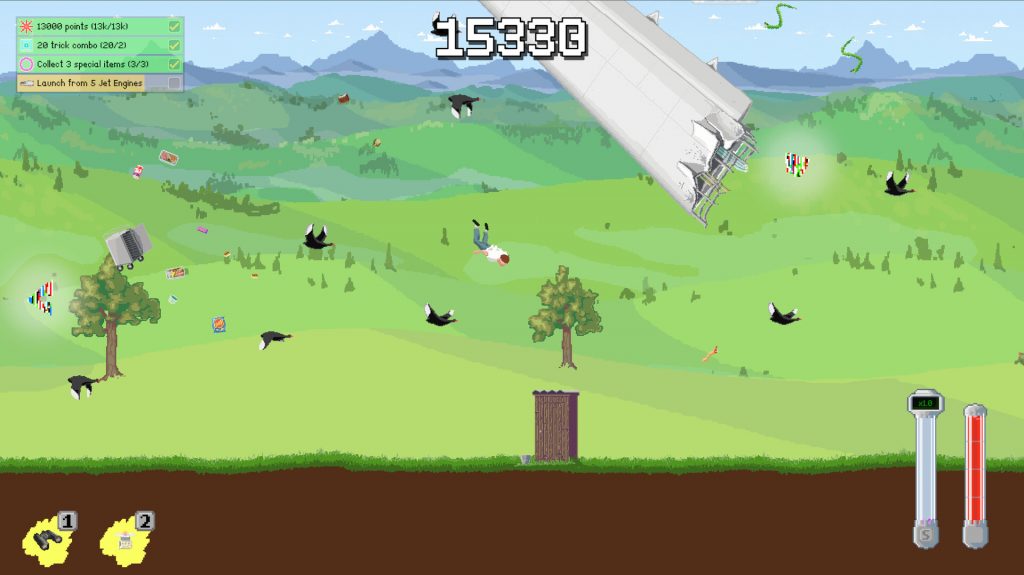
The black humor is essential here. A game about a plane crash survivor falling for 60 seconds while grabbing belongings — including, apparently, snakes — would be tonally impossible if it tried to play the premise straight. The 16-bit aesthetic and the exaggerated cartoon-violence register turn the concept into the right kind of joke: dark enough to be funny, stylized enough to never become genuinely upsetting, and committed enough that the humor lands rather than feeling like an apology.
The level variety extends the aesthetic across multiple environments — clear skies, stormy mountain ranges, erupting volcanoes — each with different environmental hazards and visual identity. The 5 levels × 3 difficulties structure (15 stages total) is the right scope for a project of this scale: focused enough to maintain quality, varied enough to justify return runs.
The Modes Stack
The full release packs in more modes than the core pitch suggests. Beyond the main campaign:
Challenge Levels — bespoke stages with specific objectives, the standard arcade structure for testing player skill against constraints.
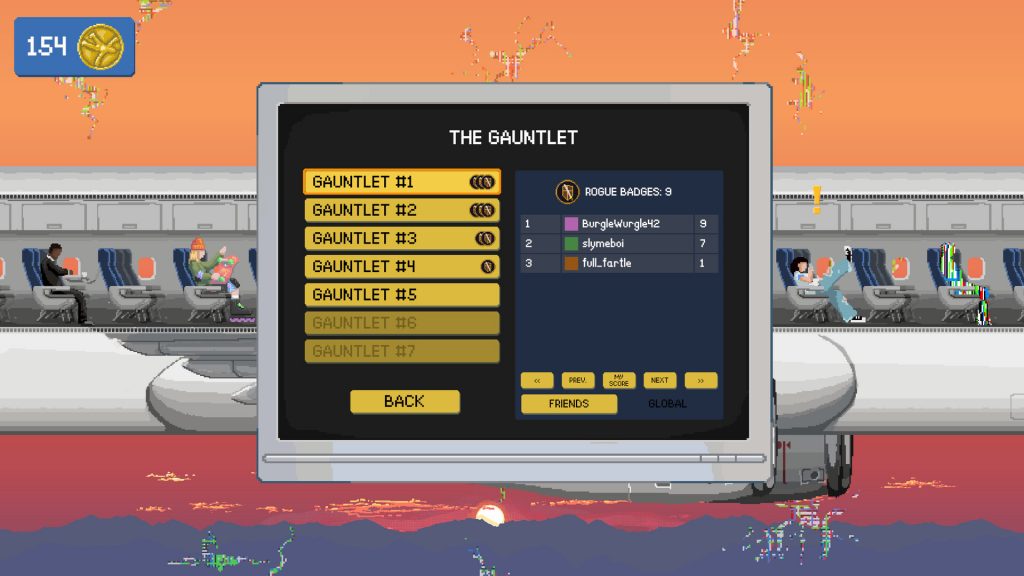
Roguelike Gauntlet Mode — strung-together falls with roguelike progression, the longer-form structure for players who want extended runs.
Global and Friend Leaderboards — the score-attack genre’s lifeblood, and a necessary feature for a game of this design philosophy.
25 Abilities — the build-variety layer that lets players develop preferred playstyles across runs.
This is a substantial content package for a debut from a three-person team. The fact that S-Bend Games is shipping with leaderboards, multiple modes, and meaningful build variety suggests they understand that score-attack games live or die on the post-campaign experience.
A Studio Worth Watching
S-Bend Games was founded in 2024 and is based in Melbourne, Australia. Three people. FREEFALL ’95 is their first commercial release, and it represents the kind of focused small-team execution that arcade games specifically benefit from. Score-attack design rewards tight teams who can iterate quickly on feel — exactly what a three-person team can do well, and exactly what larger teams often struggle with as their coordination overhead grows.
The browser-platform pre-release strategy is also worth noting. FREEFALL ’95 surfaced first through casual game platforms before the Steam demo, which built community awareness and gave the developers feedback data before the higher-stakes storefront launch. This is a smart distribution arc for an arcade game with broad accessibility — the bullet-hell roguelike scene on Steam is competitive, and surfacing through casual platforms first builds momentum without competing directly with the storefront’s hardcore audience initially.
The international press coverage has been notably positive, with one outlet’s summary capturing the project’s appeal directly: more games with this kind of audaciously original premise should exist. Another review highlighted that the retro aesthetic conceals more mechanical depth than the surface suggests. Both readings are accurate.
How the Press Has Read It
The 100% Positive demo reception across 20 reviews is the headline number, but the qualitative reception matters more for understanding the project. Coverage has consistently emphasized two things: that FREEFALL ’95 commits to a premise more completely than most indie projects manage, and that the depth underneath the absurd surface is more substantial than expected.
Gaming Bible‘s framing — that the world needs more games with premises this ridiculous — is the right register. FREEFALL ’95 is the kind of project that justifies the existence of small indie teams. A three-person studio can take a premise that wouldn’t survive a publisher pitch meeting, commit to it fully, and ship it as a complete piece of work. Nothing about the project is hedged.
Who This Is For
Strong fit for: arcade game fans, especially Tony Hawk / SSX / score-attack enthusiasts; bullet-hell players curious about hybrid structures; roguelike fans who want shorter run loops; players who enjoy 90s aesthetics genuinely rather than ironically; anyone who appreciates audacious indie concepts executed with discipline; speedrunners and leaderboard chasers.
Less ideal for: players who prefer long, narrative-driven experiences; anyone who needs gentler difficulty curves; players sensitive to cartoon violence or dark-comedy framings of crash scenarios; people who specifically dislike score-attack designs.
What to Watch For
A few questions will shape how FREEFALL ’95 lands at full release.
The first is whether the time loop narrative actually has somewhere to go. The structural setup is great, but unfolding the story across run iterations is genuinely difficult to pace — too slow and players lose interest before reveals land, too fast and the mystery box empties before the gameplay gets old. How S-Bend Games has paced the narrative reveals across the 15-stage structure is the central writing question.
The second is leaderboard health. Score-attack games depend on a competitive community forming around them, and that requires both server reliability and a player base large enough to sustain meaningful competition. The full release will need to convert demo enthusiasm into a sustained competitive ecosystem.
The third is the roguelike Gauntlet mode’s depth. Bullet-hell roguelikes have set a high bar for run variety, and the Gauntlet mode will need to deliver genuine variety across runs to compete with the genre’s standards.
None of these are concerns. They’re the standard tests for a project this ambitious.
The Takeaway
FREEFALL ’95 is exactly the kind of debut that small indie teams should be making, and big publishers should be terrified of being unable to make. A premise too weird to survive corporate development, executed with the discipline of developers who understand exactly what they’re building, and shipped with content depth that respects the player’s investment.
The 60-second freefall isn’t just a gimmick. It’s a structural foundation that supports trick combos, bullet-hell evasion, item collection, time loop narrative, roguelike progression, and a genuinely impressive content package, all packaged in 16-bit aesthetics that earn their nostalgia rather than just borrowing it.
For a three-person Melbourne studio’s first release, this is an unusually confident piece of work. The June 1 release date is close, the demo is convincing, and the full game looks positioned to be one of the more genuinely fun arcade releases of the year.
Pre-release Verdict: Strong Anticipation A debut that earns the comparisons to its 90s inspirations and finds something new in their DNA. One to wishlist if any of this sounds like your wavelength — and based on the demo’s reception, it’s a wavelength a lot of people are tuning into.
Information regarding ‘Freefall ’95’
| item | detail |
|---|---|
| Developer / Publisher | S-Bend Games (Melbourne, Australia / 3-person team, established in 2024) |
| Genre | Arcade Trick Score Attack / Bullet Hell / Roguelike / Adventure |
| Release platform | PC (Steam) |
| Release date | June 1, 2026 |
| Demo Review | 100% Positive (20) |
| inspiration | Tony Hawk Pro Skater, SSX Tricky |
| Art style | 16-bit Pixel Art / 90s Arcade / Dark Humor |
| Main Content | 5 Levels × 3 Difficulties (15 Stages) / Challenge Level / Roguelike Gauntlet / 25 Types of Abilities |
| core system | Trick Combo / Time Loop Narrative / Electromagnet & Repulsor Combination / Passenger Quest |
| Language support | English, Spanish, French, Italian, Japanese, Portuguese, Simplified Chinese |
| Main Keywords | Drop, Trick, Combo, Time Loop, 90s, Arcade, Bullet Hell, Score Attack |
| Official Channel | Discord·Instagram·YouTube |
| Steam Page | Shortcut |