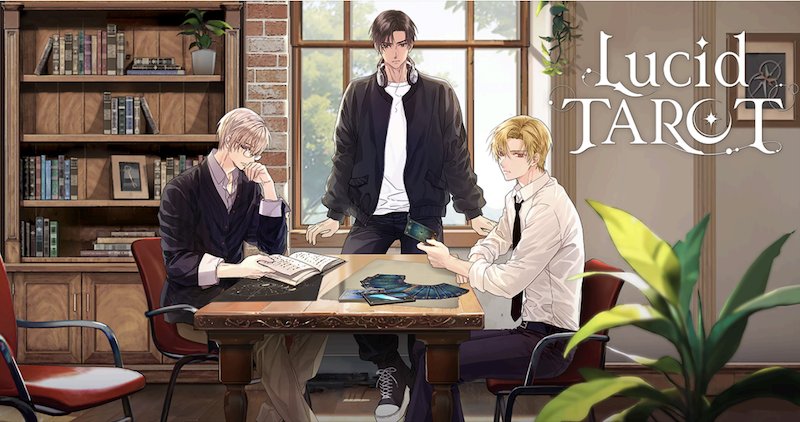
The three romanceable men in Lucid Tarot each carry the genre’s familiar archetypes — the “first love” who hides his true self behind gentleness, the “mood maker” whose bright cheerfulness conceals a secret, the quiet exorcist with steady appeal — but the mechanic that OgreeGames is putting at the center of Tokyo Game Show 2026’s first public demo isn’t the romance structure. It’s what happens when those characters stop choosing from a predetermined dialogue tree and start remembering what you actually said to them.
A three-person Ulsan studio, roughly a year old, is bringing Lucid Tarot to TGS’s indie corner for its first hands-on reveal to press and the general public — a joseimuke story RPG that pairs tarot card collection and strategic deck battles with an LLM-powered conversation system built around persistent memory and contextual response rather than branching choice menus.
The Premise
A 20-year-old protagonist who wants an ordinary university life is pulled into a mystery involving three men she meets by chance, an indestructible supernatural tarot deck, people consumed by their own desires, and nightmares that lure the player into dream states. The occult mystery investigation and the romance with the three male leads run in parallel — solving what’s actually happening is inseparable from navigating relationships with the people caught up in it.
The AI Conversation System
The specific design bet is replacing predetermined choice selection with characters who remember past conversations and respond according to current context — building what the developer describes as an experience closer to an actual ongoing relationship than a scripted dialogue tree.
This is a meaningfully different claim than most AI-companion marketing makes. A system that genuinely tracks conversation history and adjusts character response accordingly — rather than generating plausible-sounding text divorced from what came before — is the harder and more interesting version of LLM integration in romance games. Whether the TGS demo build delivers persistent memory that actually functions as advertised, or whether it produces responses that feel contextually aware only within a single conversation session, is precisely the kind of claim that only hands-on play can verify — which is exactly why the TGS booth matters more than the announcement.
The Card Battle Structure
Card collection ranges from base tarot cards to season-limited art cards produced by guest illustrators, each card carrying distinct elemental properties and abilities that combine into player-built decks. Combat splits into two tracks: main story battles that follow the narrative and dedicated training battles for concentrated card leveling — the standard structure that lets players separate story pacing from grind pacing.
The season-limited guest-illustrator cards serve double duty: they extend the tarot deck’s inherent symbolic and mystical visual appeal, and they give the game a recurring content and monetization rhythm built around collectible card art rather than only gacha character pulls.
The Dream-Reality Setting
The world exists at the blurred boundary between dream and reality — the specific setting choice that lets occult mystery and lyrical romance coexist without one undercutting the other. Guest-illustrator tarot art reinforces this: tarot’s own visual tradition is built on symbolic density and mystery, which the game’s aesthetic direction is leaning on directly rather than approximating.
The Studio and the Japan Strategy
OgreeGames is a joseimuke specialist studio roughly one year into operation, and Lucid Tarot is its debut project combining two elements — tarot collection strategy battle and AI-driven character conversation — that haven’t commonly appeared together in a single mobile title. The studio is using TGS 2026 specifically to accelerate international expansion, actively seeking a Japanese publishing partner and treating Japan as the primary overseas market given the country’s established appetite for joseimuke, mystery, and occult narrative content.
The Korea-first, Japan-adjacent rollout sequencing is a sensible market strategy: establish initial commercial performance and player feedback domestically, then use that data as leverage when approaching Japanese publishers who will want evidence the concept works before committing.
The TGS Debut Stakes
This is Lucid Tarot‘s first public appearance in front of general users and media of any kind — not a soft-launch, not a limited beta, but the actual first hands-on encounter anyone outside the studio will have with the game. Booth 09-E85 in the indie corner will run the playable demo covering both the tarot card battle system and the AI conversation feature directly, alongside a free “Lucid Tarot Lucky Draw” giveaway event separate from any in-game monetization.
Because media coverage is planned alongside the booth, the on-site reaction from first-time players and press will function as an early public verdict — one that matters directly for OgreeGames’ ability to close a Japanese publishing deal in the near term.
Who This Is For
Strong fit for: joseimuke and otome genre players who want a mystery-romance premise with real narrative stakes rather than a pure dating simulator; players specifically curious about AI conversation systems that claim persistent memory rather than one-off generated dialogue; tarot and occult aesthetic enthusiasts; card-collection strategy fans who want a story-first framing around deck-building; TGS 2026 attendees who want to be among the first to try an unreleased Korean indie title.
Cautious fit for: players who want the AI conversation system independently verified before getting invested (no outside reviews exist yet); anyone who prefers traditional branching-choice romance narrative structures; players who need a confirmed publisher and release window rather than a “fall 2026, Korea first” target.
Less ideal for: players who dislike gacha-adjacent card collection monetization; anyone seeking action combat over turn-based strategic card battles; players who want the game available at TGS in a form other than a single indie-corner booth demo.
The Takeaway
Lucid Tarot is a debut project from a young, small, genre-focused Korean studio making a specific and testable claim: that tarot card strategy and joseimuke romance can be meaningfully deepened by AI characters who remember what you told them rather than reciting from a choice tree. Tokyo Game Show 2026 is where that claim gets its first real audience — general players and international press encountering it with no prior context, at booth 09-E85, alongside a free giveaway and the studio’s active search for the Japanese publishing partner that could take the game beyond Korea.
The cards are drawn. The three men are waiting with their secrets. And for the first time, someone outside OgreeGames gets to find out whether the AI actually remembers.
TGS 2026: Booth 09-E85, indie corner. Fall 2026 release in Korea, global rollout to follow.
Information related to ‘ Lucid Tarot ‘
| item | detail |
|---|---|
| Developer | OgreeGames Co., Ltd. (Ulsan, South Korea) |
| Publisher | Undetermined (Seeking overseas publishing partners, including Japan) |
| Genre | Female-oriented story RPG, Tarot card collection and strategy battle |
| platform | Mobile (iOS, Android) |
| Billing model | Basic Free (F2P) |
| Release date | Autumn 2026 (Launch in Korea first, followed by sequential global expansion) |
| etc | LLM-based AI Character Conversation System, Playable Demo Exhibited at TGS 2026 Booth 09-E85 |
| Reactions/Evaluations | Unreleased with no user or media reviews; TGS 2026 reveal is effectively the first public unveiling. |
| Official Site | ogreegames.com |