Bippinbits made Dome Keeper — a game about mining for resources between waves of attacking creatures, managing the tension between staying underground long enough to gather what you need and returning to defend your dome before enemies break through. It won Ludum Dare in 2021 as Dome Romantik, became a fully commercial release in 2022, accumulated 20,000+ Steam reviews, and established Bippinbits as a studio that takes game jam concepts and develops them into something more substantial.
Bandwagon is a different game in almost every dimension: tone, genre, pace, aesthetic, and musical role (from defensive mining pressure to open world wandering). The constant is Bippinbits’ apparent interest in systems that do more than one thing simultaneously — Dome Keeper‘s mine timer was also a resource system, and also a risk calibration problem. Bandwagon‘s combat system is also an arrangement system is also a music generation engine.
The open playtest runs July 21 through August 3. No release date has been announced.
The Core Premise: Combat as Composition
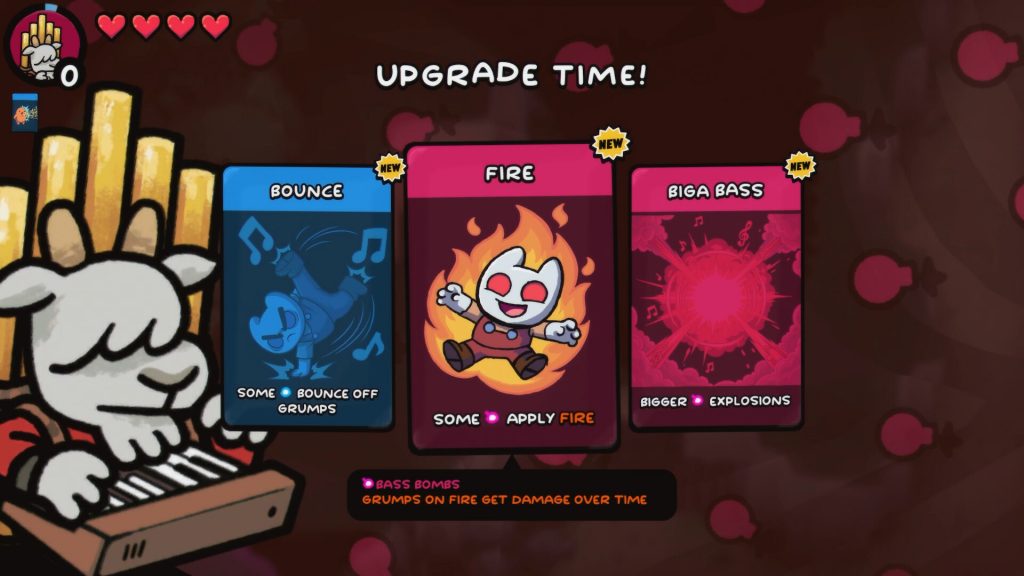
The design that distinguishes Bandwagon from the survivor-like genre it’s working within is the identification of what “combat” actually means in the game: choosing band members and upgrades IS choosing your musical arrangement, and your musical arrangement IS your combat output. There’s no separate combat layer that uses music as its aesthetic clothing — the music generation and the combat generation are the same system.
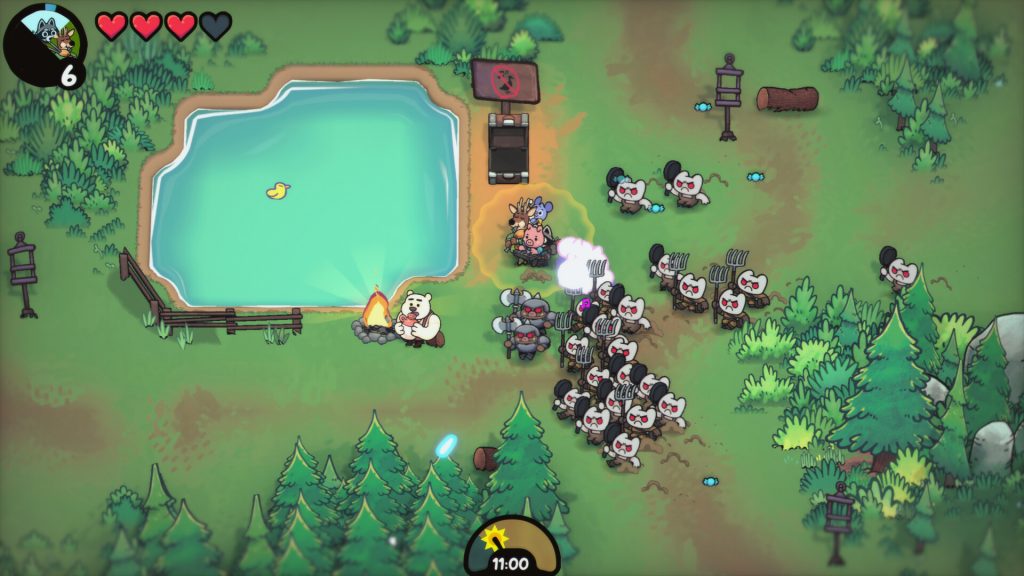
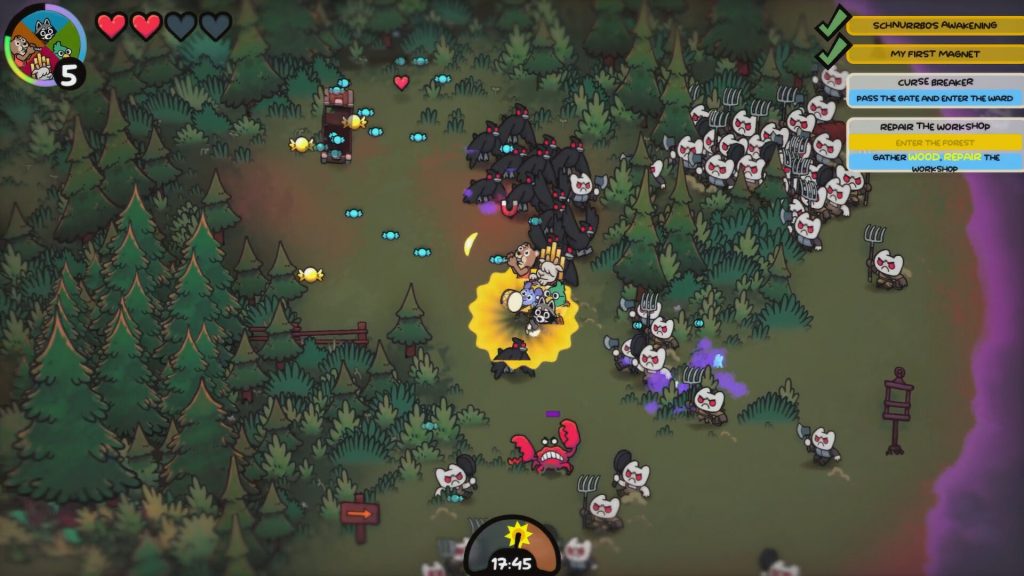
In standard survivor-likes, weapon selection, upgrade choices, and character abilities combine to determine the damage output patterns that clear enemy waves. The visual presentation of that output — bullets, beams, effects — is aesthetic. Bandwagon replaces that aesthetic layer with sound generation: your band members and their instruments produce both the visual effects that represent your combat output AND the actual audio that represents your combat output. The melody you’re hearing IS your build.
The procedural music generation system is what makes this more than a reskin. If different instrument and character combinations produced variations on a fixed theme, the musical identity would be shallow — aesthetic variation over mechanical similarity. Procedural generation means the actual musical output is genuinely different based on composition choices: different rhythm patterns, different harmonic combinations, different timbres producing different emergent sonic identities for each run’s specific band configuration.
GamingOnLinux’s description — “running around with your characters and creating music rather than just killing enemies” — captures the experiential shift this creates. The survivor-like genre’s satisfying late-game state is typically visual spectacle: screen-filling projectiles clearing dozens of enemies simultaneously. Bandwagon‘s equivalent is presumably sonic: the emergent music of a fully developed band composition becoming increasingly complex and impressive as the run develops.
The Open World and “Grumpy Disease” Setting
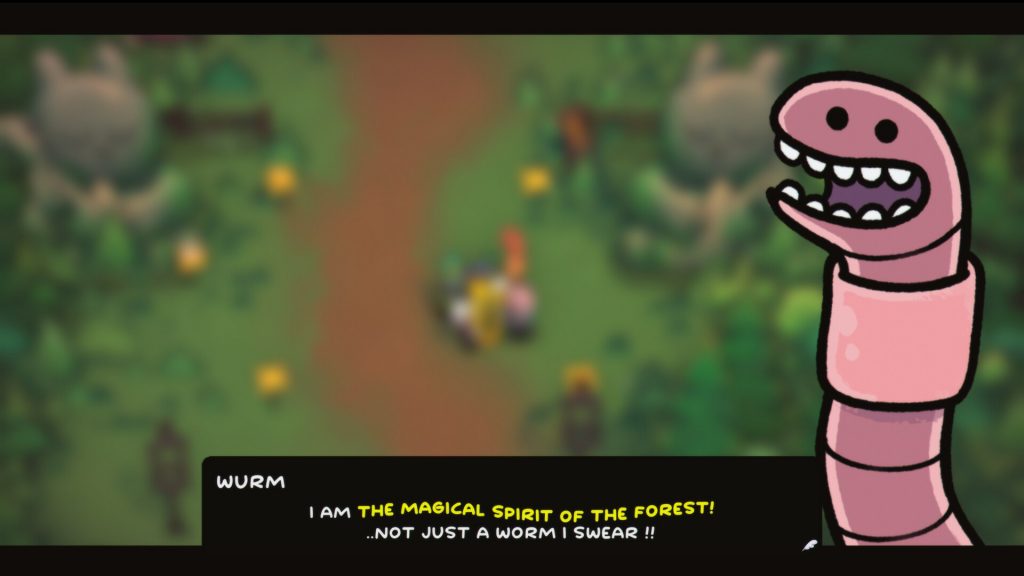
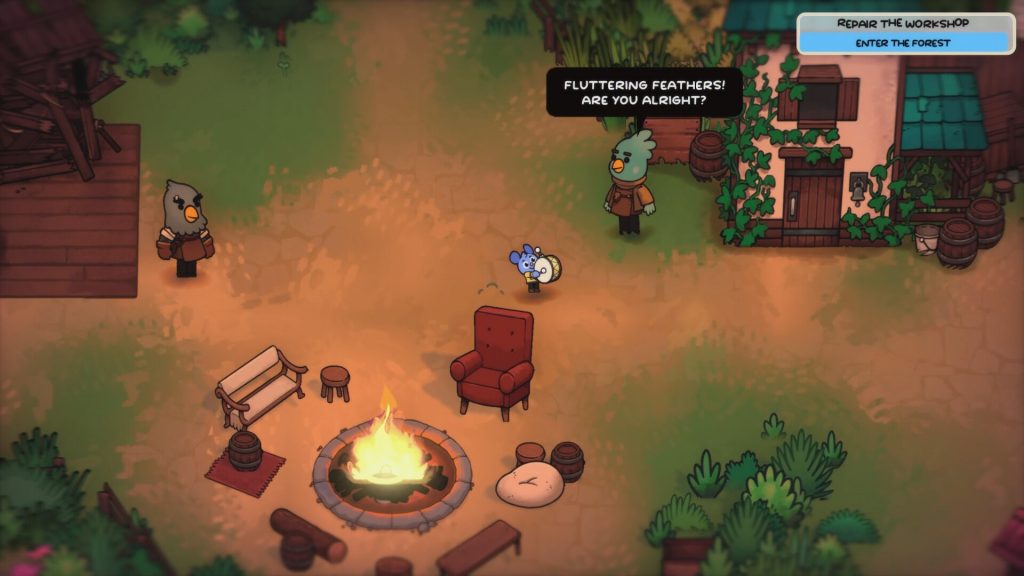
The animal kingdom afflicted with “grumpy disease” by the Grumpy King is the kind of lighthearted premise that immediately signals a game less interested in tension than in charm. The musical cure framing — converting antagonistic creatures through music rather than defeating them — extends this further. Bandwagon is explicitly not about violence, even when the mechanics are structurally similar to games organized around violence.
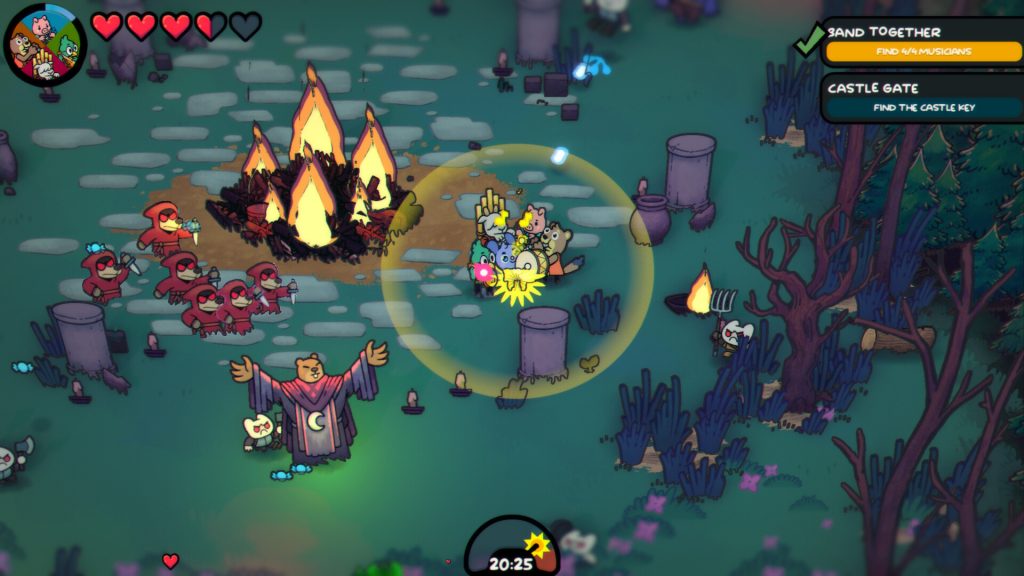
This tonal commitment shapes the open world design. Rather than a hostile environment to survive, the world is a place to explore and discover: forests, hills, and villages containing band members to recruit, instruments to find, and relationships to develop. The “grumpy monsters” are more obstacles to convert than threats to defeat — the goal is to spread music into the world rather than to clear it of enemies.
The open world structure distinguishes Bandwagon from the standard survivor-like’s linear session design. Most survivor-likes have a fixed arena, clearly defined time horizons, and directed escalation — waves become harder until the run ends or the player survives long enough to win. An open world implies spatial exploration, nonlinear discovery, and progression driven by finding things rather than surviving escalation. How these two design traditions coexist in Bandwagon — the survivor-like auto-combat and the open world exploration — is one of the playtest’s primary evaluation questions.
The Bippinbits Design Lineage
Dome Keeper earned its reputation through a specific design quality: the tension of two simultaneous demands. The mining timer (resources needed to upgrade your dome) and the survival timer (enemies approaching your dome) were always running simultaneously, and the entire game was about managing the cognitive load of tracking both. Neither demand could be satisfied by ignoring the other; the game required constant triangulation.
Bandwagon‘s design appears to be exploring a different version of this dual-system interest: combat and composition as the same action rather than two competing demands. Where Dome Keeper created tension through competing priorities, Bandwagon appears to be creating synthesis — the musical build and the combat build are unified rather than trading off against each other.
The name history (Making Friends → Band Together → Bandwagon) traces a development trajectory where the social and musical themes have been stable while the specific framing evolved. “Making Friends” emphasizes the recruitment aspect; “Band Together” emphasizes the cooperative assembly; “Bandwagon” (despite the developer’s disclaimer about its “jumping on the trend” connotation) suggests the formation of a musical movement. All three names are pointing at the same thing — building a band, creating music together — and the final name choice acknowledging the potential connotation while keeping it suggests the team thinks the game itself will disambiguate what kind of bandwagon this is.
The Playtest as Design Validation
The July 21-August 3 open playtest is Bippinbits collecting information that Dome Keeper‘s development process presumably taught them to value: what players actually do with the systems versus what the designers expect them to do. The specific questions that a procedural music generation system combined with survivor-like combat in an open world raises are genuinely novel — Bippinbits doesn’t have extensive precedent to reference because this specific combination doesn’t have extensive precedent.
Does the procedural music generation produce results that players find musically interesting rather than randomly generated? Does the open world exploration pacing work alongside the survivor-like auto-combat? Are the band member recruitment decisions engaging as strategic choices or does optimal play converge toward a small number of clearly superior combinations? These are questions that internal playtesting can identify in theory and that a public playtest answers in practice at scale.
The convergence from Dome Keeper (20,000+ reviews, stable positive rating) to Bandwagon (open playtest for an undated game) is the correct development trajectory for a studio that has established its commercial viability and wants to experiment with genuinely different design territory. Dome Keeper proved Bippinbits could execute; Bandwagon is them exploring whether they can execute something structurally different.
Who This Is For
Strong fit for: Dome Keeper fans who trust Bippinbits’ design sensibility and want to see what the studio does with different genre material; survivor-like players specifically interested in the genre’s evolution toward non-violent or thematically alternative expressions of the auto-combat structure; players who responded to Petal Crash, Chicory: A Colorful Tale, or similar games that prioritize charm and warmth over tension; music game enthusiasts who want emergent composition alongside mechanical gameplay; German indie game supporters following Bippinbits’ development.
Cautious fit for: survivor-like players who specifically want the escalating tension and high-stakes end-game pressure of the genre’s standard expression; players who need confirmed release dates before investing attention; players who want clearly defined combat feedback rather than musical audio as primary combat signal.
Less ideal for: players who dislike auto-combat survivor-like structure regardless of thematic framing; anyone wanting competitive or multiplayer-focused design; players seeking narrative depth over systemic exploration.
What to Watch For
The playtest’s primary purpose is evaluating whether the procedural music generation and the survivor-like combat structure cohere into a unified experience. Three specific questions will determine Bandwagon‘s development direction following the playtest:
Whether the procedural music is musically interesting rather than merely functionally different between runs. Random generation and interesting generation are not the same thing; if the music sounds arbitrary rather than composed, the system’s connection between combat and music fails on the music side.
Whether the open world exploration creates meaningful discovery rather than walking between combat encounters. If the world feels like space between fights rather than a place worth exploring for its own sake, the adventure component is underdeveloped.
Whether band member recruitment decisions feel genuinely strategic. Survivor-likes with diverse character options sometimes have optimal compositions that make choice illusory; whether Bandwagon‘s procedural music diversity forces meaningful trade-offs rather than converging toward a dominant strategy will determine replay depth.
The Takeaway
Bandwagon is Bippinbits asking what the survivor-like structure becomes when you replace its violence and tension with music and warmth — when the combat system is also the composition system, when the enemies are creatures to convert rather than threats to eliminate, and when the world is a place of exploration and discovery rather than escalating danger. It’s a structurally conservative choice (the survivor-like framework is established and proven), expressing a radically alternative vision of what that framework can mean.
The open playtest running through August 3 is collecting the first player data on whether that alternative vision produces an engaging experience for the people who encounter it. Bippinbits has demonstrated with Dome Keeper that they can take a game jam concept and develop it into something with lasting commercial appeal. Bandwagon is testing whether they can do the same thing with a concept that’s pointing in a completely different direction.
The band is forming. The animals are waiting to be recruited. The Grumpy King’s influence is spreading through the kingdom. And somewhere in the procedurally generated music of a fully assembled ensemble playing the right composition at the right moment, even the most stubborn creatures are starting to move differently.
Playtest open through August 3. Wishlist now. The bandwagon is forming.
Information regarding ‘Bandwagon’
| item | detail |
|---|---|
| Developer | Bippinbits (Dresden, Germany) |
| Publisher | Bippinbits (Self-publishing) |
| Genre | Musical Survivors Light / Open World Adventure |
| Release platform | PC (Steam) |
| Release date | Undetermined (Can be added to wishlist) |
| Playtest period | July 21, 2026 – August 3 |
| Previous game name | Making Friends → Band Together → Bandwagon |
| Developer’s previous work | Dome Keeper (2022, Published by Raw Fury, Metacritic 76) |
| core system | Recruiting animal band members, procedural music generation, open world exploration, purifying grumpy monsters |
| Steam Page | Shortcut |