Most deckbuilding roguelites share a foundational mechanic: you play a card, it resolves its effect, it goes to the discard pile. The card is consumed by use. ON&OFF from Korean four-person studio Dopamine Crucian (published by Jungle Game Lab) begins from a different premise: cards don’t leave the field when played. They stay on the grid, cycling between ON and OFF states, activating and reactivating through chains of directional signals that neighboring cards send to each other.
The result is a game the developers describe as “the combination of deckbuilding card games and circuit design” — which is an accurate description of what it produces. Each run becomes less about building a card sequence and more about designing a spatial system where the arrangement and orientation of persistent cards determine how activation chains propagate across the grid.
July 31 on Steam, free.
The Persistent Card Mechanic
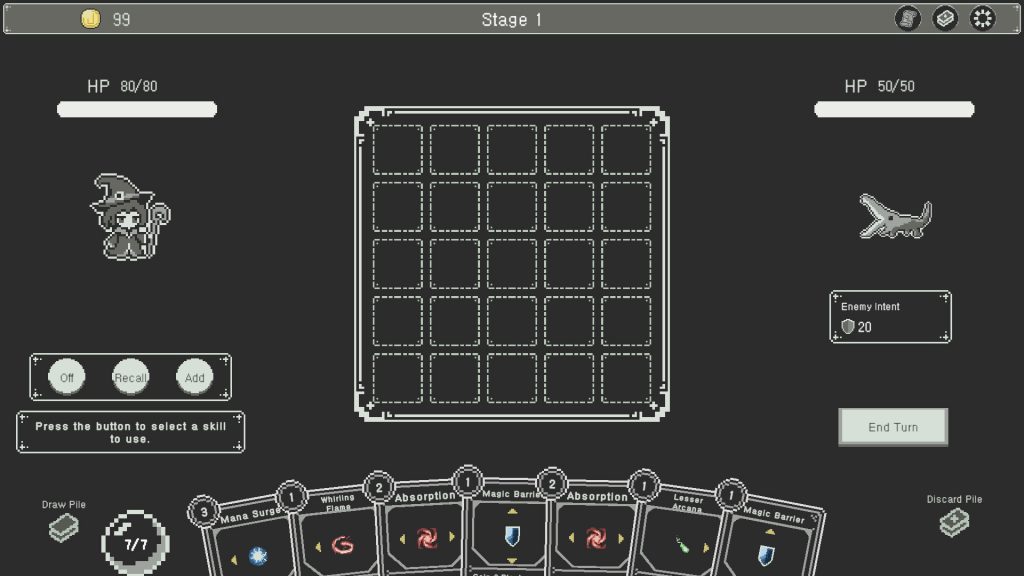
The distinction from Slay the Spire and its descendants — which the developers explicitly cite as inspiration — is structural rather than cosmetic. In Slay the Spire, cards cycle through hand, discard, and draw pile; the sequence of plays matters, but individual cards are resources consumed and replenished. In ON&OFF, played cards accumulate on the grid as persistent elements of the battle environment. The battlefield grows more complex as the run progresses, with each card becoming a component in an increasingly intricate spatial system.
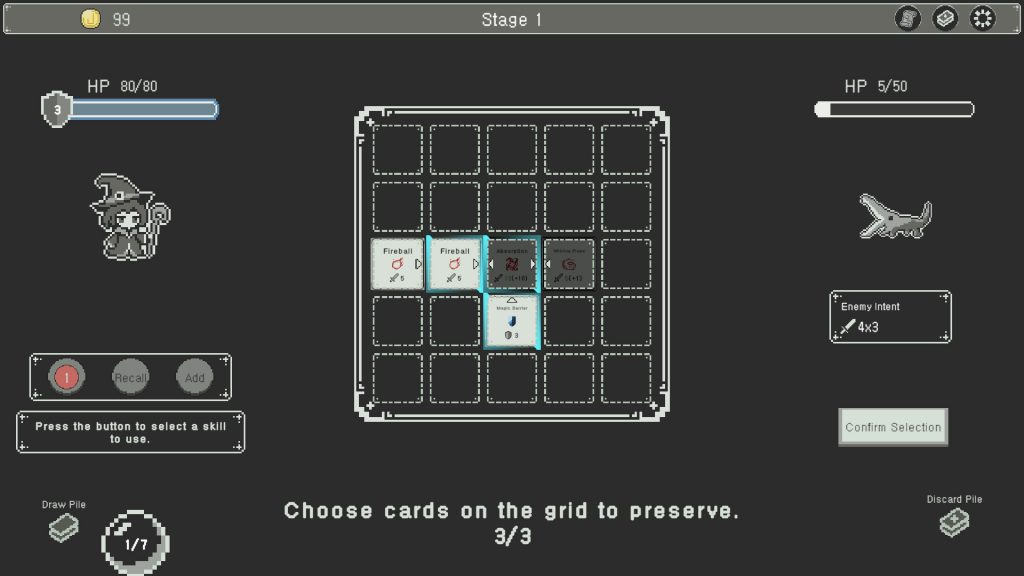
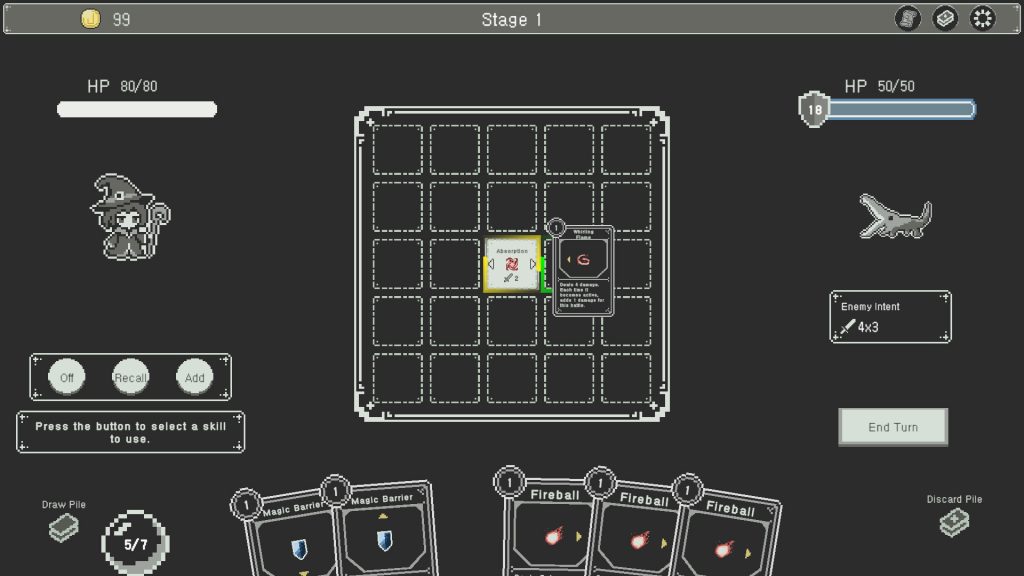
The ON/OFF state mechanic is what makes persistence meaningful rather than merely cumulative. Each time a card transitions from OFF to ON, it activates its effect and sends a directional signal — indicated by the arrow printed on the card — to adjacent cards on the grid. Those neighboring cards switch states in response, potentially triggering their own effects and sending their own signals in their own directions. A chain reaction propagates across the grid according to the spatial arrangement of cards and the directions of their arrows.
This means the placement decision when acquiring a new card is not just “which card do I want” but “where on the grid do I place this card, and in which orientation, such that the signals it sends and receives from neighbors produce the activation sequence I want.” Adjacent card positions, arrow directions, and activation order all affect combat outcomes — which is the “spatial puzzle” quality that the developers reference.
The Circuit Design Analogy
“Circuit design” as a conceptual framework for the mechanic is precise and useful. In electrical circuit design, components are arranged spatially with specific connection paths between them; the behavior of the overall system depends on how components are positioned relative to each other and how signals flow through the connections. A component’s behavior in isolation tells you only part of what you need to know; its behavior in context — what it receives and what it sends on to its neighbors — is the relevant information.
ON&OFF applies this to deckbuilding roguelite combat. A card’s individual effect is known from its description; its value in a given run depends on what grid position it occupies and what neighbors it has or will have. A card that sends signals leftward is more valuable adjacent to a card that benefits from receiving signals than it is isolated at the edge of the grid. A card with high individual effect but poor signal connectivity might be less valuable than a card with moderate individual effect that serves as a critical relay in a propagation chain.
This creates the interesting design situation where the “best” cards in isolation aren’t always the best cards in a given run’s spatial context. The circuit-design intuition rewards players who think about cards as system components rather than as isolated power units — which is a different skill set from standard deckbuilding optimization.
The Jungle Game Lab Context
ON&OFF being published through Jungle Game Lab — Krafton’s indie game incubator, which also published No Results Found (which this coverage featured earlier this month) — signals a quality baseline. The program’s selectivity means projects that reach publication have cleared a review process; ON&OFF isn’t a solo bedroom project with no external evaluation; it’s a four-person team’s work that Krafton’s incubator considered worth publishing.
The free price point matches the program’s approach with No Results Found: Jungle Game Lab appears to be using free distribution to maximize initial player reach for its graduates’ debut projects rather than optimizing for revenue extraction. For a game with an experimental mechanic that needs to build an audience through discovery and word-of-mouth, free removes the commitment barrier that experimental deckbuilders often face.
The four-language support — Korean, English, Japanese, Simplified and Traditional Chinese — reflects international ambition appropriate for the roguelite deckbuilder market, which has genuine global audiences across these language groups.
Who This Is For
Strong fit for: Slay the Spire players who have found the genre’s spatial possibilities underexplored and want placement decisions to matter; puzzle game enthusiasts who want their puzzle logic applied to roguelite deckbuilding; players who find the circuit design analogy immediately appealing; Jungle Game Lab followers curious about the incubator’s graduates; free-to-play indie game enthusiasts who want to try experimental mechanics without financial commitment; Korean indie game supporters.
Cautious fit for: players who prefer the clean card-in, card-out structure of traditional deckbuilders and find persistent grid elements adding unwanted complexity; roguelite purists who want established genre conventions rather than mechanical experiments; players who find spatial puzzle mechanics frustrating rather than satisfying.
Less ideal for: players who dislike turn-based mechanics; anyone who wants action-paced deckbuilders over deliberate strategic ones; players seeking multiplayer options.
What to Watch For
The primary evaluation question for ON&OFF is whether the signal chain visualization is as intuitive as the developers claim. Circuit-design logic is genuinely engaging when the system’s behavior is legible — when players can look at the grid and predict how an activation will propagate before committing to it. If the signal chains are difficult to trace visually, the strategic depth becomes opacity rather than complexity. The developers’ statement that signal flow is “designed to be expressed intuitively” suggests awareness of this risk; whether the execution achieves it will be the central player feedback point.
The roguelite card acquisition structure also needs to provide sufficient variety in signal-chain design possibilities across runs. If most runs converge on similar grid configurations despite different card draws, the spatial design dimension loses its freshness.
The Takeaway
ON&OFF is a genuinely experimental deckbuilding roguelite mechanic — persistent cards on a spatial grid, activation through directional signal propagation, combat outcomes determined by arrangement and orientation — that Dopamine Crucian and Jungle Game Lab are releasing for free on July 31. The circuit design analogy isn’t a marketing metaphor; it’s an accurate description of the design space the game is exploring.
For deckbuilding roguelite players who have wanted the genre to take its spatial possibilities more seriously, ON&OFF is the specific experiment worth trying. For players who want to help a four-person Korean indie team’s debut find its audience, the free price makes that decision easy.
The grid is empty. The cards don’t leave when played. The signals flow in the directions the arrows point. And somewhere in the arrangement of persistent cards and the chains they form between each other, there’s a system that clears the encounter — if you designed it correctly.
July 31. Free. The circuit is yours to design.
‘ON&OFF’ related information
| item | detail |
|---|---|
| Developer | Dopamine Crucian (Korea, 4 people) |
| Publisher | Jungle Game Lab |
| Genre | Turn-based deck-building roguelite |
| Release platform | PC (Steam) |
| Release date | July 31, 2026 |
| price | free |
| Gameplay | Single player |
| Supported languages | Korean, English, Japanese, Simplified Chinese · Traditional Chinese |
| core system | Grid card placement, ON/OFF switching, directional signal, chain trigger |
| Steam Page | Shortcut |