Somewhere in the millions of pigeons filling Trafalgar Square is your soulmate. You don’t know which one. You have to find them. This is the entire premise of Pigeon: A Love Story, and it is both completely absurd and — according to community feedback — “strangely immersive.”
London developer Wristwork’s experimental exploration game launches on August 6 simultaneously on Steam, iOS, and Android. Five real-world cities rendered at scale: London, Paris, Amsterdam, New York, Tokyo. Each is populated with several pigeons approaching reality. One of them is the one. You’re a pigeon. You have to find your soulmate through courtship attempts, reactions observed, and aerial exploration of city rooftops, squares, and streets.
The London Games Festival and A MAZE Berlin have both selected it. The latter selection is particularly meaningful — A MAZE Berlin specifically identifies games as art objects rather than entertainment products, and its selections represent the festival’s assessment of work that is doing something genuine rather than familiar.
The “Needle in a Haystack” as Game Design
The genre self-designation — “needle-in-a-haystack simulator” — is doing specific design work by setting precise expectations. This isn’t a game with traditional progress indicators. No map fills in, no probability meter that tells you you’re getting warmer, no achievement for finding 50% of the candidates. You’re looking for one pigeon among millions because that’s what finding a soulmate actually involves: undifferentiated crowds in which one specific individual is meaningful.
The absurdism is the point, and it extends to the methodology. You approach pigeons, you attempt courtship, you observe their reactions. Some react one way, some another. Eventually — maybe — one reacts the right way. This is not a dramatically different structure from how soulmate-finding actually works, stripped of the social context that usually obscures the underlying process: approach many, observe responses, continue until one response is different from the rest.
What the pigeon framing adds is permission to find this funny. Human dating games are either serious (the emotional investment makes comedy feel inappropriate) or satirical (the framing acknowledges the absurdity explicitly). A pigeon romance simulator is funny from the premise before the game begins, which gives the underlying earnestness — there IS a soulmate, finding them IS the point, the moment of recognition IS meant to be satisfying — permission to operate without defensive irony.
The City Scale and Flight
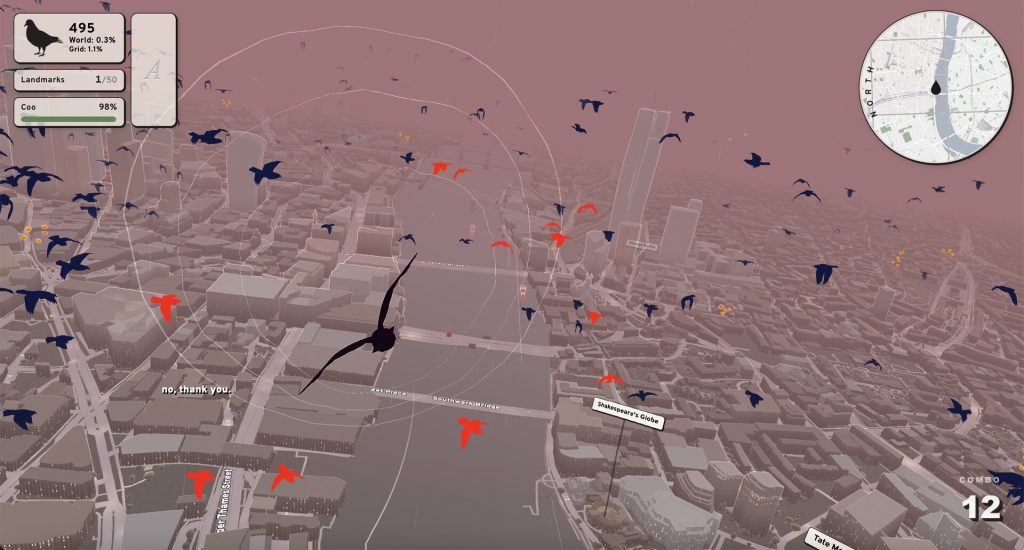
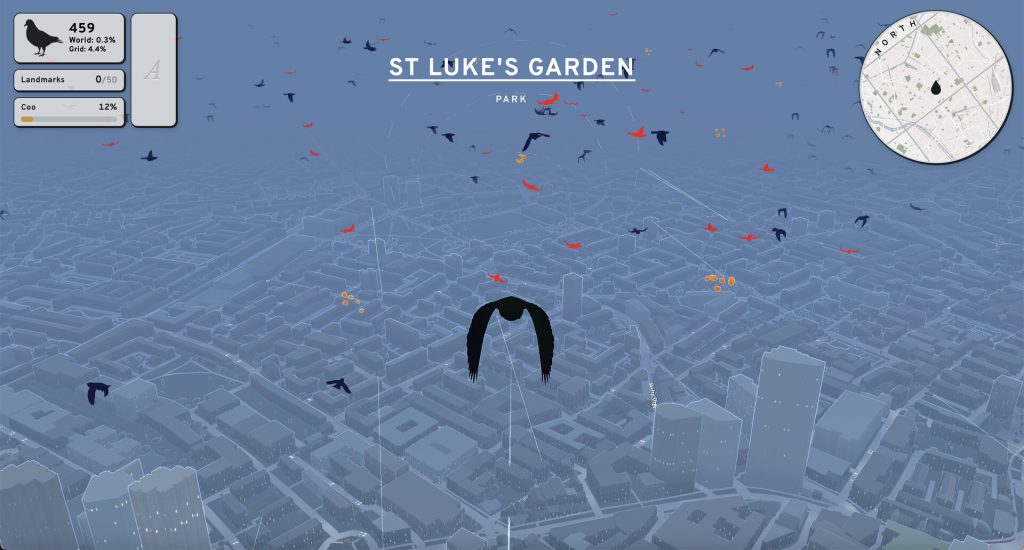
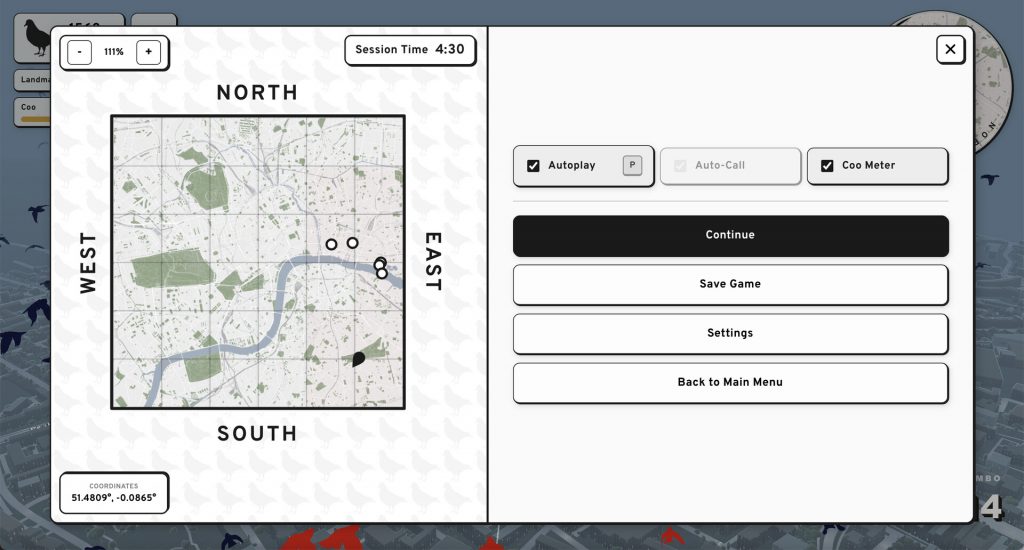
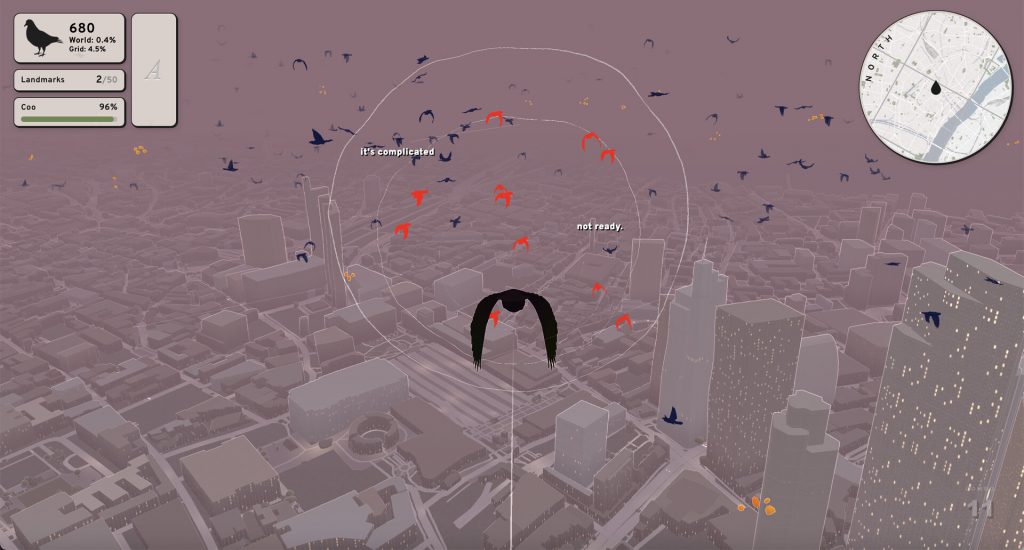
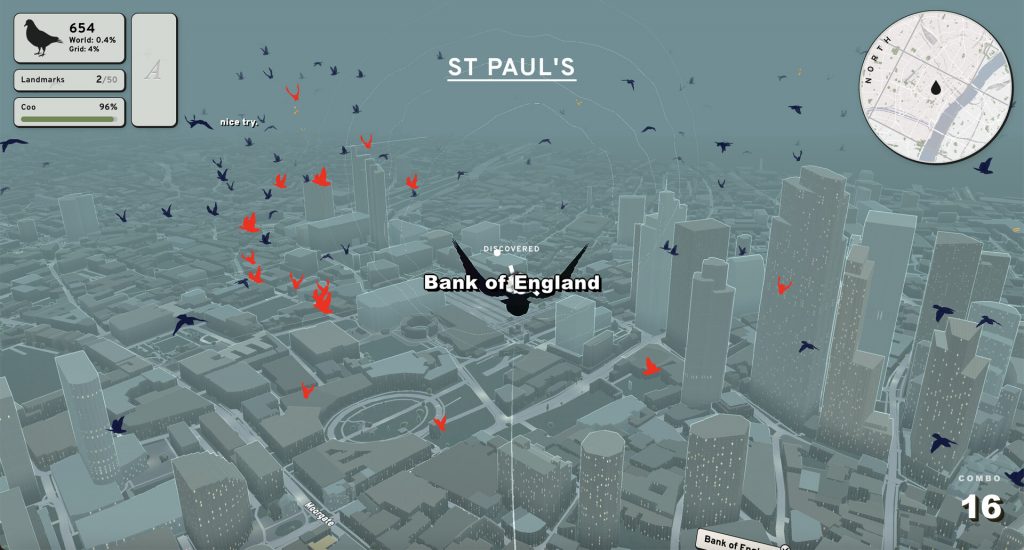
The choice to render cities at real-world scale rather than in compressed representation is the key spatial decision in Pigeon: A Love Story, and it creates the experience of actually being a pigeon in London or Tokyo rather than navigating a symbolic map.
Pigeons know cities differently from humans. They know rooftop topography that pedestrians never see. They know thermal patterns, wind corridors between buildings, the specific sight lines from elevated positions that humans spend money on tourist ticket prices to access. A pigeon flying through London knows Trafalgar Square from above as an expanse of paving and moving shapes rather than as a landmark with historical significance.
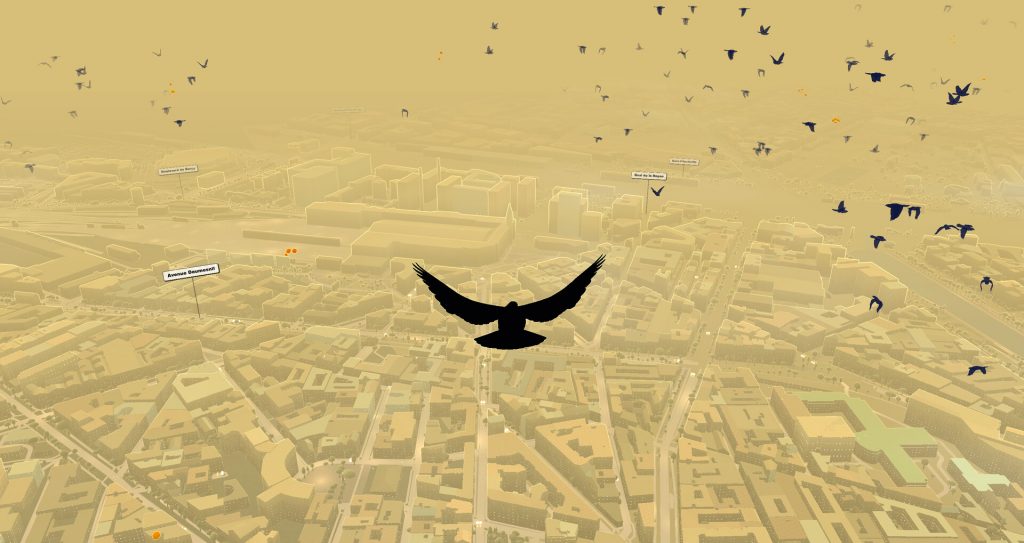
The v1.1 demo’s community-requested rooftop landing mechanic is interesting precisely because it addresses this: players wanted to stop, to perch, to see the city from a stationary elevated position rather than always moving through it. This is both a gameplay function (rest point, survey location) and a spatial experience — seeing Paris from a rooftop at pigeon height is a specific perspective on the city that humans rarely occupy.
The five-city selection — London, Paris, Amsterdam, New York, Tokyo — provides sufficient variety to give each city a distinct spatial personality while remaining a manageable production scope. Amsterdam’s canal-grid geometry is genuinely different spatial territory from Tokyo’s vertical density; Paris’s Haussmann-era boulevard grid creates different flight corridors than New York’s Manhattan grid. Pigeons navigate these differently because the wind patterns, the building heights, and the open space distributions are all different.
The A MAZE Berlin Selection
A MAZE Berlin is the festival most explicitly dedicated to games as artistic expression rather than commercial entertainment. Its selection history includes games that subsequently proved formative: Braid, Journey, Papers, Please, Disco Elysium-era experimental work. Selection for A MAZE doesn’t guarantee commercial success, but it does represent the festival’s assessment that the work is doing something worth serious attention.
Pigeon: A Love Story‘s A MAZE selection places it in a specific tradition of games that use play mechanics to explore emotional or philosophical territory that conventional game design approaches poorly. The search for a soulmate among millions of indistinguishable candidates is not just an absurdist joke — it’s a genuine statement about the scale of the problem of human connection, the fact that a meaningful encounter is statistically invisible from outside it.
The London Games Festival selection adds commercial context: LGF has historically been interested in work that represents the breadth of what British game development is doing, including experimental and unconventional projects alongside commercial mainstream releases. Both selections together suggest Pigeon: A Love Story is achieving the difficult double of genuine artistic interest and audience accessibility.
The Tiny Dragon Publishing Philosophy
Tiny Dragon, founded in 2024 with London and Montreal bases, describes itself as a “boutique indie publisher and marketing agency” whose philosophy is “helping distinctive indie games find their own audience.” This framing is worth attention because it describes a publishing model oriented toward audience matching rather than audience creation — finding the people who already want this specific thing rather than convincing people who didn’t want it that they should.
Pigeon: A Love Story is exactly the kind of project that benefits from this approach. The audience who will find this premise irresistible is real and identifiable — people who appreciate experimental game design, people who like birds, people who enjoy the combination of absurdism and earnestness, people who have played Untitled Goose Game and wanted something weirder. The challenge isn’t making that audience exist; it’s connecting the game to them efficiently.
The Tiny Teams Festival participation (organized by Yogscast Games, which we’ve encountered in our coverage through their publishing of The Gate Must Stand and Soulbound) provides a launch visibility moment specifically oriented toward the small-team indie audience where Pigeon: A Love Story will find its earliest adopters.
The Cooperative Dimension
Two-player cooperative soulmate search is one of those mechanics that sounds strange until you imagine playing it with the right person. Two people, both as pigeons, both searching for their own soulmate (or is it a shared soulmate? The game details suggest you can search together), flying through Tokyo together attempting to locate the meaningful individual among millions.
This is a genuinely unusual cooperative experience structure. Most cooperative games have shared objectives — both players win together or lose together. The cooperative pigeon romance search might have genuinely separate objectives (each player finding their own soulmate) that create parallel play in the same space rather than coordinated play toward the same goal.
The potential for this to create the specific pleasure of shared exploration — you’re in the same space, having parallel but different experiences, occasionally converging — is interesting design territory that conventional cooperative games rarely explore.
Who This Is For
Strong fit for: A MAZE Berlin and London Games Festival enthusiasts who follow experimental game selections; bird enthusiasts who want to actually be a pigeon in recognizable world cities; Untitled Goose Game fans who want something even more conceptually strange; players who appreciate absurdism that takes itself seriously; mobile gaming players who want something genuinely unusual in that space; people who find the phrase “soulmate pigeon search simulator” immediately compelling rather than confusing; cooperative game players looking for unusually structured shared experiences.
Cautious fit for: players who need clear progress indicators to feel oriented; anyone who wants explicit rewards for exploration rather than the exploration itself; players who find premise-driven games unsatisfying when the premise is the content.
Less ideal for: players seeking conventional game goals; anyone who dislikes birds specifically or finds pigeon behavior unpleasant; players who need narrative structure beyond the implied romance of the search.
What to Watch For
The primary question for Pigeon: A Love Story is whether the moment of finding the soulmate is satisfying in the way that the search implies it should be. Games built on extended searches live or die on their payoff moments — the eureka that justifies the process. Whether the game’s soulmate recognition is sufficiently distinct and emotionally resonant to search feel worthwhile, rather than arbitrary, will determine whether the experience completes properly.
The mobile version specifically will be interesting to evaluate. The pigeon flight controls that work with mouse and keyboard may translate differently to touchscreen; whether the mobile version finds intuitive control solutions will determine whether the game’s mobile launch reaches its natural audience or merely exists on the platform without thriving there.
The Takeaway
Pigeon: A Love Story is one of August 2026’s most conceptually specific indie releases — a London studio’s absurdist premise executed with enough earnestness that the soulmate search feels genuinely meaningful despite (or because of) being conducted among millions of birds in rendered real-world cities.
The A MAZE Berlin and London Games Festival selections confirm that the game is doing something artistically genuine rather than merely conceptually gimmicky. The community feedback — “strangely immersive,” “really feels like looking for a soulmate among millions of pigeons” — confirms that the concept is translating into experience rather than remaining a premise.
Five cities. Millions of pigeons. One soulmate. Somewhere in Tokyo, possibly on a rooftop, possibly still flying above the Shibuya crossing, is the one specific pigeon that is different from all the others.
The search is the game. The city is enormous. The pigeons are indistinguishable. And somewhere in all of that is the one that isn’t.
August 6. Take flight. Look carefully.
Information regarding ‘Pigeon: A Love Story’
| item | detail |
|---|---|
| Developer | Wristwork (London, UK) |
| Publisher | Tiny Dragon (London/Montreal, established in 2024) |
| Genre | Needle Find Simulator / Exploration Romance |
| Release platform | PC (Steam) / iOS / Android |
| Release date | August 6, 2026 |
| demo | Free Steam demo v1.1 available (Rooftop landing mechanic added) |
| City count | 5 (London, Paris, Amsterdam, New York, Tokyo) |
| Play Mode | Solo / 2-Player Co-op |
| Awards/Selections | London Game Festival Official Selection / A MAZE Berlin Official Selection |
| launch event | Entry for the Tiny Teams Festival organized by Yogscast Games |
| Main Keywords | Pigeon, Romance, Exploration, City, Co-op, Mobile, Indie, Cozy |
| Steam Page | Shortcut |