A key trend in the South Korean game market this year is a fundamental shift in the nature of Korean games, which have traditionally pursued profit maximization by prominently featuring a structure where players become stronger the more money they spend. Packages that are sold once and then forgotten, memberships without gacha mechanics, cosmetic items without stat bonuses, and competition where AI fights on behalf of the player—this represents a significant departure from the conventions of Lineage-like games that have consistently occupied the top spots in Korean game revenue rankings.
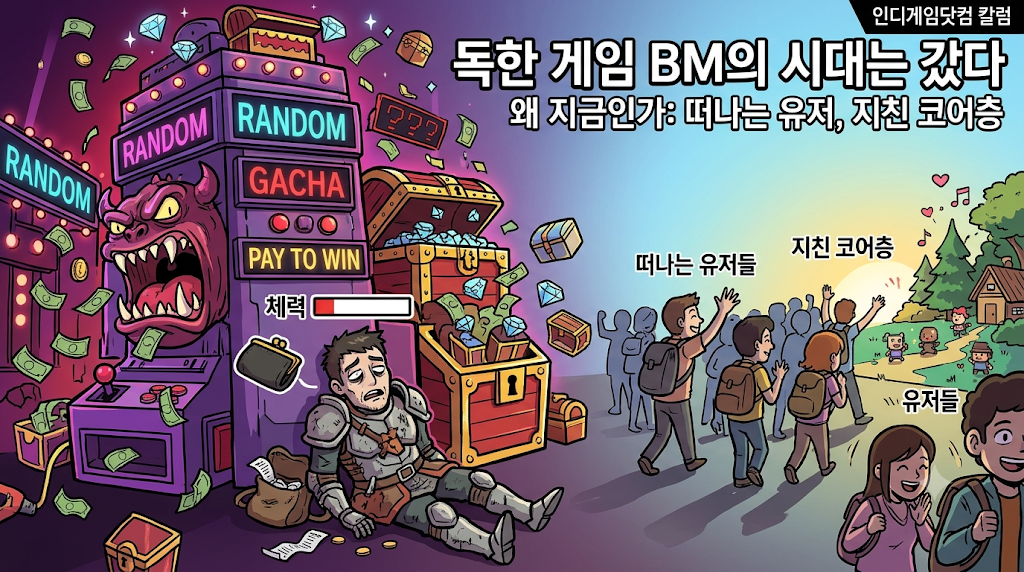
Why Now: Departing Users, Exhausted Core Base
There are numbers behind the retreat of aggressive business models. According to the Korea Content Agency’s ‘2025 Survey on Game User Status,’ the domestic game usage rate stood at 50.2%, the lowest since data collection began in 2015. This represents a 24 percentage point drop in just three years from 74.4% in 2022. The number one reason users quit gaming was ‘lack of playtime’ (44%). The agency analyzed that demand for traditional MMORPGs, which require long hours of gameplay, is also weakening.
Users aged 40 and older, the core paying user base that has supported payments, are not increasing. As the age group rises, they are now tired of the fierce competition itself.
The way users open their wallets has also changed a long time ago. Before making a purchase, users first weigh the return on investment, considering factors such as how much utility the money provides within the game and how much they will enjoy it. In other words, these are payments made after analysis, rather than purchases driven by the trend.
The core user base, which has poured in a lot of time and money, is thinning out, and the remaining users do not go out of their way to choose tiring games. The market has now become one where games that cannot reduce the two costs of time and money are difficult to be selected. Therefore, this year’s nominees have reduced those costs in their own different ways.
Five nominees, five solutions
World of Goblins – Play is the currency of growth instead of payment
“The World of Goblins,” developed by Supercat and serviced by Kakao Games, was released on October 8 and rose to the number one spot on the Google Play revenue chart on the 13th, just five days later. Above all, this game adopted a revenue structure that is rare for a top-selling MMORPG.
- Cosmetic items such as clothing and mounts do not have stats, and there is no paid summon to obtain cosmetic items.
- Even if enhancement fails, the equipment is not destroyed or its level is not lowered.
- The exchange operates using ‘money,’ a free currency obtained through gameplay.
- Paid products center on subscription passes, appearances, and time reduction passes.
Players earn money through hunting, boss battles, and guild content, and use that money to purchase growth materials. It is a structure where gameplay, rather than payment, becomes the currency for growth. The complete removal of cosmetic growth elements, based on user feedback received during pre-launch live demos, is also in the same vein (GameView). It is a transition from pay-to-win to play-to-win.
Crimson Desert – You sell it and that’s it, so quality is everything.
Pearl Abyss’s ‘Crimson Desert’ won ‘PC Game of the Year’ at the London Golden Joystick Awards 2026 on November 11. A game from Korea, once known as the land of loot boxes, took first place thanks to votes from global gamers who paid the full price. Although the start was not smooth, Pearl Abyss released controls and convenience patches just three days after launch, and ratings quickly recovered to ‘Very Positive’ (81%) on March 30 and ‘Very Positive’ (80%) for the Korean language support on April 24.
A game with no probability tables or controversies over monetization caps. User reviews directly translate into revenue. Therefore, Crimson Desert has proven through its performance that the simpler the revenue structure, the more complete quality and post-launch support become everything.
Zeus: God of Pride – Passing the Cost of War to AI
“Zeus: God of Pride,” developed by Averton and serviced by Com2uS, looks like a familiar competitive MMORPG on the surface, but its design started from a different point. Kim Dae-hwan’s team, which has proven its solid quality since their time at Nexon, established an automated competition-enhancing system to compensate for the limitations of the free competition structure among users, and this has become a perfect complement to the idle system.
- AI Mode : Hunting continues even when the client is closed, and you can perform enhancements and use the trading post in that state.
- Recruitment : Guild members hunting in AI mode are automatically summoned to a guild raid to contribute to the raid.
- Persona : Compete against AI that replicates the appearance and combat abilities of other users. From 1-on-1 Colosseums to multi-player Arcadia Festivals, you can fight at any time you want, even if your opponent is not online.
The end content of Lineage-like games is person-to-person warfare, and warfare requires login time and emotional engagement. However, Zeus has passed that cost on to AI. In other words, Zeus is a game that cleverly transitioned its business model into a system without abandoning its ruthless business model.
Chaos Zero Nightmare – Evolving into a customized game tailored to user needs
‘Chaos Zero Nightmare’ (Kazena), developed by Super Creative and serviced by Smilegate, combines character collection with deck-building roguelike elements. Released on October 22, 2025, it surpassed 2 million global downloads in just four days. Having overcome various issues, including controversies surrounding the narrative and business model in the early stages of launch, the game marked its first anniversary this October, and newly appointed Producer Choi Seung-hyun announced three directions for revamp.
- Preserving the value of existing combatants even when the season changes
- A season environment not skewed toward specific characters
- The inherent fun of roguelikes
The first two serve as pillars for preserving subculture fans’ affection and investment in the characters, while the third is the pillar of user-oriented content composition. In particular, the two-track approach—which avoids ambiguously mixing genre elements to preserve the inherent fun of the roguelike genre—can be seen as the pinnacle of user-oriented development.
Aion 2 – Replacing the core of monetization, Gacha, with Monthly Subscriptions and Memberships
NCSoft has nominated a title for the main award at the Game Awards for the first time in 14 years since ‘Blade & Soul’ in 2012. ‘Aion 2’, which had publicly promised a fundamental change in NCSoft’s policy, declared even before its release that it would remove gacha mechanics and sell only memberships, passes, and cosmetic items without stat bonuses.
And through its global service, Aion 2 recorded a peak concurrent user count of 410,000 and cumulative revenue of 110.3 billion won from September 30 to November 10, establishing itself as the most successful Korean game of the year.
The Grammar of Indie: Games created with users are the foundation
Selling a finished game at a fixed price, starting from the community, and having the developer personally come before users to explain what needs fixing—this is the approach indie developers have long followed. Major game companies are now also changing to follow this same logic.
Therefore, the current shift in the gaming industry, which is restructuring business models and content around the user, is desirable. Probabilistic gacha systems that sell stats have stepped back from the forefront, and their place has been filled by package prices, memberships, cosmetic items that offer no stats, and time-saving products. For users who weigh utility before opening their wallets, creating products that the majority can accept and enabling them to enjoy the game equitably—rather than persistently pursuing high-spending transactions for a select few—this is the starting point of proper service.
Written by: Professor Moo-Sik Jeong (Associate Professor, Department of Game & Video, Gachon University / Ph.D. in Engineering)
Who is Professor Jeong Mu-sik?
He is a first-generation Korean game developer who started as a founding member of Trigger Soft in 1994 and served as a director at NCSoft, an outside director at NASDAQ-listed company Gravity, and a vice president at Runosoft. Since planning and hosting Korea’s first indie game contest in 2003, he has maintained a long-standing interest in and support for the nurturing of domestic indie games. Currently, he serves as a member and director of the Game Rating and Administration Committee under the Ministry of Culture, Sports and Tourism, and as the head of the Content/Digital/Space subcommittee of the Seongnam City Special Committee on the 4th Industrial Revolution, striving for the development of the domestic game industry and the establishment of a sound culture.