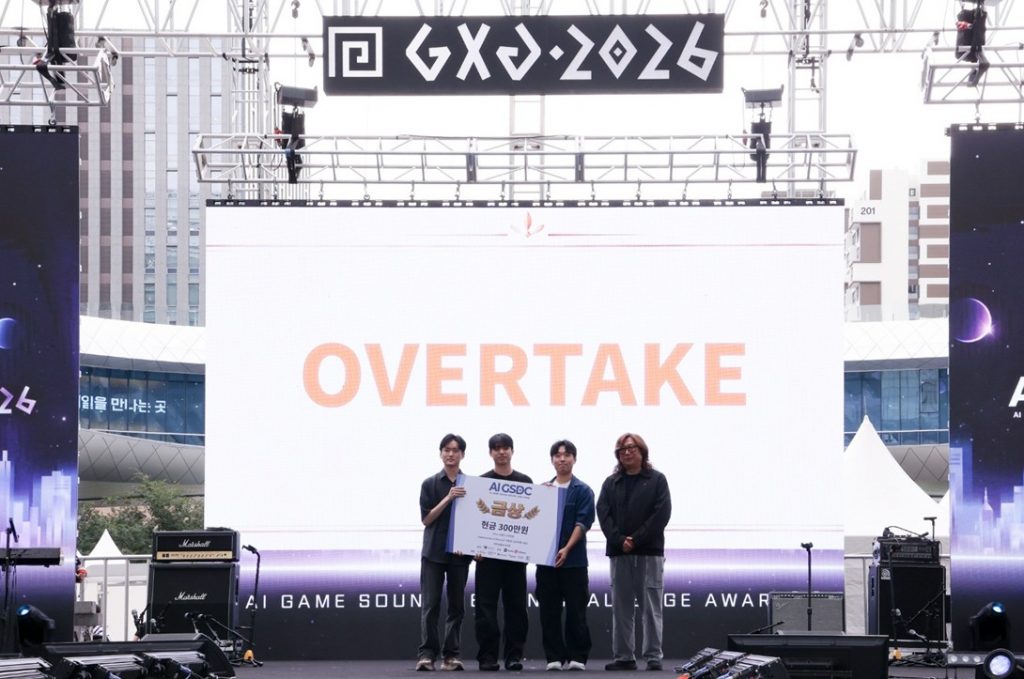
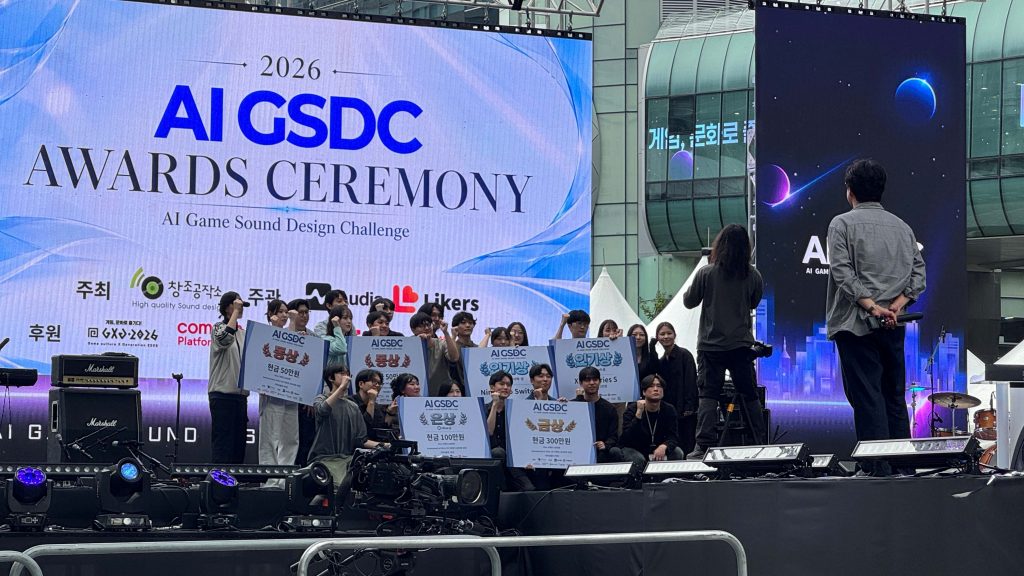
Game sound specialist Changjo Gongjakso held the awards ceremony for the “1st AI Game Sound Design Challenge with GXG 2026 (AI GSDC)” on September 12 at the GXG 2026 game culture festival in Pangyo — the results event for the competition that this coverage covered at its July launch, when 12 game companies committed footage and the entry window opened.
The Format, Confirmed
AI GSDC asked entrants to take silent game footage and build entirely new music (BGM), sound effects (SFX), and voice (VOICE) using the Gamesound.ai platform — with external audio samples and pre-made sound libraries explicitly prohibited, forcing every element to originate from the AI tool itself. Participants then edited and mixed the generated output into a finished reinterpretation of the game’s identity. Ten entries passed expert preliminary judging into the finals; final placement combined public web voting with jury scoring.
Twelve companies contributed footage across 15 game IPs total: Com2uS, Hagin, AK Interactive, Endream, Blue Potion Games, Storytaco, Tripal Games, Dreammotion, Redzinco Games, Hypercent, Birdletter, and Ubis.
The Results
Gold: Team OVERTAKE, reinterpreting World War Machines: Conquest — praised for cohesively combining sweeping orchestral score, combat sound effects, and voice work into a convincing sense of battlefield chaos and urgency.
Silver (Hive Award): Iroi, for Backroom Cleaners
Bronze: Wasureteita, for Backroom; DCTL, for Dragon Rider
Popularity Award: Team ohah, for EOS BLACK; Jeong Ha-yoon, for My Little Puppy
Gold winners received ₩3,000,000 cash, ₩1,000,000 in Hive credits, and a one-year Gamesound AI Ultra license. Silver received ₩1,000,000 cash; bronze winners each received ₩500,000, alongside Hive credits and Gamesound.ai access for all winners.
Morisawa Korea CEO Kim Jong-hyuk, Com2uS Platform director Lee Ru-da, and Changjo Gongjakso CEO Shin So-heon presented the awards, with GXG 2026, Com2uS Platform, Microsoft, Morisawa Korea, and the Korea Mobile Game Association sponsoring the event.
The Actual Finding
CEO Shin So-heon’s summary is worth quoting directly because it’s a more measured claim than “AI can now do game sound” — and more useful for exactly that reason: “Through these entries, we confirmed both the real potential for Gamesound.ai to be used in actual game sound production and that a creator’s editing and mixing skill is what determines the finished work’s quality. AI lowers the production burden and makes more experimentation possible, but refining the generated sound to fit the game and giving it life remains the creator’s job.”
Shin added a broader industry point: “Game music, built on open-ended fictional worlds rather than tied to a specific genre or trend, is a field where musicians of many different styles can participate. As the game industry has grown, game audio and music have real potential to grow into their own cultural industry.”
This is the honest version of the AI-tool story that this coverage has tracked across other AI disclosures this year: the tool changes who can attempt something and how quickly, but the human editing and mixing pass is what the jury and public vote were actually rewarding in the winning entries — not raw generation quality alone.
All 10 finalist videos and their sound work are available on the official AI GSDC website.