The mushroom enemies in Shroom and Gloom are not just opponents. They’re ingredients. You cut them down, skewer them, season them, roast them over a fire, and eat them to recover health. You can also throw them in a pot and make soup that changes the tide of a fight. The combat loop and the resource loop are the same loop — defeating enemies is how you heal, and how you heal is by cooking what you defeated.
Team Laserbeam’s first-person dual-deck builder roguelite arrives on Steam Early Access on September 10, published by Devolver Digital. The free demo is already available.
The Dual Deck Structure
Most deck-building roguelites give you one deck and ask you to optimize it. Shroom and Gloom give you two decks with separate functions and ask you to manage both.
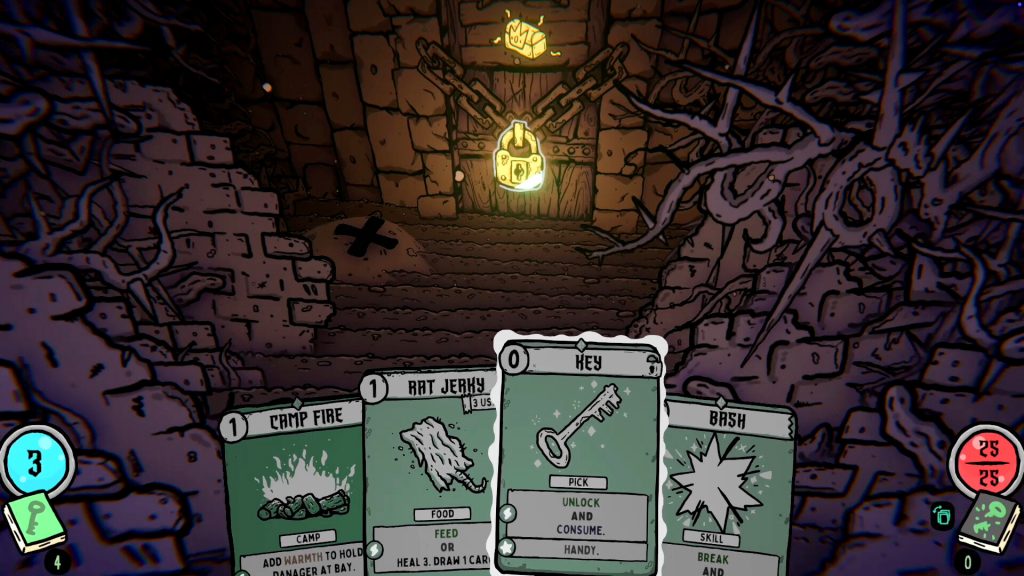
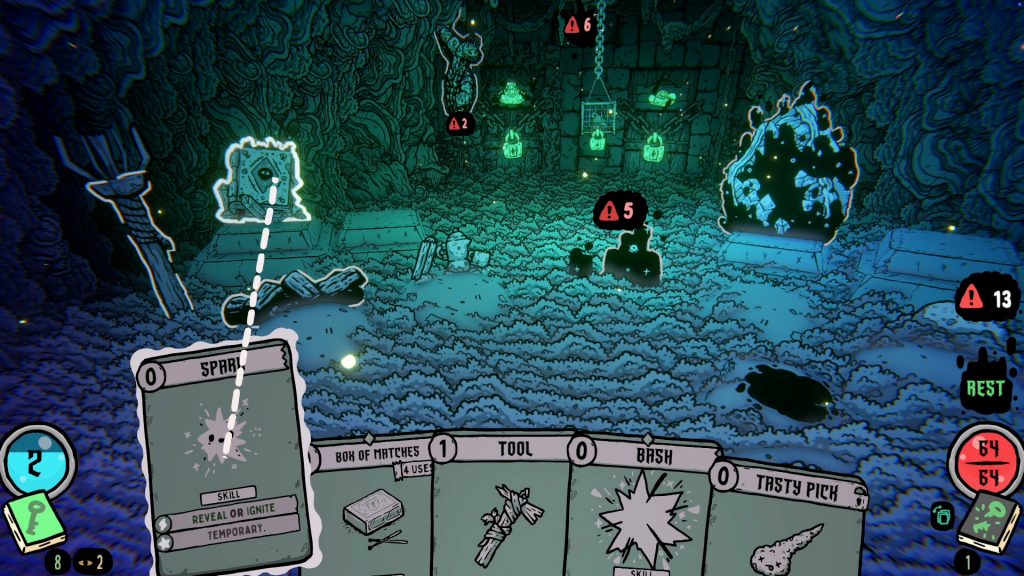
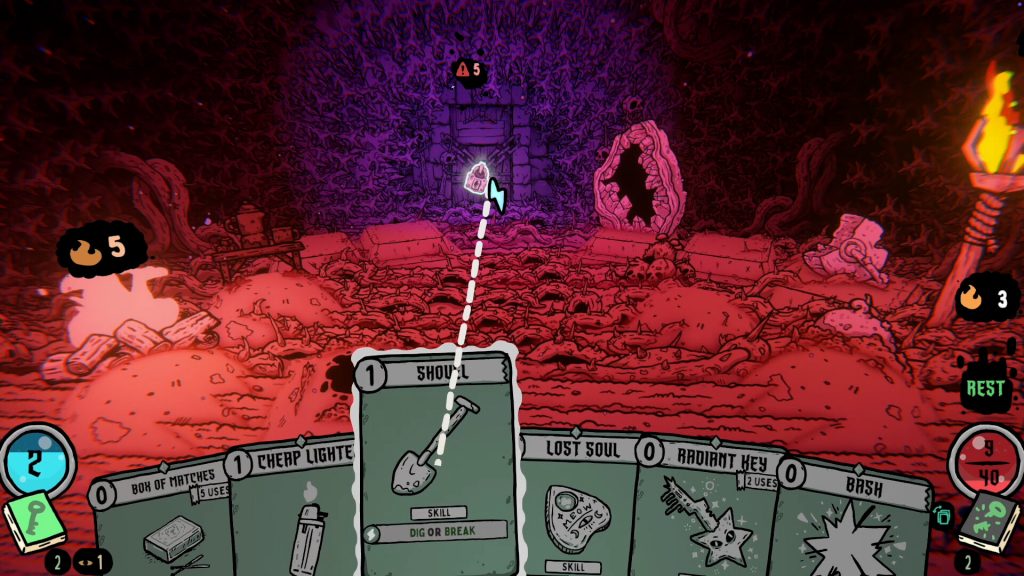
The Exploration Deck handles everything outside combat: navigating the dungeon’s dark tunnels, investigating surroundings, breaking obstacles, unlocking sealed spaces, lighting fires, feeding creatures, repairing objects, interacting with the environment. These are the cards that make the dungeon legible and traversable — the toolkit for the exploration phase between fights.
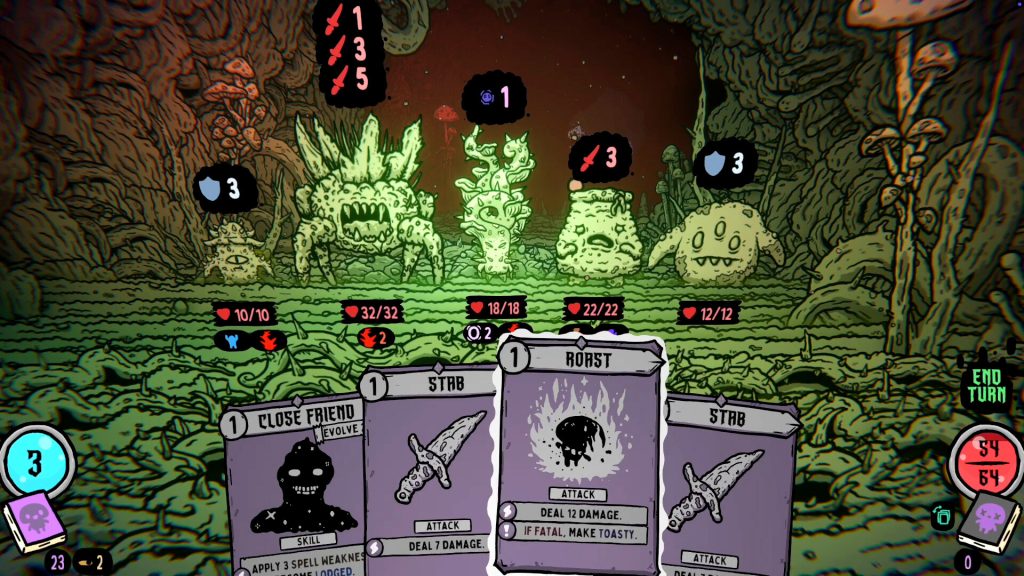
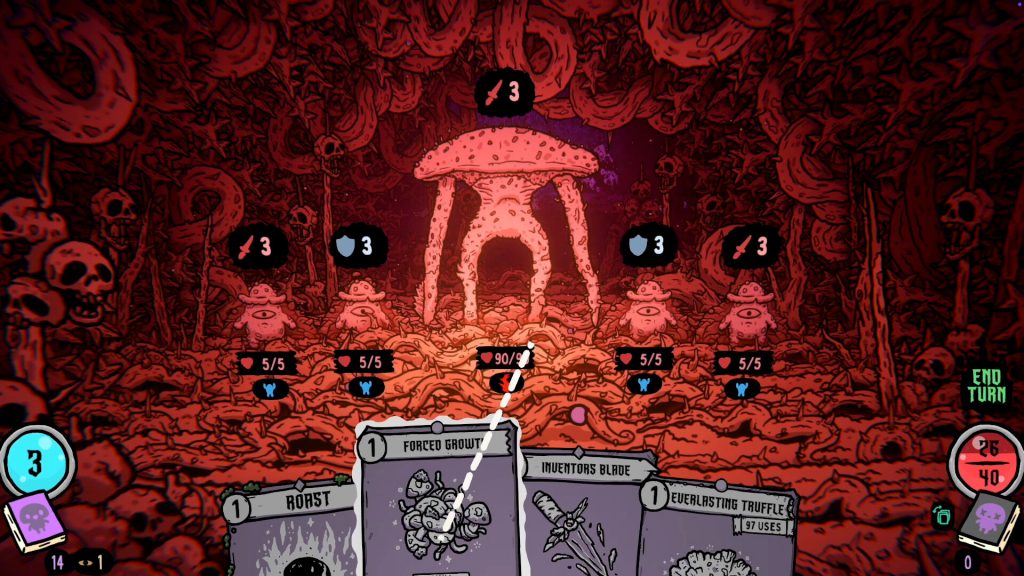
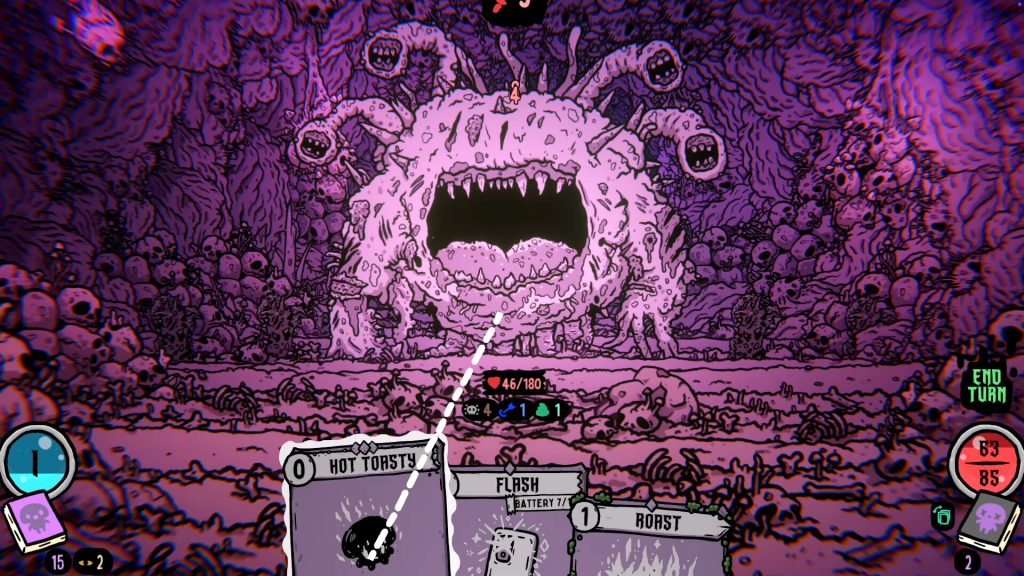
When combat begins, you switch to the Combat Deck: the cards that fight the mushroom creatures blocking the path to The Gloom. These are the offensive and defensive tools specifically designed for fight resolution.
The dual structure creates two distinct strategic problems that interact. The exploration deck determines what opportunities you have between fights — which locked areas open, which environmental advantages become accessible. The combat deck determines whether you survive the fights themselves. Optimizing one without attending to the other creates the kind of imbalance that can cause roguelite runs to die.
The Card Evolution System
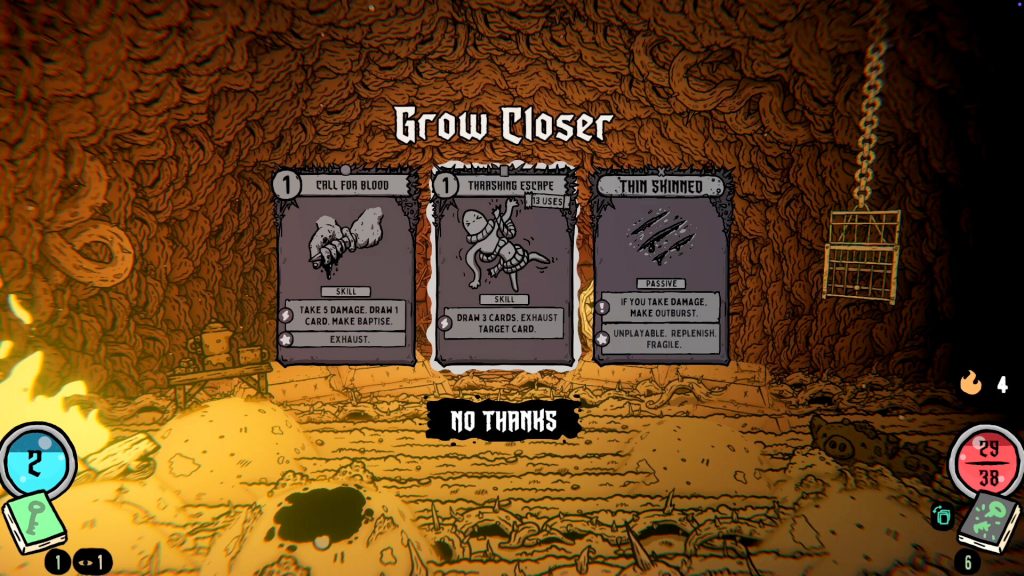
The design decision that Shroom and Gloom is specifically drawing attention to is the absence of a ceiling on card development. Standard deckbuilders operate on a replacement model: you collect powerful cards and discard weak starting cards. The weak cards are transitional — useful briefly, discarded when better options arrive.
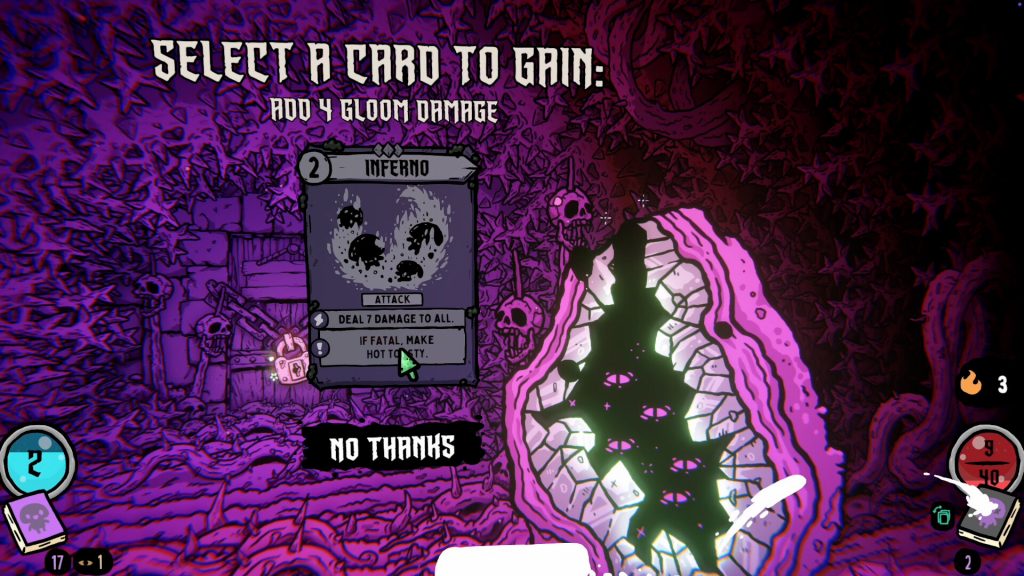
Shroom and Gloom invert this. Every card can be evolved. The basic card acquired in the dungeon’s first room can be developed into a powerful offensive technique. The rare card that seems already complete can be modified to become a run-defining weapon. There is no category of card that exists to be discarded — every card is a potential investment whose return depends on what you invest in it.
This changes the deck-building economy. In a standard deckbuilder, late-run power comes from collection — you have the right cards. In Shroom and Gloom, late-run power can come from investment — you have developed the cards you started with into something the starting versions didn’t suggest was possible. Both paths are valid, and the combination of them creates the unexpected synergies that make roguelite runs memorable.
The Cooking as Healing System
The enemy cooking mechanic is worth examining as a design rather than just as an aesthetic choice. Most roguelites separate combat resources from exploration resources — health is managed through items found between fights, through rest mechanics, or through character abilities. The cooking system unifies these: health recovery comes specifically from processing the enemies you defeat in combat.
This creates a resource philosophy where fight outcomes cascade further than just “you won or you lost.” A poorly executed fight that leaves enemies undefeated — or a fight where you defeated enemies but didn’t properly harvest the ingredients — produces a character who enters the next fight in worse condition. A well-executed fight that produces quality cooking materials produces a character who enters the next fight healthier. The fight quality is reflected in the post-fight resource state, not just in combat performance.
The soup variant extends this further: not just eating defeated enemies for health, but processing them into a resource that can alter a fight’s dynamics. This is the game design equivalent of a crafting system’s mid-fight consumable, but sourced entirely from combat outcomes rather than dungeon loot.
The Visual Identity
Hand-drawn art style applied to first-person 3D environments is the specific aesthetic combination that gives Shroom and Gloom its surreal quality. The 3D dungeon space provides the depth and spatial relationship of first-person exploration; the hand-drawn character gives it the specific flatness and mark-making quality of illustration rather than modeled digital art. The combination — the player’s hand in the 3D space holding hand-drawn cards, navigating a dungeon that has the quality of someone’s visual imagination rather than a convincingly physical space — is the aesthetic execution that the mushroom world setting specifically benefits from.
Surreal fungal environments rendered in hand-drawn style produce a world that feels inherently unstable, where the usual rules of what’s real don’t necessarily apply. This is the correct visual register for a game about eating your enemies to survive and using their remains to change the flow of battle.
The Devolver and Team Laserbeam Partnership
Devolver Digital’s publishing relationship with Shroom and Gloom places it alongside the company’s consistent selection of games with specific creative identities rather than genre-convention executions. The BALL x PIT milestone we covered earlier this month — Devolver’s brick-breaking roguelite hitting 2 million copies — demonstrates the company’s willingness to support games with niche-but-specific appeal over broad market targeting.
Team Laserbeam’s developer diary series, which documents the development process and major systems, signals a studio comfortable with development transparency — a practice that builds community before the Early Access launch and provides the player base with context for evaluating the Early Access state rather than encountering it cold.
Who This Is For
Strong fit for: deckbuilding roguelite enthusiasts who want the genre’s dual-deck variation applied to first-person dungeon exploration; players who specifically enjoy deep card evolution systems over card replacement systems; fans of the aesthetic quality that hand-drawn art applied to 3D spaces produces; Devolver Digital catalog followers who trust the publisher’s selection; Korean-language players who want the localization from launch; players who want to try the free demo before September 10.
Cautious fit for: deckbuilding players who prefer top-down or isometric views over first-person; roguelite fans who want combat-only deckbuilding without the exploration deck management layer; players who need the full Early Access content scope confirmed before purchasing.
Less ideal for: players who dislike deckbuilding roguelites; anyone wanting multiplayer options; players who find the cooking-enemies aesthetic off-putting regardless of mechanical quality.
The Takeaway
Shroom and Gloom is a dual-deck first-person roguelite in which the mushroom creatures you fight are also the food you cook to heal and the soup ingredients that change what a fight can become. The separation of exploration and combat decks into distinct strategic problems, the card evolution system that makes every card a potential investment rather than a transition to better cards, and the hand-drawn aesthetic in 3D space together constitute a game with a specific enough creative identity that Devolver Digital chose to publish it.
September 10 Early Access. Free demo available on Steam now. The dungeon is dark. The mushrooms are everywhere. And the question of whether what you just defeated goes in the fire or the pot is one of the more important resource decisions in the run.
Information regarding ‘Shroom and Gloom’
| item | detail |
|---|---|
| Game name | Shroom and Gloom |
| Developer | Team Laserbeam |
| Publisher | Devolver Digital |
| Genre | First-person duel deck builder, roguelike |
| platform | PC |
| Release date | September 10, 2026 |
| Release format | Steam Early Access |
| Korean language support | backup |
| Key Features | Dungeon Exploration Using Exploration Decks and Battle Decks |
| Card system | Hundreds of cards, card growth and combination system |
| Combat system | After defeating enemies, use them as ingredients for grilled meat, soup, etc. |
| Steam Page | Shortcut |