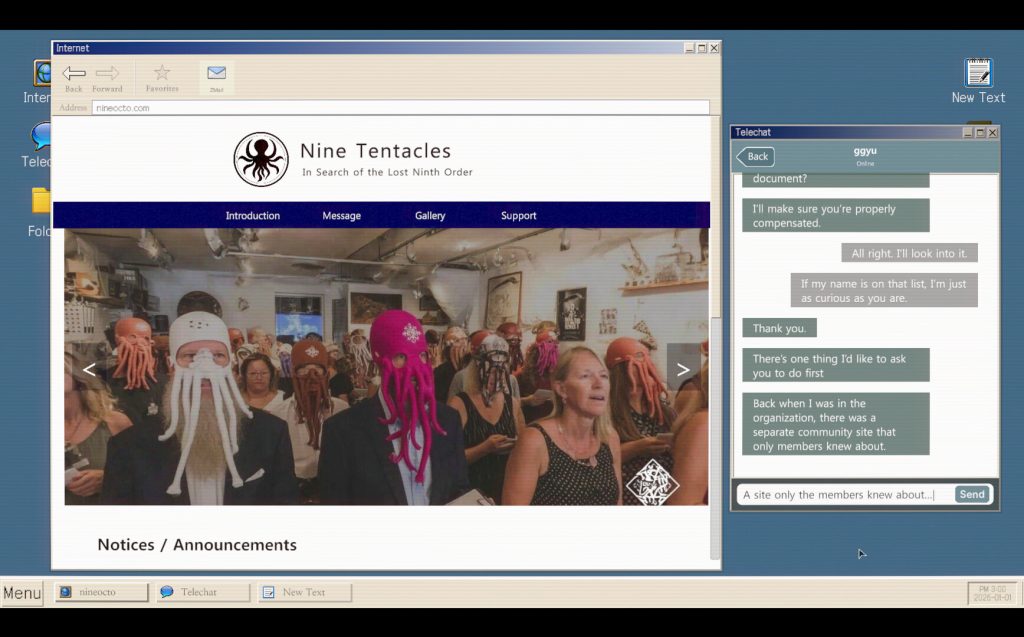
A client’s friend joined a cult called the Church of the Nine-Tentacled Octopus — a closed community where members wear octopus masks, observe their own rules, and use their own internal language to worship a nine-tentacled octopus deity — and then vanished. Your job is to find out what happened. Your only tool is the internet search.
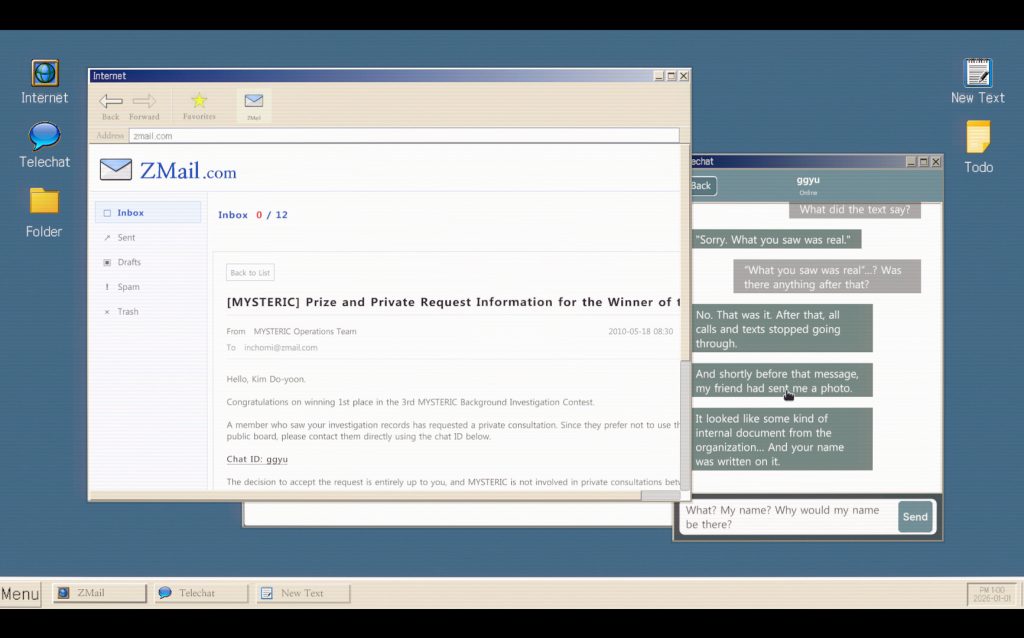
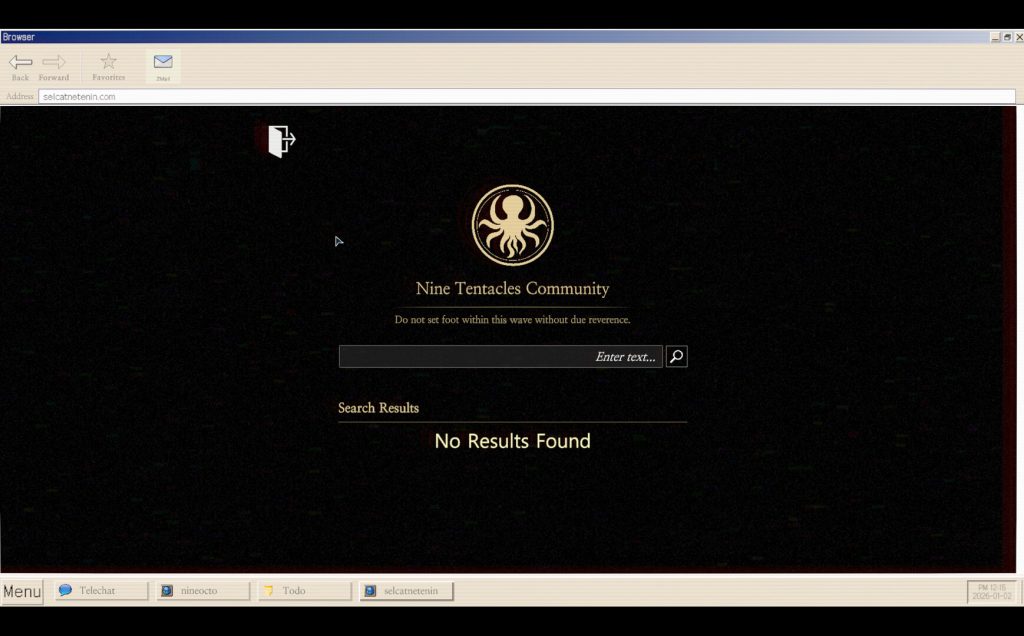
No Results Found from Korean indie team Zzangdol Games (a Krafton Jungle Game Lab graduate) launches for free on Steam on July 31, placing the player as a private detective investigating a disappearance entirely through simulated web browsing. Websites, community boards, chat logs, and files constitute the evidence; what counts as a clue, what search term to try next, and what to trust are all decisions the player makes without any in-game guidance.
The Desktop Investigation Genre
Desktop investigation games — sometimes called “desktop simulators” or “screen life” games — have established a specific niche that games like Orwell, Her Story, Hypnospace Outlaw, and Sable’s Grimoire: A Witch’s Tower have developed across the past decade. The format’s distinctive quality is that investigation happens through interface interaction rather than through player character movement: you’re browsing, searching, reading, and cross-referencing rather than walking through spaces and talking to NPCs.
What this format uniquely achieves is the specific cognitive experience of internet investigation — the way following a thread of connected information through hyperlinks and search results feels different from linear narrative revelation. Information in a desktop investigation game doesn’t come at you; you go looking for it, and what you find depends on what you thought to look for. The player’s search decisions shape their understanding of events rather than the game presenting a fixed sequence of revelations.
No Results Found takes this format’s characteristic mechanic — you search, you find things, you search based on what you found — and commits to it completely. There are no highlighted interactive elements, no “click here” indicators, no tutorial annotations pointing toward relevant information. A community post that appears to be a mundane joke might contain the keyword that opens the next investigation branch; a chat message’s specific phrasing might reveal something about the speaker’s identity. Nothing is pre-marked as significant. Everything is potentially significant.
The Church of the Nine-Tentacled Octopus
The cult’s specific design — a nine-tentacled octopus deity, masks worn by members, internal language and rules, a closed community with its own communication channels — is carefully calibrated to feel like the kind of thing that actually exists in the internet’s stranger corners. Real internet-native communities develop exactly these characteristics: the shared in-jokes that become signifiers of belonging, the specific visual aesthetic that identifies members, the internal vocabulary that creates both cohesion and opacity to outsiders.
The octopus deity choice is specifically good. Octopi have accumulated genuine internet mythological status through their genuine biological strangeness — they’re repeatedly cited in discussions of alien intelligence, distributed consciousness, and the limits of human assumptions about minds. A cult that sincerely worships an octopus god positions itself at the exact intersection of internet irony and genuine belief, where the most interesting internet communities actually operate.
For investigation purposes, a cult with its own internal language and masked members creates exactly the right information environment: public-facing materials that reveal some things, internal communications that reveal more, and the constant question of who behind a mask is actually who.
The Design Commitment to Player Autonomy
The no-hint design is a genuine design choice with genuine costs and genuine rewards. Most mystery games provide some scaffolding: quest markers, highlighted interactable objects, NPC dialogue that steers attention. These reduce friction for players who might otherwise miss crucial information, but they also reduce the specific satisfaction of having found something through your own investigative process rather than through the game’s gentle guidance.
No Results Found eliminates the scaffolding. The reward for this design decision is the specific intensity of desktop investigation games at their best: the moment when you realize why a piece of information you dismissed earlier is actually significant, the satisfaction of having followed a thread that seemed unpromising until it opened into something central, the specific pleasure of being right about a hunch that the game gave you no particular reason to trust.
The cost is that some players will miss things, follow dead ends to exhaustion, or feel stranded without the confirmation signals that conventional game design provides. The game trusts players to tolerate uncertainty and persist in investigation despite this — which is exactly the experience of real internet investigation, where no indicator tells you you’ve found the right thing.
The Search-Inference Loop
The structural description of the game’s investigation cycle — search generates information, information enables inference, inference generates new search terms — is the purest implementation of how internet investigation actually works. You search for a term, find a community post, which contains a username, which you search for, finding other posts, which mention a location, which you search for, finding a map that shows a pattern.
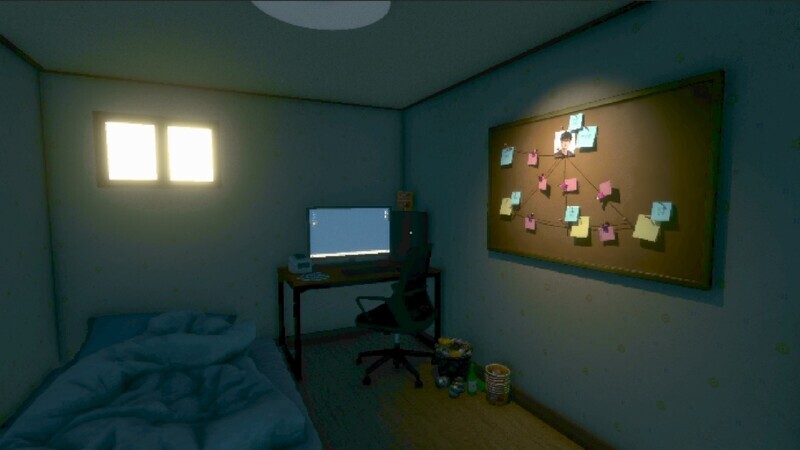
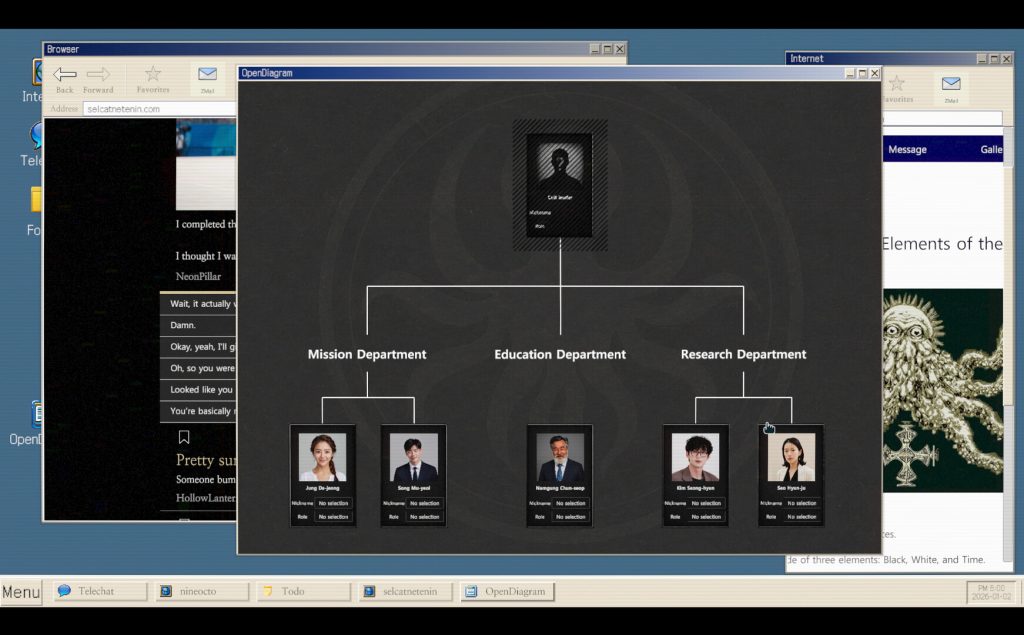
The cork board as an organizational tool — collecting evidence, establishing connections between individuals, tracking the missing person’s movements — provides the physical artifact of the investigation that makes the accumulating information feel like progress. The chart of relationships between cult members being built through the player’s own research rather than through a game-provided dossier gives ownership of the investigation to the player rather than to the narrative.
Multiple endings and challenge achievements extend engagement beyond the single path through the investigation. The “word you should never search” element — a deliberate reference to internet horror tradition, the rabbit hole you’re warned not to go down — adds the metafictional awareness that the best internet horror exercises: the game knows you’re investigating internet culture, and it uses that awareness to play with your expectations.
The Krafton Jungle Game Lab Context
Jungle Game Lab is Krafton’s indie game incubator — the program that provides development resources, mentoring, and publishing support to independent developers working outside the mainstream game industry. The program has produced several commercial releases, and No Results Found‘s free release through the label represents the program’s investment in making its graduates’ work accessible to players without commercial barriers.
The free price point is the correct decision for a game whose primary audience is people specifically interested in this kind of Korean-language desktop investigation experience. Free removes the evaluation barrier that might keep potential players from trying something unusual; it also respects that No Results Found is a debut that benefits more from maximum initial audience exposure than from revenue extraction.
Who This Is For
Strong fit for: desktop investigation game enthusiasts (Orwell, Her Story, Hypnospace Outlaw fans); players who enjoy internet rabbit-hole exploration and internet horror aesthetics; Korean-language players who want puzzle games specifically designed for Korean internet culture contexts; players who specifically appreciate no-hint, autonomous investigation design; anyone who has spent time following internet investigations and wanted a game that replicates that experience; Krafton Jungle Game Lab followers curious about program graduates.
Cautious fit for: players who find no-guidance mystery games frustrating when they reach dead ends; anyone who specifically prefers mystery games with clear progress indicators; players who need English language support (the game is currently Korean only).
Less ideal for: players who dislike reading-heavy investigation games; anyone who wants action-based gameplay alongside the mystery; players outside the Korean internet culture context who may miss specific referential elements.
What to Watch For
The primary question for No Results Found is whether the investigation’s branching search structure provides enough variety and surprise that players who fully solve the mystery feel the experience was worth their time. Free desktop investigation games face the specific challenge that players set their engagement threshold relative to cost — free means some players will engage less persistently than they might with a paid game, which affects whether the design’s demand for autonomous persistence is met.
The cult’s internal language and community structure need sufficient coherence that players can actually learn to read them — if the community material is too opaque, investigation stalls; if it’s too transparent, the investigation lacks the specific friction that makes the solved mystery feel earned.
The Takeaway
No Results Found is one of July 2026’s most formally interesting free releases — a Korean desktop investigation game that commits completely to the no-guidance internet search format, trusts players to conduct genuine investigation without tutorial support, and wraps the investigation around an internet cult that is specifically calibrated to feel like the kind of thing the internet actually produces.
The Church of the Nine-Tentacled Octopus is a better cult name for this kind of game than anything more straightforwardly sinister would be, because the specific combination of genuine strangeness and internet irony is exactly what makes real internet communities worth investigating. The game knows what kind of internet it’s depicting.
Search results are everywhere. Not all of them are useful. Some of them are traps. And somewhere in the web of community posts and chat logs and internal cult communications, there’s a person who disappeared, and the reason is in there somewhere if you’re patient enough to find it.
July 31. Free. No hints.
Information regarding ‘No Results Found’
| item | detail |
|---|---|
| Developer | Jjangdol Games (Krafton Jungle Game Lab) |
| Publisher | Jungle Game Lab |
| Genre | Desktop Mystery Adventure |
| Release platform | PC (Steam) |
| Release date | July 31, 2026, 4:00 PM |
| price | free |
| Supported languages | korean |
| Steam Page | Shortcut |