Longplay Studio’s debut game, Terminus: Zombie Survivors, sold 150,000 copies globally and collected the GIGDC 2023 General Division Grand Prize, the 2024 Korean Game Awards Indie Game Prize (Minister of Culture, Sports and Tourism Award), and the 2024 Game of the Month recognition. That game — a survival roguelite — is about as far from supply chain management simulation as games get. Which is exactly what makes FD’s Industry Tycoon interesting as a studio’s second project.
CEO Shin In-gun’s statement is worth taking at face value: “We’re pleased to attempt something new rather than the existing survival genre. The genre has completely changed, but the development philosophy of implementing complex systems with depth remains the same.” This is the correct framing for a genre pivot by a studio that has demonstrated systems competence — not “we’re doing something easy for a change” but “we’re applying the same design philosophy to a completely different problem space.”
The 1990s PC OS Aesthetic
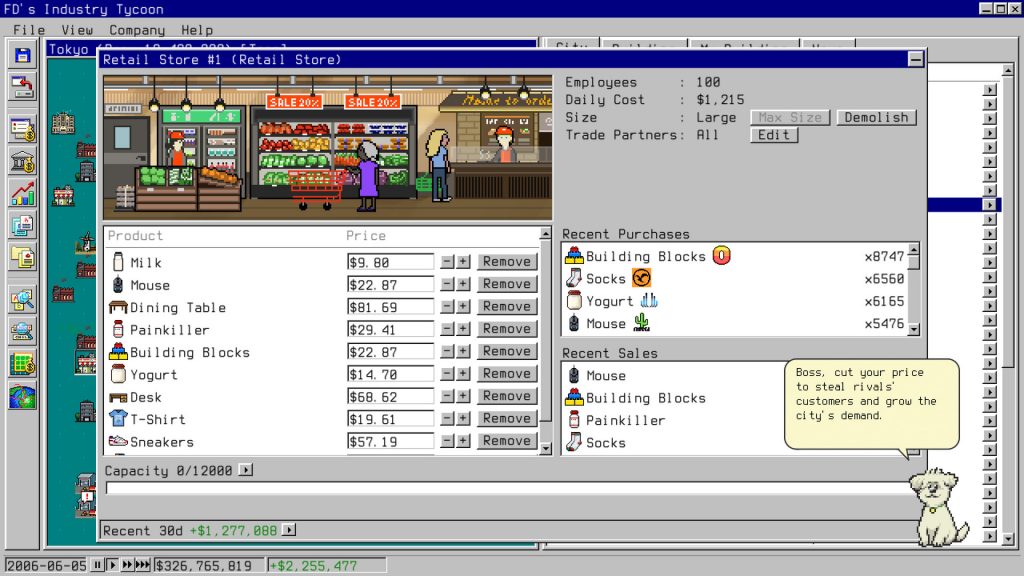
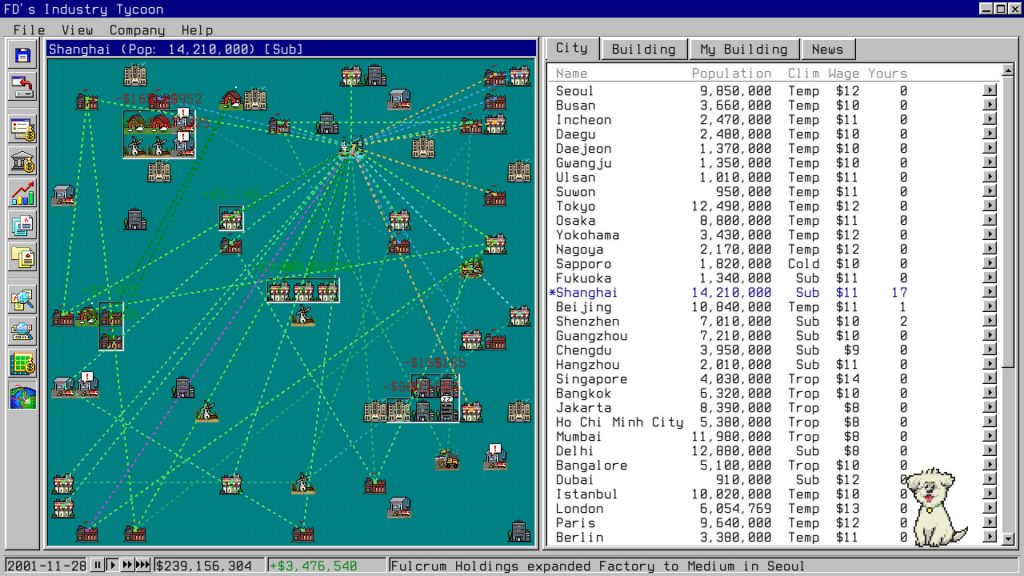
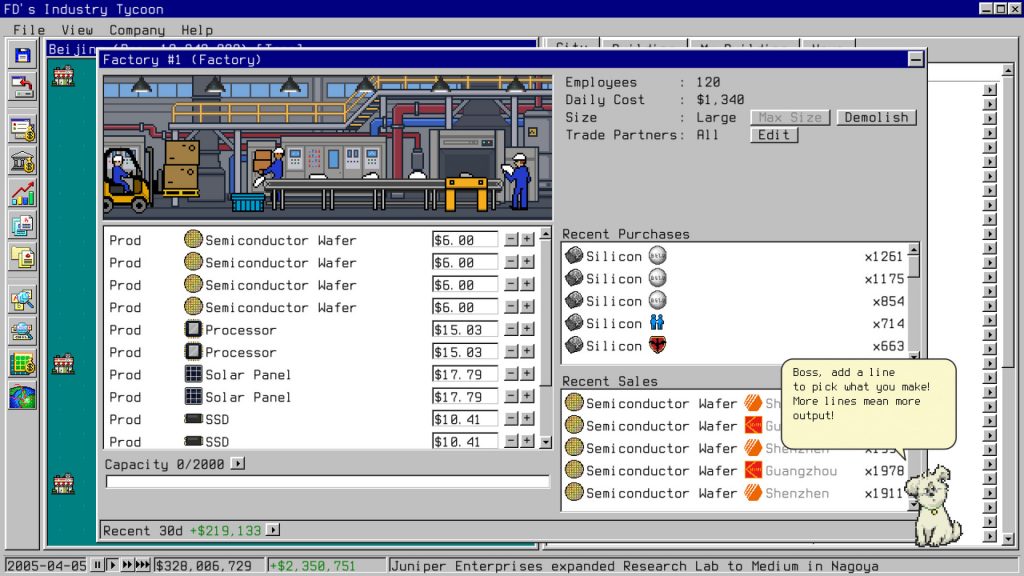
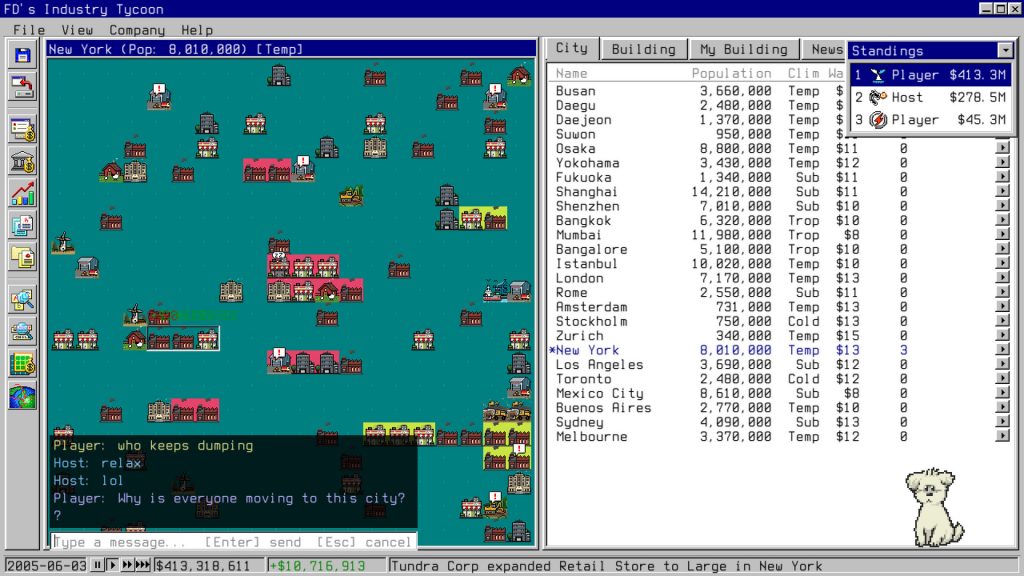
The single most immediately distinctive element of FD’s Industry Tycoon is its visual presentation: pixel art recreating the aesthetic of 1990s business PC operating systems. This places the player inside a simulation-within-a-simulation — running a company management program on a vintage computer interface within the game.
This aesthetic choice is doing multiple things simultaneously. Functionally, it provides a coherent UI metaphor for managing complex industrial systems — business software UIs of the 1990s were designed specifically to organize and present complex economic data in ways humans could process. Aesthetically, it creates immediate differentiation from modern tycoon games that typically use either clean contemporary UI or detailed 3D simulation views. Tonally, it positions the corporate management experience as something that feels like operating genuinely vintage business machinery rather than playing a modern game about business.
The specific era (1990s) also aligns with the game’s starting time period options. Players who begin in the 1980s or 1990s are managing companies using interface aesthetics contemporary to those decades, which creates an authentic period feel. Players starting in later decades presumably see the same interface type — which is either a consistent aesthetic choice or a thematic commentary about how business software UI has barely changed in forty years.
The Supply Chain Architecture
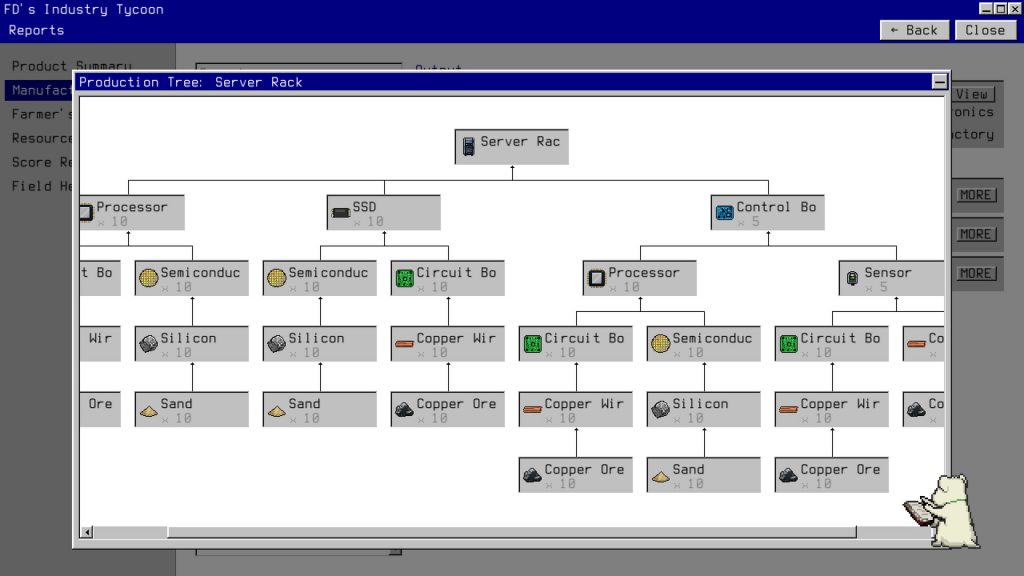
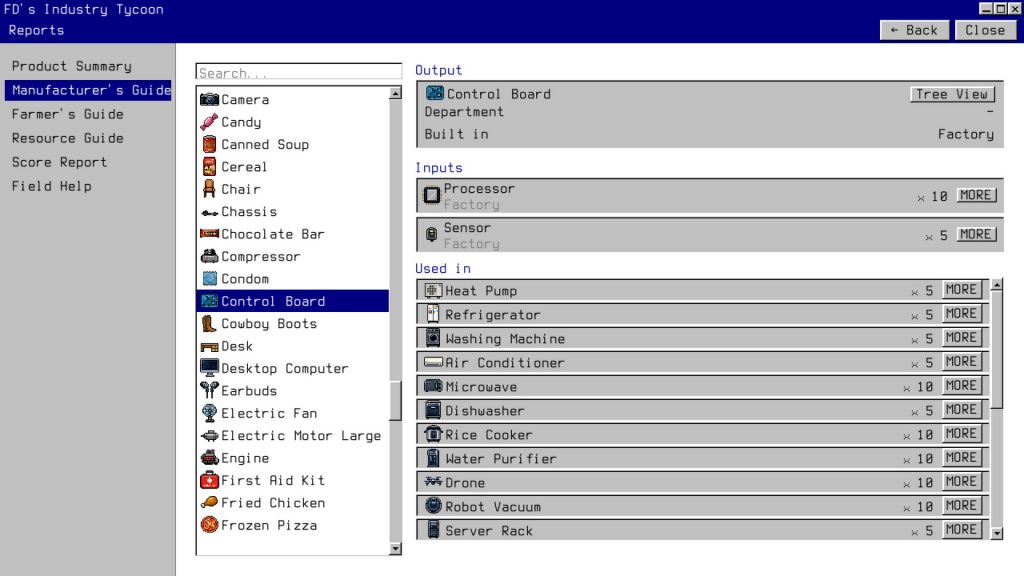
The supply chain system is FD’s Industry Tycoon‘s core design proposition, and the examples the developers provide communicate the depth of their intended implementation. Wheat grown on a farm → flour milled from wheat → bread baked from flour. Sand mined → semiconductors fabricated from processed sand → computers assembled from semiconductors. These aren’t arbitrary examples; they’re real supply chain sequences that take primary raw materials through multiple processing stages to reach consumer products.
This vertical integration model — controlling every stage from raw material extraction to final product retail — is both the deepest and most complex management approach. The game evidently also supports horizontal specialization: focusing on specific stages of supply chains rather than attempting to control everything. These represent genuinely different strategic philosophies with different risk profiles, capital requirements, and vulnerability to competitor actions.
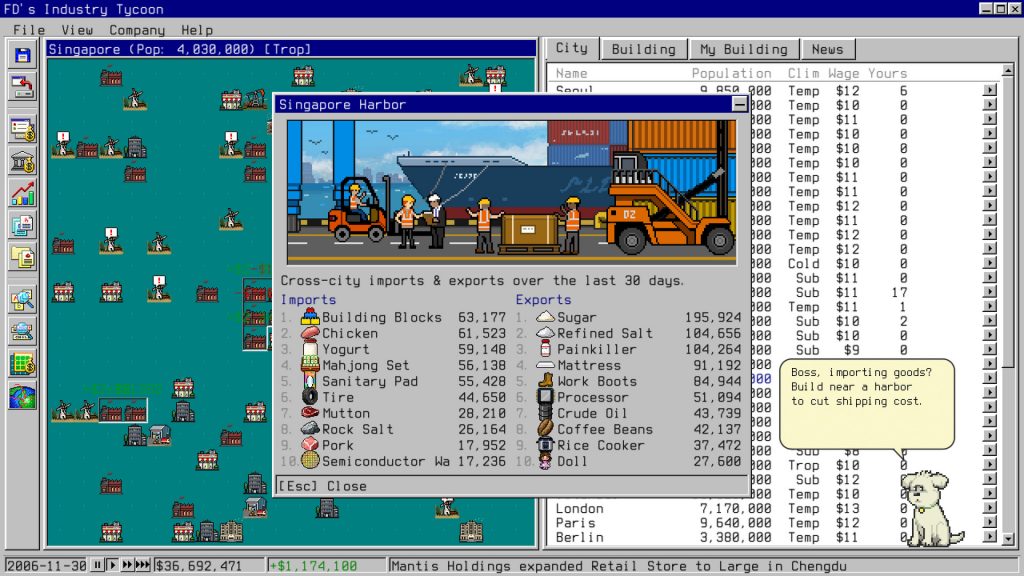
The logistics layer (railroads, ports, inter-city, and international trade) adds a geographic dimension to the supply chain management. Where you locate facilities, how you connect them, and which markets you target for export create a spatial strategy on top of the production chain optimization. This is closer to OpenTTD (transport empire building) combined with Capitalism Lab (supply chain management) than to simpler tycoon games that treat sales as an abstract number.
The 100+ AI Competitor System
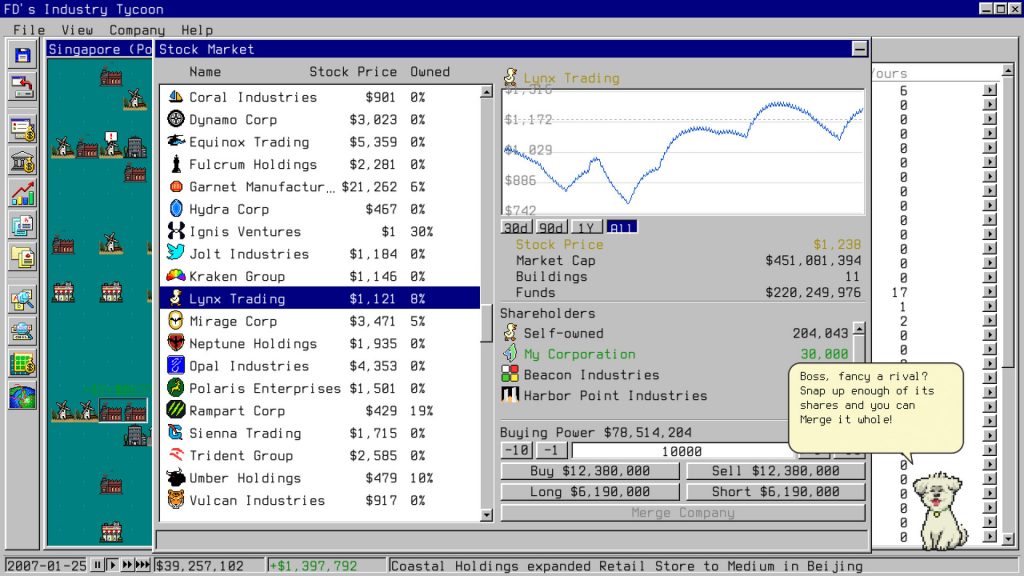
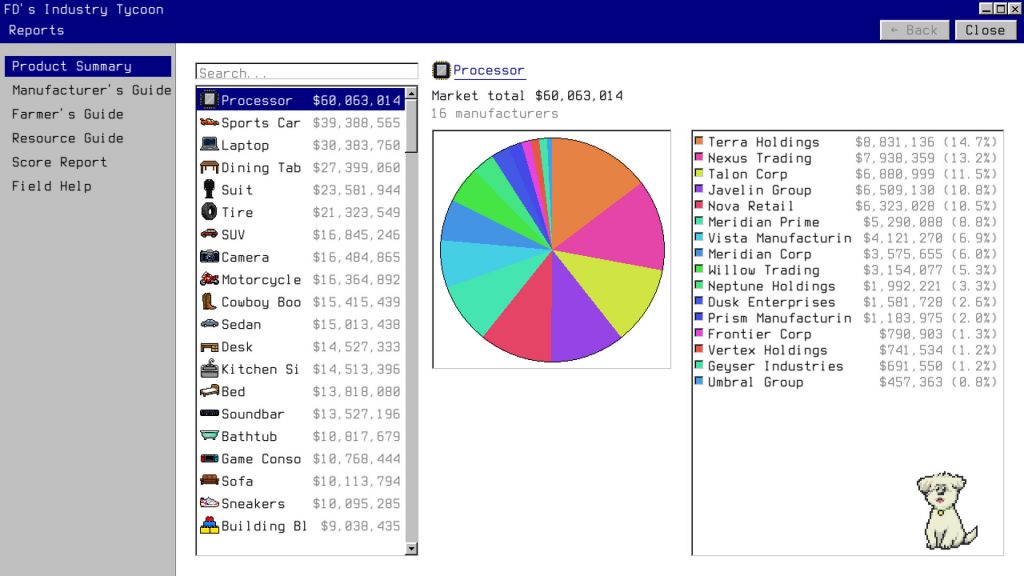
A living market economy with 100+ AI companies operating autonomously is the feature that will determine whether FD’s Industry Tycoon is a sophisticated economic simulation or a standard tycoon game with AI decoration.
The promise is that AI companies don’t follow scripted scenarios but make decisions based on their financial situations and market conditions — building factories, adjusting prices, expanding into new industries, and potentially becoming vertically integrated conglomerates or specializing in specific supply chain stages. This behavioral differentiation means the market environment isn’t a fixed backdrop against which the player operates but an evolving competitive landscape that responds to everyone’s actions.
If this is implemented with genuine sophistication, the emergent market dynamics could be the game’s most compelling feature. Price wars when multiple companies compete in the same product category, supply shortages when raw material production can’t keep pace with downstream demand, acquisition opportunities when competitor companies face financial distress — these are the kinds of situations that real market economies generate and that most management simulations only approximate with scripted events.
The comparison to Capitalism Lab or Victoria 3‘s economic model is the benchmark this feature is reaching toward. Whether the 100+ AI companies generate genuinely responsive economic behavior or merely create the appearance of competition will be the primary evaluation point for players who take management simulation seriously.
The Historical Era Selection
Starting the game in any decade from the 1980s through the 2020s and experiencing different economic environments is a feature with specific design implications. The global economy in 1982 operated under different conditions than in 2022 — different technology availability, different regulatory environments, different market structures, different supply chain possibilities. A game that genuinely simulates these differences creates meaningfully different challenge profiles for different starting periods.
The semiconductor supply chain example is relevant here: starting in the 1980s means building the semiconductor industry from its early stages; starting in the 2010s means competing in an already-mature, globally contested market where established Asian manufacturers dominate. These are genuinely different business situations requiring different strategic approaches.
The procedural generation system — cities, competitor companies, and market flow regenerating with each new game — extends replayability across the historical era variety. Two 1990s-start games won’t play identically because the specific competitor strategies, city layouts, and market conditions are generated fresh each time.
The Multiplayer Dimension
Support for multiplayer, where human players compete in the same economic environment rather than against AI competitors, adds the unpredictability of human strategy to the already complex market simulation. Human competitors make decisions that AI systems approximate but can’t fully replicate — the willingness to operate at a loss to capture market share, deliberate market manipulation strategies, cooperative arrangements between players against a common competitor.
For a game built around market simulation, multiplayer competition is the logical extension of the single-player experience rather than an entirely separate mode. The same supply chain optimization skills apply; the competitive dynamics change because human opponents have full rationality and unpredictability that even sophisticated AI can only approximate.
The Terminus Design Philosophy Carried Forward
Longplay Studio’s stated intention — maintaining the development philosophy of implementing complex systems with depth while completely changing the genre — is the interesting claim to evaluate here. Terminus: Zombie Survivors succeeded in part because its survival roguelite systems achieved genuine complexity and depth rather than surface-level feature accumulation. The GIGDC Grand Prize and Korean Game Awards recognition reflect industry judgment that the game’s systems implementation was substantive.
Whether that design competence translates to supply chain management simulation depends partly on how different the design challenges are. Survival roguelite complexity comes from: resource scarcity under time pressure, risk-reward decisions with permanent consequences, and build variety across repeated short runs. Supply chain management complexity comes from long-term capital allocation decisions, market timing, organizational scale management, and competitive positioning against dynamic opponents.
These are different enough problems that competence in one doesn’t guarantee competence in the other. But Shin In-gun’s framing suggests the studio is approaching the new genre with genuine design ambition rather than an opportunistic pivot — which is at least a promising signal.
The Korean Indie Industry Context
Longplay Studio’s trajectory — Daejeon-based studio founded in 2021, award-winning debut, now announcing a genre-ambitious second project — reflects the maturation of Korean indie game development infrastructure. KOCCA support programs, competition recognition (GIGDC, Korean Game Awards), and the accumulated commercial success of Terminus have given the studio the resources and credibility to attempt something as ambitious as FD’s Industry Tycoon.
The four-language support (Korean, English, Japanese, Simplified Chinese) signals international market targeting from the announcement stage rather than as an afterthought. Management simulation games have historically strong audiences in Japan and China alongside Western markets; launching with these languages suggests Longplay Studio is thinking about the full potential audience for the genre rather than a Korean-primary release.
The 2027 target gives the team approximately 18 months from this announcement to reach release, which is appropriate for the scope being described — 100+ AI companies with autonomous behavior, multi-decade historical economic modeling, supply chain simulation from raw materials to retail, and procedural generation of economic environments all represent substantial implementation challenges.
Who This Is For
Strong fit for: Capitalism Lab and Victoria 3 players who want dedicated supply chain management focus; OpenTTD enthusiasts who want economic production depth alongside logistics; management simulation enthusiasts who specifically enjoy emergent market dynamics rather than scripted economic scenarios; historical simulation fans interested in economic period modeling; Terminus: Zombie Survivors players curious about Longplay Studio’s creative range; tycoon game enthusiasts seeking more complex supply chain options than most games in the genre provide.
Cautious fit for: casual tycoon players who prefer clear guidance and achievable goals over open economic simulation; players who find management complexity without hand-holding overwhelming; Early Access skeptics (the 2027 target suggests a long wait from announcement to release).
Less ideal for: players seeking action-oriented gameplay; anyone who dislikes economic simulation as a game concept; players wanting a complete game soon rather than a 2027 release target.
What to Watch For
Several questions will define FD’s Industry Tycoon‘s development toward its 2027 target.
The first is the AI company’s behavioral quality. 100+ AI companies with autonomous economic behavior are a significant technical promise; whether they generate genuinely responsive market dynamics or merely simulate surface-level competition will be the most important evaluation criterion when the game becomes playable.
The second is the supply chain depth versus accessibility balance. The sand-to-semiconductors-to-computers supply chain example sounds impressive; whether navigating these chains is engaging or overwhelming for players without a management simulation background will determine the game’s audience breadth.
The third is the historical era differentiation depth. The 1980s-to-2020s era selection is compelling in concept; whether the economic environments of different decades are meaningfully distinct in gameplay terms (different technology availability, market structures, regulatory contexts) or merely cosmetically different will determine whether the feature adds real replayability.
The fourth is how Longplay Studio manages the 2027 development timeline. A studio pivoting to a significantly more complex genre simulation while maintaining quality standards faces a difficult development challenge; how they communicate progress and manages scope will affect community confidence.
The Takeaway
FD’s Industry Tycoon is one of 2027’s most intriguing management simulation announcements — a Korean indie studio with demonstrated design systems competence pivoting from survival roguelite to industrial supply chain simulation, wrapped in 1990s PC OS aesthetics, with a living market economy populated by 100+ autonomous AI competitors and multi-decade historical era options.
The concept earns serious attention from management simulation enthusiasts because it’s clearly targeting the deeper end of the genre rather than the accessible casual tycoon space. Sand into semiconductors into computers is not the premise of a game that’s afraid of complexity.
Whether Longplay Studio’s Terminus design philosophy — complex systems implemented with depth — translates to the genuinely different design challenges of supply chain economic simulation will be the defining question. CEO Shin In-gun’s statement suggests they’re approaching it with clear-eyed awareness that genre competence doesn’t transfer automatically, while maintaining confidence that the design philosophy that worked in survival roguelite has something to offer a completely different problem.
The 1990s PC aesthetic is loading. The market economy is procedurally generating. Somewhere in 1987, a small company is about to start growing wheat, and another is going to need that wheat for a bakery that will eventually need a railroad connection to ship bread to a city that doesn’t exist yet.
Information regarding ‘FD’s Industry Tycoon’
| item | detail |
|---|---|
| Developer | Longplay Studio (CEO Shin In-geon) |
| Genre | Management Simulation / Industry & Supply Chain Simulation |
| Release platform | PC (Steam) |
| Scheduled for release | 2027 |
| Background era | 1980s–2020s (Start year selectable) |
| core system | Supply chain establishment, production, logistics, and sales management, market economy simulation |
| Game Features | With a procedurally generated economic system, cities, competitors, and market environments change in every game. |
| Visuals | Pixel art UI recreating 1990s office PC operating systems |
| Supported languages | Korean, English, Japanese, Chinese (Simplified) |
| Main Keywords | Supply chain, industrial management, market economy, logistics, AI competitors, corporate acquisitions, 90s PC nostalgia, tycoon |
| Steam Page | Shortcut |