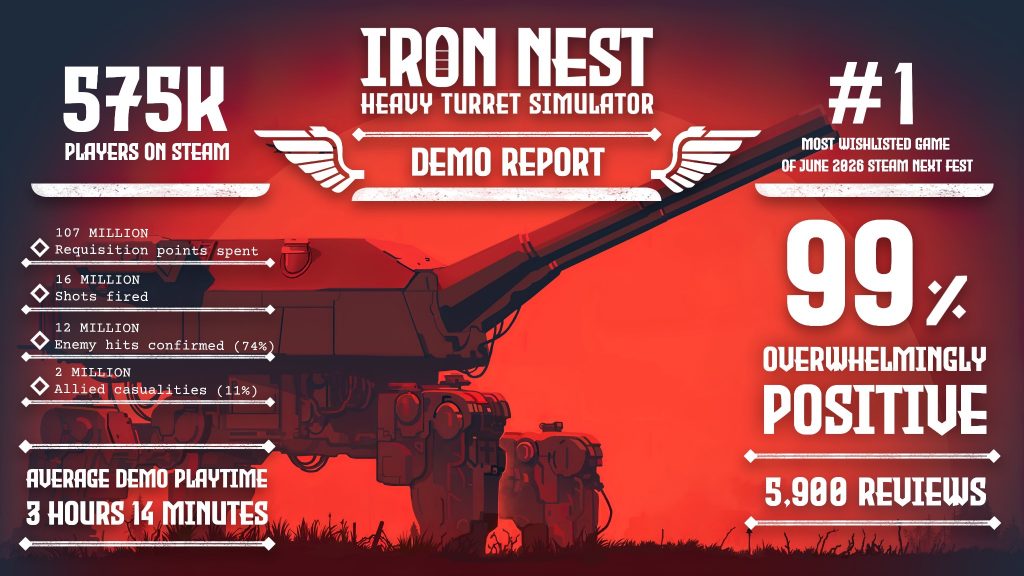
A two-person European development team. A concept that has been in development for over a decade. A demo released on June 15 attracted 575,000 players. 700,000 wishlists before the full game has even launched. 6,000 user reviews from the demo alone. For a single-player dieselpunk artillery simulator — not a battle royale, not an open-world RPG, not any genre with obvious mass-market appeal — these numbers are remarkable.
Iron Nest: Heavy Turret Simulator arrives August 6 with a premise that Nick Talmers and Dominic Ratos have been building toward for more than ten years: operate a giant spider-form artillery turret in a fictional 1920s Spain-inspired historical world, calculating range from maps, aiming the barrel through hydraulic systems, manually loading shells, and firing. The specificity of what they’ve built, and the specificity of the audience that has found it, are both worth examining.
[Related Article: No Heroes, Only Cannons, ‘Iron Nest’ Enters Next Fest]
The Core Operation Loop
The artillery operation sequence is the game’s central experience, and its appeal comes from treating this as a genuine procedure rather than a simplified game mechanic. Range calculation from a map. Hydraulic adjustment of the barrel elevation and azimuth. Manual shell loading. Fire command execution. Each step is a distinct physical operation rather than a single keystroke.
This procedural specificity is what the developers mean by “analog sensibility” — the game is replicating the actual cognitive and physical experience of operating artillery, not abstracting it into a targeting reticle and fire button. The 1920s period setting is significant here: pre-digital artillery operation was entirely mechanical and human, requiring genuine understanding of ballistics, map reading, and mechanical systems rather than relying on computerized fire control.
The “weighty feel” (묵직한 손맛) that players and press consistently mention is the specific satisfying quality that emerges when the physicality of an activity is genuinely represented rather than symbolized. Pulling a lever to elevate the barrel and feeling that lever’s resistance corresponds to some hydraulic system’s behavior creates a different relationship to the action than clicking a slider. This is why the developers specifically mention their actual artillery and engineering knowledge informing the game systems — the physicality is grounded in understanding how these mechanisms actually work.
Why the Demo Numbers Are Significant
570,000 demo players with a 3+ hour average playtime is the specific data combination that matters most here. Large demo player counts can reflect marketing investment or platform visibility rather than game quality; average playtime reveals whether players engaged with what they found or immediately left. Three hours in a demo is substantial — most demos are designed for 30- to 60-minute experiences, and players averaging three hours suggest either the demo is longer than typical or players are replaying it.
6,000 user reviews from a demo are extraordinarily unusual. Most games accumulate 6,000 reviews after commercial launch, not from free content. Players motivated to write reviews of a free demo are players who feel strongly enough about the experience to invest that additional effort — typically indicating either genuine enthusiasm or genuine criticism, both of which are more motivated than casual play.
The 700,000 wishlist count for a single-player dieselpunk artillery simulator demonstrates that niche concept identification has changed in the streaming era. A simulation game that would have found its audience slowly through word-of-mouth among hobbyists can now reach its audience rapidly through streaming and short-form video content — potential players who would never have discovered the game through traditional retail or gaming press can encounter a clip of artillery calculation and immediately understand they’ve found exactly what they didn’t know they were looking for.
The Inspirations and Development Background
The 1990s animation and “Cannon Fodder” game inspirations explain specific aspects of the game’s aesthetic character. 1990s animation — before digital production tools standardized visual styles — often had the specific rough-edged, hand-crafted quality that the dieselpunk aesthetic values. The mechanical complexity, the oversized machinery, the black humor of industrial-era weaponry — these are sensibilities that specific 1990s animated properties developed and that have influenced a generation of designers who grew up with them.
“Cannon Fodder” (the 1993 Sensible Software strategy game) is a more specific influence: a game notable for combining accessible action with genuine gravity about the human cost of war, using black humor to make military subject matter both playable and morally conscious. The newspaper-format storytelling in Iron Nest echoes this — historical reporting conventions as a narrative vehicle, delivering operational results and consequences in the same format that actual military events were communicated to civilian populations.
The ten-year gestation period reflects the specific challenges of building a detailed mechanical simulation game as a two-person team. The spider-form artillery turret — a distinctive and technically complex mechanical design — required both the artistic vision to conceptualize and the engineering understanding to represent authentically. The developers’ combination of actual artillery and engineering knowledge with the creative vision of a dieselpunk world suggests the decade wasn’t a delay but an accumulation: building the expertise to do the concept justice.
The Content Architecture
Eight challenge modes and procedurally generated missions provide the replayability structure appropriate for a simulation game. Simulation games live on whether the core operation remains satisfying across repeated engagement; procedural mission generation extends the situation variety without requiring the level design investment of handcrafted missions. Thirty ammunition types and twenty abilities provide the customization and optimization layer that lets players develop expertise and personal approaches rather than execute a single optimal solution.
Fifteen exploration zones provide the geographic and narrative variety that keeps the operational context fresh. The newspaper storytelling format delivers mission outcomes and narrative developments in a period-appropriate medium — daily developments reported as historical events rather than cinematic cutscenes.
The in-world marketing framing — addressing players as “Operators” and presenting developers as “High Command” — extends the dieselpunk military aesthetic into the promotional materials themselves. Development milestones framed as military briefings, wishlist counts reported as operational statistics: this is the same “committed to the bit” promotional approach that made Helldivers 2‘s Super Earth democracy satire so effective. Players who encounter these materials are encountering the game’s world before the game begins.
The PC Specifications
The minimum specifications — Intel Core i5-4460 or AMD FX-8350, 4GB RAM — indicate development prioritizing accessibility over visual spectacle. A game that runs on decade-old hardware has a larger potential player base than one requiring cutting-edge components, which is the correct commercial choice for a niche simulation game where the audience’s primary interest is the mechanical operation rather than visual fidelity.
Recommended specifications (GTX 1060 with 6GB, 8GB RAM) are mid-range consumer hardware from several years ago — well within the actual installed base of the PC gaming audience. The game’s availability on Steam Deck is consistent with these specifications and extends accessibility to players who prefer handheld PC gaming.
The Two-Person Team Achievement
Nick Talmers and Dominic Ratos achieving 700,000 wishlists and 570,000 demo players as a two-person team is the kind of outcome that redefines what “indie success” means in 2026. The traditional metric of indie success was commercial viability despite limited resources; the emerging metric includes genuine cultural impact through viral discovery mechanisms that weren’t available to earlier generations of indie developers.
Their transparency about the decade-long development timeline — “we finally built the giant spider-form turret we’ve been designing for over ten years” — is the kind of authentic development narrative that converts audience curiosity into investment. Players who understand that they’re engaging with something a team spent a decade making tend to engage differently than players who know nothing about the production.
Who This Is For
Strong fit for: military history and artillery enthusiasts who want to actually operate the mechanisms rather than manage them abstractly; dieselpunk aesthetic fans; simulation game enthusiasts who specifically appreciate procedural rather than simplified mechanics; players who found World of Tanks or War Thunder too arcade-like and want genuine ballistics and operation; Papers, Please players who appreciate the satisfaction of procedural task completion; anyone who has watched an artillery operation demonstration and wanted to try.
Cautious fit for: players who specifically want action-paced gameplay rather than deliberate procedural operation; anyone who finds simulation game learning curves frustrating rather than satisfying; players who were hoping for multiplayer modes.
Less ideal for: players seeking narrative-heavy experiences as primary engagement; anyone who dislikes single-player-only games; players expecting real-time action rather than careful sequential operation.
What to Watch For
The primary question for the August 6 release is whether the full game’s content — eight challenge modes, fifteen exploration zones, procedural missions — sustains the engagement that produced a 3-hour average demo playtime at commercial scale and price. Demo audiences engage with a specific tolerance for rough edges that paying customers sometimes don’t extend. Whether the full game’s production polish matches the demo’s concept quality will determine the commercial review reception.
The VR “under consideration” note is significant for a game whose core loop involves physically operating mechanisms. VR artillery operation is a natural extension of the concept — the hydraulic lever that benefits from tactile resistance in screen gaming would benefit even more from VR’s spatial presence. Whether this is implemented and how it affects the experience will be one of the more interesting post-launch questions.
The Takeaway
Iron Nest: Heavy Turret Simulator is 2026’s most compelling argument that niche specificity combined with genuine mechanical depth can find audiences at unexpected scale in the streaming era. A two-person team building a decade-long vision of dieselpunk artillery operation has accumulated 700,000 wishlists — more pre-launch interest than most mid-tier studio releases — through the simple mechanism of being genuinely distinctive and finding the players who’ve been waiting for exactly this.
The 1920s Spain-inspired world, the spider-form turret, the analog operation loop, the newspaper storytelling, the “High Command” marketing that refuses to break character: this is a game with complete aesthetic and design identity rather than a collection of genre conventions. Complete identity tends to find its audience regardless of niche.
August 6. Operator, stand by for range calculation. High Command sends.
Information regarding ‘IRON NEST: Heavy Turret Simulator’
| item | detail |
|---|---|
| Genre | Heavy Artillery Simulator / Dieselpunk |
| Release platform | PC (Steam / Steam Deck / GOG / Epic Games Store) |
| Scheduled for official release | August 6, 2026 |
| Console release | To be confirmed later |
| VR support | Under review |
| Language support | 14 languages including Korean |
| Play Mode | Single player |
| core system | Dynamic Mission Generation / Operation of Hundreds of Machine Mechanisms |
| Demo Player | 570,000+ people |
| Wishlist | 700,000+ people |
| Next Fest | June 15, 2026 onwards participation |
| Main Keywords | Dieselpunk, heavy artillery, simulator, artillery battery, command, machine, black humor |
| Steam Page | Shortcut |