- Although major domestic game companies were largely absent from this year’s G-Star, an indie showcase featuring 108 developers from 28 countries across 250 booths changed the atmosphere of the venue.
- The Indie Pavilion must now go beyond being a ‘simple exhibition space for games’ to become an integrated indie platform that connects selection, discovery, and year-round audience recruitment through global platforms, and it must become a ‘festival’ where indie developers can communicate with future ‘fans’ and develop their games through G-STAR.
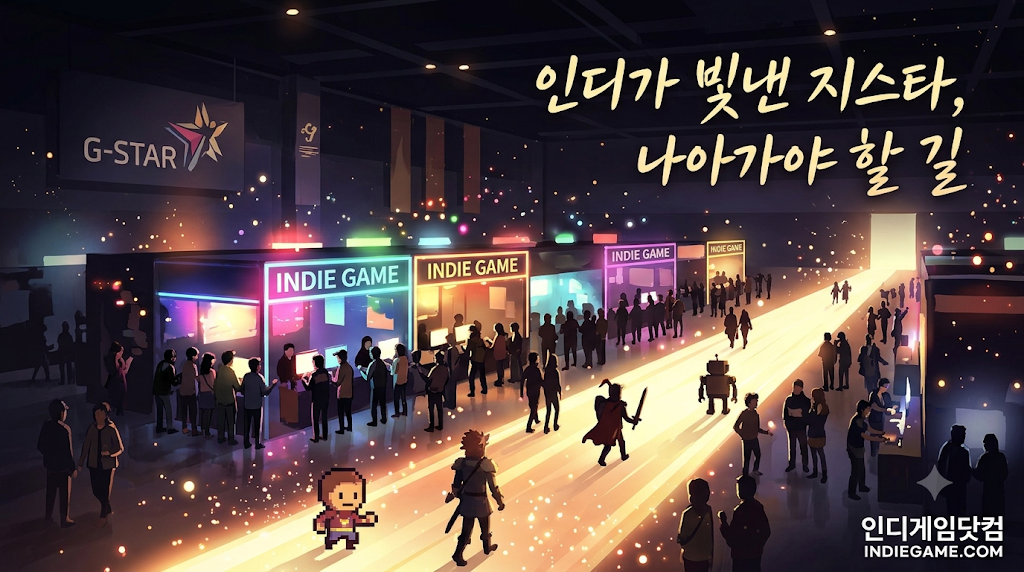
G-Star 2026 concluded its four-day schedule on the 22nd. With major domestic game companies such as Nexon, Netmarble, and NCSoft largely absent this year, one of the places that kept visitors engaged for a long time was the Indie Showcase on the first floor of BEXCO Exhibition Center 2. Instead of waiting in two-hour lines in front of demo stations for blockbusters, visitors selected and enjoyed novel games and chatted with the developers standing in front of the booths.
Were indie players, who have always been on the periphery at G-Star, merely supporting roles temporarily filling the void left by major companies this year, or did they show the path the game show should take? This article examines what the Indie Pavilion changed and what it left behind this year, as well as where the G-Star Indie Pavilion should be headed.
Indie companies filled the void left by major corporations
According to an announcement by the G-Star Organizing Committee, 1,294 companies from 42 countries participated in this year’s G-Star with 3,445 booths, and approximately 201,000 people visited over the four days. Although the number of booths increased by 176 compared to last year, the number of visitors remained virtually the same as last year’s figure of around 202,000. Only six companies set up large pavilions of 100 or more booths in Exhibition Hall 1, and among them, domestic game companies were few and far between.
It was ‘G-Star Indie Showcase 2.0: Galaxy’ that stepped up to fill that void and establish its presence. With 250 booths and 108 developers from 28 countries participating, it set a new record, bringing the total to 114 including partner companies. It also serves as a flagship ‘in-house content’ directly planned by the organizing committee. In other words, in a year of crisis marked by a decline in major participants, the Indie Hall effectively took responsibility for a significant portion of the attractions.
Naturally, most visitors also gave favorable reviews to this year’s G-Star Indie Hall. Visitors who had experienced long waits at large booths said they liked being able to immediately try out several games at the Indie Hall, and users who viewed the Indie section said that instead of thinking “there is nothing left to see at G-Star,” they should now come to see the Indie section .
From SteamDeck Experience Zone to ‘Galaxy’: How the Indie Hall Has Changed
Last year, the symbol of the Indie Showcase was the SteamDeck experience zone. However, individual indie booths were scattered around it. In other words, hardware was the main focus, and indie was closer to the background. However, this year’s ‘Indie Showcase 2.0: Galaxy’ was the largest ever with 114 companies, including partners, and 250 booths, and was reorganized and expanded into four axes of partner-based curation.
| zone | composition | meaning |
|---|---|---|
| G-Star Selected Indie | 37 studios selected by the organizing committee | ‘Official Selections’ personally chosen by G-STAR |
| Devolver Digital | 23 Studios, Special Builds of Unannounced New Titles: ‘Inscription’, ‘Katana Zero’, ‘Baby Steps’ | The first global ‘signboard’ in the Indie Hall |
| Unity World | 30 Unity-based titles and Unity AI Game Jam winners | Indie from around the world selected by Engine |
| EGDF · Polish Cultural Center in Korea | 16 European studios | Joint pavilion of overseas developer organizations |
| Red Brick House | 8 titles from emerging domestic developers (‘Void Diver’, ‘Badassgard’, ‘The Ashin Oz’, etc.) | Curation by domestic indie publishers |
| SteamDeck demo zone | Komodo Collaboration, Carefully Selected Optimized for Devices | Portable Play Experience |
The biggest change and notable point of this year’s Indie Pavilion is the diverse colors of global indie artists. It is difficult for publishers, engine companies, and international organizations to directly participate in small-scale indie events. Through 20 years of operation, G-Star has internationally secured its status and prestige as a global exhibition. In other words, as global works gathered through their respective discerning eyes come together in one space, the Indie Pavilion has been completed as a colorful picture of a small indie festival in itself.
What was G-Star to developers?
For indie developers, game shows are not merely sales outlets. They are venues for “large-scale playtesting”—invaluable opportunities to showcase their games to precious users over four days—a capability that money cannot buy. Many indie development teams have emphasized the invaluable worth of direct feedback received on-site; observing firsthand where players get stuck, where they laugh, and how quickly they put down their controllers becomes another asset for the future.
Therefore, demos refined at domestic showcases and accumulated feedback data serve as crucial foundational assets for indie developers seeking overseas showcase selection and publisher meetings, rather than unfamiliar overseas events. In an increasingly cutthroat market—and in an era of fierce competition for exposure where the number of launching titles has surged due to AI-driven development acceleration—what indie developers can rely on is not advertising revenue, but the “first five minutes that make people want to try” and a stage to prove it firsthand. And the G-Star Indie Pavilion can now be built into just such a stage.
Remaining Task: Four Limitations of the G-Star Indie Pavilion
First is the risk of over-reliance on partners. This year, Devolver was the flagship of the Indie Pavilion. However, partner participation varies each year depending on circumstances. If Devolver leaves, the weight of the Indie Pavilion diminishes along with it. A structure that relies on a partner’s name without curation that establishes G-Star as a brand in itself cannot last long.
Second, there are invisible selection criteria. It is difficult for both developers and visitors to know by what standards and who selected ‘Selected Indie.’ In an era flooded with AI-generated entries, this is a matter of trust. According to Dexerto data, 49.9% of new Steam releases in October of this year disclosed the use of AI-generated content. Whether to align with BIC or to diverge, G-Star Indie must find its own unique character and reflect that identity in its selections. Alternatively, diversity could become G-Star’s unique weapon.
Third, it is a connection that is severed after four days. The Steam promotion page was certainly a meaningful first step, but it was operated only for the duration of the event. It remains the responsibility of each individual developer to carry the interest generated at the booths through wishlists, demo play, and Next Fest. The winners of the Indie Awards were also barely visible in the closing wrap-up reports. In the age of AI, it is precisely youth and indie developers who deserve attention and the spotlight.
Fourth, filling the B2B space with indie games is not the answer. The foundation of business lies in products with proven revenue. Simply filling the void left by collapsed small and medium-sized game companies with indie and student works does not generate transactions. The reason Gamescom’s closed B2B format operates so densely is not due to the physical space, but rather to the operational method where partners who have worked together throughout the year meet all at once in Cologne according to a pre-arranged schedule. In other words, what indie games need is not a B2B booth, but a festival-style all-around program that provides opportunities for even somewhat inexperienced and imperfect indie developers to meet users, allowing them to freely interact and enjoy themselves within the game show like a festival.
The path forward for the G-Star Indie Pavilion
An open curation brand. It discloses the selection criteria and judges for ‘Selected Indie,’ and verifies playable builds, development continuation plans, and asset and copyright sources in advance. The scope of AI usage is voluntarily indicated at the booth. Just as the Tokyo Game Show connects 80 selected indie titles with ‘Sense of Wonder Night,’ where developers take the stage, it provides a stage for the selected works.
A year-round pipeline. Indie events—starting with PlayXpo’s ‘Indie Arcade,’ Busan Seomyeon’s ‘Build 051,’ and August’s BIC and GXG—serve as the preliminaries and previews, while G-Star serves as the finals and the festival. In the 2027 budget proposal, the government increased support for indie game planning from 9.3 billion won to 13.8 billion won and expanded the number of supported titles from 130 to 200; the competition rate for this year’s audition-style screening was approximately 11 to 1. There is no better stage to showcase these achievements than the G-Star Indie Hall.
Permanent online integration. Steam promotion pages are operated even after the event, and wishlist QR codes are provided by default at each booth. Award-winning works and visitor favorites are featured again during the following year’s Next Fest.
A stage for newcomers and creators. It connects the Unity AI Game Jam, works from the Game Talent Institute, university graduation projects, and UGC creators with the Indie Pavilion. The 27th Graduation Exhibition of the Chungkang University of Culture & Industry’s Game Content School will be held separately in Pangyo starting November 25, three days after G-STAR concludes. There is no reason why G-STAR cannot embrace a stage where future indie developers meet the audience for the first time.
In other words , the G-Star Indie Hall should be expanded from a simple ‘exhibition space’ for small games into a festival involving selection, discovery, and year-round attraction, as well as a ‘cultural platform’ where indie developers exhibit, interact, and enjoy themselves while communicating with users.
Indie games were not merely substitutes filling the void left by major companies at this year’s G-Star. The sight of visitors personally selecting games, talking with developers, and adding their favorites to their wishlists is precisely the moment when games evolve into a culture, and indie games were the first to demonstrate the essence of a game show combined with a culture of user interaction.
New game announcements have already moved online, and what remains on-site now are discovery and encounters. In other words, the path G-Star must pursue at the venue where indie games shone this year is not the return of blockbusters, but the “discovery of a true game culture created together with users.” Now, it is the responsibility of the organizing committee to solidify that stage, and it is up to us indie gamers to make the most of it.
Text (Planning/Review): Professor Moo-Sik Jung (Department of Game & Video, Gachon University · Ph.D. in Engineering)
A first-generation game developer who started as a founding member of Trigger Soft in 1994 and served as a director at NCSoft, an outside director at NASDAQ-listed company Gravity, and a vice president at Runosoft. Since planning and hosting Korea’s first indie game contest and the international game conference KGC in 2003, he has consistently dedicated himself to fostering indie games. He has served as a member of the G-Star Organizing Committee and a senior director at the Seongnam Industry Promotion Agency, which operates GXG. Currently, he serves as a member of the Game Rating and Administration Committee under the Ministry of Culture, Sports and Tourism, the head of the Content, Digital, and Space subcommittee of the Seongnam City Special Committee on the 4th Industrial Revolution, and a MASTER instructor at the Game Culture Education Center of the Game Culture Foundation, continuing his efforts to spread diverse game literacy and a healthy game culture.
See also