One university, one category, two honorees. Two technologies co-developed by researchers from Gachon University’s Department of Game and Film — the AI-based 3D anamorphic content production system ANAMOFIT and the real-time data-responsive interactive media façade SPACESYNC — have each been named Honorees in the Art Tech category of the CES 2027 Innovation Awards.
With both technologies selected in the same category, Gachon University has earned CES Innovation Awards for a second consecutive year, following last year’s Best of Innovation award for STORYSYNC at CES 2026.
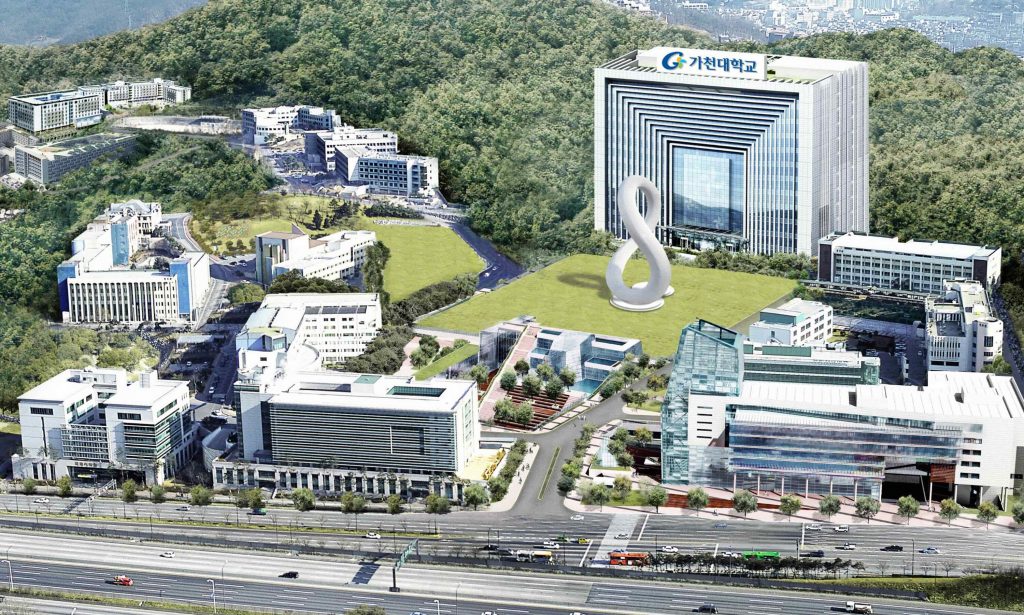
A Product of Industry-Academic Collaboration
The achievement combines the university’s AI convergence research with industry partners’ content production and commercialization experience. ANAMOFIT was co-developed by Gachon University and AI agent company Persona AI, while SPACESYNC was co-developed with Damgara and Nextep Studio.
The research team included Professors Kim Jung-yoon and Kang Ho-sung of the Department of Game and Film, Professors Jung Yun-hyun and Choi Jae-yong of the Department of AI, and Professor Lee Su-hyun of the Department of Computer Engineering, along with nine graduate students: Yoo Jung-eun, Lee So-jin, Kim Su-hyun, Ahn Ha-il, Kim Ye-jin, Kang Ji-yoon, Choi Jun-seo, Choo Dong-hyuk, and Lim Ju-han. Professor Kim Dong-jo of Sunchon National University and designer Lim Ji-ye also participated as visiting researchers.
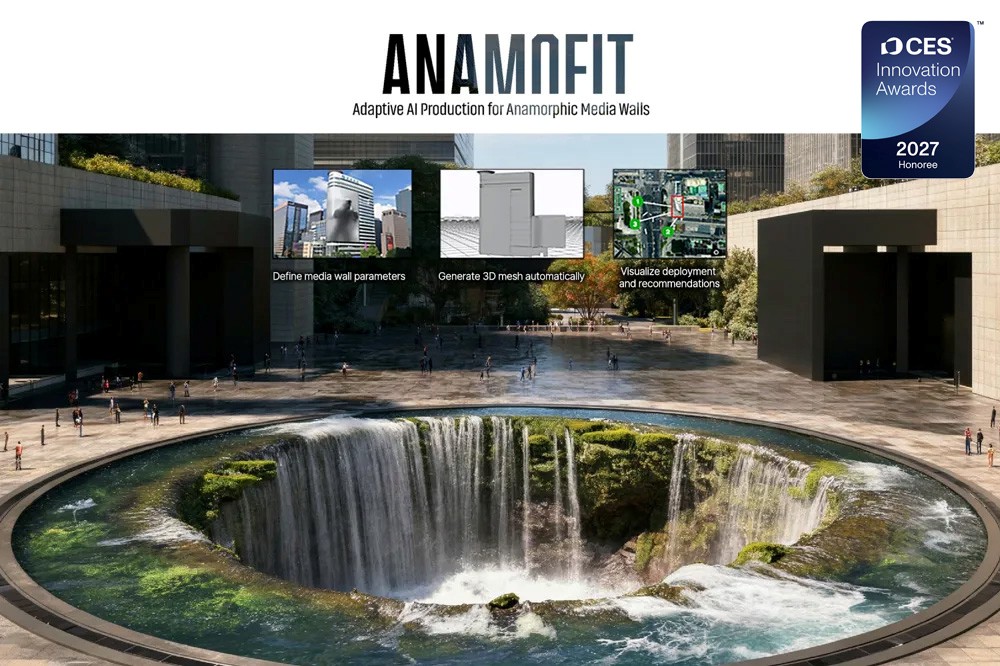
ANAMOFIT: AI-Powered 3D Anamorphic Production for Irregular Media Walls
ANAMOFIT is an AI-based system that produces 3D anamorphic video tailored to the shape, size, curvature, resolution, and viewing positions of irregular media walls installed on buildings and in exhibition spaces.
Previously, creators had to produce video for a standard screen and then separately adapt it to the actual display environment. ANAMOFIT connects the entire pipeline — media wall modeling, AI-based image and character generation, distortion correction, and final output — into one workflow designed to reduce repetitive work.
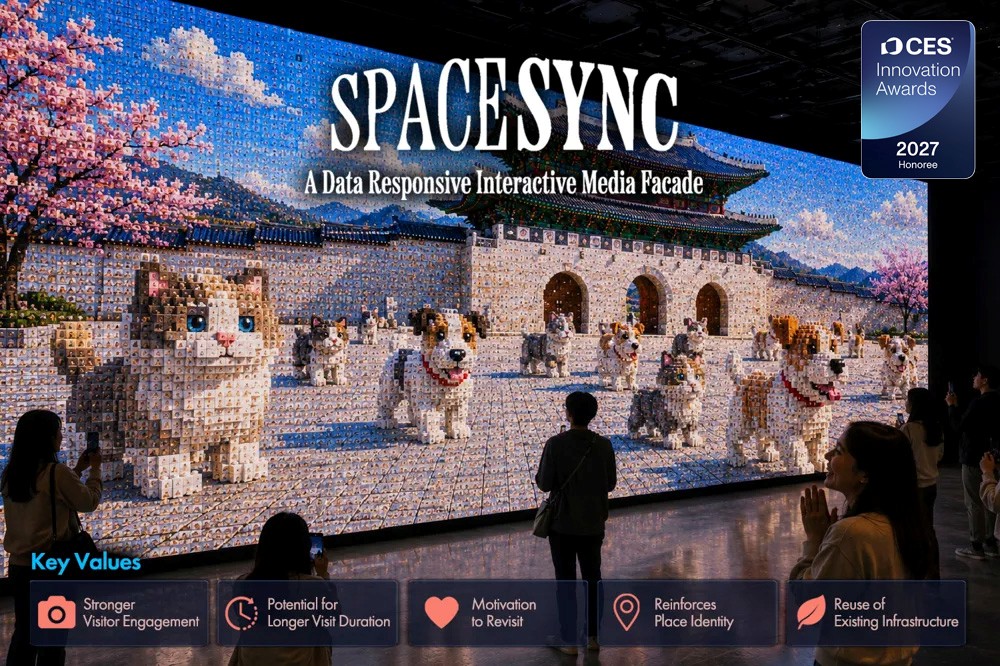
SPACESYNC: A Media Façade That Responds to Visitors and Real-Time Data
SPACESYNC reconstructs photos sent by visitors into photomosaics depicting local scenery or landmarks, and reflects on-site environmental and urban data in real time — including humidity, wind speed, wave height, air quality, noise, and crowd density.
The system adjusts the color, light, and motion of the visuals as data changes and outputs them to suit each display’s characteristics, making it applicable to tourist destinations, cultural facilities, and public media spaces.
From Government R&D to Commercialization
Both technologies were refined and expanded toward commercialization based on government-funded R&D. ANAMOFIT was developed under the Generative AI Leading Talent Program of the Ministry of Science and ICT and the Institute of Information & Communications Technology Planning & Evaluation (IITP), while SPACESYNC was developed under the Culture Technology (CT) Professional Talent Program of the Ministry of Culture, Sports and Tourism and the Korea Creative Content Agency’s culture technology R&D body.
Both projects were then linked to programs such as the IP Star Scientist program and Gyeonggi Province’s Regional Growth Talent Development (Anchor) program to advance technology development, talent training, and commercialization.
The award is especially meaningful as an industry-academic achievement that brought together faculty research guidance, graduate student development work, and industry partners’ production and commercialization experience. In particular, it stands as a model of talent development linking research and education, with graduate students participating in R&D projects reflecting real industry needs and seeing their results recognized on the international stage.
Professor Kim Jung-yoon said it was deeply meaningful to see ANAMOFIT and SPACESYNC named Art Tech Honorees at CES 2027 following STORYSYNC’s Best of Innovation at CES 2026, and that the international recognition of work developed jointly by graduate students, faculty, industry partners, and visiting researchers carries special significance.
He added that the department will continue linking graduate education, R&D, and industry collaboration to train specialists who can fuse generative AI with game and media technology, and to help research results spread into the industry.
Why It Matters
Back-to-back CES recognition — a Best of Innovation in 2026 and two Honorees in 2027 — positions Gachon’s Department of Game and Film as a notable contributor at the intersection of games, media art, and generative AI. For the Korean game and content industry, it shows how university labs, startups, and government R&D programs can combine to turn applied research into internationally recognized products.
What to Watch For
Watch for live demonstrations of ANAMOFIT and SPACESYNC at CES 2027 in Las Vegas in January, commercial deployments on real media walls and public spaces, and how the graduate researchers involved carry the work into industry.
The Takeaway
Two Honorees in a single category, a year after a Best of Innovation win: Gachon University’s game and film researchers are building a CES track record few Korean universities can match. ANAMOFIT and SPACESYNC show where game-born technologies are heading — onto the walls of buildings and into the public spaces of cities.